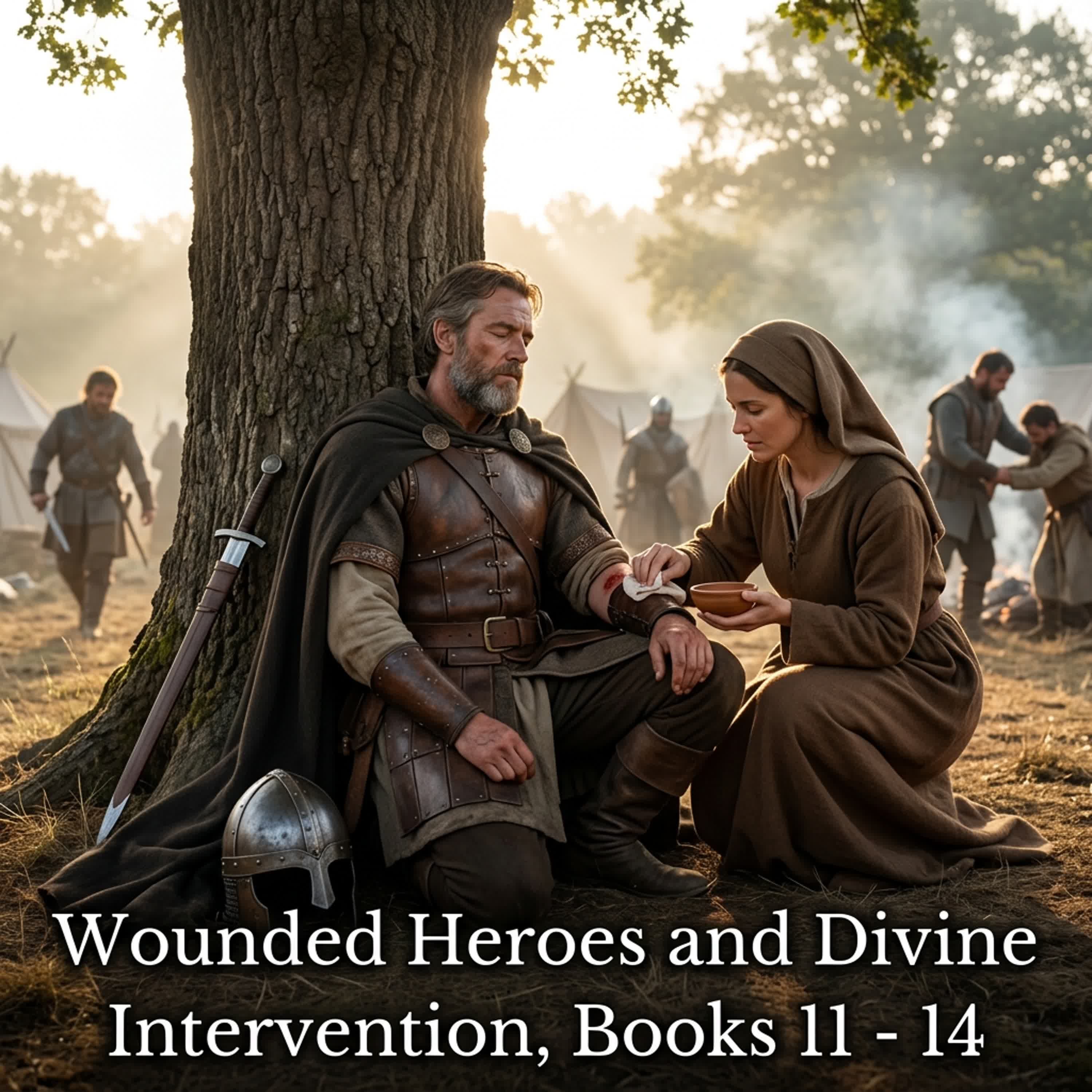
The Iliad - 4 - Chapters 11-14
from Wisdom for the Present: Western Wisdom Literature Hosted by Kanu Emeruwa
What do you do when the protective walls of your life—whether in your career, your relationships, or your mental health—suddenly and completely crumble? In this episode of Wisdom for the Present, we dive deep into Books 11 through 14 of Homer's Iliad, an ancient epic that serves as a profound psychological mirror for modern high-stakes crises. Far from being just a tale of bronze-age warfare, this narrative is a masterclass in human behavior under extreme stress, offering timeless wisdom on how we manage sudden adversity, navigate cognitive bias, and maintain our agency in a chaotic world. The sequence opens with an unprecedented systemic collapse as the Greek forces are pinned against their ships, their backbreakingly built wall failing in real-time. In a terrifying domino effect, the entire Greek command structure is physically and metaphorically dismantled as Agamemnon, Diomedes, and Odysseus are all wounded and taken off the field. The final blow is the wounding of Machaon, the chief physician, which completely vaporizes the army’s psychological safety net. Paralyzed by blind panic, Agamemnon proposes a disastrous retreat, prompting a brutal rebuke from Odysseus, who understands that a leader's posture in a crisis dictates the very survival of the collective. As the battle rages on the beach, the epic shifts to a different kind of warfare on the heights of Mount Ida—one of absolute cognitive manipulation and attention-hijacking. Juno, desperate to save the Greeks, orchestrates an elaborate, multi-sensory seduction of Zeus using Venus's magic girdle, the Cestus. This magical garment, woven with "kind deceit" and irresistible allure, acts as the ancient equivalent of the modern algorithmic feed, bypassing Zeus’s rational executive function entirely. When the ruler of the cosmos is put to sleep by his own comfort, the battlefield below erupts into chaos, serving as a stark warning about the devastating macro-consequences that occur when we allow our own focus to be seduced by modern distractions. Meanwhile, on the ground, we witness a classic breakdown of logical decision-making driven by confirmation bias and toxic positivity. Flushed with recent victories, Hector prepares to assault the Greek ramparts on foot, completely ignoring the data-driven risk assessments of his advisor, Polydamas. When a terrifying omen of an eagle dropping a live, biting serpent falls from the sky, Polydamas correctly reads it as a clear warning of impending ruin. But Hector, high on his own supply, attacks Polydamas's character, threatens his life, and marches his troops into a meat grinder, demonstrating the lethal danger of a leader who demands compliance over reality and mistakes stubborn hubris for courage. Yet, even amidst this relentless tide of tragedy and manipulation, Homer shows us how to reclaim our agency. We see it in Diomedes' concept of the "wounded presence"—the profound act of limping to the front lines just to be seen, proving that showing up matters far more than tactical output when morale is on the line. We see it in Sarpedon's immortal philosophy of noblesse oblige, reminding us that privilege is a heavy debt paid in sacrifice. And we see it in Nestor's micro-level mentorship in a tent, which ultimately shifts the course of history. Ultimately, while macro-forces and chaotic storms will always roll over us, we retain absolute ownership of our micro-choices: whether we throw the stone, heed the warning, and stand firm on the front lines. In This Episode * The Optics of Leadership: We analyze the contrast between Agamemnon’s magnificent armor and his instantaneous shift to panic when wounded. * The Healer’s Downfall: Why the wounding of the chief physician, Machaon, represents a psychological tipping point that causes an entire organization to code. * Wounded Presence: How showing up on the front lines when you are exhausted or depleted can carry more weight than your actual tactical output. * Data vs. Ego: Polydamas’s risk-assessment of the eagle and serpent omen vs. Hector’s toxic positivity and fatal dismissal of objective warning signs. * The Moral Arithmetic of Privilege: Sarpedon’s timeless speech on noblesse oblige—why those who enjoy the finest banquet cuts must stand first in the breach. * The Divine Algorithmic Hijack: How Juno’s use of Venus’s Cestus is the ancient predecessor to the attention economy, hacking the executive function of the cosmos. * The Ethics of Influence: A critical look at Nestor’s nostalgic mentorship, which saves the fleet but sends a gentle friend on a suicide mission. Practical Reflection How do you show up as a "wounded presence" in your work or family during seasons of emotional exhaustion or limited capacity? What is your personal "Cestus"—the frictionless distraction or digital algorithm currently seducing your executive function away from critical goals? Are you currently "eating the meat but hiding from the spear" by enjoying privileges without stepping up to shoulder the accompanying responsibilities? Suggested Substack Excerpt Explore how Homer's Iliad provides a timeless roadmap for surviving systemic collapse, managing attention-hijacking distractions, and carrying the heavy responsibilities of leadership in modern life. AI Disclosure This episode was created using Google NotebookLM Audio Overview, based on human-curated source material, structured guidance, and editorial review. AI is used as a tool for clarity and delivery, not as a replacement for thoughtful study or engagement with the original texts. Copyright © 2026 Wisdom for the Present / Kamashcu Production Studios. All rights reserved. This is a public episode. If you would like to discuss this with other subscribers or get access to bonus episodes, visit wisdomforthepresent.substack.com
Embed this episode
No transcript yet.