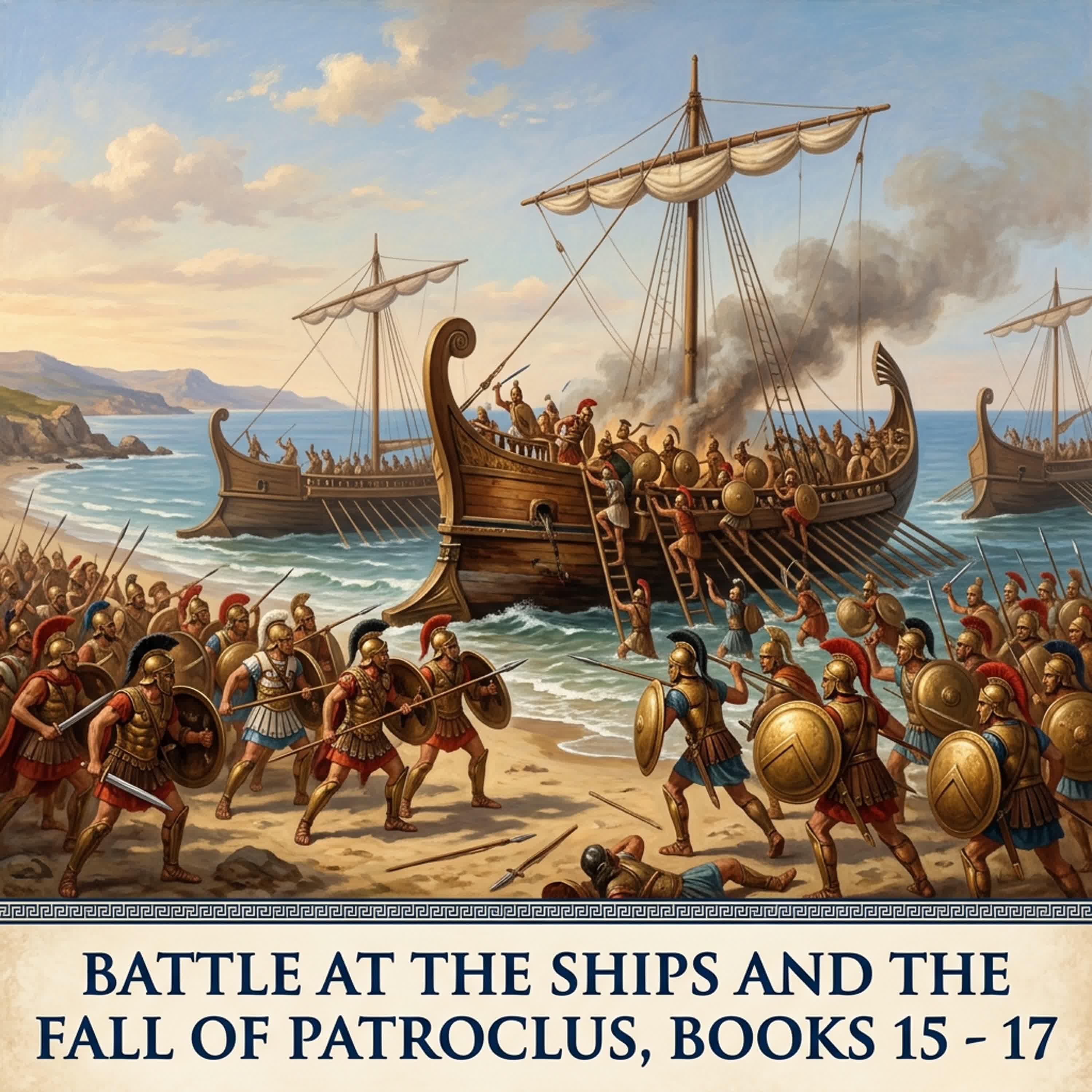
The Iliad - 5 - Chapters 15-17
from Wisdom for the Present: Western Wisdom Literature Hosted by Kanu Emeruwa
Imagine a scenario where your entire organization is on the brink of absolute collapse, yet your most talented engineer sits in the break room, refusing to touch a keyboard because their ego was publicly slighted by the CEO.* This specific flavor of toxic, self-destructive, and community-shattering ego is not a modern corporate invention. It is the exact pressure-cooker dynamic explored in Books 15, 16, and 17 of The Iliad*, a 3,000-year-old epic that dissects the catastrophic consequences of human pride and crisis management. Through these timeless narratives, we are invited to examine how personal grievances and stubbornness can drive an entire enterprise to the edge of ruin. The crisis begins with the Greek forces pushed entirely against the wooden hulls of their ships, facing an absolute and irreversible collapse with no retreat. In this desperate situation, Jove asserts his absolute cosmic authority, forcing Neptune to back down and reviving Hector with a terrifying, supernatural vitality. Against this overwhelming divine onslaught, the Greeks rely on a singular human anchor: Ajax. Leaping between the decks of the ships with a massive, thirty-foot iron-studded mace, Ajax represents pure human defiance and immediate operational adaptability when all conventional rules of engagement have completely failed. In stark contrast to the front lines, Achilles sits safely in his tent, nursing his wounded pride and choosing to let his community burn to validate his own indignation. His toxic mindset and unresolved ego lead him to a dangerous compromise: he refuses to fight but allows his close companion, Patroclus, to lead his troops while wearing his legendary armor. Achilles attempts to manipulate the strategic outcome of the war by placing rigid, selfish boundaries on Patroclus’s mission—forbidding him from pursuing the Trojans past a localized victory—simply because he is terrified that a decisive win by a proxy will dilute his personal brand and leverage. This dynamic of overextension and external disruption comes to a head when Jove snaps the bowstring of the master archer Teucer mid-draw, rendering his specialized skill entirely useless in an instant. This moment represents the black swan events and macroeconomic shifts of modern life, where a perfect plan is undone by forces completely outside our control. When the string snaps, the characters are forced to confront the sunk-cost fallacy and the danger of clinging to an obsolete tool or identity. If we remain paralyzed on the deck mourning a broken bow, we fail to recognize that reality has undergone a fundamental paradigm shift. To reclaim our agency amidst such chaos, we must look to Ajax's famous prayer when Jove plunges the battlefield into a suffocating, blinding fog. Ajax does not pray for a miracle, a sudden surge of strength, or a rewrite of fate; he prays simply for light and clarity so that if he must perish, he may do so in the face of day. Navigating our deepest personal or organizational crises requires us to demand honest, brutal truth over comforting denial. Only by accurately mapping our terrain and detaching from borrowed status can we find the authentic capacity to survive. In This Episode * The Danger of Unprofitable Bravery: Withholding valuable skills or leadership during a crisis to punish others only orchestrates a collective disaster. * Rapid Identity Detachment: When external disruptions shatter your plans, the speed at which you drop obsolete tools and adapt determines your survival. * The Sunk-Cost Fallacy: Clinging to a preferred method or identity after it has been negated by reality is a recipe for catastrophic failure. * Privilege Demands Responsibility: True leadership, as articulated by Sarpedon, is a social contract where status is paid for with disproportionate liability during a crisis. * Respecting Universal Limits: Even the supreme authority of Jove must yield to systemic rules, showing that maturity requires accepting natural consequences and boundaries. * The Trap of Mission Creep: Overextending beyond defined objectives due to a temporary high of success can lead to a sudden, fatal downfall. * Demanding Clarity Over Comfort: In moments of existential dread and confusion, seeking the brutal truth is the only way to retain personal agency. Practical Reflection Where in your life or organization are you practicing "unprofitable bravery" by withholding your talents to validate a personal grievance? When a major external disruption ruins your plans, how long do you stand there staring at the "broken string" before adapting to a new role? Are you currently fighting your battles in "borrowed armor," relying on a projected persona or copied ideas that you don't have the authentic capacity to defend? Suggested Substack Excerpt Explore how the ancient conflicts of The Iliad expose the timeless human struggles of toxic ego, overextended success, and the ultimate courage of demanding brutal clarity during a crisis. AI Disclosure This episode was created using Google NotebookLM Audio Overview, based on human-curated source material, structured guidance, and editorial review. AI is used as a tool for clarity and delivery, not as a replacement for thoughtful study or engagement with the original texts. Copyright © 2026 Wisdom for the Present / Kamashcu Production Studios. All rights reserved. This is a public episode. If you would like to discuss this with other subscribers or get access to bonus episodes, visit wisdomforthepresent.substack.com
Embed this episode
No transcript yet.