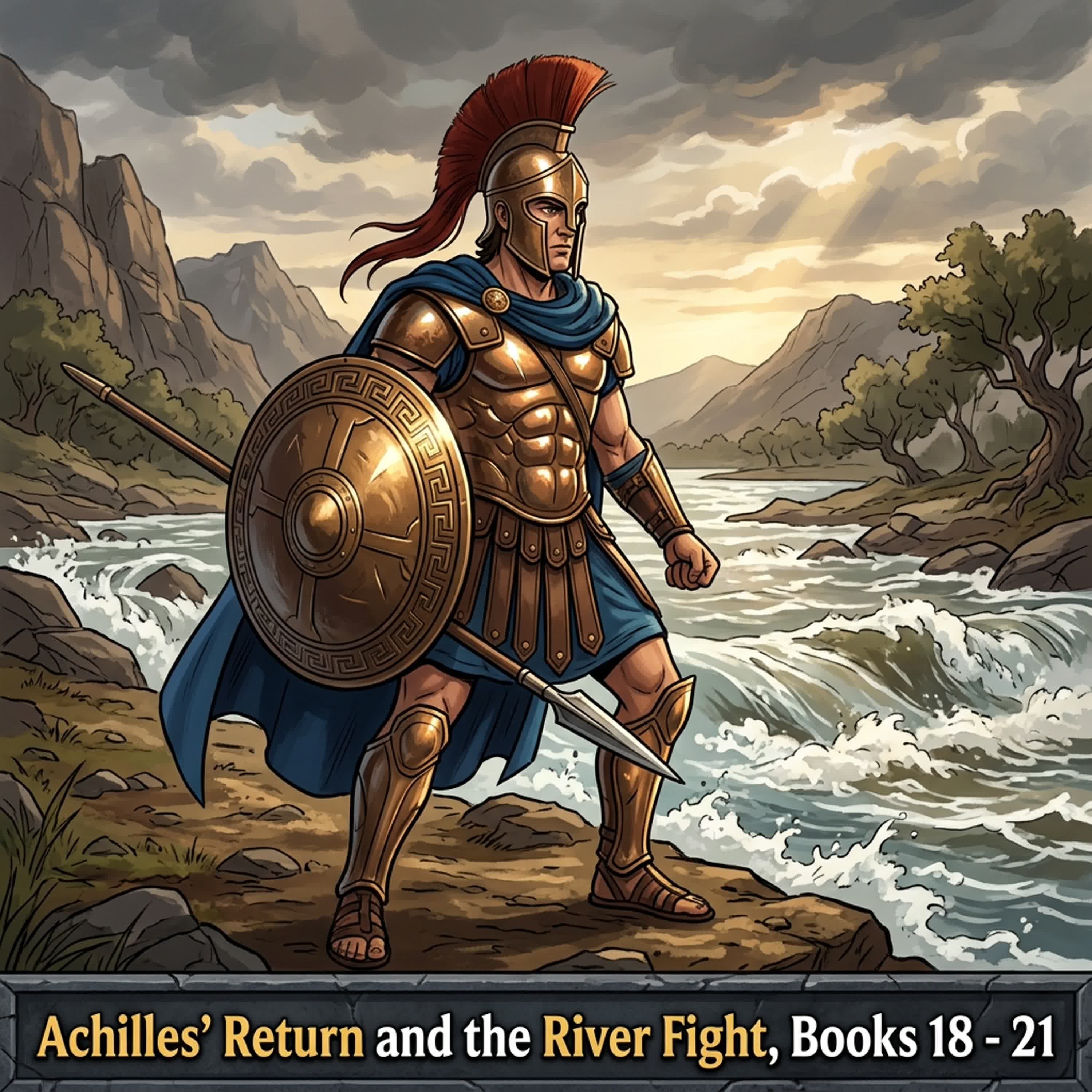
The Iliad - 6 - Chapters 18-21
from Wisdom for the Present: Western Wisdom Literature Hosted by Kanu Emeruwa
How do we respond when the floor drops out from under our lives? In Homer's epic poem The Iliad, the ancient depiction of Achilles' world-shattering grief is not one of stoic resolve, but of absolute psychological collapse. When news of his companion Patroclus' death reaches him, Achilles immediately defiles his own body, groveling in the dust and pouring black ashes over his head to match his internal agony with an external reality. This profound depiction of trauma reminds us that severe grief has a heavy, gravity-like pull that easily narrows our perspective into a single, destructive tunnel vision. In our modern lives, whether we are navigating a sudden personal crisis or a professional betrayal, we often find ourselves tempted to self-destruct, letting our pain dictate the entire trajectory of what remains of our future. As Books 18 through 21 unfold, we witness a narrative driven by the devastating decisions made in the wake of this trauma. Rather than seeking healing, Achilles willingly trades his entire future and accepts his own immediate doom just to drag Hector down with him. This "foreshortened future" represents an inability to imagine a timeline past a catastrophic event, transforming Achilles' grief into an inescapable black hole that actively weaponizes its own gravity. To offset this absolute psychological collapse, the blacksmith god Vulcan maps out the entire cosmos on Achilles' new shield, balancing terrifying depictions of the city of war with joyful scenes of a city of peace, harvests, and weddings. This divine counterweight serves as a stark reminder that even in our deepest conflicts, our suffering is bounded and does not constitute the entirety of reality. Yet, while the shield urges a broad perspective, the mortal leaders in The Iliad succumb completely to the destructive power of their own egos. Hector, driven by pride and the sunk cost fallacy, rejects rational strategy and refuses to retreat behind Troy's walls, ultimately sealing his army's doom because he fears looking like a coward. Meanwhile, on the Greek side, King Agamemnon completely abdicates personal responsibility for his past actions, delivering a long, defensive speech from his chair and blaming his terrible judgment on the goddess Ate, the personification of delusion. In the 21st century, we might not blame ancient deities, but we frequently invent our own modern gods of delusion—attributing our failures to changing algorithms, supply chains, or macroeconomic shifts. This refusal to take an ego hit and own our mistakes severely corrodes trust and serves as an immense obstacle to personal and organizational growth. This breakdown of rational leadership spirals into physical chaos as Achilles rushes into battle, entirely ignoring his biological limits. Operating purely on the manic, stress-fueled hyperarousal of fresh trauma, he insists that the entire army fast, believing his raw willpower can override physical laws. Though Ulysses wisely argues that courage is useless without calories and that a drooping body will eventually desert the mind, Achilles runs on the toxic fumes of cortisol and adrenaline until he is driven to monstrous extremes. He plunges into the river Scamander, butchering the young suppliant Lycaon, committing the abomination of human sacrifice, and throwing so many bodies into the water that the river literally rises in a boiling tsunami to purge him. It is a vivid ecological metaphor: when we operate from unhealed pain, we pollute our own environments and drown the innocent bystanders around us in our river of stress. To survive these chaotic storms and reclaim our agency, we must look to the moments of quiet alignment that exist even when the heavens are shaking. When the gods clash in a cosmic free-for-all, Neptune suddenly steps in to save Aeneas, recognizing that a seed of continuity and future purpose must be protected to carry the Trojan line forward. In our own chaotic lives, when macro forces like economic upheaval or societal shifts feel entirely out of control, we cannot stop the fighting, but we can locate and protect our own "Aeneas"—the core family, values, or work that represents our future. Even when confronted by the talking horse Xanthus with the absolute certainty of his own short, finite life, Achilles rides forward, choosing to fight for meaning within his limits. Ultimately, our challenge is to cultivate the discernment to choose the shield of peace, ensuring that our daily battles bring life and continuity rather than leaving a wake of destruction. In This Episode * The Anatomy of Trauma: Achilles' severe physical reaction to Patroclus' death reveals how we externalize deep emotional wounds when our inner world is reduced to ash. * The Danger of the Foreshortened Future: Severe grief can create a psychological "black hole," trapping us in immediate pain and blinding us to any possibility of a future. * The Cosmic Shield of Perspective: Vulcan's intricate design of the cosmos and the peaceful city on Achilles' shield serves as a vital reminder that beauty and peace exist even amidst personal warfare. * Toxic Leadership and the Sunk Cost Fallacy: Hector's prideful refusal to retreat behind Troy's walls illustrates how leaders risk their followers' lives to avoid the perceived humiliation of adapting. * The Delusion of "Blameshifting": Agamemnon's attempt to blame his bad choices on the goddess Ate is the ancient precursor to modern leaders blaming the "algorithm" or external market conditions to save their ego. * Respecting the Physical Vessel: Ulysses' debate with Achilles highlights the absolute, biological necessity of maintaining our bodies through nutrition and rest during a crisis. * The Environmental Cost of Unhealed Pain: Achilles' violent corruption of the river Scamander is a powerful metaphor for how "hurt people hurt people," polluting their ecosystems and drowning innocent bystanders in their stress. Practical Reflection * Recognizing Your Own "Ate": When a project or personal decision fails, do you find yourself passing the buck to external forces like "the algorithm," or do you take the ego hit to preserve trust? * Looking at the Total Shield: In your current difficult season, what are the thriving "vineyards" or quiet morning rituals that you can focus on to maintain cosmic proportion? * Protecting Your Aeneas: When the macro forces around you feel completely chaotic and overwhelming, what is the single, vital seed of future purpose you need to carry safely through the fire? Suggested Substack Excerpt Explore how Homer’s Iliad provides an ancient map for modern trauma, ego, and the biological limits of leadership. Learn how to carry the "shield of peace" even while navigating the "city of war". AI Disclosure This episode was created using Google NotebookLM Audio Overview, based on human-curated source material, structured guidance, and editorial review. AI is used as a tool for clarity and delivery, not as a replacement for thoughtful study or engagement with the original texts. Copyright © 2026 Wisdom for the Present / Kamashcu Production Studios. All rights reserved. This is a public episode. If you would like to discuss this with other subscribers or get access to bonus episodes, visit wisdomforthepresent.substack.com
Embed this episode
No transcript yet.