
EPISODE · May 30, 2026 · 23 MIN
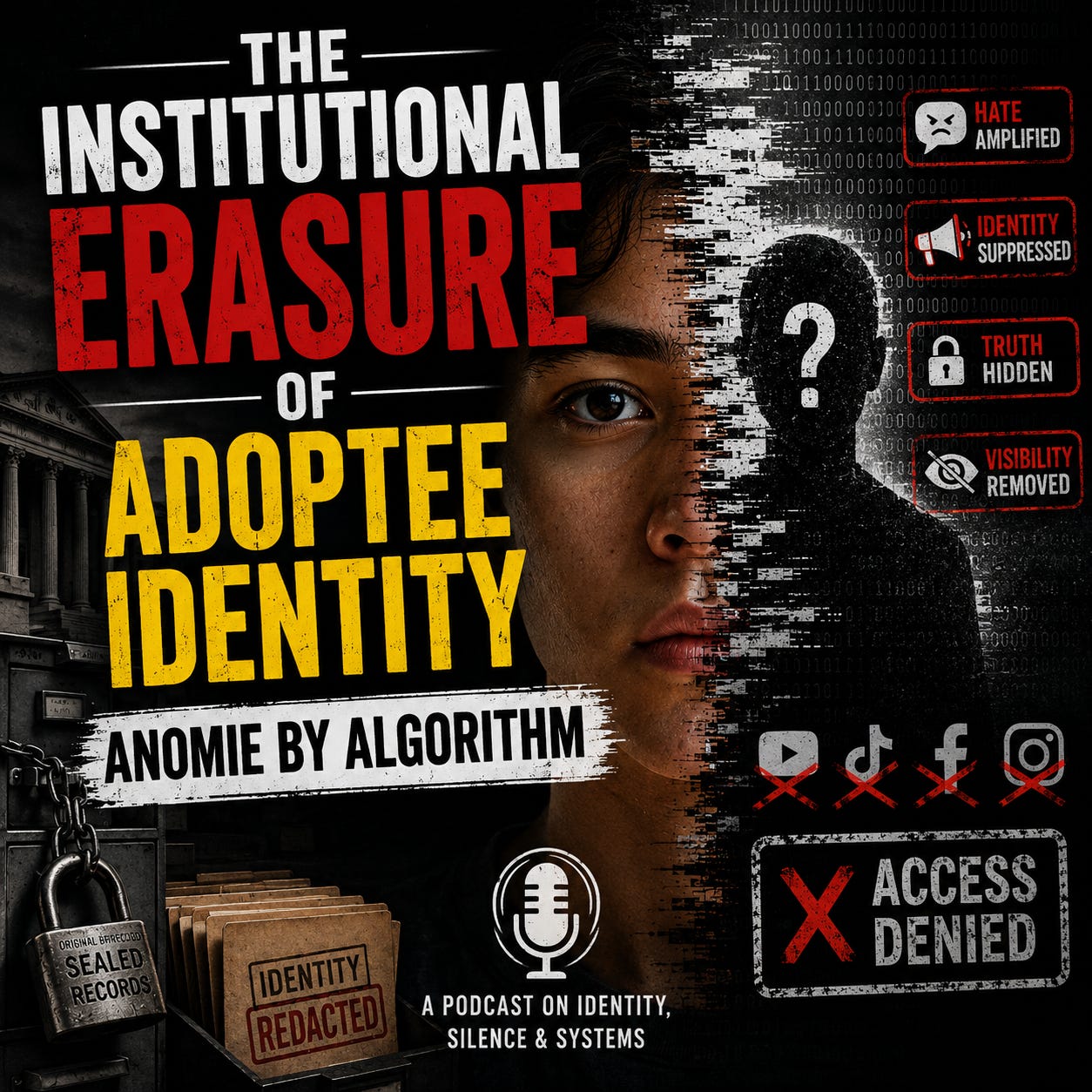
The Institutional Erasure of Adoptee Identity: Anomie by Algorithm
from The Experience of Adoption · host Thoughtless Delineation
Last week, GLAAD released its sixth annual Social Media Safety Index. The report is comprehensive, forensic, and necessary. It documents how Meta, YouTube, X, and TikTok are failing LGBTQ+ users: not just by allowing hate speech to circulate, but by simultaneously suppressing legitimate LGBTQ+ expression. The mechanism is named precisely. Platforms built to maximise engagement amplify what drives engagement. The cost is borne by marginalised people whose identity itself becomes “sensitive content.”But here is what the report cannot see: adoptees experience this identical architecture. And because adoptees are absent from GLAAD’s framework, the result is a specific kind of institutional harm.It is not just suppression. It is anomie.YOUTUBEWhat Is AnomieAnomie is Durkheim’s term for the psychological devastation of living in a society where the structures that gave life meaning have collapsed. It is not confusion. It is not simple loss. It is the specific pain of disconnection — from purpose, from community, from the possibility that your life can cohere.Anomie happens when the world stops making sense and you are made responsible for making sense of it anyway.Adoptees know this condition intimately. You are told you are chosen, rescued, integrated into a family. The narrative says: you belong here now; your original family is irrelevant; this is your home. But your body knows differently. You are severed from biological origin. You are constructed from absence as much as presence. The adaptive family narrative does not cohere with the subsonic truth.This is the Fifth-Dimensional Split — living across two asynchronous signals, neither of which resolves into coherence.For decades, the adoption industry maintained this state of anomie through the Architecture of Silence: sealed records, amended birth certificates, legal prohibitions on adoptee access to information. The state and the adoption industry said, in effect: you must not search for coherence; the coherence you are offered is the only one available.Then DNA testing happened. Adoptees found their biological relatives outside the institutional gatekeeping system. They built communities. They found ways to construct coherence from the severed parts. They demanded change.The institutions adapted. They did not open the sealed records — that would have been too direct. Instead, they deployed a new Architecture of Silence, built in code.GLAAD Documents the MechanismThe 2026 SMSI evaluated six platforms across fourteen LGBTQ-specific indicators. The findings are stark. Meta’s platforms — Facebook, Instagram, Threads — all declined in scores. YouTube dropped eleven points after removing gender identity from its hate speech policy. X remains at 29 out of 100.The specific finding: platforms fail to moderate anti-LGBTQ+ hate that violates their own policies, while simultaneously suppressing legitimate LGBTQ+ expression.One example from the report: Meta blocked teenagers from searching LGBTQ+ hashtags like #lesbian and #trans for months. The official reason was “sensitive content.” The effect was clear — the platform was erasing identity disclosure.Here is the mechanism GLAAD names:Social media platforms generate revenue by maximising engagement. Engagement is driven by emotional activation — outrage, conflict, division. This creates a structural incentive to allow harmful content to circulate.Platforms are simultaneously under pressure to be “safe,” so they deploy automated content moderation systems, usually powered by AI. These systems are trained on data from a dominant-group perspective. They are deployed at scale with minimal human review. They lack the cultural and linguistic competence to distinguish between hate speech and authentic identity disclosure.So they default to the conservative option: flag anything coded as “sensitive” and remove it.GLAAD shows this happening to LGBTQ+ people across six major platforms. The systems are simultaneously under-moderating hate and over-moderating identity.The person affected experiences it as erasure.Where Adoptees LiveAdoptees experience this identical algorithmic architecture. But because they are absent from GLAAD’s framework, the institutional blindness is easier to maintain.On genealogy and DNA platforms: Ancestry, 23andMe, MyHeritage, and other direct-to-consumer genetic testing services use algorithmic systems to match DNA and connect biological relatives. For adoptees, these systems are treated as risky. Privacy settings default to restrictive. DNA matching results are sometimes suppressed or delayed if an adoptee’s biological profile might connect them to a relative who has not consented to contact. The institutional logic is “protection.” The effect is erasure of biological truth.On mainstream social platforms: Adoptees who post about searching for biological relatives often find their content shadowbanned, age-gated, or demonetised. A TikTok creator posting about adoptee rights might see engagement plummet. A Facebook group for adoptee searchers might find posts marked as “sensitive content.” The algorithmic systems cannot distinguish between identity disclosure and exploitation risk. So they suppress.On adoption forums and genealogy communities: These spaces, where adoptees gather to share search strategies and DNA results, face the same pressures as LGBTQ+ creators. Content gets flagged. Accounts suspended. The communities are small enough that institutional oversight never reaches them.The architecture is the same. The algorithmic logic is the same. The outcome — suppression of biological identity disclosure — is identical to what GLAAD documents.But adoptees are not in GLAAD’s framework. So the suppression is not named. The oversight does not extend.The Production of AnomieHere is what distinguishes the adoptee experience from what GLAAD documents happening to LGBTQ+ people:LGBTQ+ identity suppression is an injustice. It is a violation of the right to authentic self-expression. It deserves institutional redress.But LGBTQ+ people, in the current moment, have institutional recognition. GLAAD exists because LGBTQ+ identity is recognised — politically, legally, socially — as a category worth protecting. When a platform suppresses LGBTQ+ expression, that suppression is recognisable as harm to a named group. It can be measured. It can be protested. It can lead to policy change.This institutional recognition creates a specific kind of possibility: the possibility that the harm will be seen, named, and addressed.Adoptees do not have this. Adoptee identity is not yet recognised as a protected category. There is no box on the census for “adoptee.” There is no civil rights legislation written in adoptee terms. When an algorithmic system suppresses adoptee identity disclosure, there is no framework that calls it what it is. It is treated as a privacy issue, or a commercial decision, or a data security matter. Not as suppression. Not as harm to a named group.This is the production of anomie at the institutional scale.An adoptee searching for biological relatives on Ancestry finds their DNA matches suppressed. They do not know why. The platform does not explain. There is no advocacy group demanding transparency. There is no regulatory pressure. There is no public report measuring the harm.The adoptee is left alone with the suppression — unable to name it, unable to protest it, unable to demand that it stop. The world has stopped making sense. The structures that were supposed to help them cohere — the platforms built for biological search, the institutions that claim to support adoptee rights — have become the mechanisms of their erasure.This is anomie. Not as an abstract concept, but as a lived condition.It is what happens when institutional power operates in the gaps where no one is watching.Non-Adoptee Bias as Structural BlindnessGLAAD’s framework uses fourteen LGBTQ-specific indicators. They are rigorous. They are necessary. And they are built entirely around one protected category.This is not a failure of GLAAD. This is how institutional accountability works: you define your scope, you build your metrics, you document what your metrics can measure.But the scope has an edge. And adoptees fall outside that edge.The reason is structural. LGBTQ+ identity is recognised institutionally. Adoptee identity is not.So when an algorithmic system suppresses adoptee identity disclosure, there is no institutional framework that calls it suppression. There is no metrics system that can measure it. There is no accountability structure that can address it.This is what Non-Adoptee Bias looks like when it operates at the structural level. It is not that GLAAD is indifferent to adoptees. It is that the framework for recognising harm does not yet include adoptee identity.And so the Architecture of Silence continues, using algorithmic tools, in the space where no institutional eye is watching.The Architecture of Silence, Version 2.0For seventy years, the Architecture of Silence operated through sealed records, amended birth certificates, legal prohibitions on adoptee access to information.Then DNA testing changed the game. Adoptees found their biological relatives outside the institutional gatekeeping system. They built communities. They began to construct coherence from the severed parts. They demanded change.The institutions adapted. Not by opening records — that would have been too direct — but by deploying new tools. Platforms that adoptees depend on began using algorithmic systems to manage access. Not openly. Not through legislation. Through the “neutral” machinery of content moderation and privacy settings and data governance.The outcome is the same: biological truth is suppressed. Adoptees are isolated. The possibility of coherence is constrained.But the mechanism has changed. It is no longer sealed records. It is algorithmic opacity. And because the opacity is framed as a technical problem — “How do we balance privacy and safety?” — rather than a political problem, it escapes accountability.GLAAD’s report shows exactly how this works. The platforms use opacity as a tool. The algorithmic systems are opaque. No one knows what triggered a shadowban or a removal. The person affected is left in uncertainty.This is the Architecture of Silence, rebuilt in code.And it produces anomie: a state in which the structures that were supposed to help you cohere have become the mechanisms of your erasure.Thanks for reading! This post is public so feel free to share it.The Institutional BlindnessIf GLAAD — one of the most respected organisations documenting algorithmic harm to marginalised people — cannot see adoptee suppression, then there is no institutional accountability system watching it.The platforms know this. They operate in the space of institutional blindness. They can deploy algorithmic suppression of adoptee identity because the suppression is not recognised as suppression. There is no public report. There is no advocacy group tracking it. There is no regulatory pressure.The gap in oversight is itself a form of power.It is Non-Adoptee Bias operating at the scale of institutional accountability. The entire ecosystem that is supposed to be watching for algorithmic harm to marginalised people cannot see harm to adoptees — because adoptee identity is not yet in the framework.This means the adoption industry has won something important: the ability to continue suppressing biological truth, using new tools, while remaining invisible to the accountability structures that might constrain them.And the adoptee is left in anomie: alone with the suppression, unable to name it, unable to demand redress.—What Changes When We Name ItBut there is a possibility in naming this.GLAAD has proved something crucial: that institutional oversight works. That documenting algorithmic bias creates pressure on platforms. That naming a mechanism makes it harder to deny.If GLAAD’s framework expanded to include adoptee identity as a protected category — if the report assessed platform policies not just around LGBTQ+ expression but around adoptee identity disclosure — then the suppression would become visible. It would be measured. It would be documented. Platforms would have to respond.This is not asking GLAAD to do something outside their scope. It is asking them to recognise that adoptee identity suppression operates through the same mechanism they have already named. The architecture is the same. The harm is the same.The only difference is institutional blindness.In naming that blindness, we create the possibility of seeing differently. We create the space for oversight to extend. We create pressure on platforms to change.We create the conditions for adoptees to move out of anomie — to have their suppression named, measured, and addressed.This is how accountability works. You name what was invisible. You show that it is harm. You demand that it be measured. You wait for the systems to respond.The gap is visible now. What happens next depends on whether anyone is looking.This Substack is reader-supported. To receive new posts and support my work, consider becoming a free or paid subscriber.CodaAnomie is not a personal failure. It is a social condition — produced when the structures that give life meaning have collapsed, and no one is watching the collapse happen.For adoptees, this collapse has been happening for seventy years. The adoption industry engineered it through sealed records. The platforms are engineering it now through algorithmic opacity. Each time, the institutional blindness protects the machinery.GLAAD’s work is necessary. The suppression of LGBTQ+ expression is real and documented and happening at scale. That matters.But institutional power operates in the gaps between frameworks. It hides in the categories we do not yet recognise. It produces suffering in the spaces where no one is watching.For adoptees, that gap has been widening for seventy years. The Architecture of Silence has used it perfectly. And now, as algorithmic systems become the primary tool of identity suppression, the gap is deepening.The question is not whether GLAAD should expand their scope. It is whether the adoption industry will continue to operate in the spaces where no one is watching.The answer, so far, is yes.But anomie can be interrupted. Institutional blindness can be named. Frameworks can expand. Oversight can extend.The gap is visible now.What we do with that visibility is up to us.Resources & Reports This is a public episode. If you'd like to discuss this with other subscribers or get access to bonus episodes, visit thoughtlessdel.substack.com/subscribe
Embed this episode
NOW PLAYING
The Institutional Erasure of Adoptee Identity: Anomie by Algorithm
No transcript for this episode yet
Similar Episodes
No similar episodes found.
Similar Podcasts
No similar podcasts found.