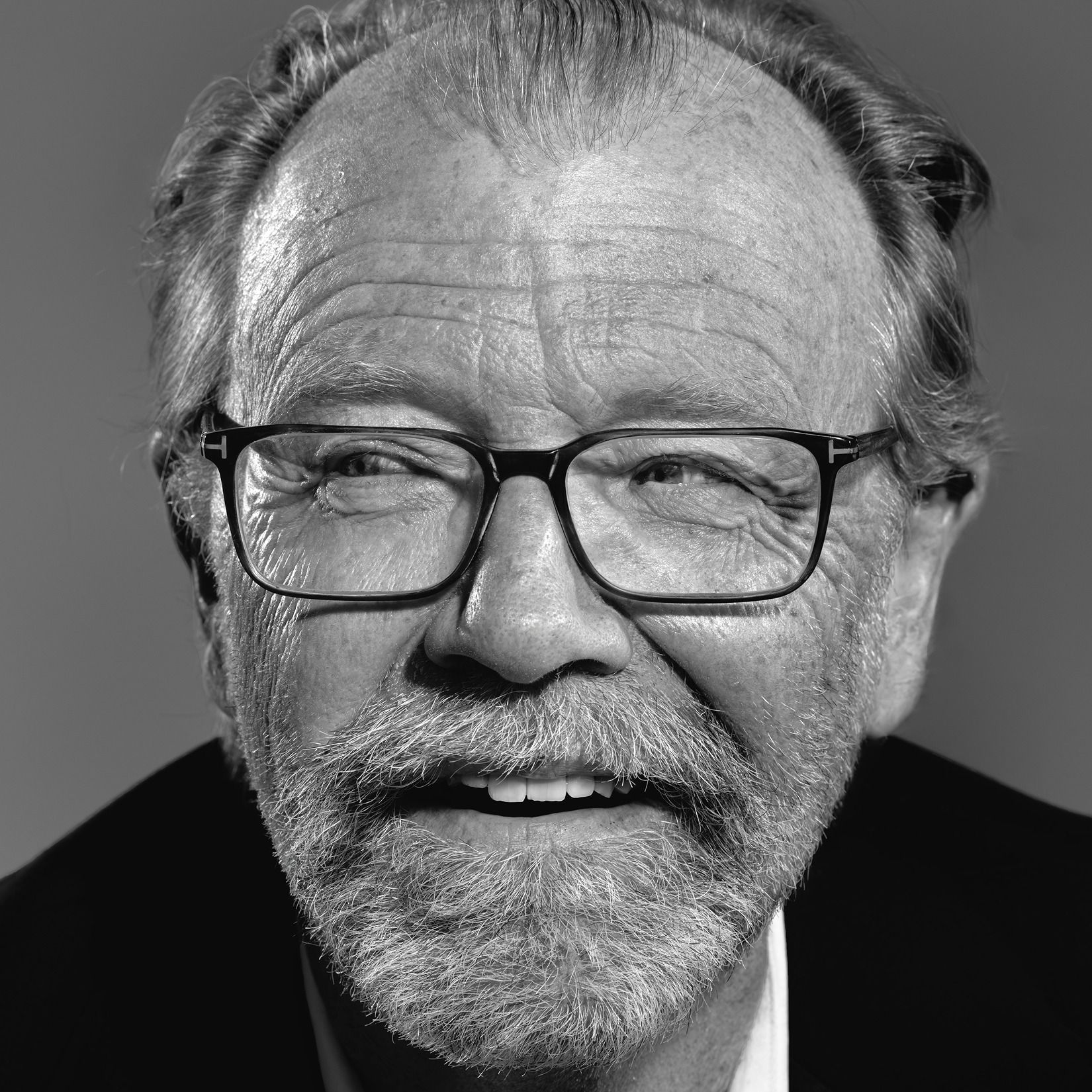
From the New York Times, this is The Interview. I'm David Marchese. Last fall, George Saunders was awarded the National Book Foundation's Medal for Distinguished Contribution to American Letters. In the speech introducing him, in addition to a glowing rundown of his literary resume, which includes the 2017 Booker Prize-winning novel Lincoln in the Bardo, he was also called the ultimate teacher of kindness and craft. Pretty good, right? Well, mostly.
The craft art isn't the problem. Saunders, who is 67, has been a revered teacher in Syracuse's prestigious creative writing MFA program since 1996. His 2021 bestseller, A Swim in a Pond in the Rain, was a distillation of his teaching, featuring close readings of Russian short stories. And out of that book came a substack called Story Club with George Saunders, where he continues to teach, answers reader letters, and shares writing exercises with more than 300,000 followers. He also has a new novel out this month called Vigil, about a cantankerous oil tycoon on his deathbed. It's the kindness part, though, where things can get a little tricky.
In 2013, Saunders gave a convocation speech to Syracuse graduates all about the power of practicing kindness. That speech went viral and then was repackaged as the bestselling book titled Congratulations, by the way. The success of that speech has wound up casting Saunders into a kind of self-help-y guru of goodness role, which is frankly a little strange given the satirical bite of his fiction. And it's also just kind of an odd thing for someone to have to live with, because as he explained in our conversation, he's just as fallible and flawed as the rest of us and as his unforgettable characters. Here's my interview with George Saunders.
George, thanks for taking the time to be here today. Oh, thanks for having me. It's great. You know, I have to start with a confession and an apology. I met you probably like 16 or 17 years ago at the Brooklyn Book Festival, where my girlfriend at the time, who's now my wife, was working for a magazine called Radar. And as a gag, they assigned her and some other junior people to try and get authors to write like jokey inscriptions on their books.
And she, to her credit, couldn't bring herself to do it. So got me to do it. And I came up to you and I asked you. I can tell you what it said. You remember? Yeah, yeah, yeah. It's so funny. It said something like, this is from my best friend. And please assure him that he's still a good man, even though his wife slept with his yoga instructor or something like that. I do remember that. That's actually the one. I felt so bad about it. But I think I wrote most of it out. And then I kept going. Yeah, I think I backed out. Yeah. And at one point you looked at me.
And you said, is this real? And I just lied to your face. I honestly popped into my head. It's something I feel bad about. What's interesting about that is when I look back at my so-called career, that was an anomaly. I thought, that doesn't make sense to me. I'm glad to know that it was fake. It was fake, yes. All right, so now I can move forward with a clean conscience. I can't stop worrying about that husband whose wife. Okay, so your new novel, Vigil, it raises a lot of questions for me, thematic questions, including questions about determinism.
about how much anyone is sort of responsible for their own life or the decisions that they make in their life. And I'm just curious to know your answer to that question. I think the book says, yeah, good question. There's this Chekhov quote that I'm kind of living by lately. And he says, a work of art doesn't have to solve a problem. It just has to formulate it correctly. So in this book, I think...
there are kind of two characters who embody that question. And I think they're both right. And so my job, rather than answering your question, is to allow each of them to make the best possible case for their view. So with this book and with Lincoln and the Bardo, I wrote myself into a place where the question got more and more profound. And I found myself less and less capable of giving a definitive answer. And you think, well, actually, that's not for an artist to do. You ratchet the question up and you go, yeah, that's a tough one. You said there's sort of characters who represent two sides of that question. Just for people who will not have yet read the book, can you?
explain. Yeah, well, there's a young, there's a guy who's a, he's one of these sort of climate change denial architects who's now in the last night of his life. And his name is KJ Boone. And he's got a couple of ghosts or many ghosts who come to see him. And one of them is the ghost of this woman, Jill. And she died at 22 in 1976. And her idea about things because of an experience she had at death is that nobody is to blame. Nobody should take credit. We're just these vessels that live out.
sort of karma, you know, and therefore the only thing to do is to be kind and comfort one another. That's her view. There's a Frenchman who died in the 1800s whose view is not that. He's a kind of a vengeful presence. So those two throughout the book are kind of going back and forth over how to approach this sinner in the bed. And so those are the two viewpoints I kept trying to like refine. When I read the book, I was, I think, more in line with the Frenchman. I really...
was hungry for KJ Boone, who's sort of an unrepentant oil magnate. I wanted him to get some sort of judgment to be rendered on him. And I just wonder how you think about the subject of judgment for the real world analogs of someone like a KJ Boone, someone who was actually not only directly responsible for downplaying the climate crisis, but also exacerbating it. Yeah. I mean, sometimes like you, I'd like for a hammer to drop on at the end of their life. But I think for the most part, and just look at my own heart, when I've been in sync with truth, I felt better. And when I was not in sync with truth, I felt poorly.
that might be the only judgment that takes place in this sphere. And as for what happens next, I don't know. In the book, in that last 15 or 20 pages, I got a lot of surprises, things that I was kind of rooting for didn't happen, things that came out of nowhere and surprised me. So for me, that's the beauty of the writing process is it's almost like something rises up out of me that's a little smarter, a little more fair, a little more curious, and hovers over the desk for a while. And in theory is the readers over there, the book urges that little spirit-like thing out of him as well, and the two things merge. So you get this brief period of rarefied communication.
that weirdly seems to inspire a suite of really nice things like a little more empathy, a little more engagement, a little more patience. So I kind of live for the moment when that little spirit comes out of me and I can stop being this guy and be him for 12 minutes. What you just described, how the engagement with literature results in these positive side effects, a little more empathy, a little bit more understanding, a little more patience, a little bit more interest in other people. It's sort of a recurring theme in interviews with you and things you've written. And I have questions about that. So do I. Because on the one hand,
I think we could point to countless examples of genius level writers, presumably people who are as deeply engaged with literature as someone could possibly be who are giant jerks. And then conversely, just an example from my life, the kindest, sweetest, most empathetic person I ever knew was my paternal grandmother who was illiterate her whole life. So what makes you believe that your hopes that you have for what literature can achieve are true and not just sort of a nice thing to hope? Yes. Well, to the first point, I think there's a mistake when we think someone who's done something beautiful in art must be a wonderful.
person. It's just like if somebody can play football really well, they might be a really bad person. They just have a skill. The second thing is I think these benefits, which I talk a lot about because I feel it every day. I see it happening to me. They're not necessarily going to fix everything. You know, there are sort of incremental changes of consciousness on the part of the writer and the reader. I'm not claiming it as some kind of universal solution, but I also think we, to me anyway, it's becoming clear that writing and reading is a way of simply underscoring that human connection is important, that you can know my mind and I can know yours, which is a vastly consoling idea. And we need it just from my own experience. I was, um,
So many times in my life, I felt a more articulate version of myself emerge after a period of writing. When that happens, the world changes. How does the world change? Well, the first time that I was in Rochester and I was writing my first book mostly on the bus, and I just would take two or three pages, and because I only had those pages, I would concentrate so hard on kind of a Rubik's Cube editing. Is this better? Is this better? And after a week or so of that, the language in which I was thinking was higher, more precise, and suddenly your perceptions change. Of course they do. The instrument with which you're perceiving becomes rarefied and more precise. So that is maybe the most meaningful thing that's ever happened to me, that you could alter yourself.
through an activity. So I just kind of, sometimes I think I just extrapolate that outwards to the rest of the world, maybe too much. That time in your life when you were in Rochester, you were working for basically as a technical writer. Do you ever think about for yourself, whether it was on some level inevitable that you would choose a different life or write your way into a different life? Is there a version of George Saunders' life where you do stay as a technical writer? Oh, sure. So that was a possibility. Yes, and I had planned to be a writer for a long time, and then it wasn't happening. I could feel that ship of literary ambition just sailing away without me very happily. So there was a time that I now remember very fondly where I just was like, well...
maybe that just wasn't meant for you. But keep trying, you know, try to publish a story a year was the idea. And that was a very sweet period because the idea, suddenly the activity of writing got separated from ambition as much as I've ever had it separated. It was very zen activity, just stealing maybe 20 minutes a day to concentrate on a bit of prose. And it felt very pure.
I also have seen you mention in passing a couple times about how when you were a younger man, you were sort of an Ayn Rand Republican. Do you remember how you came to those beliefs and then how you wound up rejecting those beliefs? Is that so not how you're thought of now? No, no. Well, I think I came to it out of a kind of a vast insecurity. I had a couple of high school teachers who intervened on my behalf and got me into the Colorado School of Mines for geophysics. So I was so far behind the curve. I hadn't really done much work in school. Went out there and I was just barely hanging in. And that was a really...
jarring thing. So along comes Atlas Shrugged. And at least the way I read it was you're special because you believe in selfishness. And at that point, just, I got caught up on your special. That was enough, you know? Um, so I think I started kind of just using it as the one way in that environment I could feel special, you know, could feel that I, for all of my external defects inside, I was a glowing night of objectivity. And also the other thing was, I remember reading Atlas Shrugged on a trip with some high school friends. And at that point I wasn't going to go to college. I was in a band and I was a, and there was a guy in the band who knew a guy who knew a guy who knew a guy in the Eagles. That was our, yeah.
set my career plan. But I was reading Atlas Shrugged in his car and I hadn't read a novel since maybe Johnny Tremaine in third grade. And just the novelness of it, you know, the places and the way it called up a world in my mind and the fact that it was 1,084 pages. So that was actually what I loved was she was a novelist. And so I kind of, you know, I think I voted for Reagan the first time, lifelong regret, but then at some point I graduated from the School of Mines, went overseas and was working in the oil fields.
I was walking home, possibly a little drunk one night in Singapore, and there was a big foundation of a hotel that was going up, and there was some movement in the bottom. I kind of staggered up to the fence, and there were, I mean, hundreds of what I came to see were elderly Malaysian Singaporean women clearing the site by hand, you know, carrying boulders off. And something in that moment, it just snapped, and I made the connection between those women and... My extended family, many of whom were struggling with the kind of the big boot of capitalism at that point. And I thought, oh, I'm on their side. So something in that instant clicked. And then I was just much more open to sort of what we would now call progressive ideas. So that kind of magical thing was, well, for the first time, I thought.
Contra Ayn Rand. These people are the result of a system. This thing that's happening to them, the way they're behaving, the difficulties they're having isn't entirely just them. And that in turn connected with my childhood Catholicism. Oh, how so? Well, I mean, I always thought, I always loved, I think it's the woman at the well when Jesus is able to, as I understood as a kid, comes up to this woman who's scorned by other people and goes, I see you.
And I like you. I love you. I forgive you. I always thought that was such a novelistic move. And that seems to me part of the magic of fiction. Because in fiction, I can make a person that I really don't like, like this guy in the book. He's a stinker. But then through that kind of weird side door of trying to make the language about him more interesting, you start sinking through the levels of his stuff. And pretty soon, I don't know if you like him, like and dislike become the most useless phrase. You are him. You have been him. And then that beautiful thing where I think specificity negates judgment.
So as I work harder and harder to know that guy through the things he's said and done and seen and remembers, my sense of wanting to judge him just becomes kind of, it seems juvenile. Anybody can judge. Let's just go deeper and deeper. And I really cherish that feeling. And of course, it doesn't last beyond the page. And I'm sure if I met his real life corollary, I'd be sneering at him. But what a blessing, you know, to, for a few minutes a day, kind of ascend up out of your habit. Do you think there are characters or real life people for whom you couldn't generate that kind of empathy for? That's a great question. I think, here's the thing. I don't think as a person like that, I couldn't generate empathy for, but it might be facile empathy. So I think if you look at someone who's really psychopathic or,
I mean, I was wondering if you could write a fictional version of Trump. Sure. I mean, I think one could for sure. And it'd be very interesting because I see a lot of vulnerability in him and a lot of, but what I've noticed is I haven't written about this, so I'm not sure I'm right. But the tools that a writer brings to this thing tend to favor.
You're constantly putting yourself in that person's shoes, but in fact, you're not in their shoes. You're you pretending to be in their shoes. So I definitely think- Yes, and you could come up with a version that was a little too soft and didn't truly account for what was making the person behave that way. That's something I'm really interested in. So with this book, especially, I'm interested because I ended up liking this guy more than I thought I would. And the question is, is he an accurate representation of the people who actually did these things? And that epiphany you had where you saw the women clearing the rubble sort of opened your eyes a little bit to the dark side of capitalism, I guess. And I wonder if you're-
thinking or feeling about capitalism has been affected by the fact that you've now done so well. I mean, as far as writers go, purely from a market perspective, you're doing very, very well. I think it's totally holy. No, I mean, I think it's actually, honestly, if you have some success, it actually makes a better vantage point to see the unfairness of the whole thing. So I think in my, in my lifetime, capitalism has gotten much meaner and much more beautiful. I had a friend, the writer, Michael Herr, who wrote the dispatches. We were friends. And he said one time, he had this kind of beautiful sixties.
way of speaking. He said, man, when the fascists come back, they're not going to wear the jackboots because they already saw that that doesn't work. So capitalism now is gleaming. It's as if it's coming from within us. We all buy into these strange fictions like shareholder value. So I'm much more, I mean, I'm as aware of it. And I think in some ways, if you're doing okay, it'll be harder to be aware of it because it's very human to mistake good fortune for virtue. So, yeah. Why do you refer to shareholder value as a fiction? Well, it's not a fiction, but it's not as important as people think it is. I mean, it seems to be...
To me, it seems that we use that to excuse a lot of bullshit that we wouldn't put up with normally. I don't know if I can articulate this, but it seems to me in our time, we've become very comfortable with a certain mental move. And it's something like, I know what the right thing is. Wait there. And then we turn and we do something else. I think it's just pervasive. It's one of the reasons our politics is the way it is. I mean, our president calls a reporter a pig.
And some percentage of people say, well, I know I would never do that. I would never. I have a wife. I have a daughter. Never would I call a person a pig. However, then we turn. So I think this is, again, this is just a first thought, but I'm interested in the way that we can know very well that certain enlightenment values are true and important and make an excuse. Sometimes it's shareholder value to turn and look away from us. Sometimes the excuse is as simple as it's easier. It's easier. Yeah. Or, you know, there's also, I mean, isn't a drag to have to say in a scolding tone.
I don't do that. Or that strikes me as low. I think maybe starting back with reality TV, we lost our ability to say, that's toxic and I don't want it. And so we say, well, it's toxic, but I'm not going to be a prig. Does that resonate with you at all? Well, it does. I think it also connects to a lot of the backlash against the censoriousness of the left. There's the idea that young men in particular, they're just always finger wagging at everything. I'm not interested in that. It's interesting because going out into America, I see a fairly medium functional culture with pretty good civility.
The politics doesn't seem to correspond to that. And I think it may be about this issue of who gets to throw the flag? You know, who gets to... Anyway, that's for the next book. I got to think about it. You know, I saw recently you won a Lifetime Achievement Award from the National Book Foundation. And in one of the introductory speeches to your acceptance speech, get ready for this one, you were referred to as the ultimate teacher of kindness and of craft. And you're often...
positioned in terms of kindness and goodness, almost, I'm going to be a little hyperbolic here, but like almost as a kind of secular saint, and your eyes just roll. But I'm wondering... I was just keeping myself from levitating. I sometimes have to roll the eyes. I just wonder if we can complicate that a little bit. Like, when do you struggle with kindness? I mean, the whole kindness thing came out of a talk I did at Syracuse, and the point was not...
It's easy. It's that it's really impossible. And when I look back at my life, the things I really do regret are the times when I fell out of that in some dramatic way. So it was never, I was never making the case that I had got it because I really don't. I'm anxious and I'm sometimes pretty grumpy and I'm also really way too busy. So that, I think the secular saint business, I think it has to do with having decent public manners, actually, which I was taught in Chicago. So that part is becoming increasingly, I'm resisting that narrative because it jars with what I know about myself as an actual person. So to say it's important to be kind does not mean I got it, you know?
But when do you struggle with it? Are there moments specifically? I mean, every day. We have an elderly dog in home who's very sick, you know? And so that's just an ongoing thing of trying to figure out what she needs. And meanwhile, I've got a call in 10 minutes. So, I mean, it's pervasive. I mean, I'm aware of this kind of riff about kindness. But really, I mean, in my experience, it came from one speech that I gave. Which was then turned into, which I think it was then reprinted maybe in the Times. Yes, I think that's right. And went viral or proto-viral. And then it was made into a book that I think also did well. Yeah. But then, so then you have made this claim that it would be good for us all to be more kind.
After that, you go on a tour and you get to dig into that bit and go, huh, okay, so what does it actually mean? Well, it's not nice. Niceness is not the same thing. And you can kind of reason your way to see that kindness has something to do with awareness. In other words, if kindness is being a benefit to people within your sphere, okay, well, how do you know if you're being a benefit or not? So it was an interesting, that talk was an interesting way for me to realize that maybe I had equated kindness and niceness in too easy of a way. Disconnect those and then it gets to be a real lifelong.
But I think now what I think is that kindness, so-called, has so much to do with your ability to be in a moment without a whole lot of monkey mind going on. Because then you're more likely to be able to posit what could be helpful in that situation and make the decision. I think people who are interested in ideas of kindness and togetherness, I think that's basically a self-selecting group of people. But for this other group of people who maybe aren't. thinking about or don't care about questions of kindness or what it means to degrade our shared world. Is there anything you would suggest that they read to maybe just open up the door just a little bit? Well, I want to push back on your framing because I think even the worst turd on the planet, if you fall down in front of him, he's going to help you up. I actually think that's true as a kind of a working hypothesis. So then we get to a different statement of your question is, why does a person who in his own life does value kindness and does love his parents, why does he hit the switch on whatever harmful thing he's doing? That's a deep question.
My theory is most people don't operate from the Cruella de Vil school of evil. Like, yeah, yeah, yeah, I suck. You know, I don't think so. So then it gets really interesting. Okay, so why then? If you sat down this person and said, do you believe in kindness? Of course I do. Why then at the moment of truth did they make the decision that they make? And I think, you know, you can look at our politics right now. And I don't really have an answer, but I'm very interested in some of the stuff that comes out of the White House press thing is really, it's.
post Orwell, post Kafka, the things that are being said. But I'm guessing that if you set that person down, they wouldn't disagree with us in principle. So that's a very rich question. And I don't think anybody knows. Yeah, I shouldn't have expected you had the answer. No, no, no. But you know, we don't have to solve it. We have to formulate it correctly. And you just actually did, you know. I'm sure you've been asked a version of this a million times, but I'm curious in this moment here with you, what are sort of the links between Buddhism, which you practice, and kindness and your art? Well, for me, it's just the...
the awareness that we have thoughts and we don't really, they sort of self-generate and they dominate us. And we mistake those thoughts for us. So, I mean, you could go through your whole life thinking that you are this cloud of thoughts. So in both Buddhist practice and writing, you have a little bit of a chance to go, oh, those are just, those aren't, they're like brain farts. They're just happening spontaneously. And I didn't actually create them. And I'm not sure I really want to take ownership of them. But, and at the same time, they're affecting my body. So the thing is you get to just get clear for just long enough to recognize them as being separate from who you actually are. And I think that would lead to some form of kindness, you know, because why, if I think like, why am I unkind?
it's almost always because I'm in a hurry and because I'm anxious. So for me, the baby steps, I can do meditation and I can do a little writing and then be aware of how inadequate I am for the rest of the day. I also do meditation. And I think the most beneficial aspect of it for me by far, life-changingly beneficial, it's still something I, it's not something I've solved, but it's gotten better is just what you described is an awareness that the thoughts are coming in and you don't have to act on the thought. You don't have to treat the thought as correct or more important than any other thought. If you could just have that one little split second of like, no, that's a.
thought, I can make a different choice to have a different thought or to respond differently to that choice. One of the reasons I'm a big advocate of meditation is because I've really slacked off in the last two or three years. And that's interesting to see the old neurosis come back. Tell me more about that. Well, I mean, just because of certain life things, and I went from meditating quite a lot to not very much at all. I'm going to get back to that. And I can just notice a lot of feelings and butt pattern, actually from adolescence even, just kind of the monkey-mindedness of it all.
coming back just just like a like a forest encroaching a little bit so that was i mean i suppose mostly we when we say we we understand meditations because we push the trees back a little bit you know clarity and then i think also well when i was writing lincoln and barter we were doing a lot of meditation and i could feel that there was a certain kind of thinking that i really had associated with my personality which had to do with kind of snark you know or sarcasm or kind of going into a situation and instantly wanting to kind of make a little light fun of it you know well under this meditation that kind of just receded enough that i could go oh that's a habit and then suddenly that book came in actually you know which that book took a lot of I had to increase my tolerance for earnestness in that book and for letting people just tell their stories without trying to fancy it up with my wit. That wouldn't have been possible except for that and that Forrest got pushed back a little bit. So it's interesting to see, have it come back in.
Just because you mentioned Lincoln and the Bardo, which is about figures in the afterlife. You know, when I started reading Vigil, a new novel, and there were more figures from the afterlife sort of shepherding someone along, I thought he's doing angels again. That was my subtitle, doing angels again. Angels again. Angels again, yeah. Are you thinking about something or trying to work through something about the afterlife or death? You know, I mean, yes, I've always been death obsessed. As a little kid, I remember being in Amarillo, Texas.
staying with my grandparents and the room I was in was one room away from theirs and they were ancient. They were like 40 or something, you know, and I was sleeping and I could hear them both breathing, breathing. And I'm like, Oh God. And it just occurred to me that that breathing was what kept them here and that they were old. And at any minute they could stop breathing and kind of listening for that, you know, and, and just finding that totally unacceptable and strange, you know? Um, so I'm thinking about it a lot. I mean, I think it's, it's, it's, and what are the thoughts? Um, I'm just so happy. It's not going to happen to me. Yeah. No, I mean, I think, I think sometimes like, you know, when your first, your first memory.
you're kind of sure that you're in a movie and you're the star of it. Your mom and dad are co-stars and there's a cast of millions out there, all kinds of sets, but you're the main thing. Also, there's that second idea that you're not leaving. That schmuck died, but you're not going to, that feeling. And then also, I think that feeling that you're separate, that you are David and everyone else is not. So all of those, I think, are pretty, I mean, they're physical, they're Darwinian, it makes sense, but they're all untrue. So death is the moment when somebody comes and says, you know, those three things that you've always thought about, I have to tell you, they're not true. You're not permanent, you're not the most important thing, and you're not separate. So that's, I know, I just can't.
I think about it a lot, I think, but I don't find it a more, I find it kind of a joyful thing because it's just a reality check. But maybe relatedly, I think you write about salvation so often, including in the circumstance of someone either near death or approaching death and how they might be saved in some way. And which I know people think of you sometimes as a Buddhist writer, but I'm like, no, that's the Catholic writer and him is writing about that. But I just want to know what you think about salvation. What is salvation?
Well, I think probably it's just any instance when you step out of those three delusions that we just talked about. I don't know about afterlife. I don't know about that. But I think any moment, even in this life, when you get clear of that trio of delusions, you're saved. Because then what's to be afraid of? I mean, the reason I don't want to die is because I'm me. I'm so fond of me. And even when I'm not fond of me, I'm quite attached to me. And I've had a couple of times in my life, just briefly, where I could feel, oh, okay, there's a little distance there between me and self, I guess you would say. But if you could get a lot of distance, then death would just be no problem. Can you share one of those?
experiences you had of when sort of the world opened up a little bit? It was just nothing particularly magical, just after long periods of meditation. I think it probably manifests in small ways, you know, that your feelings don't get as hurt. You know, you see an unflattering picture of yourself and you go, oh, that's funny, you know. But the teachings that I read, that's the indication is that self is the problem. Self is also so beautiful, you know, it's so wonderful to have a self. And that's in the book too, I think.
I just want to zoom out for a little bit here at the end. So you're one of those writers who people say things like, oh, you know, they anticipated this aspect of contemporary life or this bizarre, paranoid detail feels like something out of those writers' books. And actually, I was just using Amazon the other day, and I got a prompt to use its AI bot, Rufus. And I thought, oh, AI Rufus, that's something from George Sodders. AI Rufus. Do you ever have the experience of seeing something or experiencing something and thinking, gosh, that seems like something big?
I would have thought of or came from my book. Yeah. I mean, in a sense, as a writer, you're kind of trying to be a canary in the coal mine. And I think you're doing it by having the low thought thing so you can actually observe the data. And so there are a lot of things that, and actually my usual reaction is, oh man, I kind of underestimated it. So I think part of the fun is to pick up on just a little hints, early hints of something. But yeah. Is there anything you feel like you're picking a hint up of now? Anything that piques interest? Well, yeah. And I mean, it's not a new idea, but I think that the rate at which we're being encouraged to forego human to human activity, that's an amazing thing. And it seems to be driven by, I mean, not to sound like a...
cliche, but it is driven by corporate hegemony. And so there are forces. And the weird thing is these forces are full of wonderful people, but these forces are subtly encouraging us to see a human to human reaction as somehow second level. And I think we're going along with it sort of. I mean, I get, I get emails from non-fans saying things they would never say in person. They would never, you know, and I get a low enough volume of those that I can respond. And I think without exception, every time I've done it, the person has backed off. I had one guy who, he sent me an email about a talk I'd given, and he used a word. I don't know if I can use it here, but it's a great word. Okay. Well, he said,
That talk was truly cocksuck worthy. And so I wrote him back and I said, you know, I'm a person. I'm sitting here in my pajamas. You just ruined my day. And you have the advantage of me. You know my name. I know your name. Let's talk. And so there's a two or three day silence. And they said, I want to apologize. I was drunk. And I didn't think you would read that. You know, OK, OK, I understand. And we went back and forth for a few rounds. So I think the the number of interactions a day that we now have that have that kind of strange conditionality of impersonality, it skyrocketed. And I think it's corrosive. That to me is the major through line of my life, actually, not just the last few years, but from 1958 to now.
I think somehow we're devaluing human to human context, which is really the only thing that there is. Thank you so much for taking all the time to talk. I really enjoyed it. And I'm looking forward to speaking to you again on Friday. Sounds good. A few days. After the break, George and I speak again, this time about how when it comes to teaching, less can often be more. Sometimes even like there'll be a student who has a shining moment of real sincerity or earnestness or something in the story that the sort of hipster in them has been keeping out. And just to lightly put your hand on that and say, you know, as an older person, this is really resonant to me. This really is beautiful.
Law transforms agreement into reality. A word becomes an agreement. An agreement becomes a contract. A contract becomes law. Today, Harvey, the AI platform for legal work, is writing the next chapter. More than 200,000 lawyers are building with Harvey, accelerating review, sharpening negotiations, and more. This is how the future of agreements is being crafted now. Harvey. Learn more at Harvey.ai. Harvey does not provide legal advice. Users should always independently review and verify any output from Harvey. Hi, this is Carolyn Ryan, Managing Editor of the New York Times. At the Times, we strive to help everyone stay informed. And at this critical moment, we're making all of our election coverage free in our app.
This election has been an expansive battleground map. States that hadn't been in play before are suddenly competitive. We have more than 100 reporters out there talking to voters. I wonder if I can just call Will to get the actual numbers. Hey, how are you? How many voter interviews do you think we've done? Our plan is to talk to 30,000 voters this year. Okay, you're awesome. Thank you very much. Thank you. Don't you love the New York Times? On election night, we are the place to go for race results. Our maps are updated minute by minute. Our data team can show you what votes have come in, what votes are yet to be counted, and how that might affect the overall results. Come experience all of our election coverage for free right now in the New York Times app.
Hi, George. Hey, David. Good to see you again. So I have some questions about teaching and academia, but before I get to those, there was one question I asked you earlier, and I thought your answer was a bit of a dodge, or maybe I just asked the question. Oh, probably, yeah, probably. But I had asked about this idea that engaging with literature can make readers and writers more expansive or more generous, despite the counterexamples. And you answered by saying, basically, you know, the art is, when it's working, it should be better than the person who made it. And I thought, well, that's the question. You know, it's not really about whether or not.
the art is better than the artist who made it. It's about sort of what effect literature and reading can have on us. And, you know, I realized like maybe it's a silly question because the truth is probably for some people, you know, engaging with reading makes them a better person. For some people, it doesn't. But maybe the deeper question is why that idea seems to matter to you.
Well, actually, honestly, I'm really interested in what it does to an individual at a given time. That's really about as far as I mean to, you know, sort of preach. Sometimes I think it sounds like I'm saying literature can cure us. It can't. It never has. So I think for me, it's always saner to go down to the incremental level and say, well, on a given day, if a given person reads a given Chekhov story, something will happen. Now, I also kind of would poke at if I've ever used the phrase better person, I'll retract it because I don't know that it makes you solidly.
perpetually a better person. I think it's just expansive and more generous. I think that's true. As long as we take the timeframe down a bit, you know, for that 40 seconds after you've been nailed by a story, you're kind of a little bit different. So I think what I probably believe in is, I think we discussed it sort of the idea of the sacramental value, which is if you get your bell rung once, and in that moment of having your bell rung, you are more expansive or whatever I said, then the next time you're.
not that, then you might just go, oh yeah, okay, I'm not fixed as this lower version of myself. There's a way back, you know? So in my calmer moments, I think my views of literature are more specific and more local. And every now and then I get a little bit revved up. Yeah, yeah, yeah. But even the idea of literature having potentially some sacramental value, to me, that's sort of like...
edges towards a justification. And I find I'm always very wary of any sort of justification for art beyond its own sake. And I just wonder if, do you feel like literature needs or benefits from any justification beyond the fact of the writer liking to do it and people liking to read it? You're exactly right. As soon as you say this justifies art, you've made it have to earn its dinner. And some autocrat is going to come in and say, oh, I don't think your art is doing what we want it to do. So I agree with you. And in the end, art answers to nobody. You know, I totally agree with that. However, I think there are ways in which in our time, we've sort of poo-pooed.
the power of literature and made it kind of a niche sort of quaint thing, even in our educational structure. So I actually do believe, and this is, I'll reverse all my, but I do think, you know, imagine, okay, this is, imagine a world where fourth and fifth graders read a Chekhov story a week and you'd have to pick the stories, but there's some really beautiful ones that any fourth and fifth grader could get. Then through that doorway, you teach them to unpack a text. You teach them to have confidence, their own reading ability, their own perception of the world. I think that would actually be an amazingly powerful thing as a culture if you could somehow build that into the curriculum. And, you know, I can say anecdotally, you know, our daughters went to a really good school. And at one point, this fifth grade or sixth grade teacher was teaching Ambrose Bierce some of those really dark Civil War nonfiction pieces, beautifully written, very ornate and tough. And the subject material was dark as hell. And some parents objected to it. It was too hard. Okay. And they took it off. They got rid of it. Nobody was saying the calculus was too difficult. Calculus was causing their kids trouble. So I do tend to be a little bit of a stickler on that. I think we could do better.
So something I was thinking about in relation to your career as a teacher and a... your engagement with students at Syracuse is this feeling, I don't know how true it is, but this feeling that the place of fiction in the culture is greatly diminished from where it was, I don't know, maybe even when you were getting your start in the mid and late 90s, you know, the idea that whereas somebody like David Foster Wallace or maybe it was a Tom Wolfe or whomever could sort of be seen as almost an avatar for the culture through their work, you know, now the writing of fiction is like an artisanal pursuit or something like that. And I wonder if- I'm going to use that. That's exactly right. An artisanal, yeah. If that-
that change or that decline is something that you've noticed in terms of the kinds of work that your students want to do or what they see as the function or utility or purpose of their work. Yeah, I think they're kind of like me and it's the one thing that they really can do. In my mind, there's a lot of thinking about just this topic, the client of literature, the role of the writer. But I recognize that as being a little bit of my kind of everyday cloud mind. Actually, if I go a step deeper than that, the real answer is it's the one thing I've been good at in my life. And it's the one thing that really lights me up even now when I do it. And I think my students have the same thing. So, you know, I don't think if nobody was reading it.
I think I might still be inclined to do it. The sweetest thing for me is that feeling of the story coming out of the stone. You're just farting around and it's just text. It's just all typing. And then you keep revising and suddenly it's not just typing anymore. It's actually something else. So I think that's the real answer. So even if the role has declined, what am I going to do? And your students, you think, feel similarly? I think so. I think what they're obsessively trying to do, and I remember this myself as a student, is just, where am I in all this? Where do I sound like myself? Where am I doing something that nobody else could do? And that is such an obsessive pursuit.
I think that's what they're after still, because when in my teaching, when I get on that, when I, for example, if I give them an edit, that sort of reveals them to themselves. Oh, I mean, they're so, it's such a good feeling between us, you know, or sometimes the best thing is when you notice that somebody has had a habit, usually out of allegiance to some other writer or some previous incarnation of themselves. And then you just say, you know, seems like you have this habit. And they go, oh, thank you. Or sometimes even like there'll be a student who has a shining moment of real sincerity or earnestness or something in the story that the sort of hipster in them has been keeping out. And just to lightly put your hand on that and say, you know, as an older person, this is really resonant to me. This really is beautiful. In order to give them permission to come out of the protectionism of being perma-edgy. So it's a really beautiful job. Do you ever get who they are wrong?
I don't think, only because I don't really enforce it much. I think the more gently you do the work, the less likely you are to mess somebody up. Whereas sort of an old model was, I know who's got what. I can identify the one. You don't have it, kid. And I really don't like that. It just forestalls so many possibilities. And I can remember times in my life where if an authority figure had read my work, they'd have gone, oh, no, no, no, no. You just go back to engineering. So I'd rather miss some opportunities and do less than be Mr. Confidence and squash somebody. You know, I realized that just underneath a lot of what we've...
talked about it. And also your new book in a way is the idea of karma. I just want to know, do you believe in karma? Yeah, because actually, you know, what was interesting is when I started to read about it in the Buddhist tradition, that word just means cause and effect. So it just means the ultimate cause and effect that's at play. Now we can't always discern it. That's why karma is, karma is difficult because we think we're doing something, but the real rules and cause and effect are not available to us. So you have unforeseen consequences. But yeah, I think, I think karma for me, it's just, um, the super, super long range cause and effect that operates for sure. It does. And then, um, does it operate on an individual level? Sure. Sure. I mean, in a sense that if you have a bad habit of mind, for example, you know, of course it follows you everywhere, you know, even if you don't know what it is and many of the side effects, you never, you never knew about them, you know, so that's, um,
Yeah, that's a beautiful thing. Do you have any sense of how you're doing karmically? No, I mean, no, that's exactly it. I think when people use it in a kind of, you know, groovy way, they say, oh, man, you know, that guy, that guy got the promotion over me. Karma is going to bite him in the ass. That's bullshit because karma means whatever I want to happen will happen because God likes me. What about you? I mean, are you a karma person? Do you? I don't think there is any karma on an individual level. Like, I don't know that. I'm skeptical that people who have done evil in the world are.
are necessarily reaping what they're sowing or aware of the ways in which they might be reaping what they're sowing. But I wonder if, is it, and I'm just spitballing, but I wonder if the punishment isn't really dependent on one being aware. So for example, let's say that I went around with these headphones in my ears, really jammed in there and I couldn't hear anything. I love them. They feel great, you know? And then I get out on the street and there's, for some reason, there's a string quartet. I wander by it. I don't hear it because of my obsession with these headphones.
okay, am I punished? Not really. I mean, I don't know that I'm punished. I'm not overtly punished, but somehow there's a difference in that experience versus the one with the headphones out, maybe. That's not very satisfying. I mean, you think, oh, Hitler missed out on a lot of opportunities. You know, that's not so satisfying. But I mean, the book is struggling with that great question, for sure. Yes, yeah. And so the last thing I want to ask you is,
I reread Civil War Land and Bad Decline. And in the newer, some newer edition of it, there's an author's note where you write about where you were at in your life. That's your first published collection, where you were at in your life when you were working on those stories. And very beautifully, you talk about, even though you were in your 30s, kind of struggling a little economically, having to ride your bike to work in Rochester in the winter, not easy. You were aware at the time that it was.
kind of a magical moment in your life. You had a young family, you were, you know, sort of trying to make your way. And I thought it was very interesting and moving that you were aware in 1995 or whenever that was, it's like, oh, this is a special time for these reasons. And I wonder if you have any similar awareness about where you are now at 67 or are able to articulate what it is that is good about your life in this moment. Oh, yeah, I hope so. I mean, yeah, I had, you know, a moment a couple months ago, I went back to my alma mater, the School of Mines in Colorado. And so it was sort of an all day series of events. So they put me in this one building and kind of gave me a little temporary room office. And as I went upstairs, I thought, oh, my God, I used to live here. And so the room next to the room they gave me was my bedroom from a really fraught year in my college experience. So then we went through the day. It was really great. Met a bunch of lovely people and did a talk and everything. And at the end, I was collecting my things. And I just got to stand in that window for a minute. The desk used to be right at this window.
And it was the weirdest thing, you know, because that guy that I was was so ambitious and so stupid, you know, so like not in touch with how one went about having a writing life or what it would mean. And really, I mean, like grotesquely out of touch, but he was pretty earnest, you know. And I remember sitting at that desk, reading Thomas Wolfe, Look Homeward Angel and trying to write like that and had some heartbreaks and had a death in the family and just really intense. And there was something very wild about being almost 70 and standing there and going, OK, so what that kid wanted to do, you kind of did it. And then just feeling those two.
people juxtaposed like that it was i can't really quite describe it it's funny i started late you know the first book didn't come out till i was 38 so i feel like i'm really racing to make the most of what talent i have and trying to um do really good work in these whatever time is is less but in that early time one of the things that was so beautiful about it was that i had gotten everything like my super dreams of being a prodigy were just obviously not going to happen and so for the first time it was kind of all right what if what if you don't have any writing career what if you don't have anything at which you're particularly great at you're just a you know just a good hopefully a good father and husband and in that space it was really I found that there was plenty, plenty to live for and to live happily for. And that was a kind of a, I think I'd always secretly thought I was kind of shallow in that way, that I was all ambition. And to find out that actually even pretty much shorn of that, I still liked being alive and still felt a lot of, you know, happiness. And like, all right, well, I'm still okay. You know, that was very sweet. That's George Saunders. His new novel, Vigil, will be out January 27th.
To watch this interview and many others, you can subscribe to our YouTube channel at youtube.com slash at symbol the interview podcast. This conversation was produced by Wyatt Orm. It was edited by Annabelle Bacon. Mixing by Sonia Herrero. Original music by Dan Powell, Diane Wong, and Marian Lozano. Photography by Philip Montgomery. The rest of the team is Priya Matthew, Seth Kelly, Paola Neudorf, Andrew Karpinski, Amy Marino, Mark Zemmel, and Brooke Minters. Our executive producer is Alison Benedict.
Next week, Lulu talks with ultra runner and mountaineer, Killian Jornet. It's very anticlimactic, I think, like mountaineering, because you are doing something that is very extreme, like on the emotional side, because you are like sometimes like very close to death. You are not able to enjoy it at that point. You enjoy back home when it's already passed. I'm David Marchese, and this is The Interview from The New York Times.
I'm MJ Franklin, and this week on the Book Review Podcast, Switzy by Emma Klein. Hands down, the novel with the most impressive control I've read this year. Someone is losing their mind, and they're approaching their death. Completely moving, elegantly written. And I've got lost in the prose of it, which sometimes feels like poetry to me. What does a life add up to? What does it all mean? Listen to the Book Review wherever you get your podcasts.