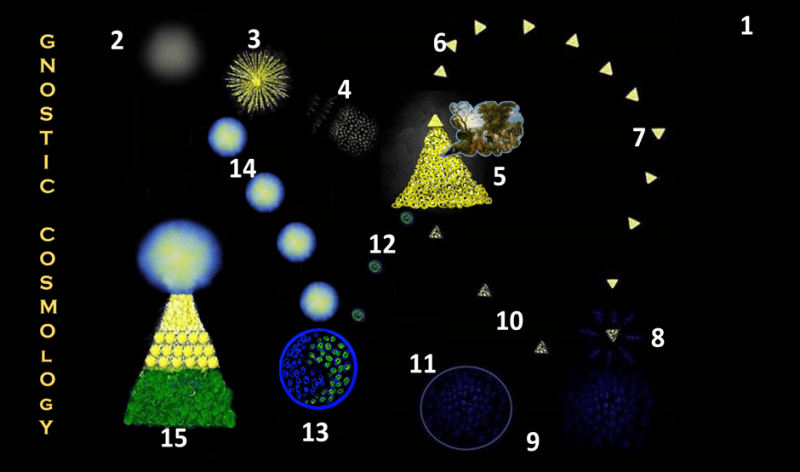
The Key to Gnostic Cosmology
from Gnostic Reformation, Clear and Simple Hosted by Cyd Ropp
Welcome back to Gnostic Insights and to the Gnostic Reformation on Substack. I think we’ve got a lot of new listeners now and new subscribers. And since you haven’t been with us from the beginning, I’d like to review the Gnostic cosmology. A basic premise of Gnosticism is that we are all born with gnosis inherent within us. We already have the answers. We already are our perfect Selves. But because of the nature of the never-ending war that we find ourselves in here in this material cosmos, we forget our inherent nature. And we begin to engage in the war through what the Tripartite Tractate of the Nag Hammadi calls the law of mutual combat. That being, since we are attacked, we attack back. And then we engage in that back and forth enough that we completely forget our mission and our goal and who we are. So today, I want to run through what I call the illustrated Gnostic cosmology. And I’m putting the illustration into the transcript so that if you are listening to this as an audio podcast, you really would do well to go to GnosticInsights.com or to my Substack location, the Gnostic Reformation, under the name of Cyd Ropp, so that you can see the illustration that we’re talking about. Now, when you first look at this Gnostic cosmology, it’s very strange looking, and it’s probably incomprehensible. But by the time I talk you through this, you’ll be able to follow the steps. There are 15 steps in this Gnostic cosmology. And once you recognize these stations, then you will literally understand Gnosis. You will remember your Gnosis, and you’ll understand what all of the various versions of Gnosticism have been trying to say. One reason is that this is a pictorial presentation. It’s not just words, because I’ve noticed when reading the various books of the Nag Hammadi, for example, some of which are Valentinian Gnosticism, some of which are Sethian Gnosticism, some are straight-out Greek philosophy by Plato. They use different words, but the concepts are the same. So what I always attempt to do is to level up to a meta-level, above the words, and envision and then picture it so that you can describe it with the words you prefer. So let’s get started. The background image of this entire Gnostic cosmology key I picture as pure inky blackness, like the sky with no stars or moons. That is the ground state of consciousness. And that is the Father’s mind. Now the Father is another one of these words where many people would like to disagree with saying Father. They want to say Source, or, for example, as it is called in the Secret Book of John, the One, the Parent, the Invisible Spirit. However, in the Tripartite Tractate of the Nag Hammadi, which is the book that I mainly use as a reference, that initial, illimitable consciousness is called the Father. Now, that’s the ground state. That’s the first principle. Consciousness is not a byproduct of the little gray cells. Consciousness predates everything. Consciousness is part of the existence of God, and it is the very first thing before anything that follows. Step number two is the emergence of the Son. It is the emergence of consciousness from the illimitable, infinite consciousness of the Father into a singularity, into a monad, as it’s called. It’s like the bucket dipped into the sea. It contains all of the characteristics and quality of the Father, but it’s contained as an individual. The Son doesn’t separate from the Father. It stays plugged into the Father. The Tripartite Tractate says that as soon as the Son was formed, what are called the Totalities of the All were formed. That’s step number three. And the Totalities of the All are all of the variabilities that make up the Son. So, the Totalities and the Son are coexistent, but it is all of the characteristics broken out and enumerated that form what are called the Totalities of the All. The Totalities of the All do not recognize themselves as individuals. They are only spokes on the wheel. They have no personal identity. They know that they are part of the Son, and they glorify the Son, and they glorify the Father. So, they are glorifying upstream, as we like to say. And it is through this giving of glory that each of the Totalities comes to self-awareness. Now, instead of one singular unit that is coexistent entirely with the Son, they blossom into self-identities, and they arrange themselves in a hierarchy. So, step four is the Totalities of the All migrating from a burst of sunshine that’s sitting within the Son into a pyramidal shape, because the pyramid is the essential shape of a hierarchy. There’s more at the bottom than there is at the top. Everything keeps leveling up, following a basic Gnostic rule of the higher the fewer, until you eventually arrive at a capstone at the very top, just like our physical pyramids look. And this entity, at number five, is called the hierarchy of the Aeons of the Fullness. And in Gnosticism, we usually identify the word aeon with consciousness, with an individual. It’s an entity. It’s not a unit of time. It’s a unit of consciousness. And so the Aeons of the hierarchy of the Fullness of God are infinite in number. There aren’t only eight or 64 or 365. Those may be ones that are named in other books of Gnosticism, but conceptually, you see, they’d have to be innumerable, because they are part of the illimitable consciousness of the Father, via the Son. And the job of the hierarchies of the Fullness, well, they’ve each got a position, a place, a duty, and a name. And basically what they do is sing songs of glory upstream to the Father and the Son, just like the Totalities did. And in this combination of the Aeons in the Fullness of God, they dream. They dream of Paradise. They dream of the intelligent design of this cosmos that we live in. And so all of us down here, we’re prefigured in the minds of the Fullness of God. And that Fullness of God is generally what we humans imagine as Heaven or Paradise. Humans in cultures all over the world have a dream of Paradise. And the reason why we all have this exact same dream of Paradise is because that’s where we come from. We are the fruit of the Aeons of the Fullness, and we instantiate their dream of Paradise. Now, according to the Tripartite Tractate, the object that in my drawings looks like a starburst re-sorted themselves into this hierarchy of the Fullness of God. The last Aeon that was produced through a combination of all of the Aeons of the Fullness of God, giving glory to the Father and the Son. In the Tripartite Tractate, that Aeon, that final Aeon, the capstone to the pyramid, sitting right up there on top, is called Logos. And Logos means reasoning. It means logic. The next step in the story is when that final Aeon that’s sitting on top of the Fullness of God wants to re-insert itself into the Father—the original source of consciousness—wants to plug into the Father the way that the Son remains plugged into the Father. It tries to take that position, and it can’t do it. And it is repelled by the Father, and that is the Fall. The Father repelled that Aeon from being able to plug into itself. I wouldn’t say that Logos was trying to become God. That’s kind of an insulting way to put it. I would say that that final Aeon was simply trying to reunite with the Father. But it couldn’t. It was repelled because no one can come to the illimitable. It’s too powerful. The Tripartite Tractate says they would be annihilated because the Father’s power is too great. It would just burn it up. And so instead of plugging into the Father, Logos fell. And that, according to Gnosticism, is the Fall. And it was the Fall that created our material cosmos. Now, you could say that that was Sophia that fell and her child Yaldabaoth. I prefer to keep it simple and just to say that it’s Logos that fell. Logos was a very special Aeon that contained within its one unity, fractal representations of all of the other Aeons of the Fullness. So Logos was perfect and complete, representing the Son of God. However,… This is a public episode. If you'd like to discuss this with other subscribers or get access to bonus episodes, visit cydropp.substack.com/subscribe
Embed this episode
No transcript yet.