KPBS On Demand is supported by the San Diego County Toyota dealers. The Toyota Corolla is a compact sedan with a spacious interior, contemporary design, and features for everyday travel. Visit your local San Diego County Toyota dealer or Toyota.com. Toyota, we make it easy. Welcome back to another edition of listener-supported KPBS Cinema Junkie podcast. I'm Beth Accomando.
Creature from the Black Lagoon holds a very special place in my heart. I've always loved monster movies thanks to my dad, who introduced me to King Kong at a very early age, and then to the Creature from the Black Lagoon, and many more. But I distinctly remember Kong and the Creature, and requesting model kits for each. I also specified that my dad buy red paint so I could detail the models with some blood. I think I was about six, and I recall my dad confessing that he told the clerk at the store that he was buying the models for his son. I guess the blood wasn't something a little girl in the 1960s was supposed to ask for. But my dad supported my love of monsters, and the Creature was one of the best.
If you've never seen the creature, or the gill man as he's often called, he's amazing. The suit designed for the two actors playing him was from head to toe, and it had to work underwater. It was a perfect melding of a man and a gilled creature, something that the trailer told us science couldn't explain. Science couldn't explain it, but there it was, alive in the deep, deep waters of the Amazon. A throwback to a creature that had existed 100 million years ago, immensely strong and destructive. A woman's beauty, the bait that brought it out of its lair.
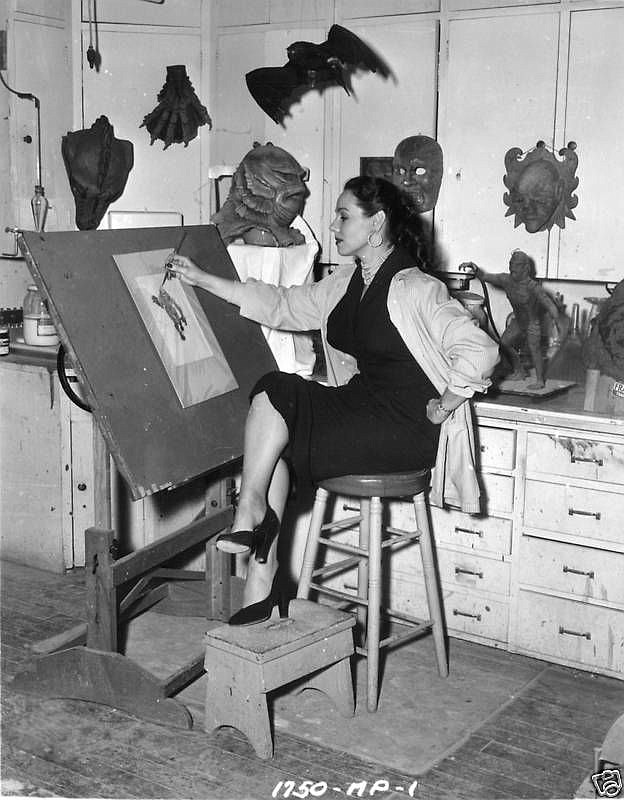
And it was a beautiful woman who created this iconic creature, a woman named Millicent Patrick, whose work on the film would be obscured by her jealous male boss. That's the story Mallory O'Meara wanted to tell in her book, The Lady from the Black Lagoon. But before I speak with her, I want to talk a little bit more about the Gill Man and the Creature from the Black Lagoon movie. Here's a scene where the scientists talk about their discovery. Here it is, gentlemen. Exactly as I found it. It's amazing. It's incredible.
Could it possibly belong to a Pleistocene man? The chances are much greater that that hand belonged to an amphibian, Mark, one that spent a great deal of time in the water. Well, then how do you account for the structure of the fingers? Obviously for land use. What do you think, Dr. Matos? We can be sure of one thing. Whatever it was, it was very powerful. You say you have hopes of finding the rest of the fossil? As soon as I get a suitable expedition together. Well, why don't we make up the expedition? We're here now, and after all, it does come under the heading of our work, doesn't it, David? It certainly does. More and more, we're learning the meaning and the value of marine research. Look. Look over here.
This lungfish, the bridge between fish and the land animal. How many thousands of ways nature tried to get life out of the sea and onto the land. This one failed. He hasn't changed in millions of years. But here, here we have a clue to an answer. Someday spaceships will be traveling from Earth to other planets. How are human beings going to survive on those planets? The atmosphere will be different. The pressures will be different. By studying these and other species, we add to our knowledge of how life evolved, how it adapted itself to this world. With that knowledge, perhaps we can teach men to adapt themselves to some new world of the future. Nice speech, David, but there's still a practical side to it.
If I sound brash and more like a banker than a scientist, try to remember that it takes money to run an institute like ours. A find of any real importance can be of great financial value to us also. Certainly your board couldn't disapprove. It certainly couldn't. The creature sets his sights on Julie Adams' sexy scientist, Kay Lawrence, but the monster finds his love unrequited, just as King Kong experienced with Fay Wray. There's a moment in the film, however, that suggests their impossible love, as Adams, in her famous white bathing suit, swims suggestively above the creature in his black lagoon. He mirrors her every move in a romantic, maybe even erotic, water ballet. He chases her throughout the film and even gets a hold of her a few times. And even though Kay expresses fear whenever she sees the creature, she does convey a certain underlying compassion when she's on the boat listening to the sounds of life from the lagoon.
Shouldn't you be resting, Kay? I couldn't sleep. Listen to the sounds. Hunting calls, mostly. Animals out for the kill. Some of them are cries of fear, like people who whistle in the dark. The gill man elicits compassion, and in a sense, Creature of the Black Lagoon represents a dark sexual yearning that a 50s heroine just wasn't ready to embrace. But Guillermo del Toro's The Shape of Water is essentially a reaction to that film. The Shape of Water serves up a valentine to all those monsters who didn't get the love they deserved. In del Toro's film, Sally Hawkins not only rescues Doug Jones' amphibious monster, which is an homage to the Creature from the Black Lagoon, but she falls in love with him. In del Toro's enlightened film, the monster does not have to change in order to get the girl.
Instead, she discovers something in herself that allows her to live happily ever after with the creature. The film allows for a consummation of their love that was not allowed in The Creature from the Black Lagoon. But happily, Mallory O'Meara has come along to set the record straight and enlighten us to Patrick's other accomplishments, as well as to the obstacles she faced in her career. I began my interview with O'Meara by asking her how she first discovered Millicent Patrick, and when did she first realize who she was. So when I was a teenager, I got really into monster movies, and I had to give myself my own education in them because no one in my family was into them.
I started with all the classic Universal monster movies and Creature from the Black Lagoon was the last one that I got to. And I loved the movie and I did what all good nerds do. As soon as I finished it, I had to go look it up online and find all the information I could about it. And while I was trolling the internet for creature trivia and facts and pictures, I saw this photo of a woman working on the creature suit. And it was like being struck by lightning because I'd never seen a woman working behind the scenes on a monster movie before. And that was my first exposure to Millicent. And what was it about the movie itself, Creature from the Black Lagoon, that kind of hooked you?
I think Creature from the Black Lagoon is very special because in that movie, the monster is not the bad guy. He's not the antagonist. Some of the male scientists in the crew are the bad guys who are wanting to do evil things. The Creature is just this poor monster that got his slumber disturbed. So it was very amazing to watch, and I think part of the reason why Creature still holds up is that...
The creature is very empathetic. You feel bad for him. He's very intriguing to you. He's not just this big, scary thing that lumbers around and tries to eat people. He has a real humanity to him, and it really, really made an impression on me. Well, it's funny because I just did this list of movies for Valentine's Day, and because I love monsters, my list was the 10 best monster romances. And, of course, Creature from the Black Lagoon had to be on that. Oh, yeah. It's so funny. That's part of the reason why Guillermo del Toro said that he made Shape of Water, because when he saw Creature from the Black Lagoon when he was a kid...
his thought at the end of the movie was why didn't Kay and the creature end up together? Because clearly they were meant to be. So he, you know, that was the sort of genesis of Shape of Water, which I completely agree with. Yes. And it took me years to realize that the reason I hated Fay Wray was because I always resented the fact that she didn't save King Kong. Oh, hard name.
I felt like if she had only clung on to him, the planes wouldn't have shot him down, and it would have all been okay. Maybe someday we'll get our King Kong remake, where it'll be our version of Shape of Water, and Faye Ray and King Kong will go and live together somewhere in the jungle. So what made you decide to actually investigate Millicent Patrick's life and do this book on her? So it was sort of a funny way of a book coming to be. She'd been my hero for a very long time, and I ended up getting into monster movies myself and becoming a filmmaker, so I got a tattoo of her. She'd always been like a talisman to me.
sort of proof that I belonged in this sort of male-dominated world of monster movies, because if Millicent could do it, so could I. I got this tattoo of her, and a few weeks after that, I was living in New York City at the time, and I was at a publishing party, and I was speaking to a literary agent, and he said, hey, Mallory, I saw on Facebook that you just got this new tattoo. Who is she? Tell me about it. And I was telling him that she created the creature, but then no one really knew what happened to her after that. She was sort of this mystery, and he said, oh, wow, that would make a great book. And I laughed, and he said, no, really, you should write that book. And up until that point, it was just sort of a fixed quantity in my mind that, you know, there was...
You know, Millicent Patrick existed, but no one knew what happened to her. And it was the first time I thought, well, why not me? Why can't I look into this? You know, I work in the same industry that she did. I know what she went through. Let's see if I can do this. Now, because this is audio only, I can't show a picture of Millicent Patrick. And although how someone looks isn't that important, the thing that's so striking about her is she really grabs your attention. I mean, she's a stunning looking person. Yeah, oh, absolutely. She really is. And I think that's always been sort of part of the mystery about her is that she was just very glamorous.
very beautiful woman. You know, she used to walk into the Universal Monster Shop every day in heels and a beautiful dress and pearls. You know, she is sort of, she would totally fit right in with this whole vintage pin-up revival that's been happening right now. And she would walk into this male-dominated environment looking like that, and she created these monsters that were so terrifying, and she was so beautiful and glamorous. Well, it seems like she really invites that whole comparison of Beauty and the Beast. Oh, yes, absolutely. And, you know, it's just, that's why it's so cool to see photos of her holding the creature head or with any of her creations.
Because it's the contrast is just so striking. And it's sort of what those photographs have really kept a very, very small amount of people who have known about her for the past few decades interested. You know, it's just it's I'm very, very lucky that she is so interesting to look at because it's probably the thing that saved her and the reason why I found out about her. Now, for the book you wrote, it's about her and her career. But you also weave your own story into this and weave kind of a contemporary perspective on what's going on in her life. Why did you feel that was important? And why was that something you felt you needed to include?
I think it's very easy for readers to hear the story about this woman. In the 1950s, she got her credit for The Creature from the Black Lagoons, stolen away from her by a jealous male colleague, and then she fell into obscurity. You look at that and go, oh, it's so sad. It happened in the 1950s. That's how things were back then. But the truth is it's not. It's how things are right now. And it gave her story a lot more urgency and importance because it's something that is very, especially now, the Me Too movement happened while I was writing the book.
And now people are really clamoring to find out about women's stories and, you know, trying to scramble to realize how it's all happening right now. And I thought, you know what, the best way for me to show how urgent and how relevant this story is, is to tell my own stories of being a female filmmaker and dealing with sexism and dealing with problems with male colleagues to show that, look, you know, yes, this stuff still happens. Here's an example that happened to me just a year ago. Now, since a lot of people do not know who she is, give us a little background on her early life, because one thing that's kind of interesting is the role that William Randolph Hearst ended up playing kind of in her early years. Oh, yes, it was so strange. When I started investigating her and researching her life, designing the creature from the Black Laguna alone would make her interesting enough to write a book about. But the more I found out about her early life and the rest of her life, I was like, oh my gosh, people are going to think I made all this stuff up. But her father was a man named Camille Rossi, and he was the superintendent of engineering at Hearst Castle for 10 years. So that's where she grew up. Hearst Castle was sort of the summer home and became more and more of the full-time home of William Randolph Hearst, who was America's first big media mogul.
And, you know, that's where she grew up. And I really think that sort of started the foundation of her getting into Hollywood. Because where else could you go after living at Hearst Castle than Hollywood? And then she ended up working or getting into a school that was a pipeline to Walt Disney. So what were those early years like? Oh, yeah. So she went to college at the Shunard Institute, which was a female-run art school in Southern California here in Los Angeles by a woman named Nelbert Shunard. And Nelbert Shunard had kind of formed this pact with Walt Disney because in the early years, Walt Disney couldn't afford to train his animators, but he knew that he needed them trained in a special way. So Nelbert agreed to have his animators come down to the studio and learn animation there, and then they would send them back to Disney. So a sort of pipeline got formed.
from Chouinard Institute to Disney Studios. And when Millicent went to school at Chouinard, she caught the eye of Walt Disney and he hired her to come work at Disney. And you mentioned that she had kind of a special skill at, because one of the things Disney needed was he didn't need people who could just draw. He needed people who could draw in a way that worked for animation and that she had a real skill for kind of this fluidity of motion in her drawings. Yeah, Millicent has this incredible ability to, just in a few lines, really, really able to convey a lot of movement, which is exactly what you need for an animator or anyone working in animation. You know when you see a friend and they can do a little drawing in just a couple of lines that just shows so much? Millicent was that kind of friend. And what was it like for a woman being an animator at that time at Disney? What's funny is that Disney was actually one of the best places for a working female artist, because they could make a living. And Disney actually went out of his way to tell his male employees, you have to leave these women alone. This is not a place to look for dates.
This is where people work. So he was actually a really great advocate for his female employees. And what kind of stuff did she work on there? Well, I do want to keep it a secret for readers, but there are some really, really big films, early Disney animated films that she worked on. And she worked as an in-betweener. She worked as a color animator. She worked in the Ink and Paint studio. So in her short amount of time there, she ended up doing quite a number of interesting things. How hard was it for you to uncover some of this information? Because part of what this book seems to be is detective work. Oh, it was incredibly, incredibly difficult. And I actually include a lot of that process in the book, just so readers can see, you know, the effects of...
purposely hiding somebody's legacy for so long. After she got fired at Universal, you know, all of her artistic influence was sort of hidden away. And I really wanted people to see what, you know, the effects of that. You know, just even getting into Disney took me years and years. Disney is not a place that you could just sort of call up and ask to come over. So there were so many pieces of her life that had just been lying hidden in different archives and different personal collections. And getting access to all of them and getting to go see them was a years-long, very expensive, very difficult process.
And was it difficult to actually find, like, examples of her early work or photos of her or things like that, like actual kind of visual elements to add to the book? Yes, it took me quite a long time to do that, because especially in the early days, like when those that worked at Disney, you know, individual artists didn't get credit like they do now. So I'm very, very lucky to link up with another author who was a Disney historian. Her name is Mindy Johnson, and she wrote this incredible book called Ink and Paint. It's all about the women who have worked and do work at Disney just over the many years that the studio has been open.
And she had found all these drawings in the Disney archives that weren't signed. You know, they were just drawings. And, you know, they weren't marked as, you know, a female animator did this. So, you know, just being able to find those or find someone who knew about them was so, so hard. So she moved to, she worked at Disney Studios doing some animation. How did she eventually get to Universal and start actually creating monsters? Or did her work at Disney kind of lay the groundwork for her love of monsters? No, there was quite a big gap, actually, in between where she did a lot of acting and modeling.
And it was actually, she was just on the set of the Universal Studio lot. She's working as a background actress, but she never lost her love of art. So while she was waiting between scenes, she would sketch out portraits of her co-stars or of the leads of the film. And while she was in the makeup chair one day, she showed the head makeup guy at Universal some of her drawings. And they were so incredibly talented that he hired her. Now, would this be Bud Westmore who...
Yes, it is. So talk a little bit about this man and his influence or his effect he had on Millicent's life because he was, in one sense, like the right guy to get her into the business and then also the wrong person completely. Yes, it's interesting. He actually set her up for the biggest career moment of her life and he also took it away. Bud Westmore ran the Universal Makeup Shop at the studio. So he was in charge of all the makeup and all the monsters.
was a really, really big figure at the time. The Westmoores were sort of a dynasty in makeup in Hollywood. But the problem with Bud Westmore was that he was also very notorious for taking the credit of others, for being a very difficult person to work with. He didn't like people being more talented than he was. He didn't like people getting more attention than he did. So when Millicent started getting a lot of attention over her work on Creature, he couldn't handle it. And that's why he fired her. And what do you think she brought to the Creature in terms of the design of it? What do you think kind of...
To you, like when you're researching this, what did you feel that she might have brought to it that wouldn't have been there if she hadn't been there? Well, the first thing was certainly the empathy. You know, Millicent wasn't looking at this monster and thinking, I'm just going to make the scariest thing on Earth. She really wanted to make a monster that you could feel bad for, that you could sympathize with. And her ability to convey so much emotion and movement in just a few lines led her to be able to make the creature's face feel imbued with so much humanity and emotion. And even today, people think that the entire face is articulated.
But it isn't. It's just a map. It's just that incredible design skill that she had that makes it look like it's conveying more emotion than it actually is. And did she create other monsters while she was at Universal? She did. She actually worked on Universal's very first science fiction movie ever, which was It Came From Outer Space, written by the great Ray Bradbury. And there were a couple other movies. I don't want to spoil it for readers, but there were a couple other movies that she worked on. So she really had a huge, huge influence and effect on the world of science fiction. Well, and in your book, you mentioned that for the Ray Bradbury one.
there isn't a whole lot of clear-cut detail that she had to work with in terms of creating what she did. Yeah, it's funny because as someone who was as incredible a writer as Ray Bradbury, he gave her this description to design from that sort of was just, you couldn't have pulled anything out of it. It was so, like he literally used the word nebulous and how are you going to draw that? It was just this giant paragraph of stuff that really didn't mean anything. And somehow she pulled this very iconic design out of it.
that, you know, I mean, It Came From Outer Space is still probably one of the most important early science fiction movies, you know, considered by historians and critics. So well done, Millicent. Now, you're a filmmaker yourself, and you work in horror. Has it ever crossed your mind that maybe this story would make a great film? It has. Unfortunately, I can't say too much more about that line of questioning at the moment. Well, I'm glad maybe you can't, because maybe that means something good is coming. My lips are sealed.
In doing the research, was there anything that you uncovered that really surprised you or that you were happy to find or something that just was really a turning point for you in writing the book? I think the most surprising thing for me when I was writing it was to uncover how much of my own biases that I was putting onto Millicent. As a female filmmaker, I have to deal with so much sexism every day. And as I was writing the book, I realized that some of it I was projecting onto Millicent. When I was a kid and I first found out about her, it was kind of funny. The thing that I disliked about her was how feminine she was.
Because I was a teenage monster nerd, and I wanted to dress like a boy, and I wanted to fit in, and I didn't wear any makeup, and I thought girly stuff was stupid. And so that was the thing I didn't like about her. And then as I was writing the book, I realized how much I had changed since then. And I thought, how absolutely cool that she marched into this male-dominated space in pearls and high heels every day. And I ended up thinking that now it's one of my favorite things about her. And it was so interesting that just writing about her and examining her in this way made me a better person and kind of unearthed some of the internalized sexism that I have.
And it almost felt like getting exercise. Well, from the pictures that are in the book and that I've seen of her, the thing about it is she might have been feminine, but she was also, she had a real flair for like flamboyance. And you felt like the way she dressed was to make an impression. Like she didn't want to just be looking like everyone else. Yeah, that was really the thing that's amazing to me about her femininity is it wasn't like she was dressing in, you know, the biggest name brands and the most expensive clothing.
made a lot of her own clothes and she wasn't dressing like that to show off or to look like she had a lot of money or to like, you know, follow any trends. She just loved absolute flamboyance. She loved being over the top. You know, she grew up at Hearst Castle. She was always chasing that level of opulence. So it just made her happy. And the fact that she embodied that every day to the point where she literally made her own clothes really just makes her shine so much to me. And in talking about kind of how you shifted your perspective on her, when you were doing this, the fact that Bud Westmore...
essentially took her career away that she had at Universal. You talk about kind of dealing with the fact that you wanted her to make this big stand and to kind of be a different person than she was. And what do you think about how she actually reacted and how you wanted her to react? I think there's this interesting knee-jerk reaction that we all have when we hear about a story like that. Your first thought is always, well, why did they do anything about it? Why did they fight back? Why did they say something? And at that point in Millicent's career, she had been in these male-dominated industries for decades, and she had been swimming upstream for decades. And at first, I had the same reaction. I thought, God, why didn't she just make a stink? Why didn't she fight back? And then I thought, when do we get to take a break? When did she get to go, you know what? I've been fighting for years and years and years. I've been working in this industry for years and years and years. I think I'm going to take a break.
And I think that we all need to look at people like that. And again, it felt like writing this book made me a better person because in forgiving Millicent for that, I was able to forgive myself, to forgive other women in the media, and to sort of get a so much kinder, more respectful outlook on all these situations. And in doing this and in looking at some of her work and some of these sketches and things like that, did it cross your mind thinking what would have happened if she had stayed on at Universal? What films might she have contributed to? Oh, absolutely. I think about that all the time. Universal continued to make a lot of monster movies, science fiction movies. But I think it's very telling that Creature from the Black Lagoon was the last classic monster movie. It was really the last one to make a big impression. And I think that more movies that Universal put out during the mid-1950s would have had more of an impact.
if Millicent had been allowed to design them. And at the same time, Millicent Patrick was really the first creature designer that Universal sent out on press tour. Even now, even today, the public doesn't have a real appreciation or understanding of special effects artists, or they don't get the recognition that they deserve. The creature designers for the Oscar-winning Shape of Water were not nominated for an Oscar. even though that monster was one of the most important parts of the movie. And I think that if Millicent's legacy hadn't been buried, it might have set a precedent for, oh, hey, we made this great monster movie. Maybe we should interview the creature designers. Maybe we should give them some spotlight. And I think things would really be different for designers and makeup artists and special effects artists today. And now that this book is behind you in the sense of having completed it, has it changed you as a filmmaker? Has it kind of given you a different way of looking at what you're doing or at the kind of stories you want to tell?
Oh, absolutely. I mean, my day job is I work as a producer and it has absolutely made a difference in my hiring practices when I look at my crews. It also made me a lot braver when I originally, when me and my agent were trying to sell this book, we got rejected by so many publishers because people weren't interested in my side of the story. And we kept pushing and we kept pushing. And finally, you know, we did, as we're having the conversation now, it's clear that I did sell the book and the book is coming out. And it made me realize that there is an audience for these stories and people do want to hear these things. And, you know, finding out about this stuff is really, really important.
And you're going on tour with the book and actually meeting people at bookstores and things like that. Have you had a chance to kind of get a sense of the public's reaction to the story? I have, and it's been overwhelmingly positive. Although I will say there are a lot of men who are very angry about this book. I get a lot of bad reviews about the book who say it's too outrageous and it's too feminist. But on the flip side of that, I get so many people, men included, people of all genders, who are just overwhelmed by how much they love it. And I've had so many female filmmakers and horror fans come up to me and say, oh, my God, I feel like this book was written for me. And that makes it all worth it.
And do you think that this is going to help kind of secure her place in history as the person who created the creature? I really, really hope so. It's been funny, even in announcing some of the dates on the tour, there was one date where I'm doing a creature screening and they announced the creature screening by saying that it was Bud Westmore's design. I was just like, oh my God, really? Am I still having to have this fight? But I'm hoping that after the tour and after me doing so many talks about her, that it will solidify her as not only the creator of the creature from the Black Lagoon, but also as a really, really important and influential artist.
And do you have any more plans to write another book? Are there any other women in film that you've kind of uncovered that have sparked your interest? Yes, there is one, and I can't announce who it is yet. It's funny, I promised myself I would never do another biography because this has been such an emotional experience for me. But just like you think, as soon as I was done with the book, I was reading some stuff about one of my favorite old monster movies, and I found a woman who was involved in it, and I thought, oh no, here we go again.
And she actually appeared in some films as well. Because I think you mentioned that there was an Abbott and Costello film that she was in as a background actress. Yeah, she is in Abbott and Costello meet Captain Kidd, which is really funny. She plays like a tavern wench. She actually has a couple lines. She's in a few movies. Her first on-screen role actually is in the Disney film The Reluctant Dragon. She's a background actress. And you can find these on YouTube. So if listeners are interested in seeing her, hearing her voice or seeing her in motion, you can just YouTube Millicent Patrick and you can see she really does light up the screen. She's very, very electric.
Even from still pictures, she manages to light up the screen. She really does. It's incredible. And what are you working on now in terms of your own films? So I have a movie that is actually also out this month in select theaters and will be out on VOD in April. It's called Yamathong, and it is a live-action puppet movie. So think Dark Crystal, think Labyrinth, and it is sort of like Dark Crystal meets Princess Mononoke. It is a sci-fi fantasy film with Whoopi Goldberg, George Takei, Nathan Fillion. We have an all-star cast of voice actors, and we're so proud of it. We're so excited about it. It's the first film that I've developed, and I produced it, and I'm so, so excited about it. I'm really thrilled to have people finally see it. Well, that's great. And when is your next book tour date?
Everything kicks off on March 5th, and I'm going to be traveling for most of March and April and part of May and June. And if people want more information about your films or about the book, what's the best place for them to follow you or to get information? I keep my website, which is MalloryOmera.com, updated constantly. But I spend way, way too much time on Twitter, at Mallory Omera, and I'm constantly posting updates about my movies, my book, all projects I do, my weekly podcast, reading glasses. So if you're at all interested in anything that I've talked about today, Twitter is a great place to go get updates for it.
All right, well, I want to thank you very much for taking some time to talk about this Beauty and the Beast. Thank you so much for interviewing me. That was author and filmmaker Mallory O'Meara. Her book, The Lady from the Black Lagoon, comes out March 5th, and she'll be in San Diego on March 8th at the Mysterious Galaxy Bookstore. Thanks for listening to another episode of KPBS Cinema Junkie Podcast. If you enjoy the show, please recommend it to a friend and leave a review on iTunes. I appreciate all the great reviews people have already posted. I'll have a podcast coming up soon about the TCM Classic Film Festival, since that's rapidly approaching in April. So till our next film fix, I'm Beth Accomando, your resident cinema junkie.
Here in Southern California, we know all too well the devastation wildfires can cause. That's why our mission is to stop the next one before it starts. I'm Brian D'Agostino, leader of SDG&E's wildfire and climate science team. And we've built one of the most advanced wildfire prevention programs in the country with a team of world-class meteorologists using artificial intelligence and real-time weather data, all to help keep our communities safe. We're also building a stronger grid and using public safety power shutoff when necessary because believe me, I've seen firsthand how unpredictable wildfires can be. But here at SDG&E, we face that uncertainty head on to help keep you safe. Learn more at sdge.com slash wildfiresafety.