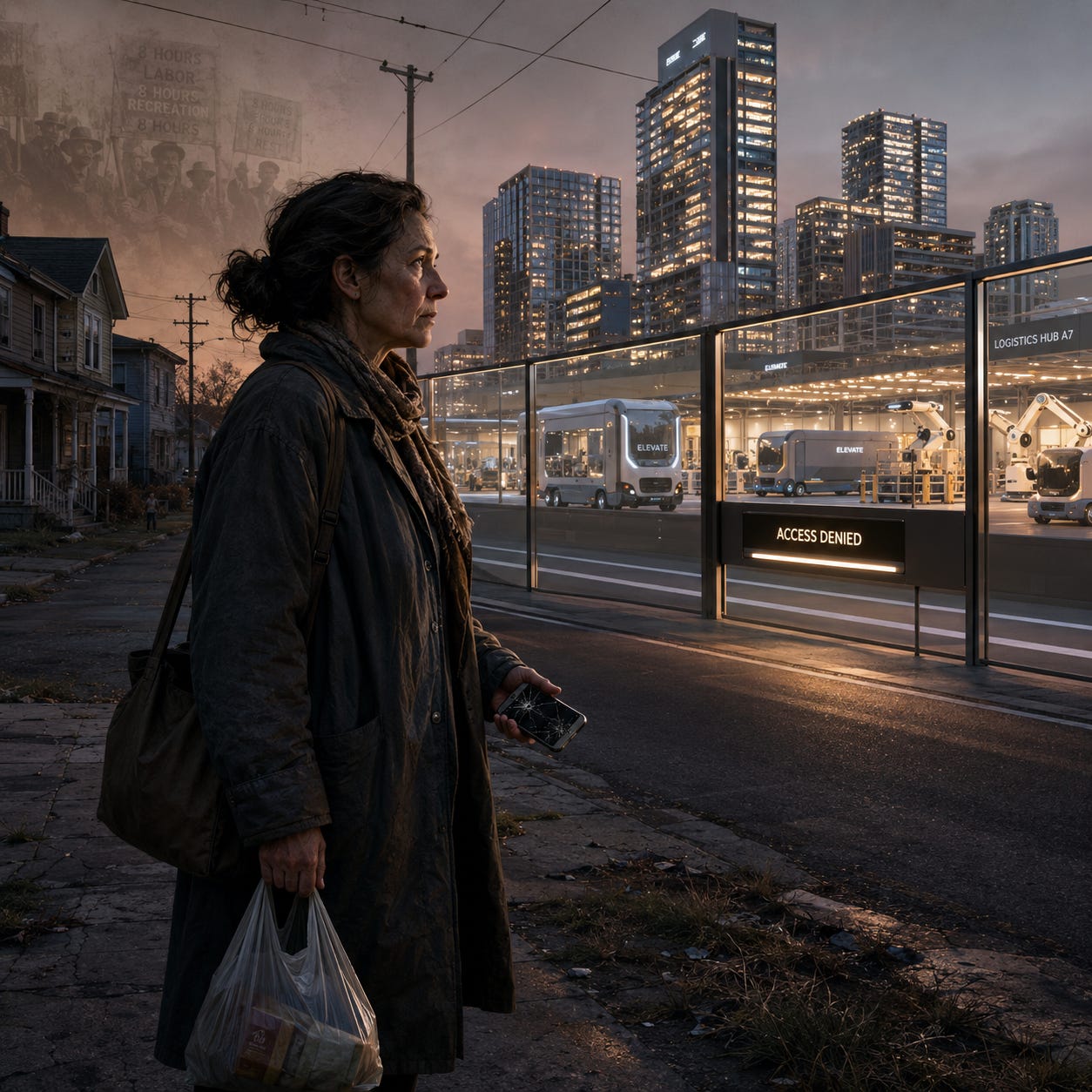
The Last Bargain
from Language Matters by Elias Winter Hosted by Elias Winter
I. A Possible Tuesday What follows is not a prediction. It is a possible Tuesday in a future we still have time not to build. Maya wakes at 6:17 because her body has not yet learned that there is nowhere she is expected to be. For twenty-three years, mornings had consequences. At twenty-four she was an analyst. At twenty-nine, a manager. At thirty-six, a director. At forty-two, she could walk into a room where five people were talking over one another, find the actual question beneath the noise, build a model around it, and tell an executive something he did not know before she entered. She was good at this. That matters to her. It matters more now than it did when people paid her for it. The clock beside her bed is not really a clock. It is an eleven-year-old phone whose battery lasts until noon if she keeps the screen dark. The glass is cracked diagonally through the upper-right corner, passing directly across the weather widget she no longer checks because she no longer commutes. She keeps the phone because replacing it would cost three weeks of food. The house is quiet. Not her house. Her mother’s house. Maya is fifty-one now. Her mother is seventy-eight. Her son sleeps in what used to be Maya’s childhood bedroom. Maya sleeps in the converted dining room because her younger brother and his wife moved into the basement after his accounting firm reduced its American staff by eighty-four percent. There are seven people living in a house built for four. Nobody calls this homelessness. That is one of the linguistic achievements of the new economy. There are mattresses. There is a roof. Therefore, according to the statistics, everybody is housed. Maya walks into the kitchen. Her mother has left two eggs beside the stove. She eats one. The other is for her son. There is plenty of food in America. That is important too. The agricultural systems work beautifully. Autonomous harvesters move through fields at night. Machine vision catches disease before human eyes can see it. Logistics systems continuously reroute shipments around weather, demand, road congestion and spoilage. Warehouses lose almost nothing. The supermarket three miles away is full. Maya simply cannot afford much of what is inside it. She used to think scarcity meant absence. Now she understands that scarcity can mean a warehouse filled with food behind a price. She opens the refrigerator. Half a gallon of milk. Carrots. Rice from yesterday. A container marked COMMUNITY KITCHEN — WEDNESDAY. Her mother has learned to save coffee grounds and brew them twice. This bothers Maya more than hunger. Her mother worked forty years. Maya worked twenty-three. Her brother worked twenty-six. Between them, this household contains a master’s degree in statistics, a CPA, a retired nurse, two decades of software experience, five languages, three professional licenses, and enough accumulated knowledge to operate a small institution. None of it reliably converts into groceries. Maya checks her messages. A former colleague has sent a link to a contract. Human Verification Specialist — 6-week engagement. The work consists of checking decisions made by an autonomous financial system in the rare cases where regulatory rules still require a human signature. There are twelve openings. The listing says 18,431 people have applied. Compensation is $19.40 an hour. No benefits. Maya laughs. She does not mean to. Her mother hears from the kitchen. “Something funny?” “No.” She closes the listing. Outside, the street looks simultaneously poorer and more technologically advanced than anything Maya remembers from childhood. Two houses across the street have plywood covering first-floor windows. Another has four families living in it. Someone has converted a garage into an electronics repair shop. The sign is hand-painted: WE FIX WHAT THEY SAY TO REPLACE. An autonomous delivery vehicle turns the corner. It is silent. It does not stop in Maya’s neighborhood. It is taking pharmaceuticals toward the secured medical district eleven miles north. For a moment, through the gaps between old houses, Maya can see one of the freight drones descending toward the distribution corridor. The corridor has its own power. Its own communications network. Its own security. Its own road maintenance. Its own autonomous repair systems. The public streets on either side have potholes deep enough that drivers remember their locations from memory. Two civilizations occupy the same geography. One is becoming more efficient every year. The other is learning how to repair washing machines manufactured before its children were born. Maya’s father would have understood part of this world. He had worked in a machine shop outside Cleveland. In 1998, the plant closed. For years afterward, he carried the closing as a private humiliation. He had known machines with his hands. He could hear when a bearing was wrong. He could feel a tolerance error through metal. He had possessed a form of knowledge that no university had taught him and no résumé could adequately explain. Then one day the market informed him that this knowledge was worth almost nothing. He told Maya something afterward that parents across the industrial Midwest had told their children for a generation. “Use your brain. Don’t end up like me.” So she did. She studied mathematics. Then economics. Then statistics. She learned SQL and Python when there was still money in knowing SQL and Python. She learned machine learning when machine learning still meant humans building models rather than models building almost everything else. She did exactly what America told the children of industrial decline to do. When the economy stopped valuing her father’s hands, she cultivated her mind. For two decades it worked. Then the market came for that too. There is a photograph of her father in the hallway. He died before the second transition. Sometimes Maya is grateful for that. At nine, she walks to the old elementary school. The school district technically still owns the building, but there are no longer enough children enrolled in formal schools to justify operating all of them. One wing has been converted into a clinic. Another is a cooperative kitchen. The gym contains shelves of donated tools, batteries, old computers, medical equipment and replacement parts. People simply began doing things because the official institutions stopped doing them. Nobody announced a new society. It accumulated. A former emergency physician runs the clinic three mornings a week. Two displaced teachers operate classes in what used to be the music room. A mechanical engineer maintains the neighborhood’s battery bank. A twenty-eight-year-old former cybersecurity analyst manages a collection of community servers built from equipment salvaged from bankrupt offices. Maya helps with accounting, planning, statistics, procurement and whatever else needs doing. Nobody pays her much. But people need her. The first time somebody said, “Ask Maya, she’ll know what to do,” she went into the bathroom and cried. Not because she had become sentimental. Because after four years of being told by labor markets that her cognition was abundant, somebody had finally treated her mind as scarce again. This is how people begin rebuilding tribes. Not because they reject modernity. Because human beings cannot indefinitely survive as surplus inventory. At noon, a boy in one of the classes asks Maya why the district beyond the river has clean streets. She knows which district he means. Everyone does. It is not officially a private city. There are still American flags. Still federal law. Still elections. But entrance is restricted by property ownership, employment contracts, service credentials or sponsorship. The district contains the regional headquarters of two infrastructure companies, a biomedical campus, automated manufacturing, several datacenters, private schools and residential towers whose lights stay on when the public grid fails. People there have newer phones. They have private model subscriptions with enormous inference allowances. Their agents continuously manage schedules, health, finances, education and business activity. Their houses do not merely contain machines. They contain intelligence. Maya’s community also has AI. But not like that. They run older open models on shared hardware and occasionally purchase frontier inference collectively for problems the local systems cannot solve. The difference between the two societies is not that one possesses artificial intelligence and the other does not. The difference is how much intelligence each can command, who owns the infrastructure producing it, and what happens to the gains. The official language still insists everybody has access. The phrase makes Maya furious. Everyone has access to private aviation too. Nothing in the Constitution prevents Maya from chartering a Gulfstream. On the walk home she passes what used to be a branch bank. The building now houses twenty-two people. Someone has painted over the old logo. A notice taped to the door lists this week’s exchanges: ELECTRICAL WORK NEEDED DENTAL CLEANINGS — THURSDAY CHILDCARE EXCHANGE SERVER PARTS FRESH PRODUCE SATURDAY NEED INSULIN REFRIGERATION BACKUP. It looks primitive if you measure civilization by corporate branding. It looks sophisticated if you measure civilization by whether people have found ways to remain useful to one another. Maya’s son asks her that evening whether he should go to college. She does not know how to answer. The university still exists. It is cheaper than when she attended because much instruction is automated. But the old promise is gone. There is no longer an obvious sequence: study → credential → profession → salary → house → retirement. Education can make him more capable. It cannot guarantee anyone will need that capability. He asks her what he should learn. Maya thinks of her father. Use your brain. She cannot say it. So she says: “Learn things worth knowing.” It sounds beautiful. She hates herself for how little practical guidance it contains. Before bed, Maya reads the news on her cracked phone. National output rose again. AI productivity reached another record. Three technology companies reported margins once considered impossible. A senator is proposing another round of emergency household credits. The administration says economic fundamentals remain strong. A business channel shows a panel arguing that displaced workers need to become more entrepreneurial. Maya turns it off. The sentence is older than the crisis. Become entrepreneurial. Become adaptable. Learn the tools. Reinvent yourself. She did. Everyone she knows did. There are entire neighborhoods filled with people reinventing themselves. There are only so many things a person can become when the machine can become them too. She lies down. Outside, somewhere beyond the dark houses, the automated corridor hums through the night. It never sleeps. It never strikes. It never asks for overtime. It never needs healthcare. It never sends a child to school. It never looks at a grocery bill. It never wonders what it is for. And somewhere inside those machines is the accumulated intelligence of a civilization that told Maya there was no longer enough economic reason to employ hers. This world does not exist. Not yet. It may never exist. But in 2026, the people building the machines began talking publicly about the possibility that something fundamental in the relationship between intelligence and labor was about to change. We should listen to them. But we should not listen innocently. Because the men explaining the future are also selling it. II. The Men Selling the Machine There is a habit in modern America that would have seemed bizarre to the workers of the nineteenth century. We listen to employers explain the future of labor as though employers were neutral observers of labor. We call them visionaries. We call them founders. We call them innovators. We invite them onto stages and ask them what technological progress will mean for humanity. We rarely begin with the most elementary question in political economy: What do they want? This does not mean Mark Zuckerberg is wrong because he is Mark Zuckerberg. It does not mean Anthropic’s economists are lying because Anthropic sells Claude. It means incentives belong inside the analysis. A factory owner’s opinion about the eight-hour day was never merely a philosophical opinion about human flourishing. He owned the factory. A railroad executive’s view of the strike was not independent of the fact that trains had stopped moving. A coal baron’s theory of labor relations did not become neutral because he delivered it eloquently. Workers once understood this without having to call it conspiracy. There were interests. There was bargaining. There was power. We have become strangely embarrassed by this vocabulary. So begin with the interests. Meta is spending enormously on artificial intelligence, datacenters and the next computing platform. Its 2025 annual filing says Reality Labs cost the company more than $21 billion that year, that Meta expects roughly seventy percent of Reality Labs operating expenses in 2026 to be devoted to wearables, and that AI, infrastructure and wearables are among its central investment priorities. Meta explicitly describes these investments as part of an effort to build the next computing platform. (SEC) Anthropic, meanwhile, is not merely studying how artificial intelligence may affect enterprises. It is working aggressively to put Claude inside them. In May 2026, Anthropic announced a new enterprise AI services company with Blackstone, Hellman & Friedman and Goldman Sachs intended to bring Claude into the core operations of midsized businesses, while expanding a partner ecosystem already involving major consulting and systems-integration firms. (Anthropic) Anthropic’s own Economic Index reports an important distinction: consumer use of Claude remains somewhat more augmentative, while first-party API use is predominantly automated and increasingly appears in back-office workflows such as document processing, scheduling and administrative work. So when Zuckerberg tells us personal superintelligence will preserve human agency, he is speaking as the chief executive of a company investing heavily in the hardware and infrastructure through which he hopes billions of people will experience that intelligence. And when Anthropic tells us society may have to prepare for unprecedented unemployment, it is speaking as a company actively selling the technology being integrated into corporate operations. Again: this does not discredit either argument. In Anthropic’s case, the willingness to publish an ugly possibility may deserve genuine credit. But these are not messages delivered from Sinai. They are opening positions from actors inside the transformation. And Americans have forgotten how to hear them that way. To understand why, we have to remember something else we have forgotten. The weekend did not simply happen. III. The Things We Forgot Were Won There was no natural law inside industrial capitalism specifying eight hours of work, eight hours of rest and eight hours for whatever remained of being human. There was certainly no divine commandment producing Saturday and Sunday as protected leisure for the industrial worker. Capital did not mature and spontaneously decide that human beings needed more life. Workers fought. The American eight-hour movement was already making national demands in the nineteenth century. On May 1, 1886, workers across the United States struck for the eight-hour day. In Chicago, clashes around the McCormick works were followed by the Haymarket rally, a bomb, deaths among police and protesters, the prosecution of labor radicals and ultimately executions. The demand beneath the upheaval was painfully ordinary by modern standards: fewer hours of life surrendered to the employer. (The Library of Congress) The Pullman Strike of 1894 became a national confrontation involving rail workers, federal intervention and the imprisonment of Eugene Debs. Labor conflict repeatedly ceased being a negotiation over wages and became a struggle over the power of employers, workers and the state itself. At Ludlow, Colorado, in 1914, striking coal miners demanded, among other things, enforcement of the eight-hour day. After miners and their families were expelled from company housing, they lived in a tent colony. National Guardsmen aligned with the company attacked the colony. Twenty-one people were killed, including eleven children. Ten days of armed conflict followed. (National Park Service) Eventually there were laws. There were institutions. There were bargaining structures. The Fair Labor Standards Act of 1938 established federal minimum-wage and maximum-hours rules and became part of the legal architecture through which the forty-hour week eventually became ordinary for covered workers. Even that legislation arrived after intense political struggle, employer opposition, judicial resistance and years of prior experimentation and organizing. (U.S. Department of Labor) The weekend was not discovered. The eight-hour day was not donated. The boundary between life and work was fought into existence through organizing, strikes, political bargaining, employer concessions, legislation, repression and sometimes blood. Then something strange happened. The victories became normal. And once a victory becomes normal, its history becomes invisible. The child born into a forty-hour week experiences it as nature. The professional with health insurance experiences benefits as an employment package. The office worker receives a paid holiday and does not see the dead miner behind it. Institutions survive while memory dies. America entered the postindustrial age carrying rights produced by labor conflict while steadily forgetting that labor conflict had produced them. Then the composition of the American worker changed. Factories closed. Manufacturing employment fell. Communities built around steel, automobiles, mining and other industrial work experienced the slow violence of economic redundancy. The cultural response was revealing. America did not say: Perhaps workers require bargaining power independent of whether their particular form of labor remains scarce. It said: Get educated. The solution to the collapsing bargaining power of the body became the cultivated mind. Learn computers. Learn finance. Learn management. Go to university. Move to the city. Become a knowledge worker. Millions did. And for many of them, it worked extraordinarily well. The American professional class lived through decades in which sophisticated cognitive labor was scarce enough to command high wages. A software engineer did not need five thousand other software engineers standing beside her at the factory gate. She could bargain alone. If Google would not pay her enough, Meta might. If Meta frustrated her, Stripe might hire her. If the consulting firm refused a promotion, she could take her résumé across town. Education, skill, reputation and mobility gave the professional something industrial workers had historically needed collective institutions to obtain: an outside option. Individual bargaining replaced collective bargaining. And because it worked, the professional gradually stopped thinking of herself as labor at all. She became talent. Talent does not organize. Talent gets recruited. Talent negotiates compensation. Talent has a career. Talent has LinkedIn. Talent has stock options. Talent attends leadership off-sites where everyone is encouraged to think like an owner despite owning very little of the productive enterprise. This psychological transformation is visible in the numbers. In 2025, only 3.7 percent of American workers in computer and mathematical occupations were union members. Finance was 0.8 percent unionized. Finance and insurance together were roughly 1 percent. Professional and technical services were about 1.3 percent. Management occupations were a little above 4 percent. By contrast, education and library occupations—where public-sector employment and union traditions remain much stronger—were more than 30 percent unionized. (Bureau of Labor Statistics) White-collarization did not single-handedly destroy American unions. Deindustrialization, globalization, labor law, employer resistance, political change and many other forces mattered. But the knowledge economy created an enormous class of private-sector workers who could plausibly live their entire careers without experiencing collective bargaining as necessary. They mistook a favorable bargaining position for the end of bargaining. They mistook scarcity for merit. They mistook individual leverage for independence. And now artificial intelligence may expose the category error. A software engineer earning $250,000 is wealthier than a warehouse worker. But if both require someone to purchase their labor in order to maintain their lives, both remain workers. Highly paid labor is still labor. The professional did not transcend class. Her labor was simply expensive. If artificial intelligence makes that labor abundant, she may discover what the machinist learned thirty years earlier: the market’s recognition of your value was conditional. The tragedy is that the knowledge worker may rediscover labor consciousness only after the technological substitute has weakened the very leverage that once made labor organization effective. That is why the timing matters. And it is why two competing stories about superintelligence deserve much more scrutiny than they have received. IV. Two Prophecies In July 2025, Mark Zuckerberg published a statement titled Personal Superintelligence. Its moral vocabulary was almost irresistible. Rather than a future in which superintelligence is centrally directed toward automating valuable work while humanity lives on the resulting dole, Meta would pursue personal superintelligence: intelligence placed in people’s hands, serving their goals, helping them create, connect and become more capable. Zuckerberg argued that glasses able to understand context because they can see what we see and hear what we hear could become a primary computing interface. (Meta) In August 2026, he expanded the argument. The future, he wrote, should belong to everyone. Invention rather than automation should become superintelligence’s greatest economic contribution. People equipped with powerful personal AI could start businesses, make discoveries and operate at scales previously requiring much larger organizations. Meta would offer free or affordable versions to billions, while users wanting additional compute could purchase it through a market mechanism. (Meta) This is a seductive vision. Anthropic published something very different. Its 2026 Economic Policy Framework begins from the possibility that sufficiently capable AI may become a broad substitute for human labor. If that happens, Anthropic argues, society could experience unprecedented abundance alongside a reduction in demand for human work that conventional adaptation cannot absorb. Instead of pretending to know exactly when this occurs, Anthropic constructs three policy regimes: approximately 5 percent unemployment, approximately 10 percent, and finally unemployment beyond historical experience. (Anthropic) At roughly 5 percent, the economy may still look superficially ordinary while churn accelerates and skills accumulated over years lose value more rapidly. Anthropic proposes training, wage insurance, incentives for firms to retain workers and universalized capital accounts intended to give citizens a direct financial stake in the economy. At approximately 10 percent, the emphasis shifts toward much stronger unemployment insurance, transition support and measures to slow or manage displacement. Beyond that lies the territory conventional labor policy cannot easily describe: sustained income support, basic income, new taxation of concentrated gains, sovereign wealth structures, public employment and broader equity ownership. Anthropic explicitly says it cannot confidently forecast how quickly this transition would occur, and its framework is meant as preparation rather than prophecy. (Anthropic) Its March 2026 empirical research is also more cautious than the most frightening headlines. Anthropic reported no systematic increase in unemployment among highly AI-exposed occupations at that point, while finding suggestive evidence that younger workers were entering exposed occupations at lower rates. Programmers, customer-service representatives and financial analysts were among the most exposed occupations. (Anthropic) One story says: Give everyone intelligence and human capability will expand faster than automation displaces it. The other says: Prepare for the possibility that intelligence itself stops being scarce enough to sustain full employment. The purpose of this essay is not to declare one prophecy true. It is to ask what happens at each stage if the darker possibility begins materializing—and what power ordinary people still possess before the next stage arrives. But first we have to dismantle the easier prophecy. V. The False Liberation Zuckerberg frames the choice as one between centralized superintelligence and intelligence placed in the hands of individuals. But there are several different things one can decentralize. You can decentralize the ability to issue commands. You can decentralize ownership of the model. You can decentralize ownership of compute. You can decentralize control over personal data. You can decentralize the economic returns generated by the system. These are not the same thing. Meta’s frontier systems still require enormous centralized infrastructure. Meta itself says it has the resources to build that infrastructure and distribute its technology through products reaching billions of people. (Meta) So the underlying structure remains something like: Meta builds the intelligence. Meta owns or controls enormous quantities of the compute. Meta determines important aspects of deployment. The individual receives an interface to some portion of that intelligence. That is broad access. It is not broad ownership. The difference becomes obvious if we apply the same language elsewhere. Electricity delivered to every house is universal access to electricity. It does not mean every household owns the power station. A checking account gives an individual control over some money. It does not decentralize ownership of JPMorgan. Likewise, a billion people independently talking to individualized instances of superintelligence does not mean the productive infrastructure generating that intelligence has become decentralized. What has been decentralized is command at the edge. And even that is conditional. The model provider establishes the capabilities. The model provider controls the service. The model provider decides pricing. The model provider controls how much compute a customer can command. The model provider can change the model tomorrow. Zuckerberg’s 2026 proposal makes the underlying inequality explicit: baseline access may be free or affordable, while additional compute can be purchased. (Meta) This sounds egalitarian until inference itself becomes economically productive labor. Imagine two people possess access to the same superintelligent model. One can afford twenty dollars a month. The other controls a corporation spending two billion dollars a year on inference. Technically, both “have access.” Economically, one commands a cognitive assistant. The other commands an army. Universal permission to purchase capital is not universal ownership of capital. Everyone in America is permitted to own a factory too. The interesting question is who can afford one. Then come the glasses. Here Zuckerberg’s technological argument becomes much more concrete. Meta does not merely want a chatbot that answers your questions. It wants intelligence that understands your context. Glasses are attractive because the agent can increasingly see what you see, hear what you hear and accompany you through the world. Meta has explicitly described glasses as an ideal form factor for personal superintelligence and as a potential always-available AI interface. (Meta) This could make an AI system genuinely more useful. A machine that sees the broken pipe can help you repair it. A machine that hears the meeting can summarize it. A machine that knows your calendar can organize your day. A machine that knows your goals can anticipate what you need. But there is an exchange underneath the convenience: the AI becomes more useful as the human becomes more legible to the system. Your eyes become context. Your ears become context. Your location becomes context. Your relationships become context. Your habits become context. Your memory becomes context. Your ambitions become context. This is not automatically sinister. Local processing, privacy protections, user-controlled memory and technical safeguards can substantially change the relationship. But Meta arrives at this bargain with history. In 2019, Facebook agreed to a $5 billion FTC settlement after regulators charged that the company had violated an earlier privacy order and deceived users about control over personal information. The resulting settlement imposed extensive new privacy requirements. (Federal Trade Commission) Past misconduct does not prove future misconduct. It does establish that when a company with an advertising business and a history of privacy violations proposes a future in which its devices see what we see and hear what we hear, citizens should inspect the incentive structure rather than merely admire the interface. The language of empowerment can conceal a two-sided transformation: the individual gains greater cognitive capacity, while the platform gains greater informational proximity to the individual. Both can be true. But the deeper problem with Zuckerberg’s argument is not surveillance. It is economics. His theory of labor rests on a heroic assumption: If artificial intelligence gives everybody enormous productive power, everybody can become economically productive in new ways. At first glance, that sounds obvious. It is not. AI can reduce the cost of supplying something. It cannot guarantee demand for that thing. Suppose a software product once required ten engineers, a designer, two marketers and a manager. Superintelligence allows one person to build it. Wonderful. Now imagine superintelligence allows one million people to build it. The barrier to entry collapses. Supply explodes. Competition intensifies. Margins shrink. The very productive capability Zuckerberg has democratized becomes less economically scarce because he democratized it. Artificial intelligence can make everyone capable of producing films. It cannot force humanity to consume a million times more films. It can make everyone capable of producing software. It cannot guarantee a million profitable software businesses. It can make everyone capable of generating excellent advertising. That may simply collapse the price of advertising production. The entrepreneur does not live from productive capability alone. The entrepreneur requires customers with purchasing power. That takes us to the problem his story almost completely evades. If corporations use artificial intelligence to eliminate enormous amounts of labor income, they are eliminating the money with which those same people purchase products. The salary of the engineer was not merely Google’s cost. It was the restaurant’s revenue. The airline’s revenue. The contractor’s revenue. The mortgage lender’s revenue. The physician’s revenue. The childcare provider’s revenue. One corporation’s labor cost is another corporation’s customer. Every company can individually rationalize automation: If we do not automate, our competitor will. But if enough companies simultaneously remove wages from the economy, they can collectively destroy demand even while each behaves rationally. This is a coordination failure. Giving every displaced worker an AI agent does not solve it. It merely gives a person with declining purchasing power an extraordinarily capable machine for producing things other people with declining purchasing power may not be able to buy. And then comes the ideological maneuver. When the displaced worker asks what society owes them, the answer becomes: We gave you superintelligence. Start a company. Invent something. Become more capable. If you fail, structural unemployment quietly becomes entrepreneurial inadequacy. The employer disappears from the moral picture. The owner disappears. The distribution of capital disappears. The worker becomes a founder who failed to found. The system offered empowerment. Apparently the individual failed to use it correctly. This is why the word access must be interrogated. Access is not ownership. Capability is not demand. Personalization is not independence. And entrepreneurship is not a distribution system. Anthropic, at least, takes the possibility of the distribution problem seriously. But Anthropic has its own missing question. VI. The Serious Warning—and the Question Anthropic Does Not Answer Anthropic deserves credit for writing down what much of Silicon Valley prefers to discuss as an abstraction. What if human labor actually becomes less necessary? Not one occupation. Not one factory. Not one technological transition absorbed by another growing sector. What if a sufficiently general technology attacks the mechanism by which humans historically escaped previous automation? When agriculture automated, people moved into manufacturing. When manufacturing contracted, many moved into services. When clerical tasks automated, people learned more sophisticated cognitive skills. The implicit escape hatch was always: learn something the machine cannot do. A general intelligence potentially follows the worker through the escape hatch. This is the problem Anthropic’s framework is preparing for. Its scenarios are deliberately conditional, not dated predictions. It emphasizes that the rate of both capability improvement and economic diffusion is uncertain. (Anthropic) But the progression matters. At five percent unemployment, retraining and wage insurance remain imaginable. At ten percent, the state has a crisis. At unprecedented levels, the state has a new political economy. The framework becomes increasingly willing to discuss redistribution as unemployment rises. That is sensible. But look at the direction of travel. Worker loses leverage. Worker loses job. Worker exhausts savings. Worker becomes recipient of policy. Government transfers income. Perhaps government eventually gives the worker some form of capital account. The worker is being managed through the transition. The question missing from this sequence is: Why should workers permit the transition to occur on terms determined almost entirely by the owners of the technology? Anthropic is simultaneously warning that Claude-like systems may contribute to labor displacement and expanding enterprise pathways that put Claude into corporate operations. (Anthropic) Again, this is not hypocrisy. It is capitalism. A firm builds a valuable technology. Customers purchase it because it reduces costs or increases output. The firm has incentives to sell it. Employers have incentives to deploy it. Workers bear some of the transition costs. That is exactly why bargaining institutions exist. Anthropic’s policy paper starts thinking hardest about workers after unemployment rises. But the moment of maximum worker leverage comes before that. If artificial intelligence can replace me tomorrow, my most valuable negotiating asset exists today. That is Gate One. VII. Gate One: Bargain While the Machine Still Needs Us The strike contains a simple theory of power. You need something I possess. I withhold it. Now we talk. For most of industrial capitalism, the thing workers possessed was labor that could not easily be replaced. That leverage was never absolute. Owners hired strikebreakers. Governments sent troops. Employers moved factories. Technology substituted for workers. But production still depended heavily upon human beings. Artificial intelligence changes the timing of the conflict. Imagine one hundred analysts working for a company. AI arrives. At first it makes the analysts twice as productive. Management celebrates augmentation. Nobody is fired. Junior hiring slows. Nobody notices because no existing employee loses a job. Then natural attrition reduces the group to eighty. The company does not replace the missing twenty. Then the agents improve. Eighty becomes fifty. Fifty becomes twenty. By the time twenty workers realize they need collective bargaining power, eighty of their former colleagues no longer work there. The union came after the factory learned to operate without the union. This is the central strategic problem of the AI transition. The first interventions therefore have to happen before mass unemployment. Workers need bargaining rights over major automation decisions. Companies contemplating significant AI substitution should have obligations to disclose the expected labor impact before deployment rather than after layoffs. Workers should have representation in decisions about which tasks are automated, how quickly, and what happens to the resulting productivity. If artificial intelligence doubles output per worker, the first social question should not automatically be: How many workers can we remove? It can also be: How much less can everybody work? Forty hours becomes thirty-two. Then twenty-four. Then twenty. Technological productivity has always contained this possibility. The reason productivity so often becomes labor elimination rather than leisure is not physics. It is ownership. Under conventional corporate incentives: 10× productivity → fewer workers → higher returns to owners. Under another ownership structure: 10× productivity → less necessary labor for everyone. Same machine. Different institution. That difference should be fought over before automation has already determined the winner. Worker equity belongs here. Automation dividends belong here. If a company eliminates a position because technological capital can now perform that person’s work, some portion of the resulting capital gain should become a claim held by the worker rather than exclusively by existing shareholders. Not a severance check designed to make the person disappear quietly. Ownership. There should also be sectors where society chooses to preserve human participation deliberately. A child’s education is not merely information transfer. Medicine is not merely diagnostic accuracy. A courtroom is not merely an optimization system producing legally correct outputs. Caregiving is not merely a collection of tasks. Democratic government is not merely administrative throughput. Civilization already protects activities from pure efficiency when we believe participation itself matters. Artificial intelligence should not become the first technology permitted to define its own sphere of legitimacy merely because it is powerful. This means regulation. It may mean restrictions on particular forms of autonomous substitution. It may mean licensing. It may mean mandatory human participation. It may mean pauses. And it may mean strikes. Not strikes demanding that civilization abandon intelligence. Strikes demanding that owners do not unilaterally determine the social meaning of intelligence. That distinction is everything. The worker’s demand should not be: Do not build the machine. It should be: You do not get to build the social contract alone. This is the last period in which cognitive workers possess enormous leverage simply because firms still depend upon them. The moment to bargain with the machine is while the owners of the machine still need us. If we do this, the story changes. AI productivity becomes shorter workweeks. Worker ownership grows. Career transitions slow enough to remain human. Society decides where substitution serves us and where it violates values more important than efficiency. The abundance is distributed before unemployment becomes catastrophic. We stop here. There is no need for Gate Two. But suppose we do what Americans have become very good at doing. Suppose the professional class remains convinced that everyone else is vulnerable but they personally are exceptional. Suppose the senior engineer thinks juniors will disappear but architects will remain. The lawyer thinks paralegals will disappear but partners will remain. The manager thinks analysts will disappear but leadership will remain. Everyone imagines himself standing on the shrinking platform after everyone else falls. Then the gate closes. And unemployment begins rising. VIII. Gate Two: The Waterfall At first, the unemployed professional experiences the crisis privately. This is one reason the political response may be delayed. Industrial unemployment had geography. The plant shut down. A gate closed. Workers emerged together. The town knew what had happened. AI displacement can be strangely invisible. The twenty jobs a company eliminated through layoffs appear in statistics. The eighty jobs it simply never creates do not march in the street. A graduating class sends résumés into a hiring funnel that has narrowed by half. Nobody receives a termination letter because nobody was hired. A junior position becomes an agent workflow. An entry-level analyst role disappears from next year’s budget. The absence has no photograph. Anthropic’s early labor research already suggests why hiring deserves special attention: it found no systematic unemployment increase among highly exposed occupations in early 2026, while finding tentative evidence of slower hiring into exposed work among workers aged twenty-two to twenty-five. (Anthropic) This is how career ladders can disappear before unemployment looks catastrophic. And career ladders matter. The junior analyst is not merely cheap labor. The junior analyst is where the senior analyst comes from. The resident becomes the physician. The associate becomes the partner. The research assistant becomes the scientist. Destroy the apprenticeship layer and ten years later employers may discover they have automated the process by which humans acquire expert judgment. But by then the immediate financial incentives will already have done their work. The individual applies. And applies. And applies. One hundred applications. Three hundred. Seven hundred. The résumé gets rewritten. The LinkedIn profile gets optimized. The person buys another course teaching them how to use the technology that eliminated the position they hope to obtain. For a while the psychological interpretation remains personal. The market is difficult. My interview skills are rusty. I need to network. I should learn the new tools. Then unemployment insurance runs out. Savings begin disappearing. This is when the crisis stops being a labor-market problem. Maya cancels the house cleaner. The cleaner loses income. Maya stops eating at the neighborhood restaurant. The restaurant reduces shifts. Maya postpones replacing the roof. The contractor loses a job. Maya sells the second car. The dealership loses a customer. Maya stops traveling. The airline loses revenue. Maya cuts discretionary healthcare. The therapist loses a client. Multiply Maya by ten million. Now the AI has indirectly displaced people whose occupations it never automated. The waiter was not replaced by a robot. The waiter’s customer disappeared. The contractor was not replaced by an agent. The contractor’s demand disappeared. This is the waterfall. White-collar displacement becomes service-sector displacement. Then comes debt. Professional workers have historically been attractive borrowers because their income was considered stable. Mortgages were written against expected future salaries. Student debt was justified by expected professional income. Car loans assumed monthly wages. Credit-card limits assumed continued employment. The bank did not price a world in which the software engineer’s human capital could suddenly be replicated by inference. Defaults rise. Housing weakens. Banks tighten lending. Home buyers disappear because even employed professionals become frightened of future unemployment. Prices fall. Households discover they owe more than the house is worth. Cities lose property-tax revenue. States lose income-tax revenue. Sales-tax collections fall as consumption contracts. Public services deteriorate precisely when more people need them. Employer-based health insurance turns technological unemployment into a healthcare problem. School districts lose funding. Universities lose tuition. Retirement contributions collapse. Small businesses fail. Then financial institutions begin reporting losses. At this stage, the government finally discovers artificial intelligence. Not necessarily because it discovered empathy. Because the banks noticed. This is important. One of the mistakes in optimistic AI economics is assuming that government intervention must arise from political benevolence. It does not. Systems force responses. Governments require tax revenue. Banks require repayment. Businesses require customers. Cities require functioning property markets. Politicians require voters who are not losing houses in large numbers. Economic collapse has a way of making philosophical questions concrete. But government may still misunderstand the crisis. It may treat structural technological displacement as though it were an ordinary recession. Cut rates. Provide emergency liquidity. Extend unemployment benefits. Send temporary checks. Rescue banks. Subsidize mortgages. Announce infrastructure projects. Then discover a new problem. In an ordinary recession: cheap money → investment → expansion → hiring. In an AI substitution crisis: cheap money → investment → AI infrastructure → greater productivity → potentially even less hiring. The stimulus can strengthen the mechanism that created the unemployment. At that moment, government reaches Gate Two. It has to decide whether the purpose of policy is to temporarily support workers until the old labor market returns—or acknowledge that the old distribution mechanism may no longer return. IX. The Check and the Share This is where universal basic income usually enters the conversation. And this is where the argument is too often stopped. If people cannot earn enough money through employment, give them money. Perhaps that becomes necessary. But there is something politically inadequate about treating UBI as the end of the story. Imagine two societies. In the first, five corporations own most productive artificial intelligence. The state taxes them. Every citizen receives $2,000 each month. In the second, every citizen possesses a legal ownership claim in diversified productive capital—including AI infrastructure—and receives $2,000 in dividends. The bank deposits look identical. The political relationships are not. In the first society: you are a recipient. In the second: you are an owner. A government benefit can be changed. Means-tested. Conditioned. Reduced. Politicized. Attached to behavior. Turned into an instrument through which some politician decides which citizens deserve continued support. An ownership claim is conceptually different. This is why Anthropic’s proposal for broadened capital accounts may be more important than its discussion of basic income. Anthropic explicitly argues that Americans should acquire direct financial stakes in the economy while AI-driven growth is occurring, rather than only receiving assistance after displacement. (Anthropic) Take that idea seriously enough and it becomes radical. If artificial intelligence increasingly functions as capital capable of performing labor, then citizens may need claims on that capital for the same reason workers once needed claims on wages. The distribution mechanism has changed. Therefore the ownership structure must change with it. Citizen wealth funds. Public stakes in strategic AI infrastructure. Automation dividends. Worker equity. Sovereign or regional capital funds. Public compute utilities. Taxation of extraordinary rents. Antitrust preventing a handful of firms from controlling the cognitive infrastructure of entire economies. The exact institution matters less than the principle: Do not wait until labor becomes worthless and then debate how much charity labor deserves. Give people claims on the productive system while those claims can still be established politically. If government acts here, capitalism may mutate profoundly while remaining recognizable. Private firms remain. Markets remain. Entrepreneurship remains. But labor income is supplemented by social ownership of capital. The productive miracle stabilizes society rather than dissolving it. We stop. But suppose government refuses. Suppose the state repeatedly rescues asset prices and financial institutions while leaving ownership substantially untouched. Suppose benefits remain temporary. Suppose displaced workers discover that the system is capable of producing astonishing abundance but structurally incapable of giving them reliable claims on it. Then something changes psychologically. The unemployed stop asking: When will my job come back? They begin asking: Why does this system have the authority to decide that I receive nothing? Now we pass Gate Three. X. Gate Three: When a Strike Is No Longer a Strike The unemployed cannot strike against an employer who no longer employs them. That does not mean they possess no power. They remain consumers. Voters. Debtors. Citizens. Professionals. Neighbors. Members of institutions. And, crucially, they remain intelligent. The labor market can stop purchasing intelligence. It cannot remove it from the skull. Imagine millions of former engineers, accountants, designers, managers, scientists, teachers, writers, lawyers and analysts sitting outside the formal economy. Their résumés are worthless. Their knowledge is not. The first step toward political power is making the condition visible. A national displacement registry could document what ordinary statistics initially fail to show. Months unemployed. Applications submitted. Former occupation. Current occupation. Former income. Current income. Whether positions disappeared entirely. Whether junior hiring ceased. Whether employers explicitly cited AI. The transformation from: I failed to this happened to three million people like me is politically enormous. Shame isolates. Statistics organize. Then come boycotts. Not the symbolic boycott of contemporary social media: Everybody stop buying everything from bad companies. That is theater. Effective economic pressure requires concentration. One target. One measurable demand. One deadline. Millions of participants. If a company eliminates thousands of jobs through automation while capturing extraordinary gains, a movement could demand a worker transition fund, equity participation, disclosure standards or contributions to citizen capital pools. Refusal produces coordinated withdrawal of consumption. Subscriptions. Purchases. Attention. Platform participation. Procurement campaigns. The individual consumer is weak. A legible bloc of ten million consumers is not. Public purchasing becomes another source of leverage. Municipalities. Universities. States. Hospitals. School systems. Government agencies. These institutions spend enormous amounts of money. They can demand labor-transition standards from AI vendors. Displaced professionals also possess political skills. The unemployed lawyer understands statutes. The engineer understands systems. The accountant understands corporate accounts. The journalist can investigate. The designer can communicate. The product manager can coordinate. The data scientist can measure. The teacher can explain. The programmer can build organizational infrastructure. And artificial intelligence itself lowers the cost of building institutions. A movement that could once afford twenty researchers can suddenly approximate the research capacity of hundreds. AI can summarize legislation. Analyze earnings calls. Track lobbying. Translate communications. Model economic impacts. Explain unemployment systems. Coordinate volunteers. Identify contradictions between corporate claims and public filings. The machine that weakens labor’s bargaining power can also reduce the administrative cost of labor’s successor. And then comes the alliance that professional America may find hardest to swallow. The displaced software architect may need the electrician. The former financial analyst may need the grid worker. The unemployed consultant may need the datacenter technician. Because even extraordinarily capable artificial intelligence remains embodied in physical infrastructure. Energy. Semiconductors. Cooling systems. Transmission. Fiber. Construction. Maintenance. Logistics. Some human workers may become more strategically important as cognitive labor becomes less scarce. The white-collar class that spent decades imagining itself above industrial labor may discover that the person capable of physically interrupting the machine’s supply chain possesses bargaining power the intellectual has lost. That could become the basis of a new solidarity: not educated versus uneducated; not white collar versus blue collar; but those whose lives depend primarily upon selling labor versus those whose lives depend primarily upon owning automated capital. This is where political history could fork sharply. One explanation of displacement says: Someone beneath you took your future. The immigrant. The foreigner. The welfare recipient. The other race. The other party. The other region. The other tribe. Another explanation says: The productive system stopped needing as much labor while ownership remained concentrated. Both stories will compete. The first is psychologically easy because it gives humiliation a human target. The second is structurally harder but potentially more accurate. Which one reaches displaced people first may determine whether technological unemployment produces solidarity or authoritarian politics. There will also be aggression. We should not infantilize the unemployed by pretending otherwise. Industrial workers did not always respond to dispossession by writing policy memos. There were riots. Machine-breaking. Sabotage. Armed conflict. Property destruction. Violent confrontation. A society that produces millions of technologically sophisticated people who believe the technological system destroyed their livelihoods would be foolish to treat cybersecurity as merely a technical problem. Most people will not become attackers. They will look for work. Care for families. Organize. Vote. Build businesses. Move. Adapt. Endure. But the politically relevant number is not the percentage who remain peaceful. It is the size of the tail. Blocked agency matters. Humiliation matters. Material desperation matters. Perceived injustice matters. A belief that peaceful channels have become fraudulent matters. The Luddite did not necessarily hate machinery as an abstract category. The grievance concerned what machinery was doing to livelihoods, wages and control over work. The AI-age radical may make the analogous inference: The machine is not merely something being used instead of me. It is the infrastructure of the order that made me unnecessary. Cyber sabotage, data theft and attacks on technical systems would become predictable risks in such a society. Not because engineers are morally worse than anyone else. Because their tools differ from hammers. The wise response to that danger is not merely harsher punishment and better firewalls. It is maintaining enough legitimate bargaining channels that destruction does not become the only remaining form of leverage imaginable to a radicalized minority. If political organization, boycotts, electoral movements, redistribution and ownership reform succeed, society can still stabilize here. But suppose they do not. Suppose the institutions remain captured. Suppose people begin losing faith not merely in employers but in the national economy itself. Then the question changes again. Can we build something beside it? XI. Gate Four: Build the Tribe Again The first temptation will be romantic. Reject the machine. Leave the city. Grow food. Turn off the network. Become human again. It will fail. A society refusing advanced technology while a neighboring society commands superintelligence, modern medicine, robotics, automated manufacturing and sophisticated energy systems simply becomes technologically subordinate. The problem was never the machine. The problem was the relationship between the machine and ownership. So imagine something else. One thousand displaced workers create an enterprise together. They use artificial intelligence aggressively. The models automate accounting. Scheduling. Documentation. Some coding. Procurement. Research. Administrative work. The cooperative becomes ten times more productive. A conventional investor-owned corporation asks: How many workers can we remove? The cooperative asks: How much necessary work can we remove from each worker? That question alone produces another civilization. Suppose the enterprise once required forty hours per person. AI reduces necessary human effort by eighty percent. The shareholder corporation may keep two hundred workers and remove eight hundred. The cooperative can keep one thousand members and reduce required labor to eight hours. Same model. Same automation. Same productive capacity. Opposite social outcome. Artificial intelligence did not make the humans disposable. The ownership structure decided what productivity meant. This insight should sit at the center of any serious post-labor politics. We do not need to preserve unnecessary drudgery simply to make people feel useful. That would be absurd. We need institutions in which technological abundance becomes freedom from compulsory labor without becoming exclusion from resources or community. A parallel economy could begin modestly. Worker cooperatives. Community land trusts. Mutual-credit institutions. Member-owned financial systems. Cooperative housing. Community energy. Shared compute. Open-source models. Repair networks. Cooperative clinics. Educational associations. Food production. None needs to become entirely self-sufficient. Autarky is fantasy. Modern civilization depends on specialization. But federations can trade. One community produces food. Another maintains software. Another manufactures components. Another provides specialized medicine. Another operates energy infrastructure. Another builds housing. The crucial change is that participation in the network establishes a claim on the network. Contribution stops being judged only by whether a machine could perform the task more cheaply. The community can say: We still prefer a human teacher because teaching is part of how humans belong to one another. Or: We want the machine to handle paperwork so the physician can spend more time with patients. Or: We use AI to automate administrative drudgery but distribute the productivity gain among members rather than firing the members. Technology becomes subordinate to the tribe. Not because the tribe hates intelligence. Because intelligence was supposed to serve life. This also creates a different answer to unemployment’s psychological violence. The unemployed person has not merely lost income. They have lost recognition. Someone who spent twenty years becoming excellent at something discovers that nobody will buy it. The market says: Not scarce. The human hears: Not valuable. Those sentences are not identical. A cooperative community can restore the distinction. The physicist teaches. The engineer maintains infrastructure. The lawyer designs governance. The programmer builds tools. The teacher raises a generation. The accountant protects collective resources. The nurse cares for bodies. The writer gives the community language. These people may not maximize GDP. That is not necessarily the objective. For most of human history, the tribe did not ask whether the grandmother’s stories maximized quarterly output. It asked whether she belonged. The industrial economy replaced much of that membership with employment. You received not merely wages but a role. A schedule. Colleagues. Status. Evidence that somebody needed what you could do. Post-labor society cannot simply remove employment and send everyone entertainment. Human beings do not live from pleasure alone. We want consequence. We want somebody to be able to say: I am glad you were here because something depended upon you. That is the tribe AI does not know how to reproduce for us. We have to build it ourselves. If we do, automation can become what its most optimistic advocates promise: freedom from unnecessary labor. But suppose we do not. Suppose parallel institutions remain weak. Suppose ownership stays concentrated. Suppose government fails. Suppose consumer power fails. Suppose labor power has already disappeared. Then we arrive back at Maya’s Tuesday. And beyond Maya’s Tuesday lies something that capitalism has never had to confront. XII. The Last Door: When Capital No Longer Needs the Consumer We have to be careful here. Capitalism today still needs mass consumers. That fact creates an enormous stabilizing pressure. Automate too many people too quickly and purchasing power falls. Purchasing power falls and businesses lose customers. Businesses lose customers and profits fall. Eventually governments and corporations themselves develop reasons to support household income. This is one reason some form of redistribution becomes economically plausible even without benevolent rulers. But push the technological premise much further. Suppose machines eventually produce most economically necessary goods. Automated agriculture. Automated manufacturing. Automated logistics. Automated science. Automated administration. Automated maintenance. Automated security. Automated medicine. Machines increasingly repair machines. Now imagine ownership remains concentrated. At some point a strange possibility emerges. The owners of the automated productive system may no longer need the majority as workers. And if automated production can directly provide everything the ownership class and its institutions require, they may eventually need the majority much less as consumers. At that point we have left ordinary capitalism. Capitalism’s historical bargain was brutal but reciprocal: the owner needs the worker’s labor; the worker needs the owner’s wage. Even feudalism contained dependency. The lord needed peasants to grow food. The king needed subjects to fight wars and pay taxes. The slaveholder, monstrously, still depended materially on enslaved labor. A fully automated oligarchy introduces something historically more radical: the majority depends upon the productive system while the productive system depends progressively less upon the majority. This is why techno-feudalism may be too comforting a term. The serf was needed. Maya may not be. XIII. Two Americas If such a system emerged, the world would not initially look like science fiction. That is what would make it so disturbing. The automated economy would coexist physically beside the human economy. One operates through high-capital corridors: datacenters, energy systems, automated ports, robotic manufacturing, private medical systems, secure residential zones, high-speed logistics. Machines contract with machines. Software schedules software. Autonomous vehicles move materials between automated facilities. A small number of humans supervise systems whose productive scale would once have required cities of workers. There is extraordinary wealth. There is extraordinary technology. There may even be extraordinary aggregate output. Then, five miles away, people repair twenty-year-old appliances because replacing them is impossible. They grow vegetables in yards. Three families occupy one suburban house. Former offices become cooperative workshops. Churches become food distribution centers. Libraries become technological commons because they still provide network access. Old laptops become precious. Repair becomes a central profession again. A strange society emerges: extremely high human capital, extremely low financial capital. A town may contain former surgeons, software architects, PhDs, teachers, electricians and lawyers while lacking the money to maintain its sewer system. The absurdity becomes visible everywhere. The knowledge exists. The bodies exist. The materials may exist. The machinery exists. The social claim connecting the people to the resources does not. The wealthier automated zones meanwhile become less dependent on public infrastructure. Private energy. Private transportation. Private security. Private healthcare. Private education. Private computing. Private water resilience. The wealthy stop encountering public collapse as an everyday experience. This changes politics. A billionaire living in a society with broken public transportation still travels. A technology executive living beside a failing hospital still receives excellent healthcare. A deteriorating school system does not educate his children. A dangerous neighborhood is routed around by an autonomous vehicle. The physical and informational distance between ruler and ruled expands. Eventually the majority is experienced through dashboards. Unemployment: 31%. Food insecurity: elevated. Infrastructure incidents: +14%. Sentiment: deteriorating. The person disappears behind the metric. That is how technologically advanced societies can become morally primitive while remaining administratively sophisticated. XIV. The Body, the Brain, and the Meaning of Worth There is another violence in this transition that economists will struggle to measure. Industrial displacement said to millions of workers: Your body is no longer economically necessary. This was not literally true. Their bodies remained strong. Their skills remained real. Their knowledge remained embodied. The market simply found another arrangement cheaper. The social consequences were enormous. Communities hollowed out. Status collapsed. Addiction spread through many regions already suffering economic decline. Families fractured. Political rage accumulated. Now imagine the second message: Your mind is no longer economically necessary either. A person spends twenty years cultivating judgment. Learning mathematics. Medicine. Law. Software. Writing. Finance. Science. Then discovers that the market can purchase comparable cognitive output from a machine at a fraction of the cost. Nothing has happened to the person’s intelligence. This is what makes the experience so cruel. The brain still works. The person can still understand the system. Perhaps better than many of the people running it. But understanding does not pay rent. The displaced professional experiences an unusual combination: high internal agency, low external agency. I understand what is happening. I understand why it is happening. I know what I could contribute. I can see how the institutions should respond. And I cannot command enough resources to buy groceries. That contradiction can become unbearable. Not for everyone in the same way. Some will anesthetize themselves. Drugs. Alcohol. Pornography. Gambling. Games. Infinite personalized entertainment. AI companions designed to make loneliness tolerable. The future may offer forms of sedation more sophisticated than any previous civilization possessed. Others will turn inward. I should have anticipated this. I chose the wrong field. I was never as good as I thought. Everyone else adapted. Structural displacement becomes private shame. Others will seek replacement hierarchies. Race. Nation. Religion. Physical beauty. Political ideology. Online status. Violence. Purity. Humans do not stop ranking one another because occupational hierarchy collapses. They invent new hierarchies. And some will become profoundly angry. That anger should not surprise us. The person looks around. Food exists. Housing exists. Electricity exists. Machines are working. National productive capacity is enormous. The civilization is not poor. They are poor. There is a difference. A starving person in a famine confronts nature. A starving person standing beside an automated warehouse full of food confronts a rule. An intelligent person can see the difference. They understand: There is no law of thermodynamics preventing me from eating. There is no agricultural failure preventing me from eating. There is no shortage of human ingenuity preventing me from eating. There is an ownership and distribution system determining that I lack the claim required to eat. That realization changes poverty into perceived injustice. And perceived injustice transforms psychology. XV. The Question of Aggression A civilization cannot produce millions of people experiencing simultaneous loss of income, loss of status, blocked agency and visible abundance and assume the emotional result will be polite sadness. Aggression will rise somewhere. Some of it will turn inward. Some sideways. Some upward. Some will blame immigrants for competing over the remaining jobs. Some will blame foreign countries. Some will blame political enemies. Some will blame the poor. Some will blame racial or religious groups. Demagogues will offer targets because humiliation desperately wants explanation. Others will identify the ownership structure. They will look at technology companies reporting extraordinary productivity while neighborhoods decline and conclude that the system has violated some basic principle of reciprocity. A minority will radicalize. Some will attack property. Some will sabotage systems. Some will use technical skills destructively. Some will form revolutionary movements. This is not a prediction that programmers become terrorists. It is a recognition that history gives us no reason to believe mass dispossession produces universal obedience. And there is something new in the threat profile. The industrial radical possessed proximity to the physical machine. The displaced technical worker may possess knowledge of the digital architecture connecting machines. Cloud systems. Networks. Software. Databases. Security. Automation. AI can lower barriers further. A government confronted with this instability may respond intelligently. Or it may do something governments often do when they have lost legitimacy: redefine the population’s anger as a security problem. More surveillance. More policing. More restrictions. More monitoring of technical communities. More control over networks. More conditions attached to benefits. More political attention to maintaining order than to repairing the economic settlement that produced disorder. Then a feedback loop begins. The state says: We need more control because society is unstable. The excluded say: The state protects the owners from us rather than protecting us from exclusion. Legitimacy deteriorates further. This is why social insurance, ownership reform and bargaining institutions are not merely acts of compassion. They are stabilizing infrastructure. Capitalism eventually learned that unions could be less dangerous than permanent labor war. A post-labor society may have to learn the analogous lesson before the alternative becomes much more expensive. XVI. The Earth Eventually the argument reaches something more primitive than economics. The Earth has finite resources. Land. Water. Energy. Minerals. Space. Forests. Fertile soil. Desirable places to live. For most people, access to these things is mediated through money. And for most people, money is mediated through work. I contribute something another person wants. I receive money. Money becomes my claim on the material world. But imagine I offer my body and the economy answers: Not needed. I offer my mind and the economy answers: Not needed. Then the system says: Without money, you have no claim on food, shelter or land. At that point the person can ask an extremely difficult moral question: I was willing to contribute everything evolution gave me. You chose machinery instead. Why does your choice eliminate my share of the world? This is where the concept of the surplus human reveals its obscenity. The machines did not create surplus humans. They created surplus productive capacity. Only an economic ideology can look at extraordinary abundance and conclude that the problem is too many people. The correct inference could be the opposite. If machines produce necessities with diminishing human labor, survival no longer needs to be conditional upon convincing an owner that one’s labor is profitable. The old moral justification disappears with the old technological necessity. This is why the post-labor argument eventually becomes constitutional. What creates a human being’s claim on civilization? Employment? Ownership? Citizenship? Birth? Humanity itself? If economic usefulness is the only answer, then sufficiently capable machines transform most people into liabilities. They consume food. They occupy land. They require medicine. They use energy. They need housing. The accounting framework turns humans into costs. That framework—not the humans—must be rejected. Production exists for human beings. Human beings do not exist for production. XVII. The Oligarch’s Problem Could the automated ownership class simply separate itself? For a time, perhaps remarkably well. The richer the elite, the less everyday reality it shares with the majority. But insulation creates its own fragility. The oligarchy may no longer need millions of people to write reports. It still occupies geography. Power lines cross land. Fiber crosses land. Water comes from watersheds. Minerals come from mines. Ports sit in cities. Datacenters occupy physical territory. Energy infrastructure requires space. Supply systems have edges. Assets have locations. And the excluded majority still exists. The more people cease believing that existing ownership arrangements are legitimate, the more expensive those arrangements become to enforce. A warehouse owned by a corporation is secure partly because almost everyone accepts the sentence: That warehouse belongs to the corporation. Property law is extraordinarily efficient when people recognize it as legitimate. Once millions look at an automated warehouse full of goods while their children are hungry and ask: Why exactly is that theirs? the cost of maintaining the word theirs rises. More security. More barriers. More surveillance. More political repression. More hardened infrastructure. The automated ruling order solved its dependence on labor only to create a growing dependence on coercive exclusion. That is not necessarily stable. Nor should we imagine “the oligarchs” as one unified mind. Capital fragments. Technology companies compete. States compete. Energy owners have different interests from software firms. Military institutions have their own priorities. Regions diverge. Some wealthy people support redistribution. Some fear instability. Some seek democratic legitimacy. Some seek harder forms of control. Some governments build public AI systems. Others protect private incumbents. Some cities experiment. Some countries establish national dividends. The future branches. That matters because the darkest trajectory is never as unified as dystopian fiction makes it appear. Power contains conflict. And conflict creates openings. XVIII. The World Fractures Globally, the transition may be even more destabilizing. For two centuries, countries climbed development ladders partly by offering labor. Agriculture moved into industry. Industry moved into higher-value production. Services expanded. Countries with large populations could transform labor into national wealth. What happens when cheap human labor ceases being an advantage? A country of five hundred million people may possess less geopolitical leverage than a country of twenty million controlling energy, advanced robotics, semiconductors and frontier models. Population ceases to map cleanly onto productive capacity. The development ladder breaks. Countries that had expected call centers, textile manufacturing, back-office processing or basic industrial work to become steps toward prosperity may discover the rich world automated those steps before poorer countries could climb them. Migration changes too. In a labor economy, immigrants are workers. In a post-labor distribution economy, immigrants may increasingly be viewed by governments as claimants on an asset pool. If citizenship carries rights to AI dividends, public housing, energy, healthcare and automated national wealth, borders can become even more politically charged. Nationality begins resembling membership in a sovereign investment fund. Some countries respond generously. Others brutally. Different political models become visible beside each other. One country creates a public AI wealth fund. Another leaves ownership private and distributes minimal benefits. Another nationalizes the infrastructure while suppressing political freedom. Another builds federated cooperatives. Another collapses into oligarchy. People can compare. The twenty-first century’s ideological competition may cease being socialism versus capitalism in their twentieth-century forms. It could become a contest among different answers to a new question: Who owns machine intelligence when machine intelligence becomes a major source of national production? XIX. Maya Again Imagine Maya’s community ten years later. Not the same Maya. Not the same possible Tuesday. Another branch. The old school still exists. But now the cooperative network owns part of the local grid. Several communities jointly operate compute infrastructure. The models are not the best in the world. They are good enough. The regional federation purchases frontier inference when necessary and runs ordinary work locally. Maya works twelve hours a week on administration and planning. She teaches another six because she wants to. Nobody calls either activity a job. Her housing comes through a community land trust. Healthcare is pooled regionally. Food is purchased through a network of farms and cooperatives. There are still dollars. There is still trade with conventional corporations. People still own private things. Markets still exist. Nothing resembles utopia. Meetings are annoying. People fight. Cooperatives fail. Some leaders become corrupt. Young people complain that older members control too much. There are shortages. There is bureaucracy. Human beings remain human beings. But Maya belongs somewhere. The machine performs enormous amounts of work. Nobody is ashamed of this. Nobody wants to return to typing invoices manually so a person can feel employed. The community made another choice. When AI eliminated work, they eliminated work. They did not eliminate membership. This is the distinction every conversation about post-labor society eventually has to confront. The purpose of technology is not employment. Employment is merely one institution through which industrial societies distributed resources and recognition. If technology makes employment less necessary, we can change the institution. The mistake is treating the disappearance of employment as though it logically entails the disappearance of the person’s claim on society. It does not. That is a choice. XX. The Last Bargain Mark Zuckerberg says the answer is personal superintelligence. Give everyone extraordinary intelligence and let them build. There is something beautiful in that ambition. But access is not ownership. Capability is not demand. Personalization is not independence. And an AI agent cannot guarantee an economic role to every person when every other person and corporation possesses the same agent. Anthropic takes the danger more seriously. It asks what happens at five percent unemployment. At ten. Beyond historical experience. It considers insurance, capital accounts, redistribution, sovereign wealth and eventually income systems capable of surviving reduced demand for human labor. (Anthropic) That is better. But it still begins too late if workers wait for unemployment to prove the danger. The real sequence is simpler. First gate: labor. While the machine still needs us, workers bargain over automation. We demand shorter hours, worker ownership, democratic limits on substitution and a share of productivity. If we succeed, stop. If not: Second gate: the state. As unemployment becomes macroeconomic crisis, government can distribute ownership rather than merely rescue the financial system. Citizen capital. Public stakes. Social dividends. AI rents returned to the public. If we succeed, stop. If not: Third gate: organized citizenship. Boycotts. Procurement. Political coalitions. Displacement registries. Professional organization. Alliances between displaced cognitive workers and infrastructure workers who retain strategic leverage. If we succeed, stop. If not: Fourth gate: parallel institutions. Cooperatives. Community ownership. Open technology. Mutual credit. Land trusts. Shared infrastructure. Federations where automation frees members from work rather than freeing owners from members. If we succeed, another society begins growing inside the old one. If every gate fails, we arrive at the world with which this essay began. Not because artificial intelligence commanded it. Because at every point where humanity could have converted technological productivity into shared power, we chose concentration instead. This is why the labor history matters. The eight-hour day was not the natural consequence of increasing productivity. The weekend did not arrive because factory owners conducted a philosophical inquiry into leisure. Workers possessed leverage. They organized it. They suffered for it. They forced institutions to recognize limits. The modern professional inherited the result and forgot the fight. Perhaps comfort made forgetting easy. For decades, educated cognitive labor possessed enough scarcity that the professional could bargain alone. She could leave. She could demand more. She could accumulate credentials. She could believe herself outside the old conflict between labor and capital. Artificial intelligence may reveal how temporary that arrangement was. The white-collar worker did not cease being labor. He merely lived through an era when his labor was scarce enough that he could afford to forget. The danger is that he remembers only after scarcity disappears. And perhaps this is why the public should listen differently when technology executives explain the future. Not with hatred. Not with paranoia. With the ordinary intelligence workers once possessed about power. Zuckerberg has interests. Anthropic has interests. OpenAI has interests. Microsoft has interests. Workers have interests. Citizens have interests. Governments have interests. There is nothing scandalous about saying so. The scandal is pretending that technological policy emerges from a neutral conversation among equally positioned participants. It does not. Someone owns the datacenter. Someone owns the model. Someone owns the energy. Someone owns the company deploying the agent. Someone loses the salary. Someone captures the productivity gain. Someone writes the law afterward. These are political facts before they are philosophical ones. The question is whether ordinary people enter the negotiation while they still possess something the other side needs. For most of modern history, human beings had bargaining power partly because civilization could not operate without them. The field needed hands. The factory needed bodies. The office needed minds. The state needed taxpayers. The market needed consumers. The army needed soldiers. The institution needed administrators. Our dignity should never have depended upon this. But much of our power did. Artificial intelligence raises the possibility that economic dependence on human beings may weaken before our political institutions have discovered another foundation for ordinary people’s power. That is the danger. Not intelligence. Not robots. Not the existence of a machine capable of doing what I do. The danger is allowing economic necessity to disappear before replacing it with political membership and ownership. Because eventually a person like Maya may stand before a civilization capable of extraordinary abundance and ask a very simple question. I offered you my hands. You said the machine was better. I offered you my mind. You said the model was better. I did not refuse to contribute. You stopped needing my contribution. Why does that mean I no longer belong? No theory of efficiency can answer her. No graph of productivity can answer her. No entrepreneur on a stage can answer her by handing her another app. She is asking something older than capitalism. What does one human being owe another simply because they share a world? We may have to answer that question sooner than we expected. But we have not reached Maya’s Tuesday. We are standing much earlier in the story. The factories still need workers. The datacenters still need electricians. The companies still need engineers. The models still need human institutions. The economy still needs customers. The state still needs citizens. The machine still exists inside a civilization built and maintained by human beings. That means the darkest future is not a prophecy. It is a warning about what happens if we surrender every bargaining position before understanding that we possessed one. There is still time to choose another future. But there is a reason this essay is called The Last Bargain. Because the moment to negotiate the terms of a world that may need less human labor is not after it has stopped needing us. It is now. —Elias WinterAuthor of Language Matters, a space for reflection on language, power, and decline. This is a public episode. If you would like to discuss this with other subscribers or get access to bonus episodes, visit eliaswinter.substack.com
Embed this episode
No transcript yet.