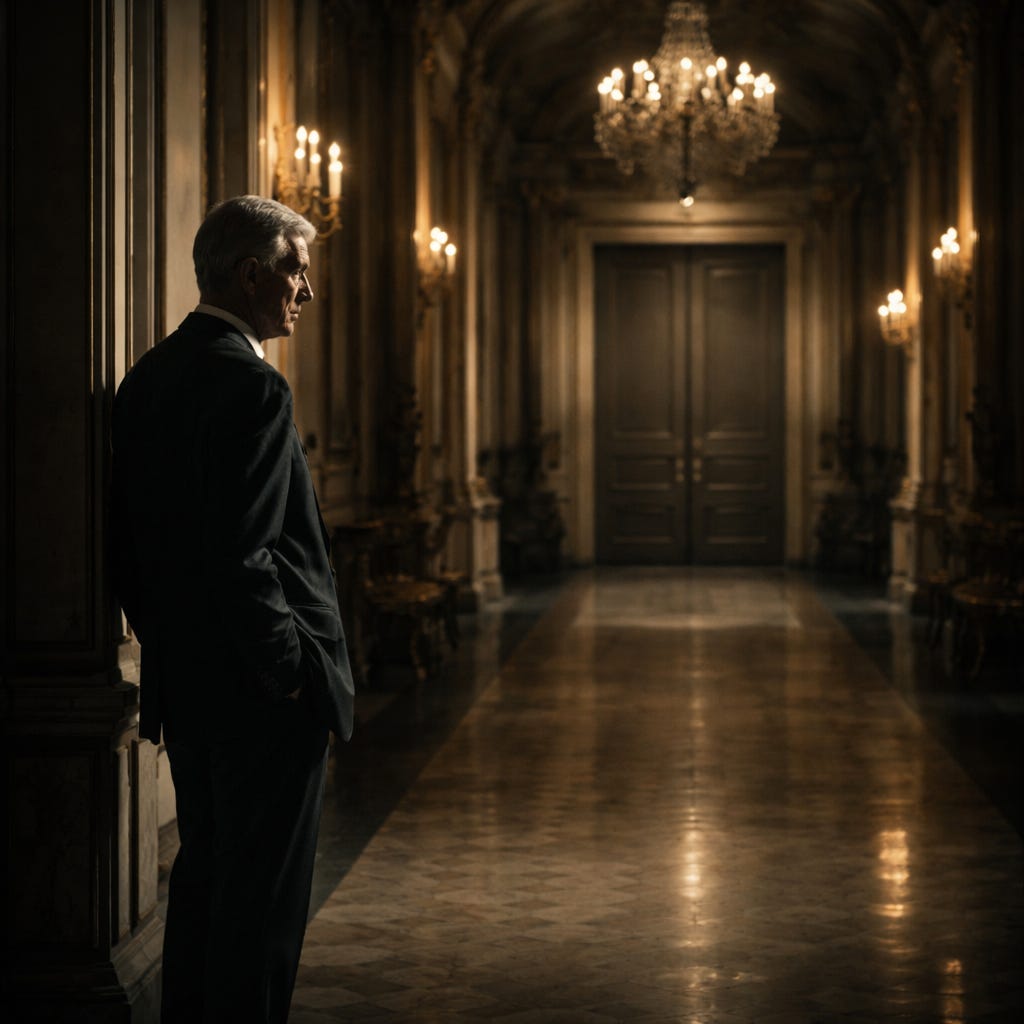
The Last Door
from Language Matters by Elias Winter Hosted by Elias Winter
I. The Last Door By the end they no longer refused me with insult. Insult would at least have conceded that I remained a person of consequence. No, they refused me with courtesy, which is the preferred cruelty of palaces that have begun to mistake order for dignity. The young captain at the door, whom I had never seen before, put one gloved hand over the register and asked my name as though I were a tradesman who had lost his way among the cypresses. He was very clean. They were all very clean in those years. The uniforms had grown more exact as the souls inside them had grown less certain. His Persian was quick and polished; his French, when he recognized my accent, carried the brittle triumph of a man who has learned another language only to sharpen a refusal. “His Majesty is occupied.” They all say this with the same face. Occupied by what? By ministers, by generals, by maps, by the long frightened whisper of a state that has learned to suspect its own people. Occupied by those men who enter carrying folders and leave carrying larger shoulders. Occupied by women with lacquered smiles and soft knives. Occupied by a future that arrives wearing foreign shoes and calls itself necessity. The palace itself had changed its breathing. Once it inhaled through corridors, through private rooms, through doors opened by habit, by memory, by affection. In those earlier years one could still move through it according to old laws: a shared glance, a known silence, a sentence begun in one season and completed in another. By the late 1950s it breathed through checkpoints. Doors no longer opened because one was expected. They opened because one had been cleared. I stood in the reception hall beneath a chandelier whose glitter was meant to reassure everyone that permanence still existed. The generals passed without looking at me. They always pretended not to know who I was. That was their revenge against the years when they had known perfectly well who I was and hated me for it. One of them—wide in the chest, thinning at the crown, carrying his body like a threat he had repeated too often—paused only long enough to let his eyes take my measure. In his gaze there was no curiosity. I had ceased to be scandalous; I was simply obsolete. Farther down the corridor two ladies of the court emerged from a receiving room in a cloud of perfume and intelligence. Women in palaces never merely walk; they announce the arrangement of power by the angle of a wrist, the refusal of a glance, the decision to laugh one beat too late. One of them, younger, with a neck too beautiful to trust, looked at me with a kind of bright amusement, as one looks at an old dog that still waits by the wrong gate. The older one knew better. She turned her face away. She understood that to notice me was to acknowledge an earlier court, a softer court, a court of dangerous informality. Such courts must be erased before the new ones can call themselves modern. I asked whether His Majesty had been told I was there. The captain lowered his gaze in the practiced way of men who wish to avoid lying by allowing the lie to become atmospheric. “His Majesty is occupied.” Again. The same sentence. A whole state summarized in four words. I ought to have left at once. An aging man preserves his dignity only by recognizing the exact minute at which it begins to decay in public. But I remained. One remains in such moments not because one expects to be admitted, but because memory is a foolish servant. It still believes the house remembers its dead. As I waited, I watched the doors at the end of the hall—double doors, walnut dark, guarded not by force but by procedure. How many times had I passed through doors on nothing more than a murmur, a nod, the familiarity of footsteps? How many times had no one thought to ask my name because my name had already been folded into the air of the place? Now the palace required that everything be spoken, stamped, sorted, denied. There was a time when no one asked my name at the door. II. Le Rosey Snow makes even the proud appear provisional. That is what I remember first: not the boy, not yet, but the snow along the stone balustrades, the pale roofs, the Swiss morning so clean it seemed to have been laundered in silence. Le Rosey was a school for princes, or so the fathers called it, though princes are only boys with too many witnesses. I did not belong there in the way the others did. I belonged by proximity, by labor, by the lesser routes through which one learns to read a world that would not seat one at its table. My father worked the grounds. I learned the seasons by the shape of branches and the moods of rich children by the violence with which they shut doors. Schools of that kind educate everybody: the heirs in entitlement, the servants in precision, the outsiders in observation. The first time I noticed him, he was standing apart from a group of boys in winter coats, listening too carefully. There is a kind of loneliness that advertises itself through excess attention. He had already learned to behave as someone watched, and he was not yet old enough to know that such behavior becomes permanent. His clothes were excellent. His posture was nearly correct. But around him hung the unmistakable weather of exile: too far from home, too close to expectation, too young to understand the bargain being prepared in his name. The other boys, especially the European ones who had been taught since birth that rank was vulgar unless worn casually, sensed his vulnerability. They sensed as well the vanity beneath it, the eagerness to belong, the mortification of failing naturally at what others performed without effort. Boys are merciless wherever institutions train them to become the guardians of future order. He dropped a glove on the terrace steps. It is possible he dropped it accidentally. It is equally possible he let it fall because he wanted someone to notice him without requiring him to ask. I picked it up. His hand, when he took it back, was cold enough to seem ceremonial. “Merci,” he said. His French was careful. The accent amused some of the others. It did not amuse me. I had already learned that a man’s accent is often the truest evidence of what the world has demanded he become before he had time to consent. “You are freezing,” I told him. He gave the quick embarrassed smile of a boy uncertain whether he is being mocked. “In my country,” he said, “it is different.” That is what people from important countries say when they are helpless in small climates. “In every country,” I replied, “cold remains ambitious.” He laughed then, and because he laughed, the whole arrangement shifted. It is astonishing how quickly certain destinies enter by the side door of a trivial remark. Later I would know his silences, his hesitations, the small gestures by which shame announces itself before words can defend it. But first there was only the school: the stone hallways, the smell of wax and wool, the chapel where boys practiced reverence as they practiced pronunciation, the dining room full of dynasties chewing under supervision. Switzerland has perfected the art of making hierarchy appear hygienic. He moved through that world as if wearing a costume tailored by anxious men. He was neither robust enough to dominate nor indifferent enough to disappear. He was watched from above and below: by teachers because he was a prince, by boys because he was uncertain, by history because it had already leased him a future. I noticed his hands before I noticed his face properly. Hands reveal what families try to hide. His were delicate but restless, beautiful in the way of things already under discipline. One sensed that his father had not touched him with tenderness and that the absence had become architectural. When one lives near power in its larval stages, one learns to distinguish between arrogance and fear. Arrogance expands; fear arranges itself. The boy was arranging himself. III. The Boys Who Become Countries I do not know at what… This is a public episode. If you would like to discuss this with other subscribers or get access to bonus episodes, visit eliaswinter.substack.com
Embed this episode
No transcript yet.