
EPISODE · Jul 12, 2026 · 19 MIN
The Last Good Adult
from Language Matters Podcast · host Elias Winter
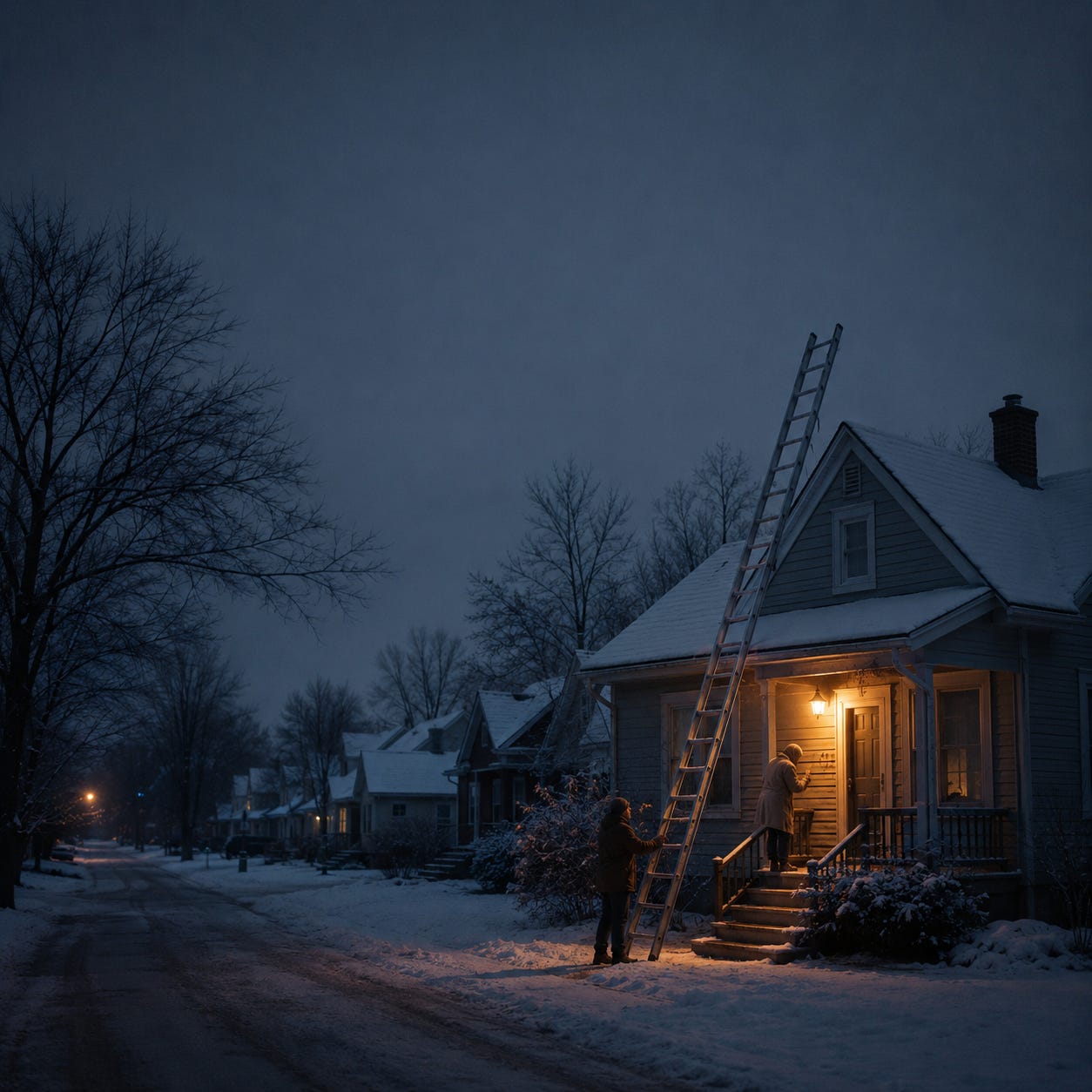
The Man Who Used to Know What to DoThere was once, in every family or neighborhood, a man who knew what to do.He knew how to restart a furnace, speak to a grieving widow, remove a stripped screw, negotiate with a mechanic, and determine whether a sound coming from the basement meant “old house” or “leave immediately.”He was not necessarily wise in every area. His views on diet may have involved margarine. He may have believed that emotional disclosure caused arthritis. But when something went wrong, he arrived with a flashlight, a thermos, and a basic conviction that the problem belonged to the human community.We have largely replaced this man with a search bar.Today, when the ceiling leaks, the child refuses school, the parent begins forgetting names, or the marriage enters one of its long, cold silences, we consult strangers. We ask Reddit. We watch a man in Arizona explain boiler pressure beside an advertisement for tactical underwear. We listen to a podcast called Radical Ownership hosted by two men who appear never to have owned a washing machine.The loss is not merely technical. What disappeared was a certain kind of adult: someone whose life supplied an answer, however incomplete, to the question, “How does a person behave when things become difficult?”We still have experts. We have celebrities, commentators, founders, coaches, influencers, therapists, brand strategists, thought leaders, and men who explain stoicism from inside rented Lamborghinis.What we have fewer of are people we can watch over time and quietly conclude: that is how courage looks; that is how responsibility sounds; that is what a person does when no applause is coming.We do not lack famous people. We lack witnesses to adulthood.We Replaced Role Models with People Who Have Ring LightsThe old role models were rarely chosen by algorithm.They were teachers, doctors, mechanics, clergy, coaches, scientists, organizers, artists, grandparents, neighbors, and occasionally one terrifying aunt who could end a family dispute by entering the room.They possessed authority because they had done something difficult for a long time. Their lives had accumulated weight. They knew things that could not be learned in a weekend workshop called “Unlocking Your Inner Legacy.”Modern public life selects differently.The visible person is not necessarily the person of greatest character, wisdom, or competence. The visible person is the person most capable of remaining visible.This requires a particular skill set: speed, certainty, emotional amplitude, photogenic sincerity, a willingness to narrate one’s breakfast, and the ability to begin sentences with “Nobody is talking about this” while discussing something everyone has been talking about for six consecutive months.We did not abolish hierarchy. We merely denied having one and outsourced it to metrics.Follower counts became a secular halo. Verification badges became tiny digital knighthoods. Podcast microphones acquired the authority once associated with pulpits and university lecterns. Anyone seated before acoustic foam could announce that civilization had misunderstood masculinity.The strange thing is that these people are not always frauds. Many are talented, intelligent, or genuinely helpful. The problem is structural. Influence and example have become confused.An influencer changes what you notice, buy, repeat, fear, or desire. An exemplar changes your sense of what a human being can become.Those are not the same thing.The influencer says, “Here is my morning routine.”The exemplar makes you wonder whether you have been living beneath your own moral capacity.One sells aspiration. The other creates obligation.And obligation is bad for engagement.The Trouble with Heroes Is That They Eventually Get Wi-FiOf course, the old world of heroes was not as noble as memory makes it seem.Many public figures were protected by silence. Institutions concealed abuse. Families hid cruelty. Biographers omitted the mistress, the drinking, the plagiarism, the political cowardice, the children who grew up afraid, and the employees who knew the great man mainly as a great inconvenience.The noble portrait was often achieved through lighting.Modern exposure corrected many real lies. We learned that presidents had appetites, artists had victims, intellectuals had servants, spiritual leaders had accountants, and nearly every revered institution had at least one locked filing cabinet marked “Do Not Open Until Everyone Involved Is Dead.”This demystification was necessary.But we did not stop at accuracy. We developed an appetite for desecration.Now every admired person is subjected to a kind of total moral audit. Every failed friendship, bad joke, private contradiction, youthful opinion, divorce, awkward interview, and poorly phrased email becomes evidence in a trial with no statute of limitations.The public no longer asks, “What can we learn from this life?”It asks, “Can this person survive complete exposure?”No one can.A human life is not a clean argument. It is a crowded house containing courage, vanity, tenderness, cowardice, sacrifice, appetite, discipline, and several boxes the owner has been meaning to sort since 2009.The answer is not to restore false saints. It is to recover proportion.A person may be admirable in one dimension and compromised in another. Some failures disqualify. Others contextualize. Some demand judgment. Others demand mercy. A life must be interpreted, not merely searched.There is a difference between refusing mythology and refusing admiration.We have become excellent at proving that our heroes were human. We have not yet learned what to do with human heroes.The Great Moral Yard SaleAt some point, modern society held a giant moral yard sale.We put out the old furniture: duty, restraint, honor, vocation, stewardship, loyalty, humility, repentance, and the idea that freedom might require self-command.Some of it was ugly. Some had been inherited from people who used duty to justify obedience, honor to conceal domination, and humility to keep everyone else quiet. So we dragged it onto the lawn.Then we sold too much.Visibility replaced virtue. Branding replaced identity. Metrics replaced judgment. Authenticity replaced integrity. Outrage replaced courage. Disruption replaced stewardship. Therapy language sometimes replaced ethical language. Cancellation replaced repentance.We kept one folding chair labeled “personal values” and a beanbag called “living your truth.”The results were not entirely satisfactory.Consider authenticity. Authenticity sounds noble because the alternative is falseness. But a person can be authentically selfish, authentically cruel, authentically vain, and authentically unbearable at dinner.Integrity asks a harder question: are your actions coherent with principles that survive your moods?Or consider disruption. Every institution now wants to disrupt something. Banks disrupt money. Apps disrupt taxis. Startups disrupt sleep, food, conversation, courtship, and occasionally democracy.Nobody announces a plan to maintain a bridge for sixty years.Maintenance lacks glamour. It does not photograph well. “Today I checked the bolts again” is not the opening line of a bestselling memoir.Yet civilization is mostly maintenance.It is people updating records, cleaning water, teaching multiplication, inspecting beams, caring for parents, correcting invoices, showing up to meetings prepared, and remembering which child cannot eat peanuts.The moral corruptions of the modern age share a pattern: appearance separates from substance.Goodness becomes signaling. Leadership becomes optics. Friendship becomes networking. Vulnerability becomes currency. Conviction becomes content. Rebellion becomes merchandise.Even humility can now be branded. There are executives who post twelve-paragraph reflections about how humbled they are to receive an award for humility.The corruption is not that people are worse than before. Human beings have always loved status, vanity, power, and shortcuts.The corruption is that our systems have become extremely efficient at monetizing these tendencies while calling the result self-expression.Nobody Needs Another Perfect PersonThe solution is not to manufacture a new class of spotless heroes.We have tried that. It ends with statues, propaganda, dynasties, cults, or a six-part documentary released after the allegations.What we need are exemplars rather than idols.An idol must be defended as a whole. An exemplar can be studied in part.One person may teach courage. Another may teach patience. Another may teach intellectual honesty. Another may teach how to apologize without hiring a communications firm.A good manager may model responsibility while possessing no useful opinions about marriage, metaphysics, or pasta.A great artist may reveal something true about suffering while remaining entirely unqualified to tell the nation how to organize healthcare.A recovering addict may know more about keeping one promise than a senator who has authored three books on character.This is a more adult form of admiration.Instead of searching for a single person to imitate, we build a moral constellation.From one life, courage. From another, discipline. From another, tenderness. From another, refusal. From another, the ability to repair after failure.The stars need not be flawless to help us navigate.They only need to remain visible enough for us to recognize a direction.The Return of the Unremarkable Grown-UpThe hopeful news is that decent adults have not vanished.They are simply poorly optimized for discovery.The nurse who tells a frightened patient the truth without making the truth cruel is not trending.The manager who absorbs blame and distributes credit is rarely invited to give a keynote titled “My Leadership Journey.”The engineer who refuses to falsify a number may never become famous, particularly if the number belonged to someone important.The parent who apologizes to a child does not receive a badge.The recovering addict who keeps one promise today has not “scaled impact,” but something in the moral universe has been held together.The neighbor who owns a ladder and actually lends it out is participating in an ancient civic tradition now known as “not making everything a transaction.”These people preserve the world.They do not usually describe themselves as role models. That may be one reason they are useful.Their authority comes from repetition. They arrive again. They tell the truth again. They make the difficult call again. They do the boring thing correctly again.Trust is built through moral recurrence.We have been trained to look for dramatic goodness: the whistleblower, the dissident, the rescuer, the saint. Those people matter. But societies are also sustained by less cinematic virtues.Someone remembers the appointment.Someone checks whether the old man has heat.Someone refuses to laugh when the joke becomes humiliation.Someone corrects the story even though the false version makes them look better.Someone stays after the meeting to clean up without creating a post about servant leadership.The ordinary adult does not solve history. The ordinary adult prevents history from becoming worse in one small jurisdiction.This may be the scale at which hope becomes believable.Not “humanity will awaken.”Not “a new consciousness is emerging.”Just: this person did not lie when lying would have been convenient.This person returned the call.This person remained.How to Become Someone’s EvidenceThe question “Where are the role models?” can become another form of spectatorship.It lets us remain in the audience, waiting for someone admirable to appear.A better question is: what might another person learn by watching me?Not from my declared values. Not from the version of myself published online. From repeated contact with my actual conduct.Would they learn that truth survives inconvenience?That authority can exist without humiliation?That error can be admitted without collapse?That attention can be given without being converted into leverage?That promises still mean something after the mood in which they were made has passed?This does not require heroism.It may require answering an email honestly. Returning borrowed money. Refusing to repeat a rumor. Giving credit to the person who did the work. Protecting someone absent from the room. Maintaining something everyone else neglects.It may require performing a good act and allowing it to remain tragically undocumented.This is one of the great spiritual challenges of the age.To do something decent and not announce it.No photograph. No caption. No thread beginning, “A small thing happened today that restored my faith in humanity.”Just the act, disappearing into the structure of the world.Moral life has always depended on people becoming evidence for one another.Evidence that courage is possible.Evidence that appetite can be governed.Evidence that power need not corrupt every relationship.Evidence that failure is not final.Evidence that adulthood is not a myth invented by people who owned toolboxes.The Last Winter Is Not the End of the WorldWinter makes a landscape look dead.The leaves vanish. The color drains. The trees stand exposed, awkward and skeletal. Everything appears to have withdrawn from the world.But winter also reveals structure.Without leaves, we can see which branches are sound, which have split, which remain connected to the trunk, and which were being held together mainly by foliage and optimism.Our moral winter may be like that.The old myths have fallen away. Institutions have lost authority. Public figures live under permanent exposure. Every ideal arrives pre-mocked, pre-monetized, and accompanied by a promotional code.That is a real loss.But it is also a clearing.We no longer need to pretend that great people are flawless. We no longer need to confuse office with virtue, wealth with wisdom, or visibility with worth.We can begin again at a smaller scale.A trustworthy person.A repaired relationship.A duty accepted without spectacle.A truth spoken without cruelty.A child watching an adult make the harder choice.Moral renewal will probably not announce itself as moral renewal. It will not arrive with branding, merchandise, or a conference featuring twelve breakout sessions.It may begin when people become reliable to one another again.Someone will do an ordinary decent thing without photographing it.Someone else will notice.And for a moment, the world will have a role model again.—Elias WinterAuthor of Language Matters, a space for reflection on language, power, and decline This is a public episode. If you would like to discuss this with other subscribers or get access to bonus episodes, visit eliaswinter.substack.com
Embed this episode
NOW PLAYING
The Last Good Adult
No transcript for this episode yet
Similar Episodes
No similar episodes found.
Similar Podcasts
No similar podcasts found.