
EPISODE · Jun 12, 2026 · 1H 20M
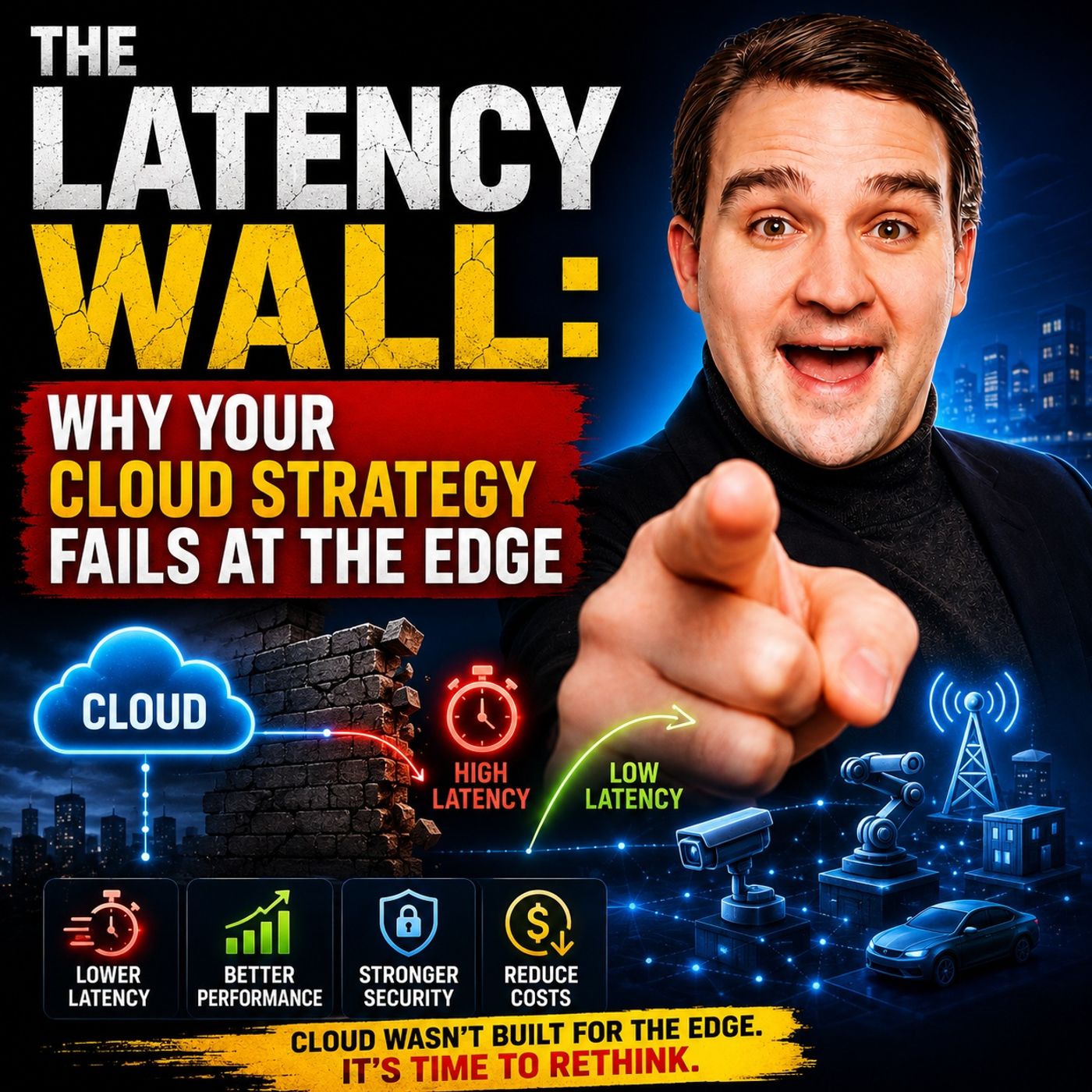
The Latency Wall: Why Your Cloud Strategy Fails at the Edge
from M365.FM - Modern work, security, and productivity with Microsoft 365 · host Mirko Peters - Founder of m365.fm, m365.show and m365con.net
For years, organizations have followed a simple rule: move everything to the cloud.The strategy worked brilliantly for collaboration, analytics, business intelligence, and productivity workloads. Microsoft 365, Azure, Power BI, Teams, and modern cloud platforms transformed how organizations operate.But a growing number of industries are discovering a hard reality.Physics doesn't care about your cloud strategy.When robots, autonomous vehicles, computer vision systems, industrial sensors, healthcare devices, and critical infrastructure require responses measured in milliseconds, traditional cloud architectures hit an unavoidable barrier: the Latency Wall.In this episode, we explore why centralized cloud architectures struggle at the edge, why bandwidth isn't the answer, and how organizations are redesigning their technology platforms around private 5G, Multi-Access Edge Computing (MEC), Azure Stack Edge, Azure Arc, and sovereign edge architectures.If your future includes AI, automation, robotics, manufacturing, logistics, healthcare, energy, or industrial IoT, this episode explains why the next phase of digital transformation is happening closer to the data than ever before.WHY THE CLOUD BREAKS WHEN MILLISECONDS MATTERMost enterprise systems were designed around humans.Humans tolerate delay.A dashboard that loads in a few seconds feels fast.A chatbot that responds in under a second feels instant.An analytics report that refreshes in a minute is perfectly acceptable.Machines don't think that way.A robotic arm operating on a production line may require updates every few milliseconds.A computer vision system inspecting defects has fractions of a second to react.An autonomous guided vehicle navigating a warehouse cannot wait hundreds of milliseconds for instructions from a distant cloud region.The challenge isn't cloud performance.The challenge is physics.This episode explores the science of latency, jitter, determinism, and why distance creates a hard limit that no cloud provider can eliminate.THE PHYSICS OF LATENCYEvery cloud strategy ultimately runs into the same constraint.Data must travel.Even at the speed of light, distance creates delay.As organizations connect factories, warehouses, hospitals, ports, mines, energy grids, and autonomous systems to cloud platforms, latency becomes an architectural problem rather than a networking problem.We discuss:Why latency and jitter matter more than bandwidthDeterministic versus best-effort networkingReal-world control loop requirementsThe impact of packet loss and network variabilityWhy cloud optimization cannot overcome physical distanceUnderstanding these concepts is critical for modern architects designing real-time systems.INDUSTRIES HITTING THE LATENCY WALLThe edge is no longer a niche concept.Across every sector, organizations are discovering workloads that cannot depend on centralized cloud architectures.This episode examines real-world examples from:Manufacturing and industrial automationLogistics and warehouse roboticsHealthcare and patient telemetryEnergy and utilitiesMining operationsSmart ports and maritime logisticsRetail automationAutonomous transportationEach industry faces different challenges, but the underlying problem remains the same: critical decisions must happen locally.THE OLD CLOUD MODEL VS THE NEW EDGE MODELFor decades, enterprise architecture followed a hub-and-spoke model.Data flowed to the cloud.The cloud made decisions.The edge executed instructions.That model is changing.The modern edge architecture places intelligence closer to the source of the data.Instead of sending every sensor reading, image, and event to a distant cloud region, organizations process information locally and send only insights, exceptions, and analytics upstream.We explore:Edge-first architecturesDistributed intelligenceLocal decision-makingAutonomous operationsResilient offline systemsReal-time control loopsThe result is a fundamental inversion of traditional cloud thinking.PRIVATE 5G EXPLAINEDMany organizations think 5G is simply faster wireless networking.Enterprise private 5G is something very different.It provides deterministic connectivity designed specifically for industrial and mission-critical environments.In this episode, we explain:Private 5G architectureNetwork slicingUltra-Reliable Low-Latency Communications (URLLC)SIM-based securityMobility managementQuality of Service (QoS)Deterministic networkingYou'll learn why private 5G is becoming a foundational technology for modern industrial environments.AZURE PRIVATE 5G CORE AND AZURE STACK EDGEMicrosoft's answer to the edge challenge combines networking, compute, AI, and cloud management into a unified platform.We take a deep dive into:Azure Private 5G CoreAzure Stack EdgeAzure ArcAzure Network Function ManagerEdge AILocal inferenceSovereign deploymentsHybrid cloud architecturesDiscover how Microsoft enables organizations to run cloud services locally while maintaining centralized governance and management.MULTI-ACCESS EDGE COMPUTING (MEC)Private 5G alone doesn't solve the problem.Applications still need compute resources close to the workload.This is where Multi-Access Edge Computing comes in.We explore how MEC enables:Real-time AI inferenceComputer vision workloadsPredictive maintenanceDigital twinsAutonomous systemsEdge analyticsLow-latency application hostingThe combination of MEC and private 5G creates a platform capable of supporting next-generation industrial applications.THE EVENT-REASONING-ORCHESTRATION MODELOne of the most important concepts in this episode is a new way of thinking about intelligence at the edge.Instead of sending every event to the cloud, the edge becomes responsible for:Event DetectionCapturing data directly from sensors, cameras, machines, and devices.Local ReasoningRunning AI models and analytics locally.Immediate OrchestrationTaking action in real time without waiting for cloud responses.The cloud remains essential for governance, reporting, model training, and enterprise-wide intelligence, but the milliseconds that matter stay local.THE BUSINESS CASE FOR THE EDGEEdge computing isn't just about performance.It's also about economics.We explore real-world research showing how organizations achieve measurable returns through:Reduced downtimePredictive maintenanceAutomated quality inspectionEnergy optimizationAutonomous logisticsFlexible manufacturingReduced networking costsYou'll learn why some organizations are seeing extraordinary returns from private 5G and edge computing investments.DATA SOVEREIGNTY AND REGULATORY COMPLIANCELatency isn't the only reason organizations are moving workloads closer to the edge.Data sovereignty is becoming equally important.This episode explores:GDPRNIS2The EU AI ActThe Data ActDORANational data residency requirementsSovereign cloud architecturesLearn why compliance requirements are reshaping enterprise architecture and accelerating investment in local processing capabilities.SECURITY AT THE EDGEEdge environments introduce new security challenges and opportunities.We discuss:Zero Trust architecturesSIM-based authenticationIdentity-driven networkingIEC 62443Operational Technology (OT) securityMicrosoft Defender integrationEdge security monitoringSecure AI deploymentsSecurity must evolve alongside edge infrastructure.THE CONVERGED FUTURE OF WI-FI 7 AND PRIVATE 5GThe future isn't Wi-Fi versus 5G.The future is both.Organizations are increasingly adopting converged networking strategies where:Wi-Fi 7 supports knowledge workersPrivate 5G supports operational technologyAzure Arc provides unified managementApplications automatically use the best network availableThis converged model is rapidly becoming the standard architecture for enterprise environments.BUILDING YOUR EDGE STRATEGYFor architects, technology leaders, and decision-makers, the question is no longer whether edge computing matters.The question is where the latency wall exists within your organization.We provide a practical roadmap covering:Pilot projectsPlatform selectionGovernance modelsData foundationsOrganizational changeEdge Centers of ExcellenceScaling strategiesOperational readinessUnderstanding these principles is essential for the next generation of cloud and AI architectures.Become a supporter of this podcast: https://www.spreaker.com/podcast/m365-fm-modern-work-security-and-productivity-with-microsoft-365--6704921/support.
Embed this episode
What this episode covers
For years, organizations have followed a simple rule: move everything to the cloud.The strategy worked brilliantly for collaboration, analytics, business intelligence, and productivity workloads. Microsoft 365, Azure, Power BI, Teams, and modern cloud platforms transformed how organizations operate.But a growing number of industries are discovering a hard reality.Physics doesn't care about your cloud strategy.When robots, autonomous vehicles, computer vision systems, industrial sensors, healthcare devices, and critical infrastructure require responses measured in milliseconds, traditional cloud architectures hit an unavoidable barrier: the Latency Wall.In this episode, we explore why centralized cloud architectures struggle at the edge, why bandwidth isn't the answer, and how organizations are redesigning their technology platforms around private 5G, Multi-Access Edge Computing (MEC), Azure Stack Edge, Azure Arc, and sovereign edge architectures.If your future includes AI, automation, robotics, manufacturing, logistics, healthcare, energy, or industrial IoT, this episode explains why the next phase of digital transformation is happening closer to the data than ever before. WHY THE CLOUD BREAKS WHEN MILLISECONDS MATTER Most enterprise systems were designed around humans.Humans tolerate delay.A dashboard that loads in a few seconds feels fast.A chatbot that responds in under a second feels instant.An analytics report that refreshes in a minute is perfectly acceptable.Machines don't think that way.A robotic arm operating on a production line may require updates every few milliseconds.A computer vision system inspecting defects has fractions of a second to react.An autonomous guided vehicle navigating a warehouse cannot wait hundreds of milliseconds for instructions from a distant cloud region.The challenge isn't cloud performance.The challenge is physics.This episode explores the science of latency, jitter, determinism, and why distance creates a hard limit that no cloud provider can eliminate. THE PHYSICS OF LATENCY Every cloud strategy ultimately runs into the same constraint.Data must travel.Even at the speed of light, distance creates delay.As organizations connect factories, warehouses, hospitals, ports, mines, energy grids, and autonomous systems to cloud platforms, latency becomes an architectural problem rather than a networking problem.We discuss: Why latency and jitter matter more than bandwidth Deterministic versus best-effort networking Real-world control loop requirements The impact of packet loss and network variability Why cloud optimization cannot overcome physical distance Understanding these concepts is critical for modern architects designing real-time systems. INDUSTRIES HITTING THE LATENCY WALL The edge is no longer a niche concept.Across every sector, organizations are discovering workloads that cannot depend on centralized cloud architectures.This episode examines real-world examples from: Manufacturing and industrial automation Logistics and warehouse robotics Healthcare and patient telemetry Energy and utilities Mining operations Smart ports and maritime logistics Retail automation Autonomous transportation Each industry faces different challenges, but the underlying problem remains the same: critical decisions must happen locally. THE OLD CLOUD MODEL VS THE NEW EDGE MODEL For decades, enterprise architecture followed a hub-and-spoke model.Data flowed to the cloud.The cloud made decisions.The edge executed instructions.That model is changing.The modern edge architecture places intelligence closer to the source of the data.Instead of sending every sensor reading, image, and event to a distant cloud region, organizations process information locally and send...
NOW PLAYING
The Latency Wall: Why Your Cloud Strategy Fails at the Edge
No transcript for this episode yet
Similar Episodes
No similar episodes found.
Similar Podcasts
No similar podcasts found.