The Law That Still Exists
from Language Matters by Elias Winter Hosted by Elias Winter
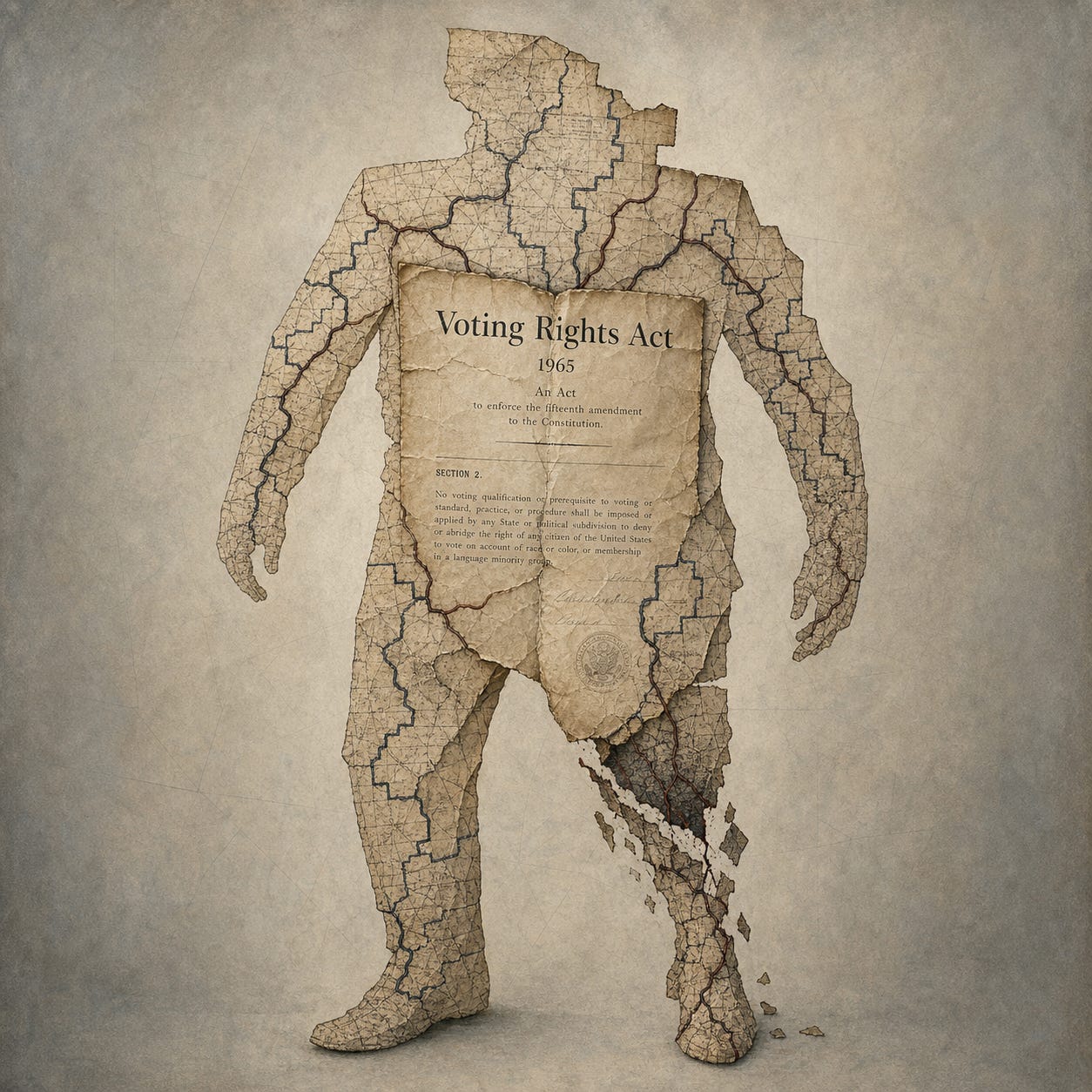
A law can still be alive and yet walk with a limp. That is the simplest way to understand the Supreme Court’s ruling in Louisiana v. Callais. The Voting Rights Act was not repealed. Black voters did not lose the right to sue. Racial discrimination in voting did not become legal. But something important changed. In a 6–3 decision written by Justice Samuel Alito, the Court affirmed a lower-court ruling that struck down Louisiana’s congressional map, known as SB8, which had created a second majority-Black district. The Court concluded that Louisiana could not rely on Section 2 of the Voting Rights Act to justify that district because, in the Court’s view, Section 2 did not require that remedy on these facts. Since race had predominated in drawing the map, and since the state lacked a sufficient legal reason for using race that way, the map failed as an unconstitutional racial gerrymander. (Supreme Court) That is the legal core of the decision. Now here is the human version. Louisiana was trapped between two rules. Rule one: Do not weaken Black voting power. Rule two: Do not draw districts mainly because of race. That is the conflict. To protect Black voters, Louisiana had to notice race. But by noticing race too much, it violated the Constitution’s suspicion of racial classification. In plain English: Race mattered too much to ignore, but relying on race too heavily became unconstitutional. That is why this case is hard. It is not hard because nobody knows what discrimination is. It is hard because the legal system is trying to stop two different dangers at the same time. The first danger is racial vote dilution. That means minority voters are not literally stopped from voting, but their votes are weakened by the map. Imagine a city where Black voters mostly live in one area. If that area is kept together in one district, those voters may be able to elect their preferred candidate. But if the map splits that community into four different districts, each attached to a larger white suburban or rural area, those Black voters may become a minority everywhere. They can still vote. Their votes are still counted. But their political power has been scattered. No one has to say anything racist. The map does the talking. That is what Section 2 of the Voting Rights Act has often been used to address. It asks whether an election system gives minority voters an equal opportunity to participate and elect candidates of their choice. But Section 2 was never a simple rule saying, “If racial outcomes are unequal, the map is illegal.” That matters. Under the classic test from Thornburg v. Gingles, plaintiffs generally had to show that a minority group was large enough and compact enough to form a district, that the group voted cohesively, and that the majority usually voted as a bloc against that group’s preferred candidates. Then courts looked at the broader facts. In Callais, the Court updated that framework by requiring, among other things, that plaintiffs’ illustrative maps not use race as a districting criterion, that those maps satisfy the state’s legitimate districting objectives, and that evidence of racial bloc voting be disentangled from partisan preference. (Supreme Court) So Section 2 was not a racial quota machine. It did not say: Black people are X percent of the population, so they must get X percent of the seats. It asked a narrower question: Has the map made it unfairly difficult for a real, cohesive minority community to turn votes into representation? That is the first side of the case. Now the second side. The Constitution is deeply suspicious of government sorting people by race. The Court’s concern is that a law designed to prevent discrimination can become a command to draw political power around racial categories. That is not a fake concern. If the state begins saying, “This district is for this racial group, that district is for that racial group,” even for good reasons, something dangerous happens. Citizens start to become racial representatives before they are simply citizens. Politics becomes a census table with campaign signs. The Court is saying: The government cannot use race as the master tool of mapmaking unless the law truly requires it. That is the strongest version of the Court’s argument. It is not simply, “We do not care about discrimination.” It is: We cannot fight racial discrimination by making racial classification permanent. The critics see the danger differently. They say: that sounds noble, but power is not stupid. Modern discrimination rarely announces itself honestly. Nobody in a legislature is likely to write, “Dear colleagues, attached is the map that reduces Black voting power. Warmly, Brad.” They will say other things. They will say “compactness.” They will say “efficiency.” They will say “partisan advantage.” They will say “traditional districting principles.” They will say “we were just following the data.” And this is where the problem becomes real. In many places, race and party overlap. If Black voters overwhelmingly vote Democratic, a state can say: We were not targeting Black voters. We were targeting Democrats. Legally, that distinction matters. Practically, the effect can look very similar. That is why critics say the Voting Rights Act has been “gutted.” They do not always mean the law was literally erased. That would be false. They mean the law has less practical force because it is now harder to use race-conscious remedies to fix maps that weaken minority voting power. The body remains. The muscle is smaller. But critics can also exaggerate. If someone says, “The Voting Rights Act is dead,” that is too simple. If someone says, “Minority voters have no rights now,” that is wrong. If someone says, “The Court made racism legal,” that is wrong. The more accurate sentence is less dramatic: The Court narrowed when states can use the Voting Rights Act to justify race-conscious redistricting. That sentence will not go viral. But it is closer to the truth. The deeper fight is really about equality and equity. Equality, in the Court’s constitutional frame, means the state should not classify people by race unless there is an extremely strong reason. Equity, in the critics’ frame, means the law should look at whether the system actually gives different communities a fair chance at political power. Equality asks: Did the government sort people by race? Equity asks: Did the map weaken a group’s power? The Court is more worried about the first question. The critics are more worried about the second. Both fears are real. The Court fears a country where government keeps dividing citizens by race in the name of justice. That fear is not trivial. Racial categories, once built into law, do not always stay gentle. They harden. They get gamed. They become permanent furniture in the house. The critics fear a country where government pretends not to see race while old patterns of power continue under cleaner language. That fear is also not trivial. Colorblindness can be a moral principle. It can also become a blindfold. That is the democratic double bind. To protect minority voters, the law may need to notice race.But the more the law notices race, the more it risks violating the ideal of equal treatment. This is where the politics becomes uncomfortable. For decades, Black voters have voted overwhelmingly Democratic. That fact is not a biological law. It is not because skin color produces ideology. It is the result of history: slavery, Jim Crow, civil-rights enforcement, federal protection, party realignment, churches, unions, local leadership, and memory passed down through families. But still, there is a civic problem here. No democracy is healthier when ethnicity becomes political destiny. Citizens should not be treated as if they arrive at the ballot box already assigned to a party by ancestry. Black voters should not be assumed to belong to Democrats. Latino voters should not be treated as a demographic prize. White voters should not be reduced to backlash. Cuban Americans, Nigerian Americans, Vietnamese A… This is a public episode. If you would like to discuss this with other subscribers or get access to bonus episodes, visit eliaswinter.substack.com
Embed this episode
No transcript yet.