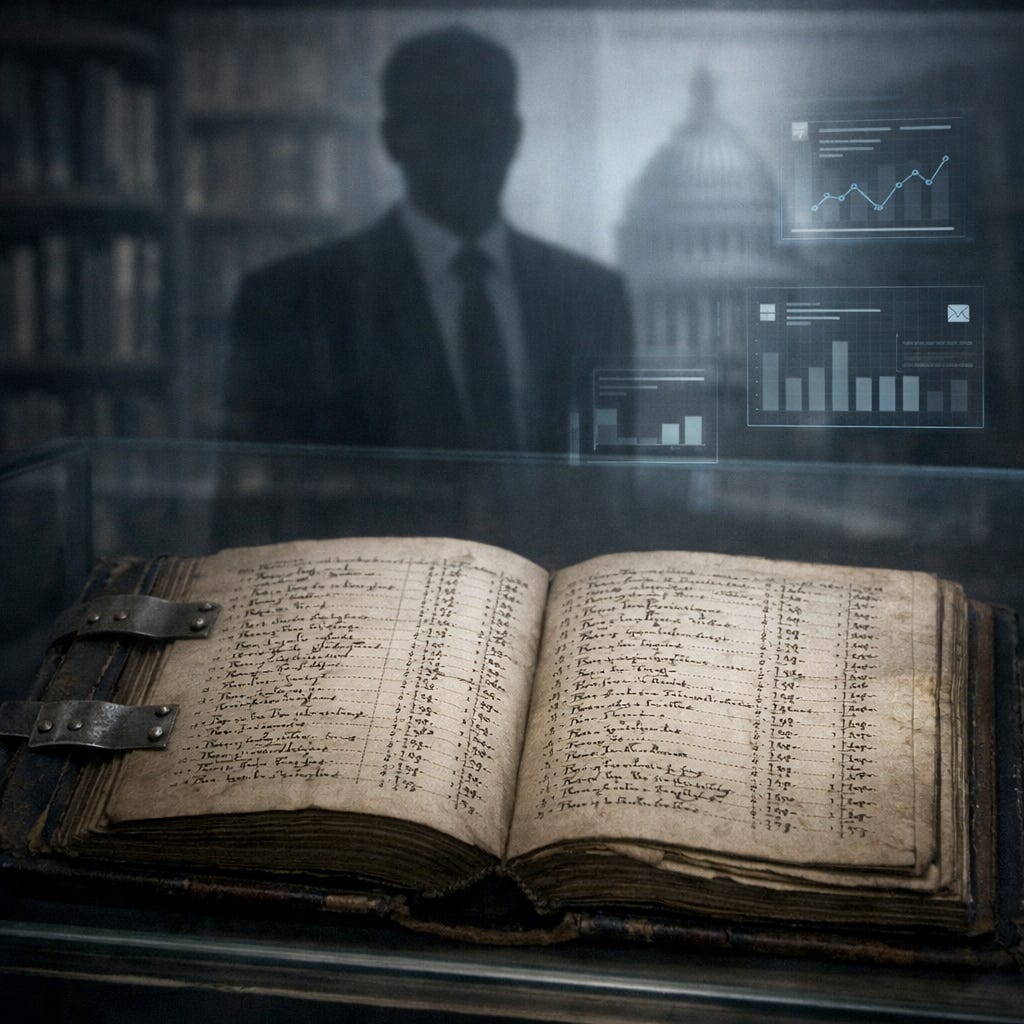
The Ledger and the Castle
from Language Matters by Elias Winter Hosted by Elias Winter
I. The Ledger of the Dead The banker’s house smelled like iron and beeswax. Lorenzo di Vieri stood by the open shutters, fingers resting lightly on the sill, watching the boy carry the last chest into the alley. The chest was small—too small to justify the screaming that had come with it—but people always screamed when you took the last thing they believed was theirs. Behind him, the father’s voice cracked. “Signore, we agreed—another month.” Lorenzo didn’t turn around. The morning light was gentle on Florence; the voices in the street below rose and fell like a market hymn—vendors calling, carts creaking, a distant argument about olive prices. Life went on, as it always did when a single household collapsed. “We agreed on a date,” Lorenzo said. “The date came. You did not.” The father—Pietro, a carpenter—still had sawdust in his beard. It clung there like he’d tried to work right up to the edge of ruin, as if one more chair, one more table could outrun interest. “My son was sick,” Pietro said. “I could not leave him.” Lorenzo finally turned. The man was holding his cap in both hands, fingers twisting the fabric, eyes sliding between the banker and the tall cabinet that had already been emptied by Lorenzo’s clerks. “You borrowed thirty florins,” Lorenzo said, “against your house and your future work. Eight months ago. You missed the last two payments.” “I… I brought what I have.” Pietro held out the cap. Inside, a few silver coins glittered. “Please. I will pay the rest. I swear to the Virgin. Just—leave us the house.” Behind him, in the doorway, the boy watched with wide, hollow eyes. Twelve, maybe thirteen. Thin wrists, knuckles scabbed over from work. The wife was farther back, hand over her mouth, like if she held it hard enough the sound wouldn’t get out. Lorenzo walked to his desk. The ledger lay open, its pages dense with neatly inked lines: names, amounts, dates, collateral. A city’s worth of desperation, flattened into columns. He ran a finger down the page until he found the line. “Pietro di Bartolo,” he read. “Thirty florins. Interest monthly. Collateral: house and furnishings.” He looked up. “Do you know what happens,” Lorenzo asked softly, “if I accept this half-measure from you?” Pietro swallowed. “Mercy?” “No.” Lorenzo’s voice didn’t rise. “Rot.” He lifted the ledger so the family could see the grid of ink. “This is not about you,” he said. “This is about order. If one man learns that terms can be broken, others will follow. The money I lent you belongs to my depositors. If they doubt me, they withdraw. If they withdraw, the city starves.” The boy stepped forward, anger briefly outmuscling fear. “We are starving now,” he said. The mother reached for his arm, but Lorenzo held up a hand. He studied the boy’s face, the way his jaw clenched. “What is your name?” Lorenzo asked. “Matteo,” the boy said. “Well, Matteo, your father gambled with time.” Lorenzo tapped the ledger. “Time belongs to God. But in this house, it also belongs to me. You enjoyed it. You could not pay for it. So now the house is mine.” He closed the book with a soft thump. “The deed has already been transferred,” he said. “I gave your father more grace than the contract demands. It is over.” Pietro sagged. The coins spilled from the cap and rolled on the stone floor. One lodged against Lorenzo’s shoe. The boy’s eyes burned. “You will answer for this,” Matteo said, voice shaking. “If not in this life, then—” “Spare me,” Lorenzo said. “Priests talk of hell because they have never known insolvency.” The sound of footsteps in the corridor interrupted them. A young man entered, thin and nervous in a black cassock. “Signore di Vieri,” he said, bowing. “You asked to see me?” “Ah,” Lorenzo said. “Brother Tomaso. Yes.” He gestured at the family. “You arrive at an opportune moment. Perhaps you can explain to our friend here that charity cannot be mandated at the point of a contract.” Tomaso looked from the carpenter to the banker. He was fresh from the seminary, eyes still bright with certainty. “The bishop has asked us to speak with you,” Tomaso began carefully. “There is concern about… excessive interest.” Lorenzo smiled. “The bishop borrows from me,” he said. “Tell him I said hello.” Tomaso flinched. “Charging for a man’s survival is not commerce,” the young priest said, finding a pocket of courage. “It is domination. The law of Moses forbids usury against the poor. Our Lord overturned the tables of the money-changers.” “And yet,” Lorenzo said, “your Church returns to us, century after century, whenever it finds itself short.” He walked to a cabinet and pulled out a small, wrapped bundle. He placed it on the desk and unwrapped it. Inside lay a half-bound book: heavy parchment, thick covers of bare wood. “This,” Lorenzo said, “is my answer to your bishop.” He turned to the family. “You must leave by sunset,” he said. “My men will see that you do not take what is no longer yours.” Pietro stared at him, then at the half-bound book. “What is that?” he asked quietly. “A new ledger,” Lorenzo said. “I am hiring a master binder for it. Strong spine, iron clasps. Parchment that will last longer than anyone in this room. I intend to record every obligation in this city that passes through my hands, cleanly, clearly, without sentiment.” Matteo’s face twisted. “Your book will be cursed,” the boy said. “Every line of it.” Lorenzo’s smile didn’t slip, but something hardened behind his eyes. “Then let it be cursed,” he said. “Curses do not balance accounts.” He nodded to his clerk, who guided the family out. Coins still lay on the floor. Lorenzo ignored them. Brother Tomaso remained by the door. “Do you feel nothing?” the young priest asked. “You could have forgiven a portion. They have a child.” “I have thousands of children,” Lorenzo replied, tapping the ledger again. “They are called debtors. They all have stories. If I listen to a single one, I must listen to all. And then I no longer run a bank. I run a theater.” He closed the half-bound book. “This ledger will outlive you, Brother,” he said. “It will outlive your bishop. It will outlive me. That is what matters.” Tomaso looked at the unfinished book as if it were a weapon. “One day,” he said softly, “men will look back at these pages and know what you did. They will know what you all did.” Lorenzo shrugged. “Then I hope,” he said, “that by then, they have learned to pay on time.” He signaled for his servants. “Send word to Bartolo the binder,” he told his clerk. “I want iron clasps. If this book is to carry the city’s future, it should be able to survive a fire.” The clerk nodded and hurried off. Lorenzo picked up the half-bound ledger. It had a heft he liked—potential weight. The beginning of something that would tie men to him without chains, without walls. He set it carefully on the desk, next to the existing book of accounts, like a child beside a parent. Outside, Matteo’s voice echoed faintly in the alley, ragged with rage: “As long as that book exists, men like him will rule!” Lorenzo listened for a moment, then turned back to the window. The city gleamed in the pale autumn light, towers and domes and red roofs stacked like coins. He thought of him as an ungrateful customer, nothing more. The ledger waited, blank pages hungry. Five centuries later, the book sat under museum glass in a private library in Ohio. It rested on a velvet cradle, its leather darkened by age, iron clasps dull with oxidation. A small placard in tasteful serif type offered a sanitized biography: Ledger of Lorenzo di VieriFlorence, c. 1490Early example of systematic banking records. Formerly in the archives of the Banco di Firenze. Private collection of C. Bray. Cassius Bray ignored the placard. He knew his own name. The room was large, a curated simulation of “old money”: oil portraits that weren’t ancestors, just expensive strangers; shelves of law reports and first editions; a fireplace no one really needed in climate-controlled Ohio. Floor-to-ceiling windows overlooked the rest of the compound. Locals called it “the castle” half-jokin… This is a public episode. If you would like to discuss this with other subscribers or get access to bonus episodes, visit eliaswinter.substack.com
Embed this episode
No transcript yet.