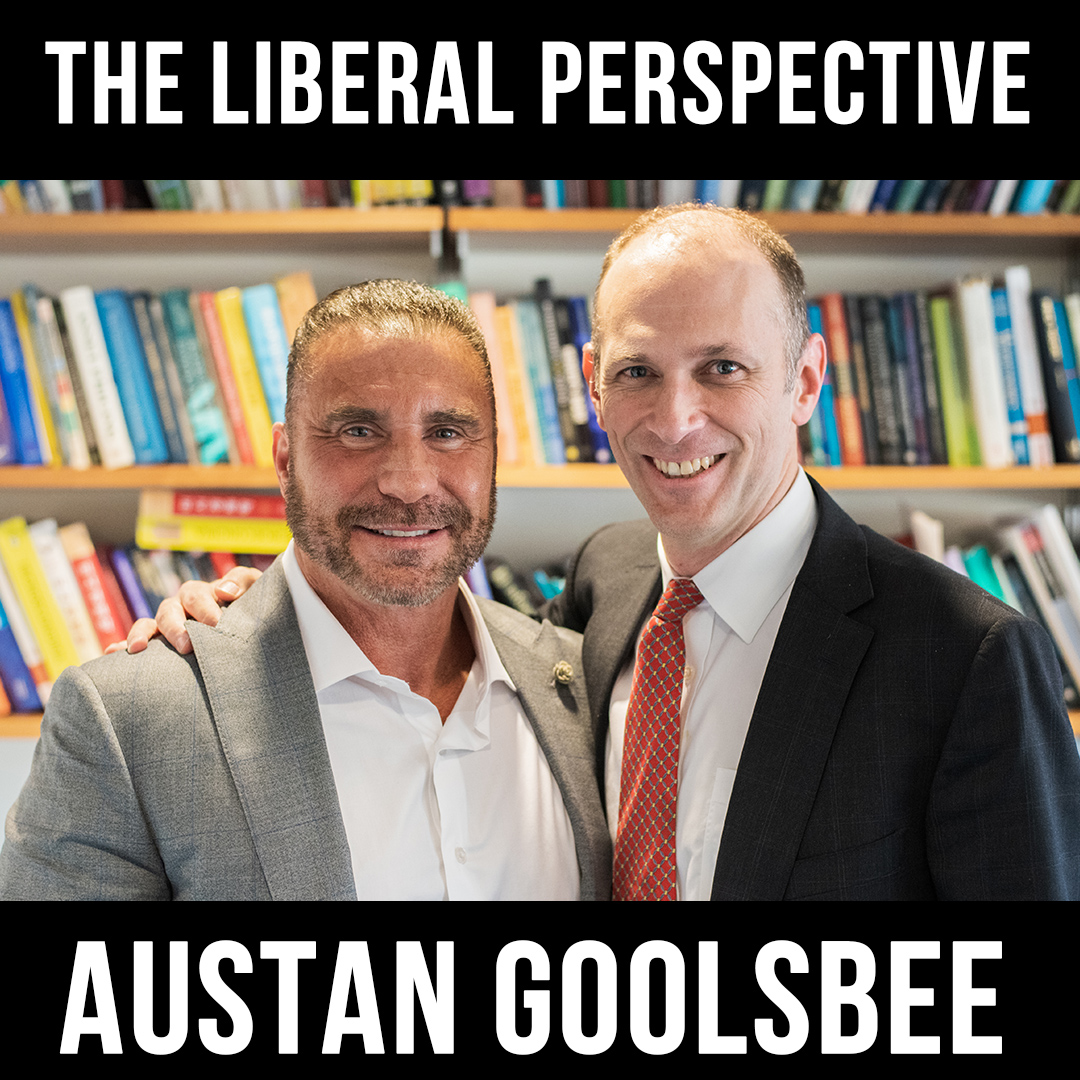
This is the admirer show. Welcome back to Matzout everybody. I'm excited today because last week you all heard sort of the more conservative perspective on the economy and on money with one of President Trump's advisers, Stephen Moore. And today I'm really blessed to have to my side here, Austin Goolsbee, an awesome member of Barack Obama's cabinet.
It was also the 26th Chairman of the Council of Economic Advisers, and there's a whole bunch of other things I could do to introduce him. But the reason I wanted Austin on the show is because I've been a fan of your work for so long, some of the ways you think and the way you handle yourself and the various interviews I've seen. So thanks for being here today. And thank you.
It's a real thrill for me to get to meet you in person. Likewise, and we are at the University of Chicago, by the way, which is one of the most beautiful campuses I've ever seen in my life. So I really appreciate your here. This is a great place.
It's not for everybody, but if it's for you, it's a... Well, it certainly wouldn't have been for me with my grades or my SAT scores. But my Austin's Yale undergrad, Yale Masters, and MIT PhD. So we're on the pretty much even footing intellectually here today, Austin.
In any event, I'm not adhering myself to my audience with these interviews because I'm going to take the Devil's Advocate position in both interviews, right? So with Stephen, I sort of took the more, I guess, more liberal perspective on the economy and challenged him, and I'm going to do more of the conservative viewpoint with you today as I ask questions. So let's start out with the elephant that's in the room, which we're hearing a lot about lately, which is socialism versus capitalism. This is great debate that we keep hearing.
First, you consider yourself a socialist or a capitalist, and how do you feel about the debate that's happening? 100% capitalist. I'm a free market economics professor at the University of Chicago. So socialism doesn't work, and I found the debate a little frustrating.
It's true, Bernie Sanders is a self-professed socialist. I don't think if you look at the other Democratic candidates, my point of view has been, being for Social Security and Medicare paid for by payroll taxes, that doesn't make you a socialist. Saying you think tax rates on high income people should be higher or should go back to what they were in some previous period, that's not really socialism. Can I challenge that?
Sure. So Elizabeth Warren has this wealth tax at 2%. That seems like redistribution of assets to me, which is sort of a socialist concept. Now, but the socialism, as I conceive it, the thing that doesn't work is the government runs the means of production.
And that, I think, is a terrible mistake. And if you look around the world where the government runs industries, takes over the industries and we don't have incentives or markets, you got problems. Tax rates, whether it's wealth tax, U.S. hasn't, other than property taxes, we haven't gone that far down the road of wealth taxes.
I could see why if you have wealth, you don't like to pay a wealth tax, just like if you have income, you don't like to pay income tax. If you buy things, you don't like to pay sales tax. Well, that's not really socialism. That's not socialism.
Let's just use that idea then. It stands on its own. I'm curious how you feel about that, because I am wealthy. But I also, well, I'm not going to tip my hand where I land politically, but I feel like that's confiscation of assets.
I mean, that's something you already paid income tax on or capital gains tax on. It's an asset of your family. And then secondly, how do you even, you know, hunt down people's paintings and how would that even look at application? Now, in the, in Europe, where there are a lot of countries that have had well taxes, it founded on these problems like this.
What the Warren, I haven't been advisor to Warren, so I'm not total expert on their, on the plan, but there's only starts at $50 million. So if you have $50 million, you pay $1 of well tax. I think it's not unlike property tax. And, you know, when you pay property taxes on your, on your houses, they, they'd have to value what's the value of your property.
I'm just saying, in a way, I guess my question would be what did you think was going to happen if Donald Trump's elected cuts taxes for big corporations on high income people by $2 trillion promising it's going to bring down mana from heaven. Right. And it basically doesn't. Okay.
And it's the most unpopular tax cut in the history of American polling. Because people look out and they're like, we just gave $2 trillion for a thing that didn't do a whole lot. And so I think it's completely natural that there would be a blowback. Okay.
People would say, let's go raise tax on high income people back again, because we just cut them so much and it didn't do anything. I agree with you, by the way. I do think that's part of the, the ebb and flow. Having said that though, I got like Steven Moore would say, well, wait a minute, it's working incredibly, we've got unemployment lower than it's ever been.
There's seven million unfilled jobs in the country, wage growth is finally moving. I looked at, I've always felt whether it's under President Obama, even all the way back to Reagan. There's just been no wage growth. I mean, the quality of life for most people in the middle hasn't gone so good.
It's been squeezed. Now, a guy like Moore says, well, hey, unemployment's low, obviously, crazy low. There's seven million unfilled jobs. Wage growth has started to tick back up.
GDP's back up. What's so bad about what we did? Well, let's just back and unpack each of those. Steve Moore has said that and the administration has tried to say, oh no, it was everything that we expected.
I think it's tough if we just sit down with the data. It's not true. You can take their, what they've predicted. Here's what the tax cut will do.
That it will pay for itself. It will generate massive business investment. That it will lead to family incomes to go up $4,000 each family. The unemployment rate is very low and it has been improving for nine straight years.
And if you look at job growth, it's just a straight line of improvement. And that's the strongest part of the economy. There's no doubt about it. It's a very strong job market.
Consumers look pretty confident. Wage growth starts to tick up in 2016. It's up a bit in 2017, 2018. Pretty good year.
That's great. That's the best part of the economy. It didn't generate its own revenue. Corporate tax revenue is more than $100 billion lower than what it was projected to be before they cut taxes.
Okay. Stephen said, told me tax revenues were at their all-time high. You're saying that's overall tax revenue. It's overall tax revenue.
And Stephen, who is a guy that I personally get along with very well. And we've debated many times. He is always prone to take nominal money. That is, don't account for inflation.
Just there's economic growth. And say, see, look, revenue went up. So that's why I wanted to start us with right before they pass a tax cut. The Congressional Budget Office makes a projection of here's how much tax revenue is going to go up over the next five years.
We're coming in way below where it was supposed to be and where it's where we're failing is on exactly the spot where they said it was going to pay for itself. That is corporate revenues way below what was expected. And business investment, which was supposed to be the massive thing that this was going to do. It's nowhere.
It's actually stock by back. And so you can see why people would be frustrated. Now, that doesn't that doesn't automatically mean, oh, well, then it should be a two percent wealth tax. That's over $50 million.
Fine. Okay. But again, I go back to if you try a $2 trillion thing that basically doesn't do what you promise. You can't really be surprised when people come back and they're like, let's raise taxes $2 trillion.
Yeah, because I am not a corporation. I'm going to do it. I actually pay a little bit more in Trump's plan than I play. Is that right?
Because you're in California. So I don't get to deduct my estate income tax or property tax. So that's changed. But let's talk about that point from then.
I went to the overall economy and kind of go a little more basic. But having said that, I agree with you. The revenues are not what they said it would pay for itself. It hasn't paid for itself.
It hasn't even come close to doing that. It's been pretty good. It's grown. It's obviously a much stronger recovery than yours was with president.
Go look at the GDP numbers. The much heralded, oh, well, Obama is the only president to ever hit three percent growth. Actually, they're now two presidents who have not hit three percent growth. It's barely been any higher than it was under Obama.
Okay. Post the recession. So that you can't count the recession. And now the projections for the second half of this year are literally in the 1%.
Now, I will say I do not attribute that to president Trump. So if the economy deteriorates or even goes into recession, we can talk about what would be the dangers of recession and what would be the signals to look out for. That's not Donald Trump's fault. And I when I was in the White House, I used to say when we get good news, I'd say 90% of what happens in the economy has nothing to do with Washington.
And so when it was good or it was bad, I feel like I have some credibility to say for the best parts of the economy. It feels like the Trump White House is trying to say we did that and for anything that goes wrong, they're like, that has nothing to do with us. You can't do that. That's true.
I don't know that that wasn't true with President Obama either because he did inherit this mess. I want to get out of the weeds. I just want to ask you a corporate tax cut thing. Because prior to that, those corporate rates being cut, I thought it was almost kind of a bipartisan agreement that we needed to reduce corporate tax rates to be competitive in a global economy because our corporate tax rates were so much higher.
You could have quoted me and you'd say, wait, didn't you say that they needed to let me criticize them? No, because I'm not. My criticism is not that we cut the rate on the books. Okay.
The great paradox or whatever you want to call them of the US government. The point of the value of the US corporate tax system is we have the highest rate in the world. And if you look at how much they actually pay, it was no higher than average. And say, but how is that possible?
How do we have this high? And it's because we had the goofiest system. We had a very narrow base and a high rate, which is the opposite of what you want. So what I always said, and what I thought there was bipartisan consensus on was let's get rid of a lot of deductions and lower the rate, but not cut the amount that corporations are paying by $2 trillion.
And I was trying to cut the rate on the book so it doesn't give these weird incentives. They took that on its head. They were like, oh, you said we need to cut the rates. So we just cut them and just run the bill off.
Okay, fair enough. That's a new one I've not heard before. So that's fair. So let's talk about, there's something that frustrates me as someone who came from the middle that's now a top earner.
And I know I sound like I'm crying here, but one of the things that's frustrating, and by the way, there's these blowbacks both ways, is this concept that the rich don't pay their fair share. And what I mean by that is I'm not a corporation, but I am a top earner, right? And I look at some data and I feel like, let's be real about who pays taxes in this country. And I know that's the only way to pay federal income taxes.
The top 1%, I know this isn't a popular thing to say, but the top 1% are in 21% of the country's income and paid 38, almost 39% of the tax revenue. The top, the top 1%, the top 1%, the top 1%, paid a greater share of the tax revenue to the US Treasury than the bottom 90% did combine. Of income tax. Correct.
Well, what we're talking about here? By the way, they also pay more in property tax, they pay more in property tax, they pay more in sales tax. And more in sales tax. And not as a share of their income.
But so the only, yes, that's true about income tax, but the big taxes paid by the middle class, they pay more in payroll tax than they pay in income tax. And so the Romney argument that like, ah, there's 47% of people who don't pay any income tax. So they're living off the state. That's totally misleading because that's not counting the main taxes that they're paying as tax.
See what I mean? I do. I'm following you. And so, once we add the fair share, I agree with you.
Now we're into a, that's not an economic thing. There is no economic definition of what is a fair share. And so now we're just explicitly in the political sphere. And some people are like, no, I think they pay enough.
And other people are like, no, I don't think they, when I tell them what I tell myself. When I tell them I tell them I tell them I tell them I tell them I tell them I tell them I tell them I tell them I tell them what I actually pay in income tax between federal and states, especially in California. They tell me, they think, wow, they had no idea. They got like over 50% in between federal and federal.
But now the thing is, I can tell from that that most of your money comes from direct earnings, ordinary earnings. And you live in California, so you got a high, you know, a high tax from that. Now, a lot of the very highest income, highest well people in the country, that's not true. They got capital gains.
They got capital gains. They have other forms of income. So then they, so then you get into this, you get into these arguments about. Which lands us, I think.
I mean, which lands us where people think, you know what, I, this socialism idea may be a good idea. But it's not socialism to say that we should have higher tax rates. I'm with you on that. I'll acknowledge that.
Whether I completely agree with that or not, I don't know. But I'll give you that. But I think you would agree with me that your party has been starting to be hijacked by a pretty large segment of people who at least think they believe in socialism. It may not even be.
For sure, Bernie is there. He says, I would have argued, no, it's not as big as you think it's been mischaracterized. But I can't deny Bernie Sanders says he's a socialist. He criticized Elizabeth Warren publicly and said she believes in markets.
I don't know. So for sure, Bernie's folks don't like me. And part of that dates back to 2016, he outlined a health plan that somebody had scored that was going to cost $20 trillion. And they asked him how would they pay for it.
And they had an economist who said, well, it would raise the growth rate of the country to 5.5%. So it not only would pay for itself, it would eliminate the national debt. And I wrote a letter with three other previous chairs of the Council of Economic Advisers. He said, don't do this.
When the Republicans go for tax cuts, they do stuff like that. And we're always out and saying, wait a minute. That's bogus. So we said that to Bernie, my experience was Bernie's people do not take criticism very well.
Well, facts are funny things, right? So you touched on something earlier, but I'd like you to speak on, which is I asked Stephen this question. Where's the economy? Do you feel like we're in danger of a recession?
Because everyone just wants to know this. They may not care that much about top earning taxes and some of the other things. But what signs are you looking for and where are we out on the economy? Super important.
And look, I teach at a business school. 90% of the economy has nothing to do with Washington. 90% of what I think about economics is not about politics. So everything I'm going to say is I'm not pretending in any way is evaluation of the White House.
Like I said, I am afraid. I think there is a pretty decent danger that over the next year we could be facing recession. Not from Donald Trump, not from any policy, but the way I view it, if you take a step back and ask since World War II, we've had 14 or 15 recessions, depending on how you want to count some of the double-dip recession. And a very small number of things have caused all of the recessions in the United States.
The Fed either raising interest rates overly fast from what the economy can handle or keeping interest rates higher than the economy can handle is the major cause of recession in the United States. On that, we've gone through a long period, multiple years in a row where the Fed has been over-optimistic in its predictions of how well we've been doing a year or two years from now. In a world like that, where the Fed, as I say, is kind of 36 quarters in a row, 36 times in a row, wrong in the same direction, that's at least a yellow light. That could be a cause of recession.
Two, asset bubbles popping, whether equity, first internet bubble leads to a 2001 recession, housing bubble popping leads to our last recession. I don't know if we're in a bubble, but prices of a lot of things look pretty high. If you just try to buy a house in Laguna, then it seems expensive. Sure does.
And so you at least got to give a yellow light to that. Third, oil prices have caused recessions. That's not as big of a danger. Oil prices aren't up that much.
And we became a big oil producer. So at least part of the economy would do well of that. And then fourth category, a lump in, hasn't really caused recession in the US, but has caused recession outside the US, is major national policy action by the government. And in that one, I would say there's at least a yellow light of caution around escalating trade war between the two biggest economies on the planet.
So three out of four are at least blinking. And we're in the longest recovery in US history. So we're in a way we're doing. So the strongest parts of the economy are the job market is very strong, and the consumers still quite confident in consumer spending strong.
The weaker parts, if you look at manufacturing, so if you look at say, normally I would tell you, if you said, what should I look for, I would say, look if the, the yield curve inverts, that is if long rates get to be below the short rate, and then I would say look at the most cyclically sensitive parts of the economy, like manufacturing, durable goods, business investment. Manufacturing might already be in a recession. And not just in the US, around the whole world. The manufacturing is kind of already in a recession.
Consumer durable is still looking pretty decent. Business investment looking kind of weak. So all of those, I think are points of concern. I think they're points of consensus.
Right? Most people that I've taught to. Yeah, well, it wasn't was Stephen. But with other people I've asked who might respect like yourself and I respect Stephen to, but that is the consensus.
And one of the other concerns I hear, and I want the audience to hear your thoughts on this too, is if we did slip into one, that perhaps may not be quite as deep necessarily as last night, but maybe longer because there's not a whole lot that Fed could do from where it is now. And that that's a concern I have. I think that's a good concern. I think that's a valid concern.
On two grounds, one fed to a box of smaller. The runway shorter, as they say. Normally the Fed cuts the cut interest rates 4 percentage points. And you do that if the rate is not less than 4%.
Although I guess in Europe now they got negative rates. But I think the short runway problem, the second, and I even wrote a little thing about that in the New York Times. Often one of the most powerful bits, economic bits of a Fed rate cut is the fact that there's pent up demand. So if the Fed cuts rates and at least mortgage rates that go down, there's a mass of people who've been waiting.
Maybe if the rates come down, I'm going to refinance. We've had nine years of rock bottom rates, so if anybody was waiting for rates to come down, they already did it. So I think that's a valid concern. The other thing I will highlight is, and maybe it destroys my own credibility, but economists are terrible, not just at predicting recessions.
At predicting recessions that already happened. They're terrible at predicting. So in 2001, I think that the recession began in April of 2001. In June of 2001, they had a survey in Wall Street Journal, and I believe only 7% of economists thought we were in a recession.
But the recession's been going and it's almost done. And they didn't see it. So we only see recessions after the fact. You said earlier one of the four concerns was trade, and I was going to ask you about this anyways.
Isn't there a part of you that is glad that President Trump is trying to do something about China this way, with our trade issues? Not if you add the phrase this way. I saw Donald Trump say something to the effect of nobody's ever gotten. He's ever asked the Chinese to do anything.
And I'm finally am. That's not actually true. So if you look at the past history, one of the biggest confrontations, sources of friction or whatever, with China that we had in the past, was that they were constantly devaluing their currency. And we got them to stop devaluing their currency.
And the way we did that was, A, we had very specific demands. And B, we got all our allies on the same page, and we went to them behind the scenes and said, look, we don't want to make a big public battle. You're going to have to stop doing A, B, and C specific thing, or else all of us are together going to come. And they stopped.
This approach that the administration has taken, which is, let's try to publicly humiliate and confront China to get them to do what they want. That's not like I'm the world expert in negotiating. I was at the S&E demeaning's, I've talked to the Chinese economic officials. This is a recipe to get them to not do what we want, because they can't, if you're the head of China, it's not a democracy, but you've got to answer to your own people too.
You can't be like, oh, you know what? I'm going to do everything Donald Trump said. And he's right. And I should be ashamed to myself.
Publicly kneeled down. Publicly kneeled and do as I say, they won't do it. And we've declared and threatened trade wars with all our allies, so they're not on board with what we're doing. And we don't have any specific agenda.
We're saying we want them to stop violating intellectual property. Okay, well, how, what do you want them to, if you gave them a, they think that they've been making concessions. They opened up their financial markets, which is a thing that we, the US, have been asking them to do. And they're kind of like, well, if we do that, what will you do?
And so I don't know. So you like that it's being approached, but you don't like the nation, which we've done it? I kind of don't like the nation, which we've done it. So I don't object to the approach that says, hey, we want to be tough on intellectual property and China.
Bearing in mind, if you get tough on that, they probably will go back to devaluing your currency. But that's okay. If you decide one is more important than the other, then just have a strategy about it. This strikes me as, as a lot of, a lot of the people who want to cover for the president.
If he does some things, some of the things that he does that you can agree with, they'll say, see, that was a good one. And then if he does something that's a mistake, they want to come up with a rationale. How's that any different than President Obama? That's what people around presidents do.
I don't know. I thought, or I at least tried to be more objective in when I was in the administration, and certainly when I was out of the administration, if they asked me what was a mistake that you made or that the president made, I would try to think through and say, well, look, here are places where we made mistakes. I haven't noticed any willingness to do that. Tell me one thing.
Tell us all one thing about the president Obama that we might not know. Something about him and all your interactions with him that, you know, maybe not people may not know about him. But his personality, the way he thinks, anything like that. I would say the popular view, and Mike's, I knew President Obama, when Michelle was way more famous than he was here at the university, he had a major job at the university.
He was my state senator here in Hyde Park. And my oldest child was a daughter, and she's right between the age of President Obama's daughter and they were all in the lab school. So we had a bunch of common friends, and I knew him as a guy from the birthday party. So he was teaching at the university, and he ran for the US Senate.
And that's when I first got involved with him. And they called me and they said, would you be willing to help on policy? And I was like, Michelle Obama's husband? Are you kidding me?
That was my introduction. I feel like I've known him for a while. I would say the popular conception that he's not a guy who gets way low or high, he's very even killed. And my experience is pretty accurate.
I would say maybe is not as well understood. He's got a kind of an introverted side. Okay, so he's amazing speaking, give amazing speech, you know, when the teleporter, the thing. But he's sort of a private guy.
And I heard I wasn't in the Clinton administration, but there were a bunch of people who were. And I would ask them, well, what's the difference? Does he manage the same? What's the difference?
And they said President Clinton was much more like he'd get to the residence and then he'd like, he'd want to call you from the bathtub or whatever. And he's like, tell me about this mortgage fund. Obama's not like that. And the only puzzle, and I had this puzzle about him through the whole campaign too, is he's kind of got the personality of like a writer.
Interesting. And how did a guy who's got an introverted writer side end up wanting to get into politics and run for president? I never really sorted that out in my mind. That's incredible.
It's not even to this. Yeah, it's like a, there's a, to me it feels like a little bit of contradiction. Sure. I appreciate the insight.
And that doesn't surprise me, ironically, only because a lot of the people that I know in my life that are incredible orders actually are. I'm talking about whether they're a performer, a singer, a public speaker. I'm not in any way suggesting that I'm on anyone's level that way, but I'm also introverted and I speak publicly. It's surprising to me.
And you're introverted. I would have pegged that. So then that gives me a tool or something to analyze this a little different. So if you had a criticism of him, what didn't get a cop or should have when he was president?
I asked Stephen Moore this and he gave me a pretty transparent criticism of President Trump. If you had a criticism of President Obama, whether that be in something that you observed a decision or just something that you didn't go far enough, you would have gotten done. Anything like that. I could take that two ways.
One, I could tell you the thing that's like the most disappointing or heartbreaking to me that it didn't go that way. Or we could get into details of where was what was some policy mistake that if you had to do over again? The most disappointing to me is that through the campaign of starting at 06 really, but all of 07, all of the way, we have a horrible financial crisis. We go into the thing, Obama really wanted to be a figure that was going to try to get us out of these horrible battle lines that had been developing at least since the end of the Clinton years.
But they had gotten worse over Bush. They had it in his head. Red and blue. Just fighting.
And just, you know, it felt like every policy, every election, every battle comes down to 50 plus one and 49. And for whatever reason that didn't happen. We did not transform politics to be kinder gentler, less confrontation. Now, if we then say, you know, who was at fault, I can give you a list of a bunch of reasons I don't really think Obama was at fault, but I still, it kind of breaks my heart.
That didn't transform things. The night of Grant Park that he wins the election. My wife and I are there, we're standing 20 feet from him in the stage. And it was an amazing night.
And it felt like, you know, as bad as the financial crisis is, as bad as all this stuff is happening, maybe we can open a new door and do something different. It didn't happen. That's the, I find most disappointing. When Donald Trump came in, when he was first running, there were people who said, well, if Obama's fault, Obama gave us Trump.
There is a sense in which I do think that's true. That there is this inevitable pendulum swing. And in reaction to Bush, we elected Obama. And in reaction to Obama, we elected Trump.
And I do think there is something to that. And I don't want to be overly critical of either two presidents because I have admiration for anybody who seeks that office and leads our country. So I don't want to make sure I've said what I thought on that. Yeah.
Look, it's fair. You were very fair. I've heard a lot. He didn't fix it.
It certainly existed. I would say, look, if you still, I think he's going to be remembered as the Democrats Reagan. And they are going to point to that there was no depression, despite the massive crisis that we experienced, that they put in Dodd-Frank and reregulated the financial system, and that they passed them. A massive expansion of health care coverage for millions of people in the United States.
Those are going to be major, era making historians, whether conservative or liberal, are going to remember that is that first two years of the Obama administration were a period of massive doing, like the first year of the Reagan administration, like the first year of Lyndon Johnson. Yeah, I certainly agree with you on the first point. No question about it. The third point, though, and I want to ask you about this anyway.
I thought when I asked you what he didn't get done or that you were disappointed in that you were going to tell me that what he really wanted was probably universal health care for all. But he just couldn't go there. So he sort of, you know, Obama care was sort of a compromise of what he assumed could probably get done realistically in that short window period of time. And in that question, how do you feel about universal health care and Medicare for all as a program on its own?
Well, I think the ACA is going to be remembered as quite an important move. And I mean, the number of people in the country losing insurance was rising by the millions every year. For year after year, the ACA has passed and millions of people get coverage. I think it's a tremendous achievement.
It's one that many Democratic presidents before tried to do and were not able to do. As part of the guy, I mean, it came down to one vote. So along the way, they did have to get rid of things like they started wanting a public option that it would be like a Medicare, you could choose Medicare. And there were Democrats who said they can't support it.
That's in there. So it was like, why? That's not going to be in there. If the Democrats can't vote for it.
So I am a little frustrated to see the critique from the left, let's call it, of Obamacare, that it's like, oh, well, obviously we should have done five times more because that's a purely academic exercise. I think a lot of people feel like it wasn't a very effective, well done piece of legislation in terms of some of the things that were promised about keeping your doctor that rates were going to be precipitously lower. However, on my side, or from my perspective, one of the great things about it is the idea that these pre-existing conditions are no longer going to be an issue. I think that that is a winner.
And I think that's right. And look, the step back from the politics of the specific bill, the basic concept of what was going wrong in the insurance market, everyone knows. And that is, rather than like in every other business where the companies are competing by getting better and faster and cheaper, what was happening is the insurance companies were getting better at figuring out who was going to be expensive and dropping them. And we won't cover you.
You got pre-existing condition. Whatever. You know, your dad had terrible heart problems. We're not going to cover you.
And the ACA fundamentally changes that. And that is an important thing. I think that's the big win for me. Look, there's details on what I'm sure for all the Austin.
Okay. So now, major care for Medicare for all. Everything hinges on what does that mean? Okay.
The Bernie Sanders version of Medicare for all is not Medicare. Okay. That's not what Medicare is. So that is all mental health, physical health, dental care, optical care for free with no copay.
Okay. Okay. That's what the, that's what one version of Medicare for all is. That costs $30 trillion, I think.
And then the question is, could you save money? It is true if you look at single payer systems around the world, they're way cheaper than the US system. So if you could get their costs while by doing that, that would go a long way to paying for it. The only thing is there are a lot of things about the US system that are not the same.
You know, doctors are paying more. We pay more for prescription drugs. We have a different lawsuit in the tort system. There's a lot of things that are different.
And Medicare has a private option in it, the Medicare advantage. Sure. Sure. And it's not, everything is not free.
It doesn't cover all that. And you'll peed into it for many, many years. And you'll pay it for the biggest assumption. If you add up what you've paid into it, it doesn't nearly add up to what it costs.
But yes, you have paid into it. So that's why I say, to me, the phrase Medicare for all on the Bernie Sanders bill is, is, is, it's, it's, it's mistitled. It's just, it's, that's not what Medicare is. Okay.
Now, if you, I was in favor when we did the ACA of having a public option. And I still favor it now. That is to say, there are subsidies in the ACA. If your income is middle income or below middle income, you only pay a share of your income.
And you get a, you get a subsidy. And if you use that subsidy to pay up the premium for Medicare, and you could just buy it. You're like, you went to an exchange and you could buy into Medicare just like you buy a private plan. I would be in favor of that.
And actually, that's cheaper. That doesn't cost anything. That's actually cheaper than the system we have now. In my world, you should be able to call that Medicare for all because allowing anybody buying Medicare, but you know, now we're into the semantics.
You know, fighting within the Democratic primary, everybody's going to fight about, well, no, that's Medicare for everyone. That's not Medicare for all. And I don't know. But you'd agree with me.
If you went somewhere like Bernie's playing, middle class, middle class people would be paying more taxes at some point. I think so. I think so. Now, so it is worth saying, if you want to call those middle class taxes, premium, because in a way, it's like you're paying taxes for premium.
You do have to think about, well, if you wouldn't have to buy health insurance, you might be a better one. There's not a part of you that thinks like I do that, my gosh, like 70 something percent of the country at least is really happy with their health care. Do they get through their employer? They like their doctor?
They like the plan? They like how it works? Why are we? Why is this such a significant topic?
Why I mess with that? The vast majority of people look at this stuff and go, I really like my gig. Why are you people messing with this? And I wonder that.
The only thing I'll say is a lot of people like their insurance and nobody likes how much they have to pay for it. And the prices go up each year. So if by having a public option, let's say it applied more competitive discipline so that prices did not rise as fast, I think a lot of people, that's why that is a very popular thing. And maybe short term that's true, but historically every government program ends up lacking those disciplines long term.
Yes and no. I would be a little careful now because once you get into health because of this cream skimming problem, it actually is the case that in most of the, unlike most industries, if you look at single payer government run plans, they tend to do better in other countries. I'm not necessarily just talking about efficiencies to an application of the healthcare. You guys live in Canada, I travel up to Canada.
There's a pro mix bag up there about how they feel about what they get in terms of service, wait times for surgery, wait times for certain things like that. There are, but I'm scared to act. I'm not disputing that people look, everybody is fundamentally uncomfortable with the healthcare system because we all get sick and we all die. And so it's like being at hospitals and we're prone to not like that system.
It's not, if you look at Canada, it's dramatically lower cost. They have better life expectancy than us. And the Canadians, if you ask them, would you like to have the US system, there's massive non support. They do not want to speak.
Well a lot of my friends are that have their own means by private plans because they have to have it. That's why I say in Medicare, we have private plans. But if you, if you have in your mind that government, a government option is socialism, I think you got to kind of figure out why is Medicare as popular as it is and why Social Security is popular as it is. It's because universal coverage is in a way the cheapest of all coverage.
Okay, so let's put a bow on this and we're almost done for everything. That whole, this whole discussion, if we just step back for a second, this is, I mean this too, when is there a point eventually where the entitlement programs in general aren't always going to be the fix for things? In other words, how many of these can we have? Once this is done, what's the next big government program?
And I mean that from both sides, but it just seems as if there's one after the other, after the other. Does it become a point where like the government can't fix all of these things all the time? This is the, this is the yin and yang or push and pull or something of modern capitalism, which is we're unbelievably productive compared to what we're going to go back to 1500 or something. Talk to the peasants and show them like, Hey, look, I can drive to the corner and fill up my car with gas and drive.
I got a phone to tell me where to go. So we're massively productive. We have high incomes, but we have every rich country, ops to have a safety net. And the safety net includes retirement security, includes health, health care security.
We have unemployment insurance, we have food stamps, we have mandatory. If you walk in the emergency room, they got to treat you. You know, so we got a bunch of, we got a quite a robust safety net. And one point of view of that safety net is to be like, well, how can we pay for that?
And shouldn't we skim it down? I kind of think the 500 years of history tell us it's, it's almost the opposite. What makes us rich is we get more productive. And one of the things we buy with our wealth is a safety net that we don't have to, we don't have to, we either we ourselves don't have to go below or nobody in our society has to go.
We're rich enough that nobody does that. So I think the answer is that vastly, our capacity for safety net is vastly in excess of where it is. I mean, it doesn't mean that we have to, and that's not social, insurance is not socialism. No, I don't think that.
I guess what I'm referring to is what you said about we're vastly very productive. I think one of the reasons we're incredibly productive is because there's an incredible incentive still to be productive. And if the safety nets get bigger and bigger and bigger and percentage of income is taken greater and greater, those incentives to be productive go away. And that's a very nature of a capitalist society.
It's incentive to be productive. All I will say is be aware there are also some arguments on the other side that say the existence of a robust safety net actually enable people to start their own businesses and not be nervous. Like, I just have to work for the man my whole life because otherwise I can't get health insurance. If you can get health insurance on your own, you can go start some company, try it out.
And if it works or doesn't work, it's on you. And the, if your worldview is that the thing that makes us innovative and entrepreneurial is the lack of taxes and the lack of regulation, then I kind of think the puzzle you got to answer is what is the deal with California, where they've always had the highest taxes and they've always had the highest regulation. And why is Silicon Valley there and not out on the island of Vanuatu where there's no taxes of any kind? And the answer is it's not that they go to Silicon Valley because it's cheaper.
They go there because they can't afford not to. And if you cut the taxes so much that you can't invest in education or your people, you've done a terrible disservice. And I'm sure you don't disagree with that. And I don't disagree with that.
And I don't disagree with that. And I don't disagree with that. And I don't disagree with that. And I don't disagree with that.
You could over tax and over regulate your prosperity. There's no question about that. Of course you go. I haven't lived in California.
You could also argue that Microsoft ended up in a state of Washington, and there's no income tax there. So I think I might be more through circumstance than so they went there to grow. Although those companies, obviously, have been there a long time. I have instead of though, I look at California as a state, and I'm concerned about what I see in our state.
If you go to the cities of California, the homeless issues we have and the overpopulation issues in California. It's a really significant thing, and I know a lot of them are leaving that state because they feel like there aren't incentives to stay there to start up new businesses. That does happen. Look, you can definitely and we can find hundreds of examples, where government being too aggressive in taxes and regulations and regulations and whatever do you do?
and whatever, destroy the Golden Goose. The question is, for example, now, is a tax rate going back up for high income people to something that it absolutely has been many, many times in post World War II in the United States? Is that so extreme that it should be called socialism and it's gonna destroy the American Dream? I think Steve Moore or others are a little too, maybe it's Dr.
Nair, they're a little too, it's almost a religious conviction to them. And my thing is, hey, let's just go look at the data. It is not the case that, I don't wanna have too many negatives in this sentence, it is true that we have had tax rates well in excess of the rates that we have now in high income people. They've paid more and we've been deeply innovative and it certainly doesn't seem like these tax cuts for billionaires are magic beanstalk beans for anything.
I mean, Bush cut them more than they've ever been cut and we had measly growth followed by a real crisis. And now Donald Trump has cut them two trillion dollars and growth is barely, the second half of this year is that I might not even get to 2%. So I mean, it's like, that's not a magic one. Yeah, that's why I wanted to have this type of discussion because it hasn't been about, I said this is Steven.
President Clinton said something, I don't know that he believed it or not. He said politics shouldn't be about it, in fact I don't think he believed it. But he said politics shouldn't be about who's good and bad, but about who's right and wrong. And I think the kind of discussions that we've had today, obviously the discussions that I have with Steven helped people at least think through some of these issues.
And I wanted to have you on because I wanted to be able to challenge your perspective like I did Steven. I would have been disappointed if you didn't. And look, in society, if you could even have one conversation, civil conversation where you engage on ideas with people who disagree, one thing about the University of Chicago is we've always had that this was, what Milton Friedman was from here. Which is Steven's hero.
Steven's hero. And we've got behaviorally common us like the guy Dick Thaler who just won the Nobel Prize. And we're in the same room, in higher education, like in politics, that's gotten rare and rare that you have people disagreeing. It works because fundamentally, we all kind of love each other.
You know what I mean? And so we're fighting about content. I'm not all just milk toast to happiness. We are fighting about it, but we're not trying to kill each other.
We're family. And so I hope people can do that more. I do too. Real quick, armchair forecast here.
We got the armchair. We got it by the way, the armchair. Also, Ben Bernanke's Fed Chair sitting right over here too. It's pretty cool.
Last question will be an easy answer. If you had to predict right now, here we are many months out. President Donald Trump has reelected or one of the Democrat whoever ends up being the nominee ends up winning. You have to predict right now.
Oh, Democrat or Trump? Yep. I feel like Trump barely won last time. And he's gotten less popular.
So if the Democratic nominee is more likable, is a better candidate than Hillary Clinton, that Trump's in trouble, that's what I think. So I actually, I don't know, not the vote chair, but I think probability of victory, 60-40 for the Democrats. I enjoyed today. I did too.
I really like it. I really like it too. I appreciate the conversation so much. Everybody, now listen, for my audience, I don't want to be hearing that I was too hard on him or not hard enough.
They're going to say, why did you have that vote on there? I don't know. I don't know. It is a good guy.
You know that. Don't hold against. So it's Austin. So guys, please, I'm trying to ask questions that are fair and down the middle.
If you're a conservative, you feel like I didn't push him hard enough on different things. Give me a break. And if you're a liberal, you feel like I pushed him too hard. I just try to get the best answers I could at Boston.
So you could hear his perspective today, not mine. And I'm hoping between hearing both the conservative perspective from Stephen and the more liberal perspective from Austin that is just making you think about what each side has to stand for. And maybe it'll help you make some of the decisions you need to make as you vote. And as you move through your life and decide whether you're going to start a business or not, start one.
Say it your career or not. And so thank you again, Austin. That's it. I want to remind you, every day on Instagram, we're on the max out two minute drill.
Every day when I post at 730 Pacific, 1030 Eastern, you've got about two to five minutes to make a comment. If you do that or make a comment on people's comments or third, just comment every day on every post I make at the end of the week, we pick winners. So I can engage with you. I read all of the comments.
And it takes a long time. But you win max out gear. Tickets to come see me speak. I ride on my jet, possibly coaching calls with some of my guests, coaching calls with me, all kinds of great stuff.