
EPISODE · May 9, 2026 · 1H 8M
The lifestyle and opulence of the inhabitants of Jambūdvīpa (5th Canto #18)
from Mysteries of the Vedas · host Caitanya Chandra Dasa
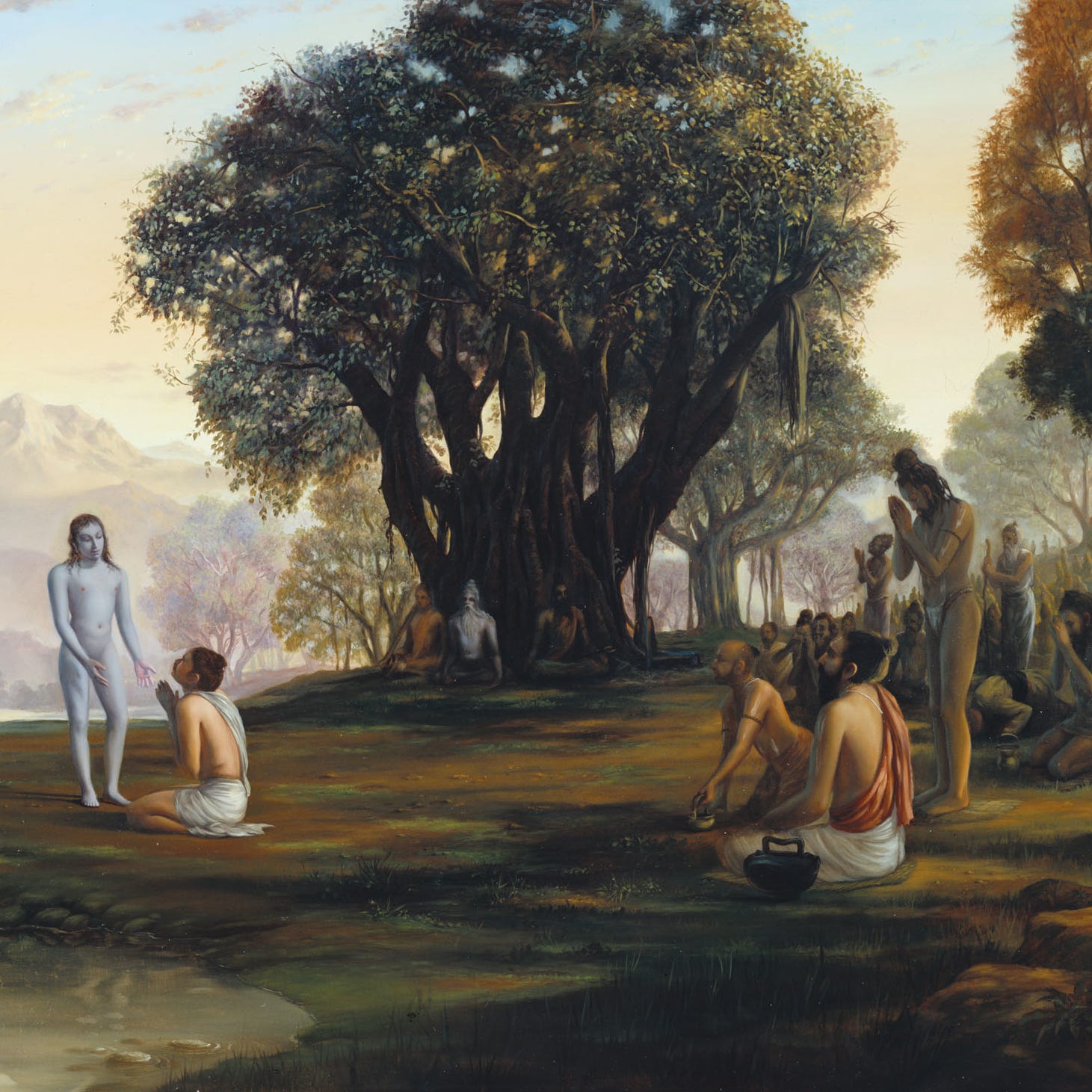
The lifestyle and opulence of the inhabitants of Jambūdvīpa “On the side of Supārśva Mountain stands a big tree called Mahākadamba, which is very celebrated. From the hollows of this tree flow five rivers of honey, each about five vyāmas wide. This flowing honey falls incessantly from the top of Supārśva Mountain and flows all around Ilāvṛta-varṣa, beginning from the western side. Thus the whole land is saturated with the pleasing fragrance. The air carrying the scent from the mouths of those who drink that honey perfumes the land for a hundred yojanas around.” (SB 5.16.22-23)To the west, a complex of five rivers of celestial honey flows from the great kadamba tree situated on top of Supārśva Mountain. These five rivers flow around the whole Ilāvṛta-varṣa. The special characteristic of this honey is a very pleasing fragrance that perfumes not only the environment, but also the bodies of the inhabitants of these places. Instead of depending on artificial perfumes and cosmetics, they maintain their beauty in attractiveness by simply consuming the products of their celestial abode. “Similarly, on Kumuda Mountain there is a great banyan tree, which is called Śatavalśa because it has a hundred main branches. From those branches come many roots, from which many rivers are flowing. These rivers flow down from the top of the mountain to the northern side of Ilāvṛta-varṣa for the benefit of those who live there. Because of these flowing rivers, all the people have ample supplies of milk, yogurt, honey, clarified butter [ghee], molasses, food grains, clothes, bedding, sitting places and ornaments. All the objects they desire are sufficiently supplied for their prosperity, and therefore they are very happy.” (SB 5.16.24)The great banyan tree on top of Kumuda Mountain is the source of many rivers, which are described as “kāma-dughāḥ” (fulfilling all desires). The verse lists a long list of desirable items (milk, yogurt, honey, ghee, molasses, grains, clothing, bedding, seats, ornaments, etc.) that are directly connected with these rivers. This appears to indicate that these rivers are the direct source of all these objects, which are supplied for the happiness and prosperity of the inhabitants of Ilāvṛta-varṣa. In other words, these rivers are like kalpa-vṛkṣa trees that supply everything desirable. In this way, no one there has to work to obtain all the necessities of life… Get full access to Mysteries of the Vedas at www.ccdas.net/subscribe
Embed this episode
Ready to play
The lifestyle and opulence of the inhabitants of Jambūdvīpa (5th Canto #18)
No transcript for this episode yet
Similar Episodes
No similar episodes found.
Similar Podcasts
No similar podcasts found.