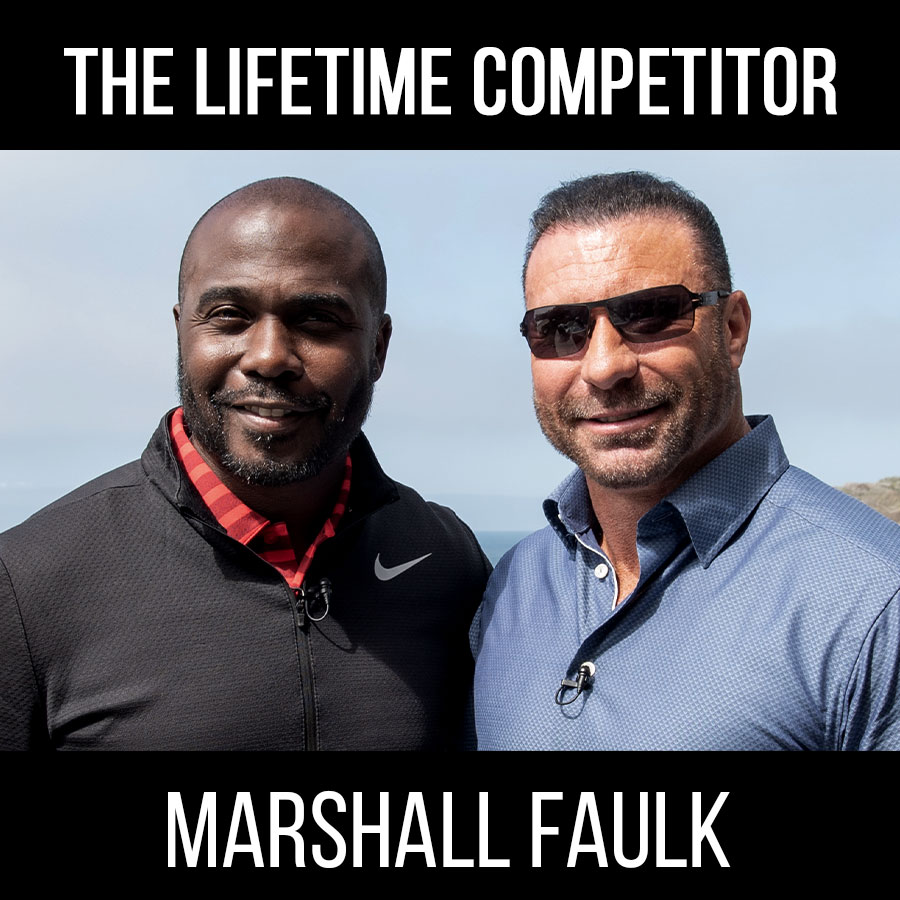
This is the end my life show. Welcome back to Max out with Ed My Let. This gentleman to my left does not need any introduction, but I'm gonna give him one anyway. This is NFL Hall of Famer.
Only man of the history of the NFL with 70 rushing touchdowns and 30 receiving touchdowns in the history league. This man right here. So this is the great Marshall Fox. You want to me here today?
Thank you for being here. Oh, thanks for having me. It's really really a blessing. So I knew who you were before the rest of the world does.
And when I tell you this story, I don't want to tell you. I'm gonna know right away what I'm talking about. I want to call it University of the Pacific. You don't know what I'm about to tell you?
Yes. So I made your school famous. Yeah, well, you became famous because of my school. Actually, it's how the way I look at it.
So just so you all know, I knew who this man was before the whole world did really in football. I played baseball at University of the Pacific and my sophomore year, they asked me to come play football because our corner got hurt. And luckily I pulled a hamstring that week. So I sat on the sidelines and watched this guy enter the game.
Let me tell you what happened. First off, it wasn't even starting right back that day, right? You weren't even the starter? No.
You got the starter. This pain ends up getting in the game. It goes 37 rushes for 300, makes it right. 386 yards.
Did you see what I said? 37 rushes, 386 yards. Seven touchdowns. It was responsible for 44 points in this football game.
Do you remember that game? Oh, yeah. Oh, I cannot forget it. And so at that point, I went A, I'm not playing football because I don't relate to that at all.
And B, I just watched one of the greatest football players of all time. Way back when. That was really the beginning kind of wasn't it for you. That was the start of everything.
It was that game was. Yeah, that game was it was like Hello World for me. Yeah. And people always ask me like man, because you envision yourself, you don't have those kinds of dreams.
You have dreams of being successful. But to that degree, it just you can never fathom or thinking your head that's going to happen. But I always felt people I was prepared for it though. What do you mean?
I was prepared the work that I put in making sure I knew I was the backup. And as the backup, I got a senior playing in front of me. He was all conference. The chances of me playing, the week before, I got like two snaps.
Is that right? And then second week of the season, he goes down and I'm in the game and coach looks at me and he's like, you just hold on to this football. You think about all the film work that I put in, just wanting to make sure that if I do get in, I know what I'm doing, I know what I'm supposed to do then I'm not going to let the other 10 guys in the huddle down. And that's the work that goes in.
And the opportunity presented itself, I'm just glad I was prepared. You talk about taking advantage. I think in every career that's true. What if you don't, what if you don't perform it?
What if you put a couple on the ground that day? I mean, we may, it's possible you never even see a football field against possible. So it's true for all of you, even starting out the interview, there's going to be times in your career and chasing your dream where there's going to be a moment. Oh yeah.
And those moments are few and far between them. When they arrive, you need to be prepared for them because that was the hello world. I mean, I'm telling you, I've been doing a lot of sporting events, but I've never seen an athlete dominate other athletes in my damn life like I did that day. And I knew after that point, I better keep an eye on this guy.
So before you get there though, before you become an NFL Hall of Famer. And one of the best football player I've ever seen, right? So, were you not? Obviously, I'd be a great high school player, but how do you only end up at San Diego State?
I don't mean to put down San Diego State, it's a great school. No, no, no. But this isn't USC running back university back. Right.
So how come you end up at San Diego State and not one of these big schools? It was a combination of back then, they didn't label, you were only labeled to a position. If you were running back, you were running back. You played defensive back, you played defensive back.
You played receiver, you played receiver, you played receiver, you played receiver. They didn't have this thing called the athlete. And in high school, I played quarterback, receiver, tight end, corner safety. I kicked, I punt it.
I returned kicks, I returned puns. I kicked field goals, I held for the field goals. I did everything. I did everything.
And my football coach, my high school football, exactly. He built football players. We were, we weren't a big school. But we were like, we were the smallest school in the biggest division.
And we didn't have a, I mean, I played whole games in high school. Literally every snap. When I got on the field, I didn't come up until halftime. I played offense, defense.
I was on every special team. Oh my gosh. I never left the field. You think that has something to do with the way you played in the NFL?
You were really kind of that new breed of like a complete football player running back. You blocked well. You understood the blocking schemes. You were a great receiver, right?
Obviously a great runner too. Do you think that had something to do with it? A lot to do with it. Yeah.
I became the why, why are we doing that? What is that? I want to do that. And my coaches, early in my career, my coaches, they didn't like it.
Coaches don't like explaining why. Hey, we're going to do this play. Hey, coach, why we're doing that? I watched the film and they do this, this and this.
They look at you like, you couldn't appreciate the fact that I was watching film on my own. You were. You know, at a young age, I'm going to go on my own. Yes.
Yeah, you're always going to student of it. Just I love football. And there's only one way to get better. Yeah.
And everything that I did, I went home, I watched film, I watched practice. We watched practice and I go home, I watched practice. You did. Yeah.
That's not the only way to get better. Is that and that's the only way to get better or anything, right? Yes. Is that a separate?
That's all I want to ask you. So you get to the NFL, by the way, I never might mark saying literally their goal. It's almost like a basketball player like LeBron. You want to get as many touches as you can't.
You're really one of the first football players I ever saw where the coordinator literally said, we need to get him X amount of touches at football game. And that's part of that because of your preparation too. It was, Mike felt, if they tried to get me to, as much, he could get me to ball as much as possible. Yes.
And when they couldn't get it to me, if they showed me as a, like I'm the primary. Yeah. And I attract attention. There's a lot of one on ones.
Isaac Bruce is going to win. They're going to win. They're going to win the majority of the battles of the one on one. As soon as they get me to draw the attention to my position.
It's totally different way of using a running back in that time, right? It is. It is. It is still not all that common.
I mean, it's still not that common. Some teams, some teams, Pittsburgh, they do it with Levy on Bell, Buffalo, they do it with LaShawn McCoy. Dallas, do it with Zeke. They get him involved in the passing game.
Maybe not as much as lining up as a wide receiver as I did, but they get him involved. And it's here's the reason in football, the minute you break a huddle running back running back, you think he's wants to run a football. Right. If you run a swing route and they throw you to ball, the big 300 pounders that they have in the middle of the football field, you just got me away from them.
Right. Yeah. And there's the advantage. Now, now you've got a 180 pound, 190 pound corner back.
Who really doesn't like the tackle? Right, no one tackle. You got a tackle, one on one. Awesome.
I get that. But you got that. See, I think you were the first players I saw and I love football. Obviously, I don't know anything about it compared to you, but I would read that this man knew what everyone on the offense's responsibilities were.
You knew what the guards was, the tackles was, what route the receiver was running. Like, and I think that helped you get in space too. And I mean, that's like, trusted you getting the football for those reasons. Understanding the game.
You know, and I just took it to the quarterback level. I don't want to go to the, it's the quarterback level. And this is what I tell people. A lot of, you know, I watch, I have friends who work in Hollywood and, you know, let's say you get a script.
What if you only know your line? How are you going to know when your line is done? So you have to learn the whole script. So you understand the principles and what you're trying to accomplish.
Do you think that that was the, that's a good point. Was that, I always wanted to know when you get to an elite level, because a lot of people are watching this, whatever, they're being business and fitness and any sport, they're out of pretty elite level. And then how do you separate? Because we're talking about four, you're out of four, three, five, 40, that's fast.
But there are other guys in the league, you're in four, fours. Yeah. What's the separator? Is it preparation?
Like, what's the separator at the elite elite level in sports or business? And you're like, what's the, that little inch, that difference? Um, preparation, mental toughness. And understanding that when you come into the game, your skill level is here and your knowledge is here.
And you're going to intercept to where like, you're, you're playing and then they're going to pass each other where your skill level goes down and your knowledge in the game goes up. The faster you can raise your knowledge, the longer time you're going to have to be as good as you are physically and as smart as you can be mentally. That's the elite, the elite players, they're up here a long time. The Kobe Bryant's Kobe was like, once he got it and understood the game, he was able to slow down the deterioration of his body.
I got you. Do you think that's how he continued to grow? Do you see that in a guy like Brady a little bit? Oh, yes, without a doubt.
Like, Thomas, Thomas, Thomas, he's fighting father time. Yeah. That's why a crazy guy, it's all these workouts. All the stuff that he does because he understands mentally, this dude is maxed out.
I mean, he knows everything. You might be out of tricking once, but you're not going to trick him all game. Right. And he understands the only thing that's keeping him back now is age.
Age. So he's trying to slow it down. Yeah. So his preparation is physical preparation, diet preparation.
So that's all that stuff. Anything to slow down the aging process of his body so he can remain at that peak. That's crazy. And I watched that.
I'm curious. It's a football question about that. I just always wanted to know you played with Peyton when he was young, right? And then you played with Kurt Warner.
I'm curious. Well, we're the similar to great football players. You caught Peyton earlier in his career. But those two guys just out of curiosity, what are the similarities and what was different about it to both of them?
They have unbelievable leadership skills and they're committed to doing things the right way. What do you mean leadership skills? Like specifically like what's that look like? They know that each player requires a different type of encouragement.
You don't treat everybody the same? No. Yeah. Some dude you can lay on and get on.
Peyton Kurt, like whether it was Peyton or Kurt, we have conversations and they knew the conversation with me had to be intellectually about how we're going to pick up the blitz, what we're going to do, these adjustments. He'd go to the tie in and he'd say, so when I do this, where would you like to be? Do you need me to let your motion go a little wider so you can hook the end? Or do you?
So it's all about encouraging people, letting them know you understand what their job is and that you are out to help them do their job better. Not you. Because let's be honest. The five guys that protect the quarterback, you only hear their name or number if they hold.
That's up. That's up. When they score it, touch down and say, number 71. That's so true.
Now you'll have played, come on. Hold it. 71. So when you take them to dinner, you invite them to your house.
Yeah. Peyton Kurt, let's sit down and watch the film with the offensive line. Yeah. Did you ever do anything for your offensive line?
Oh, yeah. Dinner is bottom stuff. I mean, yeah. And here's the reality.
When you do things for those guys, this is how no one guys are taking care of their offensive line. Quarterback on his back. Right back on his back. They did it.
Pick it up. Cleaning guys off. It is kind of telling. They keep you clean.
It is telling sometimes when you see that not happen. You see it not happening. You see it not happening. You're like, wow, what's going on in the fall?
I told people this. I was like, I watched the Washing Red skins. I couldn't figure out why they wouldn't give Kurt Cousins the big deal. And then they moved on.
Offensive line never helped him up. You never heard a teammate saying, we need to pay him. We need to keep him. Something was wrong.
Well, you just knew it from being there. Something was wrong. And I don't know Kurt personally. Yeah.
But if I did and I was in a circle, I'd tell him, you've got to work on your leadership skills. You've got to fresh start this time. You better clean it up this time. You've got to work on your leadership skills.
That's awesome. What a great insight. So I'm curious a couple more football things. You played on great teams.
You've won a Super Bowl, right? I was at that Super Bowl, by the way. You probably enjoyed a little bit more than I did. But you also were on teams that weren't great.
Yeah. You know, you know, like, you're a camp. You're a team that won five games. Do you know or do you not know until the season reveals itself?
Every team at the start of the season, they are playing their best players. Yeah. And you feel like you have a chance of winning every game. The special teams, there's just something different.
Okay. When I started the season on teams when we went 3 and 13 or 13 and 3, it was the same. It is, okay. It was the things that happened throughout the season.
I hurt my knee. I go down. My backup comes in and scores three touchdowns. You know what?
Thanks for being ready. Yeah. Kurt Warner goes down. The backup comes in.
Yeah. Drink green. Throws a couple touchdowns. We win a couple of games.
Kurt don't play. Those are the kind of things. It's not as much the players that the 22 guys that start, it's the guys behind them. Because every team you're going to have, you're going to have bumps in the rows.
You're going to have roadblocks. There's going to be obstacles. Yes. And you can't expect those 22 guys to solve every problem.
That's interesting because I'm a Patriot fan. And every offseason season like this, I watch these guys, you know. And I'm like, but it seems to me that they understand building that back end of their roster too. Because that's going to be part of the football.
So you're just going to have a Trish in the football. We're going to have a big highlight at the end here in the Hall of Fame. But I'm curious, what's that feel like after all that work, you've been playing a while too, right? And what was that like?
And then compare it for me to the one against New England. I played football, basketball, baseball, Ranchetrack and had been a champion at everything other than football. I never won a championship in football. You kidding me?
So the dream, the dream as a kid, we growing up, always, me and my friends, we ended the day when it was time to go home. This play is sort of super bowl. Yeah. You were on offense or defense.
So you were all, and I never got a chance to experience that. Not only did I get a chance to experience it, it came down to this play. It's a point of play. One card, whatever, right?
Yeah. I mean, there's no, I could have retired. Seriously. That was like that.
I could have retired after that game. I didn't have, I really, I had to refocus, set some new goals. OK. Because I was playing for that.
I didn't need to win multiple. It wasn't about I want to win three or four and beat it. But no, no, I have a childhood dream. Wow.
I'm playing this game because I want to win a Super Bowl. Wow. I want that dream to come through. It came through.
That's amazing. And does that stick with you more? I'm curious. Like every day you're walking around your martial falker, but knows you, you got your post football life now.
Does that stick with you more? You don't mean to rub it in, but I'm curious. Does that stick with you more than the loss? I'm a glad to have full gunner guy.
You are. So anytime football is a joy to me. And the many of Patriot fans out there, they think I hate the Patriots. And they have no idea my relationship with Tom Brady, my relationship with Mr.
Craft, Howard Suckham. Just so you know, and I know you got a lot of Patriots fans. I was the first player ever, ever, ever that Mr. Craft sat down and talked to.
We became owner of the team. It was my draft year. They flew me in. And we had a great, we had an awesome lunch.
Yeah. I mean, we went to dinner that night. I met his family. Wow.
Got to meet his wife, who's an awesome woman. That's awesome. And he and I, we've always, there's just the respect. Sure.
You talk about it. And he says to me, if I want to let Bill make the decision, you would have been with the Patriots. It's been one of the amazing day in the Patriots. Bill just went into the next one.
Bill was an into, but it was Marcel. That's really interesting. It was an into drafting, running back. Didn't like California players.
Is that right? Yeah. I mean, if you just look at it. You didn't go those.
Yeah. Offensive players. He was draft defensive guy, but never really, you know, like California players who played offense. But anyways, that was that was my like actually just last spring.
I was one of the players, one of the Hall of Famers, who went with Mr. Craft to Israel. Oh, wow. Yeah.
So I, I, I, I love everybody to know. I love and respect. That's what I have a duty on television. My job is an anti-patreon.
Right. So, so I play my role. You play the role. The role, TV is a role.
That's my job. I play that role. I poke holes in everything that they do. Yes.
But understand that I respect everything that Mr. Craft. Bill, Bill, Bill, and Tom Brady, what they built. That's what they want.
I mean, it's, it's, it's, it's the model now. And what you want to do it and how you want things to happen. Wonderful. And about segment that a little bit into the broadcasting.
You are my favorite guy on TV. I'm not saying, I'm not saying because you're here either. I'm saying that because, and I think of other analysts. This is true.
I've watched NFL Network and they'll literally say they enjoy being in the green room with you off camera. Everybody just, you know, this is true, isn't it? The other guys at the network will say they've enjoyed it. And other places you broadcast and will continue to broadcast.
But they'll say they enjoy being in the green. They love watching football with you because of your mind about the game. Other players say that. You know that.
I say it. You wouldn't say it. And so it's the same preparation for you. Now going to doing the broadcasting stuff as it did playing.
And that's why you're so very similar. Really. Very similar. Really.
So much film even. Yeah. You do. Yeah.
I mean, I enjoy it. I mean, you love the football game. Yeah. It's just a part of, you know, if the NFL Network right now, if there's a game on, like, oh, they show like classic games or whatever.
I'm going to watch that game. You do. As if I hadn't seen it before. Whether you played it or not.
Yeah. That's crazy. It's all teaching moments. You know, like, people don't understand.
Like, they think, OK, they just draw a place and go play. Yeah. There's a whole strategy before you play the game. And then once you start the game.
There's adjustments. You have a plan. I have a plan. Somebody's plan is not working.
Yeah. Right. Right. Now when your plan is not working, what are you going to do?
Right. And then I have to decide, is that enough to get me out of my game plan? Right. Yeah.
And then if you get me out of my game plan, do I show what I'm going to do versus this? Because I might have a divisional opponent next week. Wow. Wow.
I mean, there's so much that goes into it. That's why when you get to the playoffs and you don't know if you're going to play the next week, you're all in. Everything's in, man. Everything's in.
Guys will actually not reveal things in particular. I'm serious. But I'm curious. What do you miss about playing?
Because we've got just right now talking to you. Cameron, when I was talking about football, your face changed. Just so you know, your lip. I can feel your intensity.
Right. So what do you miss most about it? The locker room. You did.
The camaraderie. I say that loud. You don't. I don't care what we do as a civilian.
When you're not playing a team sport, you can never get that feeling. At the country club, we're not sitting around. And our boxer is talking about like, we're not in a hot tub, kind of a jacuzzi, in a steam room, pow ball, and talking about this meet-up opponent. We're just not doing that.
We're not sharing stories of what happened last night, or you can't take these first steps, and I'm proud you were as a father. You don't have that intimate setting to really conjugate. That's men. We don't have that.
Women, they somehow get it in. We don't have that. That's it. And you only get it in team sports.
Wow. That is a team business too, by the way. Some of the building team business, you get something similar to that. One last football question.
What don't you miss? Is it how you feel Mondays? Or what do you not miss about playing football? How did I guys tell me?
Mondays like I ran before running back. I've been through 30 car accidents. Yeah, I didn't play that way. I never was out to prove that I was more macho than anybody else.
I just I wanted to do my job. And if I got my job done, and I didn't have a headache, fine. Really? So but what don't I miss?
You love it. Look at you. I'm just sneaking. I mean, because I because I probably, you know, there's the work losing.
I'm thinking about it because you put so much work into it. And I know it's not war, but blood, sweat, and tears are out there. And you know, when those 60 minutes are up and you lost, it's a bad, so miserable feeling. It's an awful feeling.
Yeah, for the great ones it is. I think we both played with guys who didn't bother quite as much. Oh, yeah, sure. I'm not doing it for the job.
He was a job for him. Yeah, I'm fascinated by getting in the mind of a champion of a Hall of Famer. And so the last football part, I mean, I'm literally this fascinating for me. Like, because you do this stuff for flexing, like this is who you are.
But not everybody says, wait, you know, people need to learn these things oftentimes. Now you're a member though of the greatest team, right? There's something really special to become a Hall of Famer. What was that like, like the call and being a part of that group now, forever?
Down in history, someday your great grandchildren are going to be part of that legacy that you're in the Hall of Fame in the NFL. So what's that feel like? It was, and it still is surreal. I'm a football junkie.
Yeah, you are. Part of my story is being from New Orleans, poor, not being able to ever see a pro game by buying a ticket. At age of 13, 14, 15, 16, I would hustle up to get five, 10 bucks, whatever it was, the price increase. You had to pay that to get your rack to sell your popcorn or your peanuts.
That's how I got to watch games. Wow. So I'm a football junkie. Respect the game, love the game, appreciate everything that was done by the guys who was before us, who made the game what it is, so we can have the lives that we have.
People don't understand. They have summer jobs. They sometimes work during the season, after practice, they have to go to work. It was totally different than the game that we play now and how we have it.
And I get an opportunity to see these men, don the yellow jacket and go myself a Hall of Fame. I have a number, just like they have a number. And I get the call in teammates. I get the call in friends.
I get the socialized. I get to sit down next to Tony Dorsett. And just, how you doing? I'm doing.
I'm doing. You know, when you think about it, I grew up with Barry Sanders and Emmett Smith, Eric Dickerson. I grew up idolizing these guys. And now, they talk to me, like we're friends.
That's the reality of being a part. They embrace me. They take you on the day wing and tell you, hey young fella, take care of yourself when you get old. You guys buy you the things and it's, you know, I have five older brothers.
It's, but it's so different. The advice and being a part of that and having the opportunity to just, to just rub elbows with those guys. Wonderful brother. I sit around and listen to the stories, you know, and we have that whole of fame week.
It's unbelievable when we welcome the new guys in, but they're here to older guys talk. And actually, just this past, actually last year, July was my first time getting a sweet at the Niski luncheon. I got to speak. I mean, it's like, you know, it really, the near was like, hey Marshall, tell us about your experience.
I'm like, oh my God, really? I get to tell you about my experience. Oh, that's so cool. So it's just fascinating.
And now for me, you know, I was part of the new wave that came in in 2011 and now 2011. And now a bunch of the guys that come in in are guys that I played against. Minor Lacker, you know, Derek, Mark, Steven, and I'm like, it's so cool now. Not only is it guys that I looked up to, but it's now it's guys that I completed against.
It's awesome. That's awesome. I'm having Trello and I'm on my show in a few weeks and I want to play him this clip so that he can see it. It's so good for me, just so you know, because obviously my generation, you're a hero, just to see how grateful you are.
I don't think all people give themselves the gift of gratitude. Like you're grateful for all this. Oh, I have. That's what it's like to be like.
You could give me a million answers. Your answer was gratitude, you know, and that's just wonderful. Hey, man. That's so wonderful.
It's the reason we have the game that we have. Awesome. I love your passion. I'm so grateful that you're doing this.
Bam. That just struck me because I didn't know that would be what you would answer. So that's so powerful. I want to segue a little bit into your work because of a Hall of Famer.
You're real passionate about these former players. Like not only the ones that are on your team now on the Hall of Fame, but also you're doing some work now that you're passionate about, both for Inter-Cities when it comes to the financial services business a little bit. And then also your partner with a couple of my colleagues with Hannah and Bobbi at our firm. And also you're really working with former players and you're having a passion for Inter-Cities.
So talk a little bit about how you step into this into the financial sector, so to speak. You know, I've always, actually, I go back to my college days. I was interning in the public relations office for the San Diego Padres. And at the time, the San Diego Padres and the San Diego Chargers shared their stadium together.
And I got to meet Junior Sea. Okay. And Junior said to me, you know, whatever you do, you're going to be a great player. Just remember this community, give back.
And I was like, okay, whatever. Right. And then I watched what he did with his foundation in San Diego and how, you know, he went back to Oceanside and not just Oceanside, but all of San Diego. His thing was uplifting people, you know, reaching their hand out, trying to make sure other people had an opportunity.
And for me, you know, that became kind of my thing philanthropy. I wanted to, my rookie year, I did a football camp in 1994. We did a football camp. We raised money, gave the money to the Boys and Girls Club.
Started from here. And I started golf tournaments. Then we traveled to the Super Bowl to do golf tournaments and provide experiences. And my foundation started to grow.
And I wanted to get back and have inner city kids like myself who was not exposed to much. Just so they can see there's more to life than what's on the street corner. In drugs, games, affiliations with bad things. There's other things out there.
And we figured out if you expose them, if you show them college, they're going to want college. If you show them this beach, they're not trying to get to this beach. They're not trying to get back to it. And those are things that sometimes as adults, we don't understand.
But kids, they sometimes need to be shown to dream. So they can dream. So they then have a blueprint to follow. That's so true.
If you're living in a nightmare all the time, you're not about dreaming about all the time. That's it. That's it. It's nightmares.
It's not dreams. Your dream is you got shot. Your dream is your house got robbed. Your dream is you got to be in a game.
It's a big leap between survival and chasing a dream. And so I think it's wonderful. What about the former players? I've had a lot of guys on us.
It's something I know this too. Just from a career standpoint or a life standpoint, I know you're passionate about even former players too. Like what are you doing with those guys and how are you helping them? Well, I do as much as possible with any type of fundraising that goes on for former players, any way that we can help.
And my newest partnership, obviously with WFG and what they do, but two or three financial partners, we've kind of signed on to deal with the NFL alumni to kind of bringing in the services that we offer to give them an opportunity to see what, and it's crazy, but what having financial freedom is all about and having a financial education and understanding all the things that are out there for you, all the different tax laws, all the different loopholes that if you don't have enough money and you can't go to Goldman Sachs and stuff like that, you're not going to understand, well, we've provided techniques and tools for them to use and it doesn't matter what your level of wealth is, what your level of income is. If you want to leave a legacy for your family, for your kids, we can help you create that. It doesn't matter how much you make. It's about how much you put away and how smart you are, what you make.
That's so true. I'm amazed at you. Like, I don't have a matter athlete who's able to speak on so many different things. No, really, seriously, when it comes to football, before the interview with football, business, life, and I'm really excited that we're partnering with you on this stuff too.
I think it's wonderful and I love your heart, brother. I love people who pay it forward because you've had a blessed life. You've worked hard to work, but it's this gratitude that you have. It's such an important emotion that we all have.
I love what you talk about being a separator. I want to be curious because there's a lot of young people that watch my stuff. They look up to you, obviously, and we've got a few minutes left, but I would mess up if I didn't give you a chance to address young people because they're talking about inner city kids as well. So let's say one of these kids, who's watching this?
They got out of that nightmare and they got a dream. It's the plan, the NFL. So be an astronaut. It's to be a successful business woman.
Whatever it is, what advice would you give a young person who wants to chase their dream? What counsel would you give them about? I mean, it's chasing a dream. It's easy.
It's your dream. The stupid thing is to not chase it because you own it, but I just encouraged them to always look back, try to help others and try to help others get ahead. Be careful of the people who want to take advantage of you and only do the things that you're passionate about. Don't do them because they're popular.
Man, the thing I got from you when we were off camera and we're honest, I think sometimes I discount people that are great at something that they're passionate for. Like, you love football. I love it. I actually think you love to compete.
Oh, without a doubt. I think it's like, I think if we're playing golf, I mean, all of a sudden, I saw your face change. We're talking golf. I talk about golf like it's fun.
You talk about golf like, hey, I'm not playing around with this. You and I, we're competing right now. I just want to make sure that I'm better than you on your podcast. You don't know that.
I just want to know. Well, I wish you the best of luck on that. I enjoyed today so much, my friend. Seriously, we went.
I want to go longer. We went as long as I've permitted to go because I want to respect for your time. Everybody else's time here. This is how a Hall of Famer thinks, but more importantly, everybody, this is how a Hall of Famer person acts and conducts their life.
They're grateful. They give back. They pay it forward and they're humble about all their successes. So from all the way back to you kicking the heck out of UOP in 1991.
You got your revenge at the Super Bowl with the Patriots. There you go. There you go. There you go.
I went on that team, but what I got was I got to take a dream come true of my which was meeting you today and spend some time and I'm excited about our new partnership together. And I want to thank you so much for today. Everyone out there, you know, I bring these unbelievable people to you for free. Here's all I asked, right?
It's free. Just give myself in the podcast a nice review on iTunes or a comment here on YouTube. Say some great things about us and please continue to follow Marshall Fox in the progress he's having in his career. Max out everybody.
God bless you.