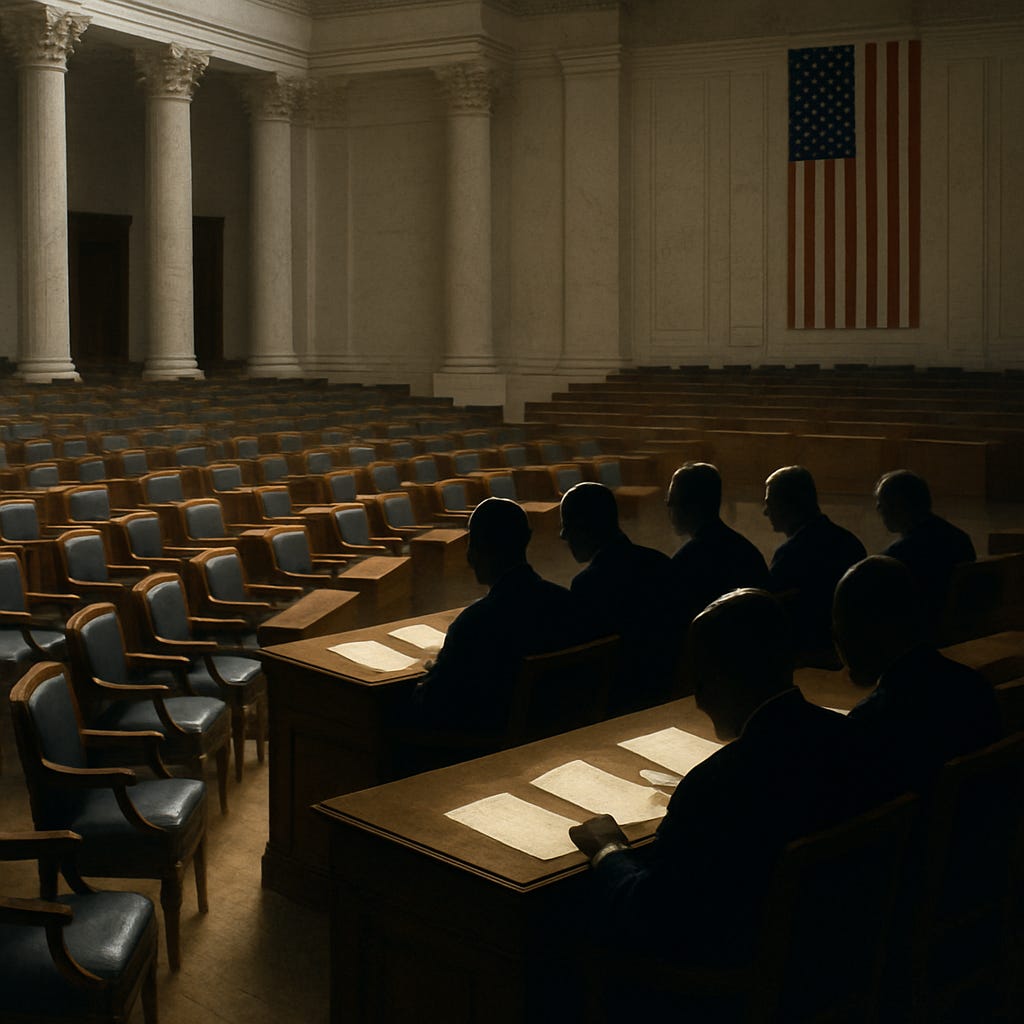
The Mandate for the Few
from Language Matters by Elias Winter Hosted by Elias Winter
Chapter 1 — The Lie as Liturgy There is a way a nation learns to pray without knowing it is praying. Not to God, but to power. The words repeat, the gestures repeat, the cadence repeats, until speech becomes ritual and ritual becomes truth. The old name for this was propaganda. The more accurate name, in our age of think tanks and donor routes and glossy PDFs, is liturgy. The Heritage Foundation did not invent the liturgy; it professionalized it. It learned that policy is not merely a set of rules but a choreography of belief. You don’t just pass a bill; you catechize a public. You don’t simply deregulate; you narrate deregulation as emancipation. You don’t merely centralize executive power; you present it as the rescue of a nation from “unelected bureaucrats.” And you repeat it—on television hits, in op-eds, in Hill briefings, in breakfast roundtables—until the repetition does the believing for you. Call the first movement naming. “Anti-communism” was the master key of the late twentieth century—not just an opposition to the Soviet Union, but a license to paint labor, social insurance, public investment, and regulatory constraint with the same brush. A word that once meant gulags and one-party states became the solvent poured over teachers’ unions, consumer protections, and progressive taxation. Naming rearranged the moral map: markets became freedom, government became threat, solidarity became suspect. Once the names were fixed, the facts would have to catch up or be discarded. The second movement is laundering. Money that would be inflammatory in its naked form—oil fortunes, extraction profits, fortunes made by squeezing labor and privatizing the commons—gets purified as “philanthropy.” Donor-advised funds add a veil, a moral white coat. The check travels from the family office to a donor conduit to a policy shop; by the time it arrives, it is no longer a self-interested bet—it is civic virtue underwriting “research.” From that research come white papers, scorecards, bill templates, and “model” laws, all presented as nonpartisan expertise. The goal is not only to influence legislators; it is to cleanse the influence. Then comes incarnation—the blueprint taking on flesh. The Reagan years were the first great embodiment: tax cuts marketed as growth miracles, deregulation sold as liberation, welfare reform as responsibility. The results—wealth concentration, financialization, weakened labor power—were not bugs; they were predictable outcomes of the liturgy. A generation later, Project 2025 offered the most explicit catechism yet: remake the executive branch, politicize the civil service, use grantmaking power as a lever, refashion education in “patriotic” terms, and accelerate an energy posture that subordinates climate and commons to immediate private gain. This time, the incarnation came with the candor of a manual: here is how to seize the levers quickly and make the changes hard to reverse. But every liturgy needs absolution—a release valve for the conscience of the faithful. That is the work of the grand denial. “I’ve never heard of it.” “We have nothing to do with it.” “It’s just ideas floating around.” The disavowal is not an afterthought; it is an instrument. It provides plausible deniability for moderates uneasy with the speed and severity of the program, and it buys time. Meanwhile, agencies are reclassified, oversight is centralized, discretionary funds are routed through political filters, and the educational frame is adjusted to produce the citizens who will not resist the next round. You can call these lies. They are. But the power of the lie is not only in the falsehood; it is in the flood. Say enough contradictory things, loudly enough, across enough channels, and the average person learns not to adjudicate claims but to withdraw from reality-testing. This is not censorship by force; it is censorship by excess. In the white noise, precision feels pedantic, expertise feels partisan, and exhaustion feels like wisdom. When exhaustion governs, governance follows. If the lie is the hymn, fear is the organ beneath it. Fear of the foreigner, the protester, the regulator, the teacher, the bureaucrat. Every oligarchy requires a story about chaos: that without decisive rulers and unshackled capital, the nation will fall to disorder. The paradox is that the “order” advertised is a redistribution of disorder—away from markets and balance sheets and onto the bodies of workers, renters, students, and the poor. Social risk does not vanish; it is reassigned. There is also a gentler instrument—admiration. Think tanks learned to wrap capture in merit: the philanthropist as benefactor, the donor as steward, the executive as “job creator,” the tax cut as a medal pinned to the chest of efficiency. What looks like withdrawal from civic obligation is reframed as investment genius; what looks like free-riding on public goods is reframed as “private solutions.” Admiration anesthetizes anger; you do not audit whom you idolize. And then there is the loop—policy creating power that writes policy. Cut taxes at the top, and you increase the pool of private capital that can endow the institutions that justify further tax cuts. Deregulate finance, and you expand the war chest that can endow the legal projects that argue courts should be kept out of “innovation.” Politicize grants and civil service, and you tilt the machinery that will validate the politicization. Each turn strengthens the next, until the machinery feels natural and memory of a different arrangement feels naïve. At this point a nation asks: was it fooled, or did it cooperate? The honest answer is both. The average voter did not read a 900-page mandate or trace a grant from a donor-advised fund to a university center to a bill markup. But the average voter did absorb the metaphors, the hero/villain casting, the ambient sense that government is incompetent, that public goods are indulgences, that organized labor is thuggish, that taxes are theft, that regulation is red tape, that expertise is arrogance. The liturgy worked not because people became cruel, but because they became tired—and in their tiredness, they wanted someone to promise relief. The promise came. The bill followed. What, then, is the counter-liturgy? It begins by breaking the spell of naming. We say plainly: anti-communism, as deployed domestically, has meant anti-egalitarianism. “Small government” has meant large control by private power. “School choice” has meant public exit and private subsidy. “Patriotic education” has meant curated memory. None of this requires hating markets or scorning enterprise; it requires refusing the theology of inevitability that markets alone can sustain a nation’s moral life. Next, we relight the ledger. Follow the money without flinching: who funds the paper, who staffs the panel, who writes the rule, who benefits in cash flows. Not to condemn automatically, but to name loyalties. There is no neutral center here; there are arranged interests. A mature democracy admits this and negotiates openly, with countervailing powers strong enough to bargain on behalf of the many. Finally, we repair the faculty of attention. The lie as liturgy depends on exhaustion. It needs your doomscroll, your helpless shrug, your sense that it’s all too much. The antidote is not naïve optimism; it is disciplined seeing. We learn to hear the euphemism and translate it back into its budgetary, ecological, and human cost. We relearn the dull virtues—oversight, transparency, conflict of interest rules, slow governance—that protect the weak precisely because they frustrate the strong. Heritage did not turn America into an oligarchy by sorcery. It taught a country to repeat the right words until the wrong world felt right. The response will not be a single revelation or a single election; it will be the patient unlearning of a ritual that mistook wealth for wisdom, speed for truth, and strategy for salvation. A people can be catechized into forge… This is a public episode. If you would like to discuss this with other subscribers or get access to bonus episodes, visit eliaswinter.substack.com
Embed this episode
No transcript yet.