
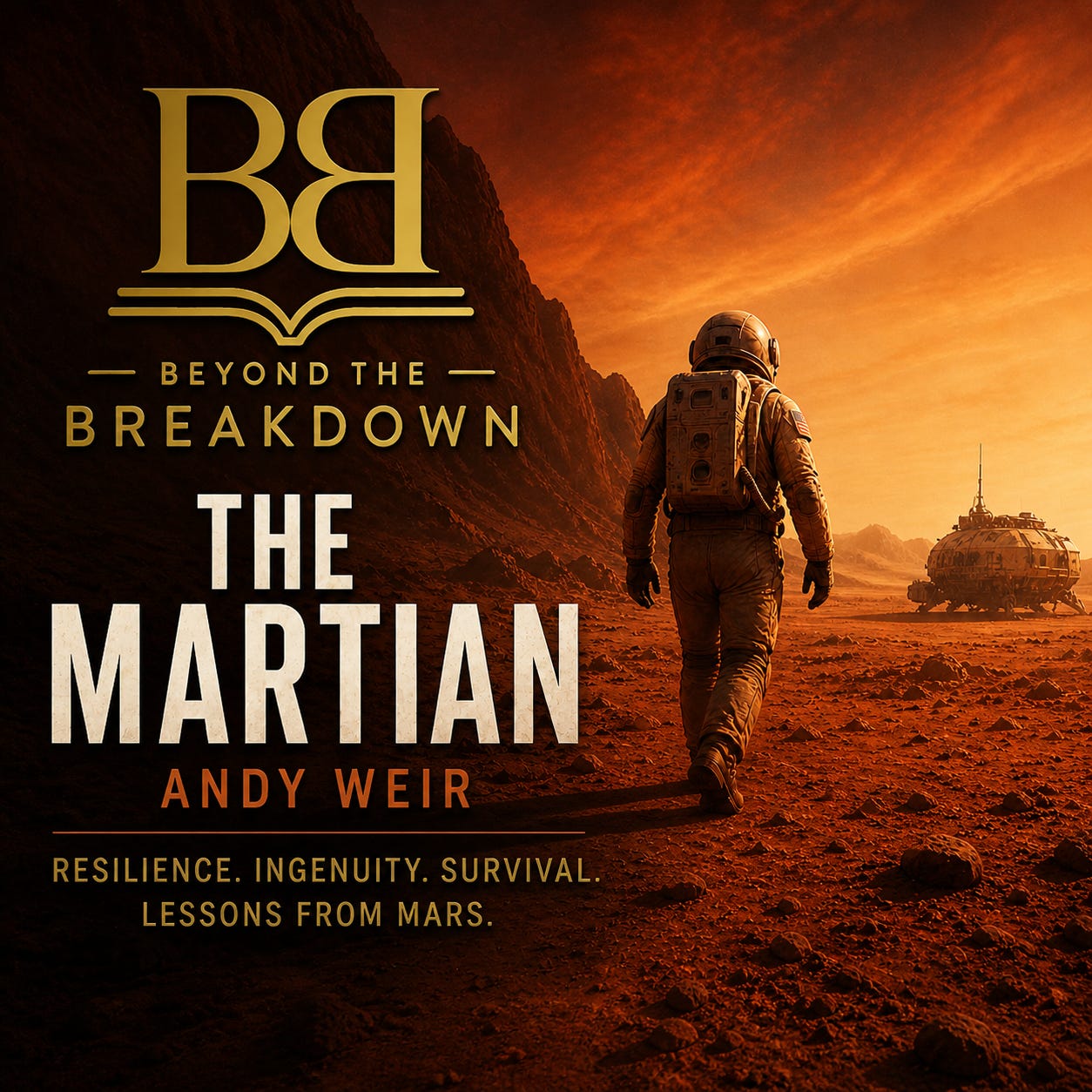
EPISODE · May 3, 2026 · 19 MIN
The Martian | Transmission 07: The Long Drive Home
from Beyond the Breakdown · host Yvan Blanchette
FULL SPOILERS. YOU’VE BEEN WARNED. 3,200 kilometers. That’s like driving from New York to Denver.Except it’s -60 degrees at night, your bathroom is a resealable plastic box, and if your solar panels get dusty, you die.This episode is about what survival actually looks like when there are no more explosions, no more crises to solve by Tuesday. Just a man in a rover, crossing a dead planet, one agonizing sol at a time.What We DiscussedBuilding an RV out of a golf cart and an emergency tent. The rover modifications take weeks. Watney has to move the Hab’s three massive life support systems, specifically the atmospheric regulator, the oxygenator, and the water reclaimer, into an unpressurized trailer that was never designed to hold them, and then create a pressurized living space out of an emergency pop tent. Every step of this is physically brutal in ways the text doesn’t let you skip over. The trailer hull is carbon composite, an aerospace material specifically engineered to distribute stress and resist puncture. A standard drill just skates right off it. He has to chisel a tiny divot first with a hammer and screwdriver just to give the drill bit somewhere to bite. Then when he starts drilling, the drill overheats after three holes. This feels counterintuitive: it’s -60 degrees outside. Shouldn’t the freezing Martian environment keep the motor ice cold? But the Martian atmosphere is less than 1% as dense as Earth’s. It is essentially a near-vacuum. Heat transfer on Earth relies mostly on convection, air molecules bumping against a hot object, absorbing the heat, and floating away. There is no air to do that on Mars. The drill’s cooling fans are spinning in a void. The friction has nowhere to go. He has to drill three holes, put the drill down, and sit there for hours waiting for the heat to slowly radiate away through radiation alone. What should be a two-hour job on Earth becomes weeks of agonizing, brutally slow labor.Physics hates a right angle in a pressure vessel. Once the trailer haul is done, he builds the bedroom extension from the pop tent: guts it, strips away its intended purpose, and sees it only as a pressurized volume of canvas with a standardized airlock attachment. That’s Watney’s specific genius in this section. He doesn’t look at objects and see what they were designed to do. He looks at their physical properties and asks what they could do. He tests the bedroom inside the Hab first, at 1.2 atmospheres of pressure, because if the duct tape and resin seams fail he wants it to happen while he’s already surrounded by breathable air. Smart, calculated. Then he takes it outside for its first real test attached to the rover. It fails instantly. The canvas pops like a balloon. He built a boxy extension instead of a cylinder, and all the explosive force of the internal air pressure went straight into the corners he had taped by hand. Physics is absolute about this. He goes back, double layers the canvas, double seals the resin, and tries again. That physical toll, the weeks of drilling and chiseling and taping and failing and rebuilding, is what gives the rover its narrative weight when it finally rolls out onto the Martian plain. It is so hard earned.The choreography of boredom. Once the rover is built and rolling, the book shifts from high-stakes engineering montage to something rarer and more honest: the unglamorous daily routine of a man keeping himself alive through repetition. Every morning is identical. Microwave potato for breakfast. Manual check of the oxygen dials. Electric razor. And then the bathroom situation, which Weir refuses to make cinematic. Watney doesn’t have a toilet. He uses a resealable plastic box for urine. When he opens it in the morning in the sealed rover cabin, he describes the smell as resembling a neglected truck stop restroom. He can’t throw it outside because every drop of liquid is a critical asset he worked too hard to produce. He dumps it carefully into the water reclaimer. We talked about why Weir spends so much time on these details, and the answer is participatory dread. If the book only gave us explosions and cliffhangers, we would get numbed to the danger. By forcing us to live alongside the routine, Weir builds a fortress of specificity inside the reader’s mind. You know exactly what it costs to stay alive, not in the dramatic moments, but in the endless accumulation of small maintenance tasks that never stop. When something goes wrong, you don’t just read about the disruption. You feel it as a violation of a space you’ve been inhabiting for chapters.The air days and the bedroom deflation. The rover runs on solar panels feeding two battery packs. He drives for about two hours, the first pack dies, he stops, puts on his EVA suit, manually swaps the cables, drives another two hours, and he’s done for the day. Then he sets up the solar panels and sits for 12 hours doing nothing. Every five sols, the CO2 tanks saturate completely and he has to stop traveling entirely for a full day, running just the oxygenator to clear the backlog. And the bedroom deflation routine is its own specific kind of claustrophobic horror. To save air, he can’t just unzip it from outside. He seals himself in the rover’s tiny airlock, leaves the outer hatch open to the bedroom, tells the computer to depressurize. The computer starts sucking air out, thinking it’s just emptying the airlock tube, but it’s actually emptying the entire canvas tent. As it deflates, Watney has to physically reach out, grab stiff freezing canvas and pull it inward, folding it around his own body in the metal tube, all while wearing a bulky pressurized suit. This is the grind of survival. Not heroism. Just endurance.“I’m the first person to be alone on an entire planet.” Inside the Hab, the jokes worked because the space felt contained. There was a lab, a kitchen, familiar lights. A little piece of Earth. In the rover, he is in motion across a dead alien world. A tiny bubble of glass and metal sliding across nothing. He has free time now, for the first time in hundreds of sols, because the automation is handling the driving and the life support. And free time on a dead planet is a liability. He starts longing for things he used to complain about. The MAV simulator back on Earth, cramped with six astronauts in a box meant for a 23-minute flight, where they wanted to kill each other after three days. Now he writes that he would give anything to be back there. He even misses Beck giving him health lectures. The humor is still there in the logs, but it lands differently. There’s a melancholy quality that wasn’t present in the Hab. Busyness, it turns out, was doing enormous psychological work that he only notices now that it’s gone.Sol 431 and the Apollo mask. He survived explosions, airlock failures, near-vacuum, and over 400 days of isolation. Walking out the door of the Hab for the last time terrifies him. He has to actively psych himself up to leave. He asks himself what an Apollo astronaut would do, imagines one of them drinking three whiskey sours, driving a Corvette to the launchpad, and flying to the moon in a command module smaller than his rover. The invocation isn’t just a love letter to spaceflight history. It’s a mask he puts on. The Hab was his womb. His last physical tether to the mission, to Earth, to a structure humans built. Leaving it means he is truly, entirely on his own. He puts on the Apollo mask of reckless bravado and walks out the door.The dust storm and the indifference of scale. The storm doesn’t look like the Hollywood version. There are no ripping winds or flying debris. The Martian atmosphere is too thin for that. 150 kilometer per hour winds on Mars barely have the kinetic energy of a gentle breeze on Earth. The danger is quiet and invisible: the low gravity suspends microscopic dust particles in the air, blocking sunlight, slowly cutting his solar efficiency. He doesn’t notice the sky getting darker because human eyes naturally adjust to gradual light changes. He figures it out only when he checks his power readouts and sees the numbers dropping. 97%. Then 92.5%. The entire planet Earth is watching him drive straight into this storm via satellite, shitting bricks because they can see it forming and cannot warn him. His radio is fried. He is completely deaf to their terror. His response is elegant and mathematical. He builds improvised solar power loggers from spare EVA cameras wired to power meters, drops them behind him as he drives, and checks the data to triangulate the storm’s shape and direction. The cameras would freeze overnight in -60 degree temperatures, so he wires spare resistors from his electronics kit inside the containers to bleed off a tiny amount of power as heat, just enough warmth to keep the cameras functioning. He determines he has to drive 540 kilometers due south just to skirt the edge of the storm. A catastrophic detour that throws him completely off course. But it saves his life. You cannot fight a continent-sized weather pattern. You can only measure it and navigate around it.The Mars rocks left in a catalog pile. Right before the final leg toward Schiaparelli Crater, Watney packs up his geological core samples. He knows he cannot take them on the MAV. The ascent vehicle has strict weight limits and NASA will force him to leave them behind. He doesn’t dump them out the airlock. He arranges them in a neat catalog pile on the Martian dirt, labeled and ordered, hoping that maybe decades from now a future probe or another mission will find them. Even when facing the very real possibility of his own death on a planet that does not know he exists, Watney takes the time to leave a gift for the future of science.The Question We Left HangingThink about that catalog pile of rocks.Watney is in full survival mode. He has been for hundreds of sols. Every calorie, every drop of water, every watt of solar power is accounted for and rationed. And yet he stops to carefully label and arrange geological samples for a future mission he will never see.When you are entirely consumed by your own survival mode, what kind of legacy are you leaving behind for those who come after you?Survival isn’t just about keeping yourself alive. It’s about preserving what makes you human.Next TransmissionEpisode 08: Watney arrives at the Ares 4 MAV. And NASA’s instructions for what he has to do to it are going to make your stomach drop. He strips out the nose cone. He removes the front window. He covers a spacecraft with HAB canvas. And then he locks himself into orbit in what amounts to a space convertible.Beyond the Breakdown | The Martian Series | Available wherever you get your podcasts.Thanks for listening to Beyond The Breakdown. You want more stories decoded, subscribe for free and never miss what’s beneath the surface. This is a public episode. If you would like to discuss this with other subscribers or get access to bonus episodes, visit beyondthebreakdown.substack.com
Embed this episode
NOW PLAYING
The Martian | Transmission 07: The Long Drive Home
No transcript for this episode yet
Similar Episodes
No similar episodes found.
Similar Podcasts
No similar podcasts found.