
EPISODE · Aug 14, 2026 · 1H 8M
The Massacre At Son My
from Disturbing History · host Disturbing History-True Stories
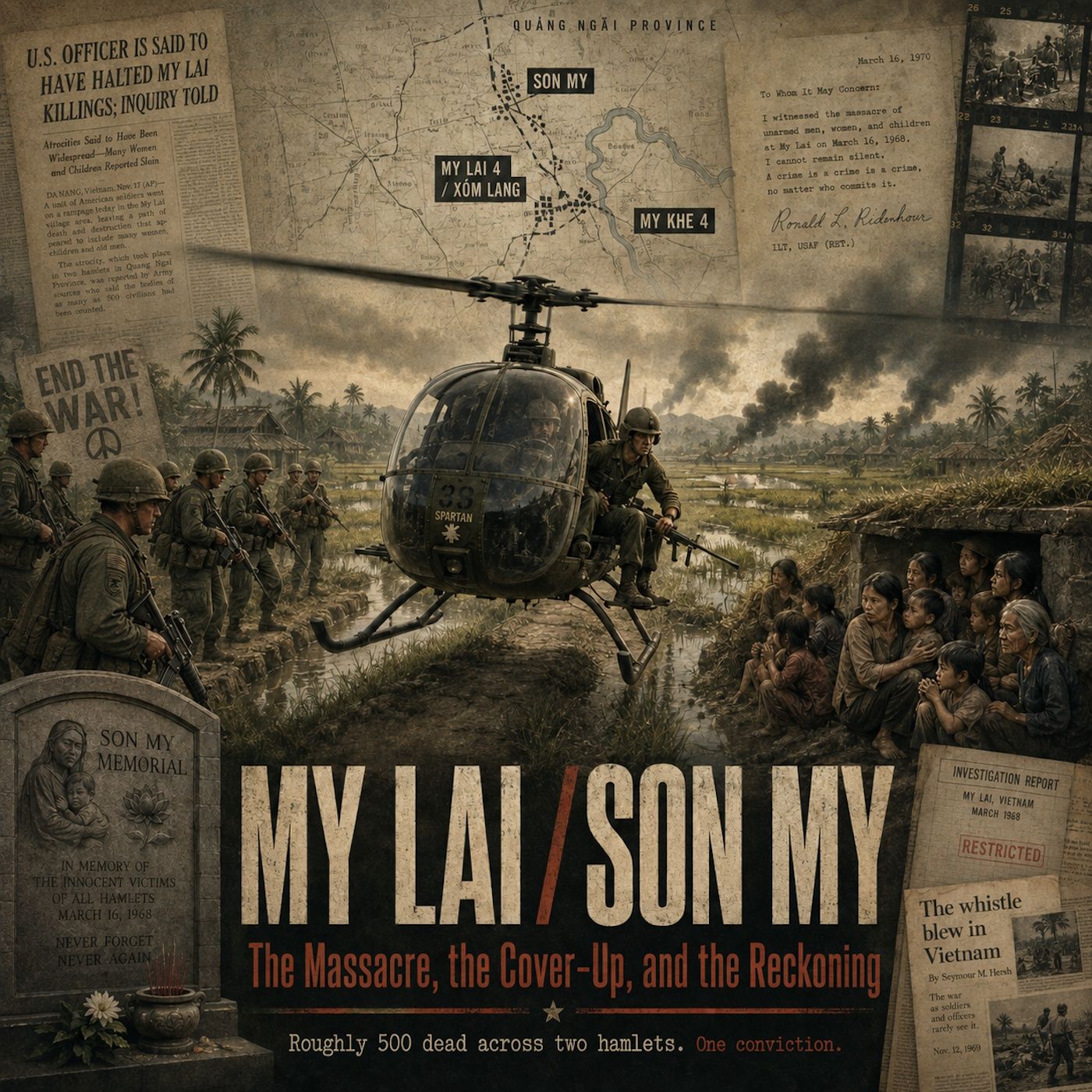
On the morning of March 16, 1968, an American helicopter pilot named Hugh Thompson dropped a smoke grenade to mark a wounded Vietnamese woman so a medic could reach her. He flew a circuit and came back a few minutes later. She was dead, and an American officer was standing over her.Within the hour, Thompson would land his helicopter between armed American infantry and a bunker full of civilians and tell his own door gunner to open fire on Americans if they opened fire on the villagers.Almost everyone has heard of My Lai.Almost everything most people believe about it is wrong or badly incomplete. It wasn't one village. It was a village complex called Son My made up of four hamlets, and the place we call My Lai 4 was actually a sub-hamlet named Xom Lang that American mapmakers mislabeled. It wasn't one company, because two separate American infantry units killed civilians in Son My that morning, several kilometers apart, under the same task force headquarters. And it wasn't one man, because the Army's own inquiry identified roughly 30 officers and enlisted men who either committed crimes or helped bury them afterward, up to and including a major general commanding a division.This episode walks the whole operation from the beginning.The attrition strategy and the body-count culture that made dead Vietnamese the measure of a good officer. Quang Ngai Province, the free-fire zones, and why American troops called the area Pinkville. Task Force Barker, an ad hoc unit thrown together from three companies that had never worked with each other, under a colonel who had commanded the brigade for exactly one day when the massacre happened. Charlie Company's three months of losing men to mines and booby traps without ever getting a fight, including the February 25 minefield and the booby trap that killed Sergeant George Cox on March 14.The memorial service on March 15, and the briefing Captain Ernest Medina gave that night, which remains the most disputed half hour in the case.Then the morning itself. Artillery preparation beginning around 7:22 a.m., a landing zone that turned out to be completely cold, and a company that came off the aircraft firing at people who were not shooting back. Charlie Company took no incoming fire that day and captured 3 weapons. The only American casualty shot himself in the foot. What they reported afterward was 128 enemy killed.The episode covers the irrigation ditch, where somewhere between 70 and 80 people were gathered and shot, and the trail junction to the south where another 20 to 30 were killed. The men who refused to fire, and what happened to them, which was nothing. The rapes and mutilations documented by the Peers Inquiry. Hugh Thompson, Lawrence Colburn, and Glenn Andreotta in detail, including the child Andreotta carried out of the ditch alive, and the 30 years it took the Army to award those three men the Soldier's Medal. Andreotta was killed in action on April 8, 1968, three weeks after the massacre.There is a substantial section on My Khe 4, the second massacre, which almost nobody has heard of. Bravo Company, a different battalion, different officers, men who never attended Medina's briefing and had never met William Calley, killing roughly 90 civilians in a coastal sub-hamlet on the same morning and reporting 38 enemy dead. It only came to light because investigators digging into My Lai tripped over it.The back half is the concealment and the reckoning. Colonel Oran Henderson's April 1968 investigation, which concluded about 20 civilians had been killed inadvertently.The Viet Cong leaflet that was substantially accurate and was used as proof the whole thing was fabricated. Tom Glen's letter to General Abrams in late 1968 and the young major who reviewed it. Ronald Ridenhour, a door gunner who heard about it secondhand in April 1968, spent months quietly interviewing witnesses, and mailed a letter on March 29, 1969, to some 30 officials in Washington. Seymour Hersh and the story no major magazine would buy, which ran on November 13, 1969, in roughly three dozen newspapers. Paul Meadlo on the CBS Evening News on November 24. Ronald Haeberle's color photographs, carried around for a year and a half before anyone acted on them, published in the Cleveland Plain Dealer on November 20, 1969, and in Life on December 5. The Peers Inquiry, delivered in March 1970, and what it found about command failure at four levels.Then the trials. Roughly two dozen men charged, 5 court-martialed for the killings, and 14 officers charged with suppressing information. Sergeant David Mitchell, acquitted. Sergeant Charles Hutto, acquitted. Captain Eugene Kotouc, acquitted. Captain Ernest Medina, acquitted on September 22, 1971. Colonel Oran Henderson, the only officer tried for the cover-up, acquitted on December 17, 1971. Major General Samuel Koster, charges dismissed, censured, demoted one grade, and out as Superintendent of West Point.Calley was charged with 109 murders, convicted on March 29, 1971, of the premeditated murder of not fewer than 22 Vietnamese civilians, and sentenced two days later to life at hard labor. Within days the White House had received something on the order of 100,000 letters and telegrams running overwhelmingly in his favor. Flags flew at half-staff. A novelty record sold in the hundreds of thousands. On April 1, 1971, President Nixon ordered him out of the stockade and into an apartment at Fort Benning.The sentence came down to 20 years in August 1971, then to 10 years in April 1974, and he was paroled in November 1974 after about three and a half years, nearly all of it under house arrest.Roughly 500 dead across two hamlets. One conviction.The Criminal Investigation Division found at least 347 killed at My Lai 4. The Peers Inquiry added roughly 90 at My Khe 4.The memorial at Son My carries 504 names, arranged by household so you read them in family groups. 182 women, 17 of them pregnant. 173 children, 56 of them infants. 60 people over the age of 60.And Pham Thanh Cong, who was 11 years old and lay under his mother and his four brothers and sisters in a bunker until the shooting stopped, and who spent much of his adult life walking American visitors through the ground where his family died.Email BrianJoin Our FREE NewsletterGet Brian's Books Leave Us A VoicemailVisit Our WebsiteHave a forgotten historical mystery, disturbing event, unsolved crime, or hidden conspiracy you think deserves investigation?Send your suggestions to [email protected] History is a dark history podcast exploring unsolved mysteries, secret societies, historical conspiracies, lost civilizations, and the shadowy stories buried beneath the surface of the past.Follow the show and enable automatic downloads so you never miss a deep dive into history’s most unsettling secrets.Because sometimes the truth is darker than fiction.
Embed this episode
What this episode covers
On the morning of March 16, 1968, an American helicopter pilot named Hugh Thompson dropped a smoke grenade to mark a wounded Vietnamese woman so a medic could reach her. He flew a circuit and came back a few minutes later. She was dead, and an American officer was standing over her. Within the hour, Thompson would land his helicopter between armed American infantry and a bunker full of civilians and tell his own door gunner to open fire on Americans if they opened fire on the villagers.Almost everyone has heard of My Lai. Almost everything most people believe about it is wrong or badly incomplete. It wasn't one village. It was a village complex called Son My made up of four hamlets, and the place we call My Lai 4 was actually a sub-hamlet named Xom Lang that American mapmakers mislabeled. It wasn't one company, because two separate American infantry units killed civilians in Son My that morning, several kilometers apart, under the same task force headquarters. And it wasn't one man, because the Army's own inquiry identified roughly 30 officers and enlisted men who either committed crimes or helped bury them afterward, up to and including a major general commanding a division.This episode walks the whole operation from the beginning. The attrition strategy and the body-count culture that made dead Vietnamese the measure of a good officer. Quang Ngai Province, the free-fire zones, and why American troops called the area Pinkville. Task Force Barker, an ad hoc unit thrown together from three companies that had never worked with each other, under a colonel who had commanded the brigade for exactly one day when the massacre happened. Charlie Company's three months of losing men to mines and booby traps without ever getting a fight, including the February 25 minefield and the booby trap that killed Sergeant George Cox on March 14. The memorial service on March 15, and the briefing Captain Ernest Medina gave that night, which remains the most disputed half hour in the case.Then the morning itself. Artillery preparation beginning around 7:22 a.m., a landing zone that turned out to be completely cold, and a company that came off the aircraft firing at people who were not shooting back. Charlie Company took no incoming fire that day and captured 3 weapons. The only American casualty shot himself in the foot. What they reported afterward was 128 enemy killed. The episode covers the irrigation ditch, where somewhere between 70 and 80 people were gathered and shot, and the trail junction to the south where another 20 to 30 were killed. The men who refused to fire, and what happened to them, which was nothing. The rapes and mutilations documented by the Peers Inquiry. Hugh Thompson, Lawrence Colburn, and Glenn Andreotta in detail, including the child Andreotta carried out of the ditch alive, and the 30 years it took the Army to award those three men the Soldier's Medal. Andreotta was killed in action on April 8, 1968, three weeks after the massacre. There is a substantial section on My Khe 4, the second massacre, which almost nobody has heard of. Bravo Company, a different battalion, different officers, men who never attended Medina's briefing and had never met William Calley, killing roughly 90 civilians in a coastal sub-hamlet on the same morning and reporting 38 enemy dead. It only came to light because investigators digging into My Lai tripped over it.The back half is the concealment and the reckoning. Colonel Oran Henderson's April 1968 investigation, which concluded about 20 civilians had been killed inadvertently. The Viet Cong leaflet that was substantially accurate and was used as proof the whole thing was fabricated. Tom Glen's letter to General Abrams in late 1968 and the young major who reviewed it. Ronald Ridenhour, a door gunner who heard about it secondhand in April 1968, spent months quietly interviewing witnesses, and mailed a letter on March...
Ready to play
The Massacre At Son My
No transcript for this episode yet
Similar Episodes
No similar episodes found.