
EPISODE · Mar 28, 2026 · 17 MIN
The Maternal Health Crisis: Imperatives for Modernizing Perinatal Care
from Culture Coalition Podcast
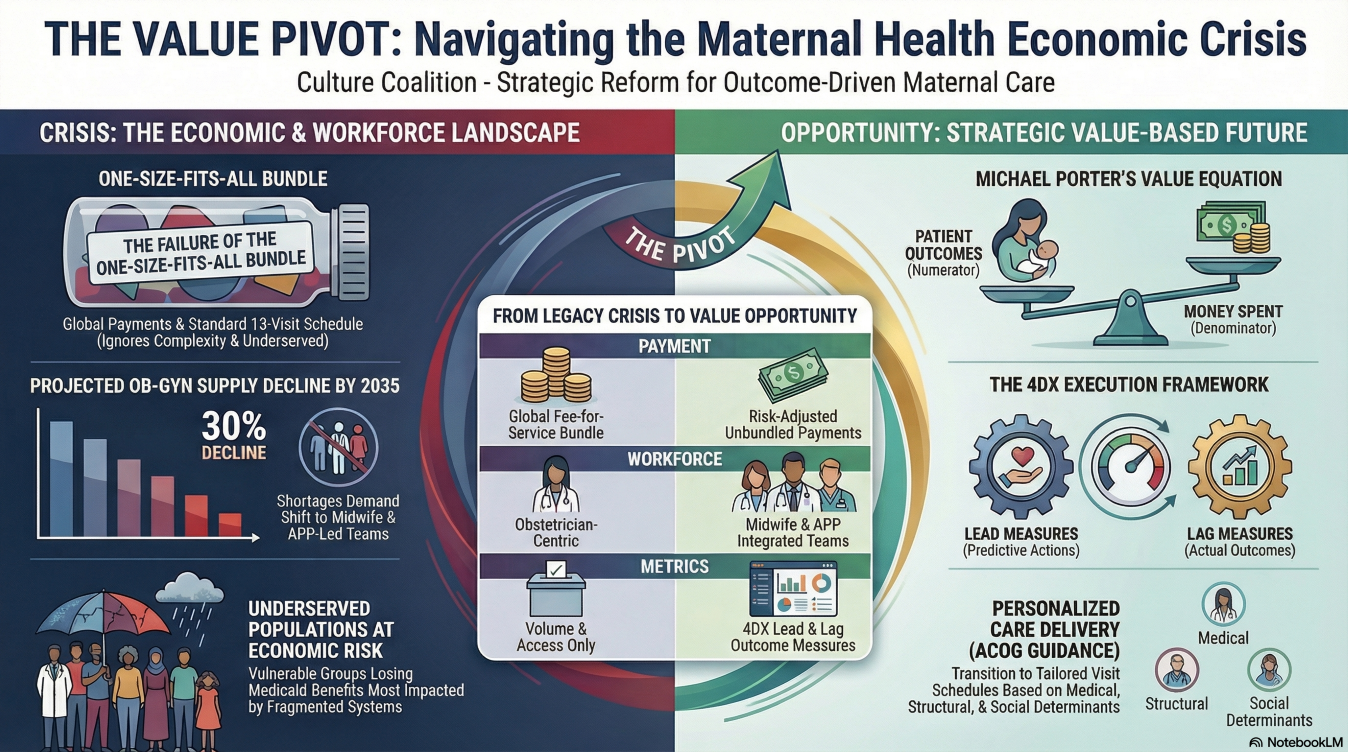
The Maternal Health Crisis: Why Payment Innovation is the Lever for SurvivalThe American maternal health landscape is at a breaking point, reeling from a shifting economic crisis that necessitates the industry’s first true structural reorganization. While labor shortages and insurance volatility are exogenous shocks, the payment structure remains the most influenceable lever for institutional survival and clinical excellence.The Economic Danger of FragmentationOur legacy system, designed for local inpatient care, is fundamentally misaligned with the modern "cycle of care" required for pregnancy. The dangerous pivot toward "unbundling" services into fragmented fee-for-service bubbles increases administrative complexity—a catastrophic barrier for Medicaid populations navigating disconnected scheduling and billing. Leaders must embrace the Porterian principle that value is defined by outcomes achieved relative to the money spent. Crucially, it is actually less expensive to deliver excellence. By improving the numerator (clinical outcomes) across the entire pregnancy cycle, we naturally collapse the denominator (total cost) by eliminating the waste of complications, readmissions, and fragmented delays.Reimagining the TeamThe worsening obstetrician shortage is a management constraint, not a medical one. Leaders must mandate a reorganization into multidisciplinary teams of physicians, midwives, and APPs focused on the patient's holistic medical problem. Moving beyond siloed "pickup teams" allows organizations to consolidate volume into dedicated centers, ensuring that expertise is a structural standard rather than a matter of random chance.Execution: Surviving the WhirlwindStrategic failure occurs when new initiatives are swallowed by the "Whirlwind"—the daily deluge of administrative churn and urgent labor gaps. To ensure the Wildly Important Goal (WIG) of maternal safety survives, leaders must dedicate 20% of their effort to Lead Measures. Unlike "Lag Measures" (clinical results that have already occurred), Lead Measures are predictive and influenceable activities, such as the consistent completion of high-risk prenatal screenings."The real constraint in health care actually is management, organization, measurement..." — Michael PorterA Question of ValueSurviving this crisis requires moving beyond incremental Band-Aids. We must restructure our delivery systems to compete on demonstrable value.Is your organization ready to compete on excellence, or will it remain a prisoner of volume? Hosted on Acast. See acast.com/privacy for more information.
Embed this episode
NOW PLAYING
The Maternal Health Crisis: Imperatives for Modernizing Perinatal Care
No transcript for this episode yet
Similar Episodes
Mar 22, 2026 ·14m
Similar Podcasts
No similar podcasts found.