
EPISODE · Jul 16, 2026 · 31 MIN
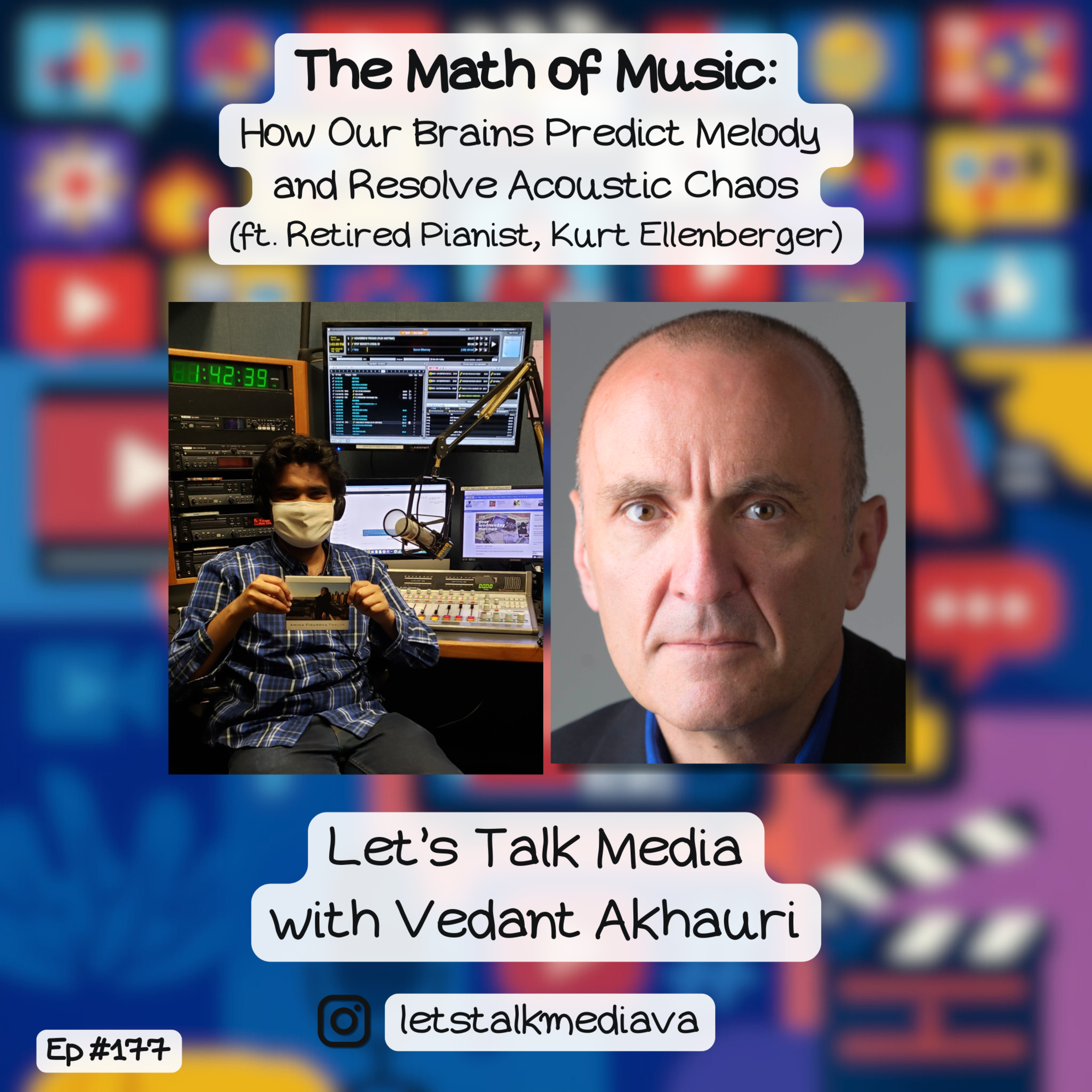
The Math of Music: How Our Brains Predict Melody and Resolve Acoustic Chaos (ft. Retired Pianist, Kurt Ellenberger)
from Let's Talk Media with Vedant Akhauri · host Vedant Akhauri
Why does a certain song make us feel happy, excited, or deeply melancholic? How does the human brain instantly translate physical sound waves into raw emotional narratives?In this episode of Let’s Talk Media, the podcast exploring the craft, careers, and chaos of the creative world, host Vedant Akhauri sits down with retired music professor, professional pianist, composer, and Fulbright scholar Kurt Ellenberger. Kurt, who is also a contributing editor at All About Jazz and has written for NPR and the Huffington Post, shares his fascinating insights into how our brains mathematically predict melodies, why minor chords act as "acoustic interlopers" to induce sadness, and why evolutionary science has hit a complete dead end trying to explain why humans love music in the first place.In this episode, we discuss:Math Before Meaning: How our brains instantly translate analog sound waves into electronic signals, using predictive processing to mathematically calculate where a melody will go next.The Power of the Binary Series: A deep dive into the perfect binary progression (1, 2, 4, 8, 16...) that dictates octaves.The "Sonic Doppelganger" and the Physics of Melancholy: Kurt breaks down the physics behind his theory of why minor keys make us feel sad.Tempo and Physiological Mimicry: Why humans behave in a highly mimetic way to musical tempos, matching our nervous systems and heart rates to the beat.Hearing the "Ghosts in the Ether": How modern technology allows us to electronically strip away the fundamental notes of a performance so that we can physically hear the hidden, quiet harmonic partials vibrating in the room.The Evolutionary "Dead End": Why Charles Darwin and modern science cannot convincingly explain the survival advantage of a genetic mutation that allows humans to calculate octave symmetry and predict pitches.Follow Along: Kurt's mentioned examples can be found here.You can find all of Kurt’s music, articles, and book links at his personal website, kurtellenberger.com, as well as on allaboutjazz.com.If you like what you hear, please subscribe and leave a rating to be notified of future episodes! You can subscribe wherever you get your podcasts and follow the show on Instagram @letstalkmediava
Embed this episode
NOW PLAYING
The Math of Music: How Our Brains Predict Melody and Resolve Acoustic Chaos (ft. Retired Pianist, Kurt Ellenberger)
No transcript for this episode yet
Similar Episodes
No similar episodes found.
Similar Podcasts
No similar podcasts found.