
EPISODE · Jun 1, 2026 · 1H 11M
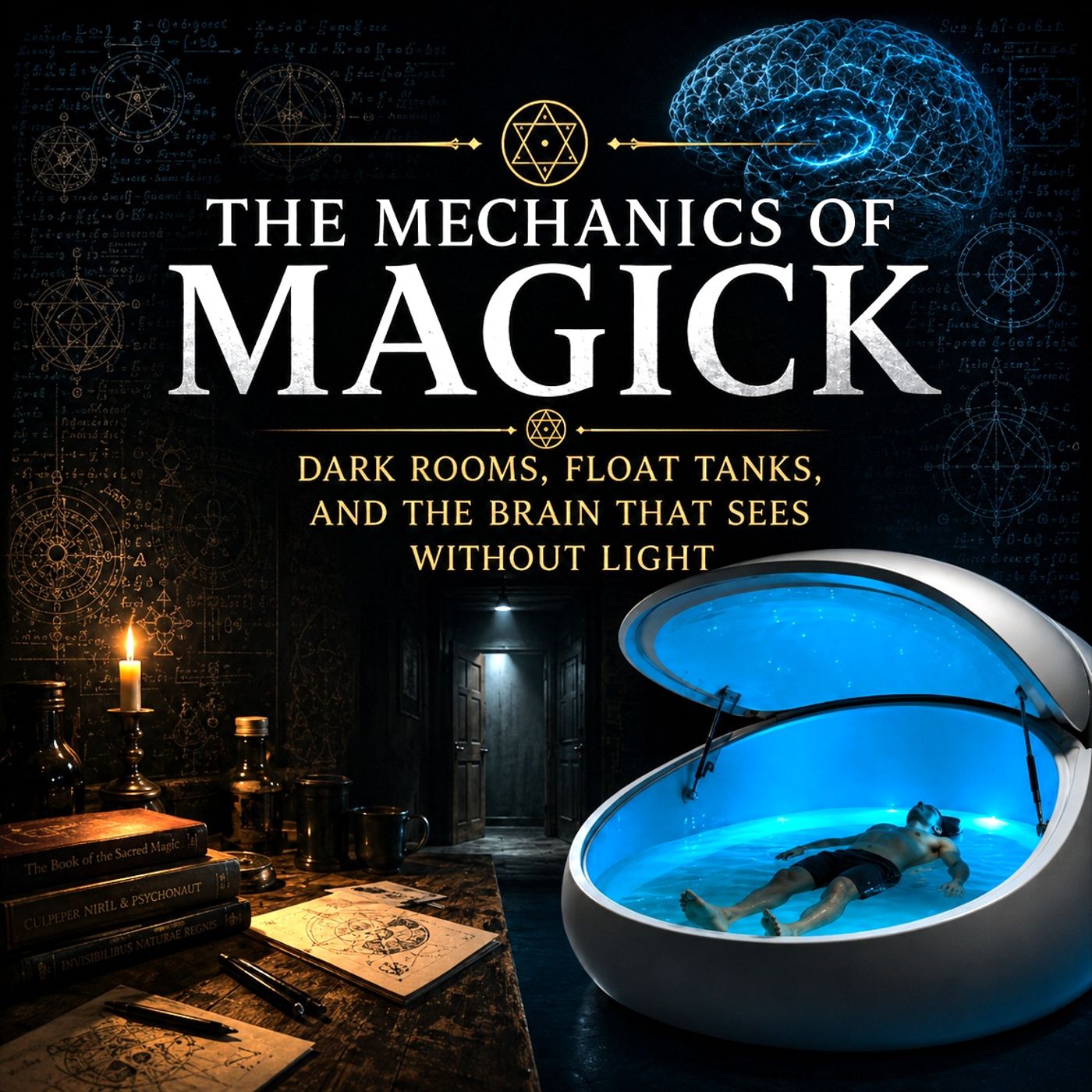
The Mechanics of Magick: Dark Rooms, Float Tanks, Initiation, and the Brain That Sees Without Light Part 1
from The Occult Rejects · host The Occult Rejects
Links For The Occult Rejectshttps://linktr.ee/theoccultrejectsOccult Research Institutehttps://www.occultresearchinstitute.org/Substackhttps://substack.com/@theoccultrejects?r=7auau0&utm_campaign=profile&utm_medium=profile-pageCash Apphttps://cash.app/$theoccultrejectsVenmo@TheOccultRejectsBuy Me A Coffeebuymeacoffee.com/TheOccultRejectsPatreonhttps://www.patreon.com/TheOccultRejectsPart 1: The Road of RhythmPart 1 focuses on the drum as an ancient technology of altered consciousness. The argument is not that every beat causes trance, or that neuroscience has proven spirits. The stronger argument is that rhythm enters the human organism through hearing, motor prediction, breath, movement, attention, emotion, expectation, culture, and social synchrony. The drum becomes powerful when sound, body, group, ritual frame, and meaning converge. These sources support the archaeology, neuroscience, EEG research, shamanic studies, possession studies, Indigenous and culturally specific drum traditions, ritual theory, placebo and meaning-response research, ceremonial magic, and modern witchcraft material used in the episode.Core Academic and Scientific SourcesHuels, Emma R., Hyoungkyu Kim, UnCheol Lee, Tirsa Bel-Bahar, Ana V. Colmenero, Alexandra Nelson, Stefanie Blain-Moraes, George A. Mashour, and Richard E. Harris. “Neural Correlates of the Shamanic State of Consciousness.” Frontiers in Human Neuroscience 15 (2021): 610466. Use for the strongest modern EEG anchor. This study used high-density EEG with shamanic practitioners and controls during rest, shamanic drumming, and classical music listening. It assessed altered-state reports alongside brain measures such as power, connectivity, signal diversity, and criticality. Use carefully: the study does not prove spirits or show that drumming mechanically causes trance in everyone. It supports the more careful claim that trained practitioners entering shamanic states with drumming show measurable brain-state differences.Gordon, Yoel, Golan Karvat, Noa Dagan, and Ayelet N. Landau. “Neural Tracking at Theta Predicts Drumming-Induced Altered States of Consciousness.” Scientific Reports 16, no. 1 (2026): Article 10204. Use for the strongest updated drumming/theta/neural-tracking source. This study tested drumming at theta, delta, and alpha-rate rhythms while recording EEG, and found that stronger rhythmic neural tracking at theta was linked to stronger altered-experience reports. Use carefully: this does not mean theta equals the spirit world or that one frequency opens a portal. The serious point is that altered experience may depend partly on how strongly the nervous system tracks rhythmic stimulation.Aparicio-Terrés, R., et al. “The Neurobiology of Altered States of Consciousness Induced by Drumming and Other Rhythmic Sound Patterns.” Annals of the New York Academy of Sciences, 2025. Use for the newer review literature showing that rhythmic sound is now a serious altered-consciousness research topic. This supports the opening claim that modern academia is examining drumming, rhythmic sound, absorption, relaxation, cognition, and neural activity without reducing the subject to one simple “trance frequency.” The review is especially useful for framing the field as promising but still complex.Neher, Andrew. “Auditory Driving Observed with Scalp Electrodes in Normal Subjects.” Electroencephalography and Clinical Neurophysiology 13 (1961): 449–451. Use for the historical bridge between repetitive sound, EEG, auditory driving, and early scientific interest in rhythmic stimulation.Neher, Andrew. “A Physiological Explanation of Unusual Behavior in Ceremonies Involving Drums.” Human Biology 34, no. 2 (1962): 151–160. Use carefully. This is useful as an early attempt to connect ceremonial drumming and physiology, but it should be balanced with Rouget because the “drum simply causes trance” argument is too mechanical.Maurer, R., V. K. Kumar, L. Woodside, and R. J. Pekala. “Phenomenological Experience in Response to Monotonous Drumming and Hypnotizability.” American Journal of Clinical Hypnosis 40, no. 2 (1997): 130–145. Use for monotonous drumming, subjective altered experience, imagery, absorption, and hypnotizability.Maxfield, Melinda C. “Effects of Rhythmic Drumming on EEG and Subjective Experience.” PhD diss., Institute of Transpersonal Psychology, 1990. Use as older supporting context on drumming, EEG, imagery, body-image changes, and subjective altered experience. Do not make this the main scientific proof; use it as background.Nozaradan, Sylvie, Isabelle Peretz, and André Mouraux. “Tagging the Neuronal Entrainment to Beat and Meter.” The Journal of Neuroscience 31, no. 28 (2011): 10234–10240. Use for EEG evidence that the brain can track beat and meter. This supports the claim that the brain does not merely hear rhythm as background sound; it can represent rhythmic structure in measurable ways.Nozaradan, Sylvie. “Exploring How Musical Rhythm Entrains Brain Activity with Electroencephalogram Frequency-Tagging.” Philosophical Transactions of the Royal Society B 369, no. 1658 (2014). Use as broader rhythm/EEG entrainment support. This helps explain frequency-tagging, beat tracking, meter, neural entrainment, and the measurable relationship between rhythmic structure and brain activity.Thaut, Michael H., Gerald C. McIntosh, and Volker Hoemberg. “Neurobiological Foundations of Neurologic Music Therapy: Rhythmic Entrainment and the Motor System.” Frontiers in Psychology 5 (2015). Use for rhythm as motor-system timing information. This supports the claim that a beat can become bodily instruction, not just sound for the ear. Especially useful when discussing rhythmic auditory stimulation, motor planning, gait, entrainment, and the auditory-motor bridge.Ross, Jessica M., John R. Iversen, and Ramesh Balasubramaniam. “Time Perception for Musical Rhythms: Sensorimotor Perspectives on Entrainment, Simulation, and Prediction.” 2022. Use for rhythm, timing, prediction, sensorimotor entrainment, and the way musical rhythm interacts with time perception.Hove, Michael J., and Jane L. Risen. “It’s All in the Timing: Interpersonal Synchrony Increases Affiliation.” Social Cognition 27, no. 6 (2009): 949–960. Use for synchrony and social bonding. This helps support the group-body argument: moving or acting in time with others can increase affiliation.Wiltermuth, Scott S., and Chip Heath. “Synchrony and Cooperation.” Psychological Science 20, no. 1 (2009): 1–5. Use for the claim that synchronized movement can increase cooperation and attachment among participants.Tarr, Bronwyn, Jacques Launay, and Robin I. M. Dunbar. “Music and Social Bonding: ‘Self-Other’ Merging and Neurohormonal Mechanisms.” Frontiers in Psychology 5 (2014): 1096. Use for music, synchrony, bonding, endorphin/social mechanisms, and why group rhythm can feel like more than private listening.Fancourt, Daisy, Rosie Perkins, Sara Ascenso, Louise Atkins, Fatima Kilfeather, and Aaron Williamon. “Effects of Group Drumming Interventions on Anxiety, Depression, Social Resilience and Inflammatory Immune Response among Mental Health Service Users.” PLOS ONE 11, no. 3 (2016): e0151136. Use for modern group-drumming research showing psychological and physiological effects, including anxiety, depression, social resilience, wellbeing, and inflammatory immune response. Use carefully: this does not make group drumming a cure-all. It supports the more grounded claim that embodied rhythm and group participation can affect mood, social connection, and body chemistry.Bittman, Barry B., et al. “Composite Effects of Group Drumming Music Therapy on Modulation of Neuroendocrine-Immune Parameters in Normal Subjects.” Alternative Therapies in Health and Medicine 7, no. 1 (2001): 38–47. Use as older supporting material on group drumming and neuroendocrine-immune measures. Keep secondary. Fancourt is cleaner for the main script body.Archaeology and Deep History of DrumsLawergren, Bo. “Neolithic Drums in China.” In Music Archaeology in China. 2006. Use for clay drums in Neolithic China and the deep-history claim that drums are not just poetic symbols of antiquity. They appear in the archaeological record as instruments tied to early sound-making, ceremony, and social order.Both, Arnd Adje. “Music Archaeology: Some Methodological and Theoretical Considerations.” Use as general support for why ancient instruments should be treated as ritual and social evidence, not merely decorative objects.Anthropology, Ethnomusicology, Ritual, and TranceRouget, Gilbert. Music and Trance: A Theory of the Relations Between Music and Possession. Translated by Brunhilde Biebuyck. Chicago: University of Chicago Press, 1985. Essential source. Use for the caution that music does not mechanically or universally cause trance. Rouget helps keep the argument academically serious by emphasizing culture, ritual frame, meaning, and expectation.Becker, Judith. Deep Listeners: MAlso want to remind people about the website, if you're into reading we have tons of information by multiple contributors, and we got t-shirts up on the site if you're interested. Fun fact, the art is all based on the eyeball.
Embed this episode
What this episode covers
Links For The Occult Rejects https://linktr.ee/theoccultrejects Occult Research Institute https://www.occultresearchinstitute.org/ Substack https://substack.com/@theoccultrejects?r=7auau0&utm_campaign=profile&utm_medium=profile-page Cash App https://cash.app/$theoccultrejects Venmo @TheOccultRejects Buy Me A Coffee buymeacoffee.com/TheOccultRejects Patreon https://www.patreon.com/TheOccultRejects Part 1: The Road of Rhythm Part 1 focuses on the drum as an ancient technology of altered consciousness. The argument is not that every beat causes trance, or that neuroscience has proven spirits. The stronger argument is that rhythm enters the human organism through hearing, motor prediction, breath, movement, attention, emotion, expectation, culture, and social synchrony. The drum becomes powerful when sound, body, group, ritual frame, and meaning converge. These sources support the archaeology, neuroscience, EEG research, shamanic studies, possession studies, Indigenous and culturally specific drum traditions, ritual theory, placebo and meaning-response research, ceremonial magic, and modern witchcraft material used in the episode. Core Academic and Scientific Sources Huels, Emma R., Hyoungkyu Kim, UnCheol Lee, Tirsa Bel-Bahar, Ana V. Colmenero, Alexandra Nelson, Stefanie Blain-Moraes, George A. Mashour, and Richard E. Harris. “Neural Correlates of the Shamanic State of Consciousness.” Frontiers in Human Neuroscience 15 (2021): 610466. Use for the strongest modern EEG anchor. This study used high-density EEG with shamanic practitioners and controls during rest, shamanic drumming, and classical music listening. It assessed altered-state reports alongside brain measures such as power, connectivity, signal diversity, and criticality. Use carefully: the study does not prove spirits or show that drumming mechanically causes trance in everyone. It supports the more careful claim that trained practitioners entering shamanic states with drumming show measurable brain-state differences. Gordon, Yoel, Golan Karvat, Noa Dagan, and Ayelet N. Landau. “Neural Tracking at Theta Predicts Drumming-Induced Altered States of Consciousness.” Scientific Reports 16, no. 1 (2026): Article 10204. Use for the strongest updated drumming/theta/neural-tracking source. This study tested drumming at theta, delta, and alpha-rate rhythms while recording EEG, and found that stronger rhythmic neural tracking at theta was linked to stronger altered-experience reports. Use carefully: this does not mean theta equals the spirit world or that one frequency opens a portal. The serious point is that altered experience may depend partly on how strongly the nervous system tracks rhythmic stimulation. Aparicio-Terrés, R., et al. “The Neurobiology of Altered States of Consciousness Induced by Drumming and Other Rhythmic Sound Patterns.” Annals of the New York Academy of Sciences, 2025. Use for the newer review literature showing that rhythmic sound is now a serious altered-consciousness research topic. This supports the opening claim that modern academia is examining drumming, rhythmic sound, absorption, relaxation, cognition, and neural activity without reducing the subject to one simple “trance frequency.” The review is especially useful for framing the field as promising but still complex. Neher, Andrew. “Auditory Driving Observed with Scalp Electrodes in Normal Subjects.” Electroencephalography and Clinical Neurophysiology 13 (1961): 449–451. Use for the historical bridge between repetitive sound, EEG, auditory driving, and early scientific interest in rhythmic stimulation. Neher, Andrew. “A Physiological Explanation of Unusual Behavior in Ceremonies Involving Drums.” Human Biology 34, no. 2 (1962): 151–160. Use carefully. This is useful as an early attempt to connect...
NOW PLAYING
The Mechanics of Magick: Dark Rooms, Float Tanks, Initiation, and the Brain That Sees Without Light Part 1
No transcript for this episode yet
Similar Episodes
No similar episodes found.
Similar Podcasts
No similar podcasts found.