
EPISODE · May 18, 2026 · 1H 8M
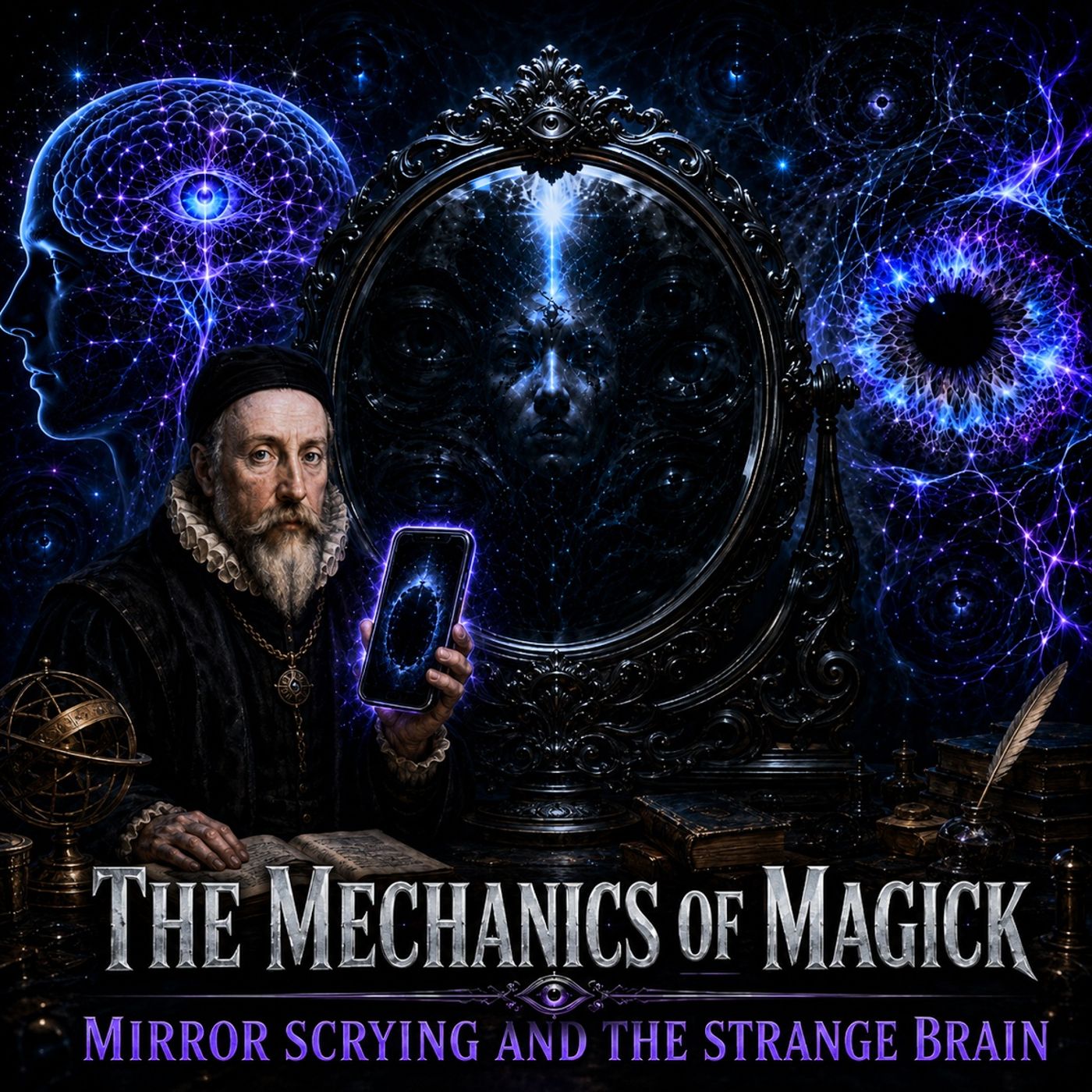
The Mechanics of Magick: Mirror Scrying and the Strange Brain
from The Occult Rejects · host The Occult Rejects
This episode draws on experimental and review literature on mirror-gazing, strange-face illusions, anomalous self-experience, dissociation, agency, face pareidolia, and face-distortion disorders, especially the work of Giovanni B. Caputo, Caputo/Lynn/Houran, Mash et al., Bregman-Hai and Soffer-Dudek, Derome et al., Palmer and Clifford, and Blom et al. Historical and occult context comes from research on catoptromancy, John Dee’s angelic scrying records, the British Museum’s “Dr Dee’s Magical Mirror,” Campbell et al.’s Antiquity study on the mirror’s Mexican/Aztec obsidian origin, and Mesoamerican material on Tezcatlipoca and the “Smoking Mirror.”Links For The Occult Rejectshttps://linktr.ee/theoccultrejectsOccult Research Institutehttps://www.occultresearchinstitute.org/Cash Apphttps://cash.app/$theoccultrejectsVenmo@TheOccultRejectsBuy Me A Coffeebuymeacoffee.com/TheOccultRejectsPatreonhttps://www.patreon.com/TheOccultRejectsCore Scientific Sources: Mirror-Gazing, Strange Faces, and Altered Self-ExperienceCaputo, Giovanni B. “Strange-Face-in-the-Mirror Illusion.” Perception 39, no. 7, 2010, 1007–1008.Key use: This is the main science anchor for the episode. Caputo showed that prolonged mirror-gazing under low illumination can produce strange-face apparitions, including distortions, unknown faces, monstrous faces, animal-like faces, archetypal faces, and faces of relatives or deceased people.Caputo, Giovanni B., Steven Jay Lynn, and James Houran. “Mirror- and Eye-Gazing: An Integrative Review of Induced Altered and Anomalous Experiences.” Imagination, Cognition and Personality 40, no. 4, 2021, 418–457.Key use: This is one of the strongest overview sources. It reviews empirical studies on mirror-gazing, psychomanteum work, and eye-to-eye gazing, especially in relation to altered perception, anomalous experiences, bodily experience, and self-identity.Mash, Joanna, Paul M. Jenkinson, Charlotte E. Dean, and Keith R. Laws. “Strange Face Illusions: A Systematic Review and Quality Analysis.” Consciousness and Cognition 109, 2023, article 103480.Key use: Newer review source. Useful because it supports strange-face illusions as a reliable phenomenon in both mirror-gazing and interpersonal gazing, while also warning that stronger research is still needed on mechanisms and prevalence.Bregman-Hai, Noa, and Nirit Soffer-Dudek. “Mirror-Gazing-Induced Dissociation Impairs Self-Reported and Implicit Sense of Agency: A Causal Investigation of Dissociation and Agency Under Controlled Laboratory Conditions.” PLOS ONE 21, no. 2, 2026, e0341316.Key use: Excellent source for the agency section. This connects mirror-gazing-induced dissociation with weakened sense of agency, which pairs well with mediumship, possession, automatic writing, and the feeling that “something else” is present.Derome, Mélodie, Eduardo Fonseca-Pedrero, Giovanni Battista Caputo, and Martin Debbané. “A Developmental Study of Mirror-Gazing-Induced Anomalous Self-Experiences and Self-Reported Schizotypy from 7 to 28 Years of Age.” Psychopathology 55, no. 1, 2022, 49–61.Key use: Useful developmental source. It connects mirror-gazing-induced anomalous self-experiences with age, self-perception, and schizotypal traits.Caputo, Giovanni B. “Visual Perception During Mirror-Gazing at One’s Own Face in Patients with Depression.” The Scientific World Journal, 2014.Key use: Useful for the emotion/self-face relationship section. Caputo found that strange-face apparitions were reduced in patients with depression compared with healthy controls, including shorter duration, fewer strange faces, weaker intensity, and lower emotional response.Tramacere, Antonella. “Face Yourself: The Social Neuroscience of Mirror Gazing.” Frontiers in Psychology 13, 2022, article 949211.Key use: Strong support for the idea that mirror-gazing is like seeing yourself as another. It connects self-face perception with social neuroscience and the overlap between how we perceive our own face and the faces of others.Chakraborty, Anya C., and Bhismadev Chakrabarti. “Looking at My Own Face: Visual Processing Strategies in Self–Other Face Recognition.” Frontiers in Psychology 9, 2018.Key use: Useful for the self-face recognition section. This study looks at how people process their own face compared with other faces.Conty, Laurence, Nathalie George, and Jari K. Hietanen. “Watching Eyes Effects: When Others Meet the Self.” Consciousness and Cognition 45, 2016, 184–197.Key use: Best support for the gaze/presence section. It argues that direct gaze captures attention and triggers self-referential processing, which helps explain why a mirror can make the viewer feel watched.Face Perception, Pareidolia, and Monstrous DistortionPalmer, Colin J., and Colin W. G. Clifford. “Face Pareidolia Recruits Mechanisms for Detecting Human Social Attention.” Psychological Science 31, no. 8, 2020, 1001–1012.Key use: Best source for the “face-making brain” section. It supports the idea that illusory faces are not treated as meaningless noise; they can recruit mechanisms involved in social attention.Blom, Jan Dirk, Bastiaan C. ter Meulen, Jitze Dool, and Dominic H. ffytche. “A Century of Prosopometamorphopsia Studies.” Cortex 139, 2021, 298–308.Key use: Use carefully as a comparison source, not as a direct explanation for all scrying. Prosopometamorphopsia is a rare condition where faces appear distorted, showing that face-processing systems can produce frightening facial distortions under certain conditions.Psychomanteum, Grief, and Seeing the DeadHastings, Arthur, Michael Hutton, William Braud, et al. “Psychomanteum Research: Experiences and Effects on Bereavement.” OMEGA: Journal of Death and Dying 45, no. 3, 2002, 211–228.Key use: Main grief / dead-in-the-mirror source. Use carefully. It does not prove afterlife contact, but it supports the idea that mirror-gazing, darkness, memory, and grief can produce powerful experiences interpreted as contact.Moody, Raymond A. Reunions: Visionary Encounters with Departed Loved Ones. New York: Villard, 1993.Key use: Main modern popular source for the psychomanteum as a grief-contact chamber. Use as practitioner/popular context, not as the strongest academic evidence.Terhune, Devin B., and Matthew D. Smith. “The Induction of Anomalous Experiences in a Mirror-Gazing Facility: Suggestion, Cognitive Perceptual Personality Traits and Phenomenological State Effects.” The Journal of Nervous and Mental Disease 194, no. 6, 2006, 415–421.Key use: Good supporting source for anomalous experiences in a mirror-gazing facility. Pairs well with Hastings and the Caputo review.Kamp, K. S., Evgenia Steffen, Louis A. Kasket, and others. “Sensory and Quasi-Sensory Experiences of the Deceased in Bereavement: An Interdisciplinary and Integrative Review.” Schizophrenia Bulletin 46, no. 6, 2020, 1367–1381.Key use: Strong source for the grief section. It supports the point that bereaved people often report sensory or quasi-sensory experiences of the deceased, including feeling a presence, seeing, hearing, smelling, or sensing the dead.Hewson, Helen, and colleagues. “The Impact of Continuing Bonds Following Bereavement: A Systematic Review.” Death Studies, 2024.Key use: Useful for continuing bonds. It helps frame ongoing inner relationships with the dead as part of bereavement rather than automatically pathological.Historical, Religious, and Occult Mirror DivinationJohnston, Sarah Iles. Ancient Greek Divination. Wiley-Blackwell, 2008.Key use: Broad academic background for ancient divination systems. Not only mirror scrying, but very useful for framing divination as a serious religious and cultural practice.“Technical Divination and Mechanics of Sacred Space.” In Technologies of the Marvellous in Ancient Greek Religion. Cambridge University Press.Key use: Useful for ancient catoptromancy. This chapter discusses mirror divination as a technical mode of ancient divination involving reflective/catoptric knowledge and assumptions about divine intervention in human knowledge.Lee, Mireille M. “The Gendered Economics of Greek Bronze Mirrors.” Hesperia 86, no. 1, 2017.Key use: Useful for Greek bronze mirrors as social, gendered, material, and possibly magical/divinatory objects.Pitt Rivers Museum. “Mirrors.” Body Arts Collection Resource.Key use: Good museum-level source for folklore around mirrors and catoptromancy. Useful for basic show-note support on the traditional belief that mirrors could reveal the future.John Dee, Black Mirrors, and ObsidianBritish Museum. “Dr Dee’s Magical Mirror / Dr Dee’s Magical Speculum.” Collection object 1966,1001.1.Key use: Essential object source. The British Museum identifies the object as Dr. Dee’s magical mirror or magical speculum, made of obsidian, catalogued as Aztec, and broadly dated to the 14th–16th century.Campbell, Stuart, Elizabeth Healey, Jago Cooper, Naomi Speakman, and others. “The Mirror, the Magus and More: Reflections on John Dee’s Obsidian Mirror.” Antiquity 95, 2021.Key use: Essential academic source for Dee’s mirror. The study uses geochemical analysis to show that the British Museum obsidian mirrors are Mexican in origin, with Dee’s mirror matching the Pachuca obsidian source.Nature. “A ‘Spirit Mirror’ Used in Elizabeth I’s Court Had Aztec Roots.” 2021.Key use: Short science-news summary of the Antiquity findings. Useful for quickly explaining that Dee’s mirror was traced to a source near Pachuca, Mexico.Smithsonian Magazine. “Obsidian ‘Spirit Mirror’ Used by Elizabeth I’s Court Astrologer Has Aztec Origins.” 2021.Key use: Useful public-facing summary of Dee’s mirror, its Aztec/Mexican origin, and its connection to Elizabethan occult culture.Dee, John, and Meric Casaubon, ed. A True & Faithful Relation of What Passed for Many YeaAlso want to remind people about the website, if you're into reading we have tons of information by multiple contributors, and we got t-shirts up on the site if you're interested. Fun fact, the art is all based on the eyeball.
Embed this episode
What this episode covers
This episode draws on experimental and review literature on mirror-gazing, strange-face illusions, anomalous self-experience, dissociation, agency, face pareidolia, and face-distortion disorders, especially the work of Giovanni B. Caputo, Caputo/Lynn/Houran, Mash et al., Bregman-Hai and Soffer-Dudek, Derome et al., Palmer and Clifford, and Blom et al. Historical and occult context comes from research on catoptromancy, John Dee’s angelic scrying records, the British Museum’s “Dr Dee’s Magical Mirror,” Campbell et al.’s Antiquity study on the mirror’s Mexican/Aztec obsidian origin, and Mesoamerican material on Tezcatlipoca and the “Smoking Mirror.” Links For The Occult Rejects https://linktr.ee/theoccultrejects Occult Research Institute https://www.occultresearchinstitute.org/ Cash App https://cash.app/$theoccultrejects Venmo @TheOccultRejects Buy Me A Coffee buymeacoffee.com/TheOccultRejects Patreon https://www.patreon.com/TheOccultRejects Core Scientific Sources: Mirror-Gazing, Strange Faces, and Altered Self-ExperienceCaputo, Giovanni B. “Strange-Face-in-the-Mirror Illusion.” Perception 39, no. 7, 2010, 1007–1008. Key use: This is the main science anchor for the episode. Caputo showed that prolonged mirror-gazing under low illumination can produce strange-face apparitions, including distortions, unknown faces, monstrous faces, animal-like faces, archetypal faces, and faces of relatives or deceased people.Caputo, Giovanni B., Steven Jay Lynn, and James Houran. “Mirror- and Eye-Gazing: An Integrative Review of Induced Altered and Anomalous Experiences.” Imagination, Cognition and Personality 40, no. 4, 2021, 418–457. Key use: This is one of the strongest overview sources. It reviews empirical studies on mirror-gazing, psychomanteum work, and eye-to-eye gazing, especially in relation to altered perception, anomalous experiences, bodily experience, and self-identity.Mash, Joanna, Paul M. Jenkinson, Charlotte E. Dean, and Keith R. Laws. “Strange Face Illusions: A Systematic Review and Quality Analysis.” Consciousness and Cognition 109, 2023, article 103480. Key use: Newer review source. Useful because it supports strange-face illusions as a reliable phenomenon in both mirror-gazing and interpersonal gazing, while also warning that stronger research is still needed on mechanisms and prevalence.Bregman-Hai, Noa, and Nirit Soffer-Dudek. “Mirror-Gazing-Induced Dissociation Impairs Self-Reported and Implicit Sense of Agency: A Causal Investigation of Dissociation and Agency Under Controlled Laboratory Conditions.” PLOS ONE 21, no. 2, 2026, e0341316. Key use: Excellent source for the agency section. This connects mirror-gazing-induced dissociation with weakened sense of agency, which pairs well with mediumship, possession, automatic writing, and the feeling that “something else” is present.Derome, Mélodie, Eduardo Fonseca-Pedrero, Giovanni Battista Caputo, and Martin Debbané. “A Developmental Study of Mirror-Gazing-Induced Anomalous Self-Experiences and Self-Reported Schizotypy from 7 to 28 Years of Age.” Psychopathology 55, no. 1, 2022, 49–61. Key use: Useful developmental source. It connects mirror-gazing-induced anomalous self-experiences with age, self-perception, and schizotypal traits.Caputo, Giovanni B. “Visual Perception During Mirror-Gazing at One’s Own Face in Patients with Depression.” The Scientific World Journal, 2014. Key use: Useful for the emotion/self-face relationship section. Caputo found that strange-face apparitions were reduced in patients with depression compared with healthy controls, including shorter duration, fewer strange faces, weaker intensity, and lower emotional response.Tramacere, Antonella. “Face Yourself: The Social Neuroscience of Mirror Gazing.” Frontiers in Psychology 13, 2022, article 949211. Key use: Strong support for the idea that mirror-gazing is like seeing yourself as another....
NOW PLAYING
The Mechanics of Magick: Mirror Scrying and the Strange Brain
No transcript for this episode yet
Similar Episodes
No similar episodes found.
Similar Podcasts
No similar podcasts found.