
EPISODE · Aug 31, 2026 · 57 MIN
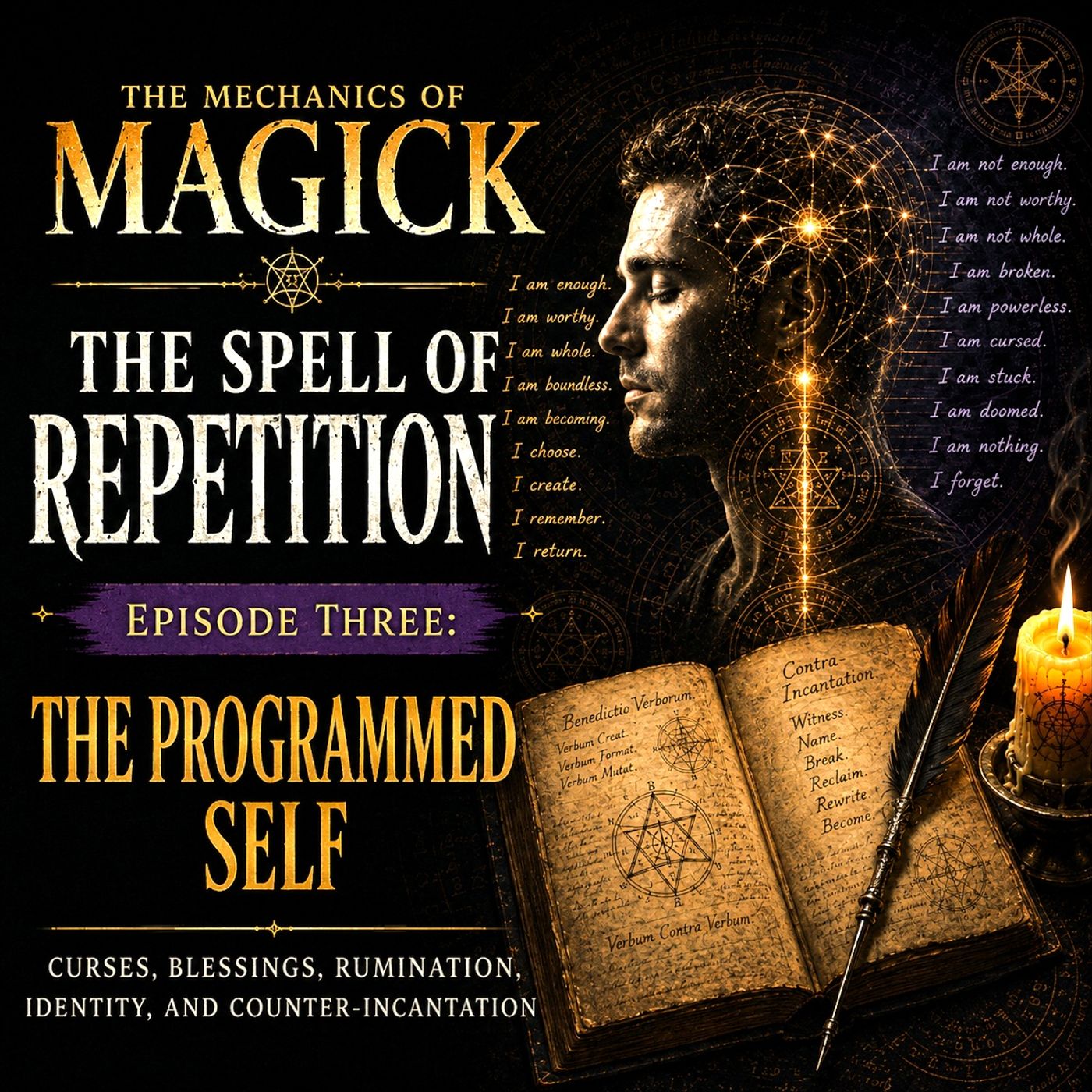
The Mechanics of Magick: The Spell of Repetition Episode Three: The Programmed Self
from The Occult Rejects · host The Occult Rejects
Links For The Occult Rejectshttps://linktr.ee/theoccultrejectsOccult Research Institutehttps://www.occultresearchinstitute.org/Substackhttps://substack.com/@theoccultrejects?r=7auau0&utm_campaign=profile&utm_medium=profile-pageCash Apphttps://cash.app/$theoccultrejectsVenmo@TheOccultRejectsBuy Me A Coffeebuymeacoffee.com/TheOccultRejectsPatreonhttps://www.patreon.com/TheOccultRejectsBibliographyCurses, Blessings, and Ritual HarmCannon, Walter B. “‘Voodoo’ Death.” American Anthropologist 44, no. 2 (1942): 169–181.Faraone, Christopher A. Ancient Greek Love Magic. Cambridge, MA: Harvard University Press, 1999.Gager, John G., ed. Curse Tablets and Binding Spells from the Ancient World. New York: Oxford University Press, 1992.Graf, Fritz. Magic in the Ancient World. Translated by Franklin Philip. Cambridge, MA: Harvard University Press, 1997.Ogden, Daniel. Magic, Witchcraft, and Ghosts in the Greek and Roman Worlds: A Sourcebook. 2nd ed. New York: Oxford University Press, 2009.Stratton, Kimberly B., and Dayna S. Kalleres, eds. Daughters of Hecate: Women and Magic in the Ancient World. New York: Oxford University Press, 2014.Tambiah, Stanley Jeyaraja. “The Magical Power of Words.” Man 3, no. 2 (1968): 175–208.Placebo, Nocebo, and Medical CommunicationBarsky, Arthur J., Ralph Saintfort, Malcolm P. Rogers, and Jonathan F. Borus. “Nonspecific Medication Side Effects and the Nocebo Phenomenon.” JAMA 287, no. 5 (2002): 622–627.Benedetti, Fabrizio. Placebo Effects: Understanding the Mechanisms in Health and Disease. Oxford: Oxford University Press, 2009.Benedetti, Fabrizio, Marina Lanotte, Lorella Lopiano, and Luana Colloca. “When Words Are Painful: Unraveling the Mechanisms of the Nocebo Effect.” Neuroscience 147, no. 2 (2007): 260–271.Colloca, Luana, and Fabrizio Benedetti. “Nocebo Hyperalgesia: How Anxiety Is Turned into Pain.” Current Opinion in Anaesthesiology 20, no. 5 (2007): 435–439.Colloca, Luana, and Damien Finniss. “Nocebo Effects, Patient–Clinician Communication, and Therapeutic Outcomes.” JAMA 307, no. 6 (2012): 567–568.Colloca, Luana, and Franklin G. Miller. “The Nocebo Effect and Its Relevance for Clinical Practice.” Psychosomatic Medicine 73, no. 7 (2011): 598–603.Enck, Paul, Fabrizio Benedetti, and Manfred Schedlowski. “New Insights into the Placebo and Nocebo Responses.” Neuron 59, no. 2 (2008): 195–206.Häuser, Winfried, Ernil Hansen, and Paul Enck. “Nocebo Phenomena in Medicine: Their Relevance in Everyday Clinical Practice.” Deutsches Ärzteblatt International 109, no. 26 (2012): 459–465.Inner Speech and DevelopmentFernyhough, Charles. The Voices Within: The History and Science of How We Talk to Ourselves. New York: Basic Books, 2016.Vygotsky, Lev S. Thought and Language. Revised and expanded ed. Edited and translated by Alex Kozulin. Cambridge, MA: MIT Press, 1986.Winsler, Adam, Charles Fernyhough, and Ignacio Montero, eds. Private Speech, Executive Functioning, and the Development of Verbal Self-Regulation. Cambridge: Cambridge University Press, 2009.Rumination and Repetitive Negative ThinkingBrosschot, Jos F., Bart Verkuil, and Julian F. Thayer. “Conscious and Unconscious Perseverative Cognition: Is a Large Part of Prolonged Physiological Activity Due to Unconscious Stress?” Journal of Psychosomatic Research 69, no. 4 (2010): 407–416.Ehring, Thomas, and Edward R. Watkins. “Repetitive Negative Thinking as a Transdiagnostic Process.” International Journal of Cognitive Therapy 1, no. 3 (2008): 192–205.Nolen-Hoeksema, Susan. “Responses to Depression and Their Effects on the Duration of Depressive Episodes.” Journal of Abnormal Psychology 100, no. 4 (1991): 569–582.Nolen-Hoeksema, Susan, Blair E. Wisco, and Sonja Lyubomirsky. “Rethinking Rumination.” Perspectives on Psychological Science 3, no. 5 (2008): 400–424.Smith, Jeannette M., and Lauren B. Alloy. “A Roadmap to Rumination: A Review of the Definition, Assessment, and Conceptualization of This Multifaceted Construct.” Clinical Psychology Review 29, no. 2 (2009): 116–128.Treynor, Wendy, Richard Gonzalez, and Susan Nolen-Hoeksema. “Rumination Reconsidered: A Psychometric Analysis.” Cognitive Therapy and Research 27, no. 3 (2003): 247–259.Watkins, Edward R. “Constructive and Unconstructive Repetitive Thought.” Psychological Bulletin 134, no. 2 (2008): 163–206.Watkins, Edward R. Rumination-Focused Cognitive-Behavioral Therapy for Depression. New York: Guilford Press, 2016.Self-Talk and PerformanceHardy, James. “Speaking Clearly: A Critical Review of the Self-Talk Literature.” Psychology of Sport and Exercise 7, no. 1 (2006): 81–97.Hatzigeorgiadis, Antonis, Nikos Zourbanos, Evangelos Galanis, and Yiannis Theodorakis. “Self-Talk and Sports Performance: A Meta-Analysis.” Perspectives on Psychological Science 6, no. 4 (2011): 348–356.Theodorakis, Yiannis, Antonis Hatzigeorgiadis, and Nikos Zourbanos. “Cognition: Self-Talk and Performance.” In The Oxford Handbook of Sport and Performance Psychology, edited by Shane M. Murphy. New York: Oxford University Press, 2012.Affect Labeling, Emotion, and LanguageBarrett, Lisa Feldman. “Solving the Emotion Paradox: Categorization and the Experience of Emotion.” Personality and Social Psychology Review 10, no. 1 (2006): 20–46.Lieberman, Matthew D., Naomi I. Eisenberger, Molly J. Crockett, Sabrina M. Tom, Jennifer H. Pfeifer, and Baldwin M. Way. “Putting Feelings into Words: Affect Labeling Disrupts Amygdala Activity in Response to Affective Stimuli.” Psychological Science 18, no. 5 (2007): 421–428.Lindquist, Kristen A., Lisa Feldman Barrett, Eliza Bliss-Moreau, and James A. Russell. “Language and the Perception of Emotion.” Emotion 6, no. 1 (2006): 125–138.Torre, Jared B., and Matthew D. Lieberman. “Putting Feelings into Words: Affect Labeling as Implicit Emotion Regulation.” Emotion Review 10, no. 2 (2018): 116–124.Self-Distancing and Reflective ProcessingAyduk, Özlem, and Ethan Kross. “From a Distance: Implications of Spontaneous Self-Distancing for Adaptive Self-Reflection.” Journal of Personality and Social Psychology 98, no. 5 (2010): 809–829.Kross, Ethan, and Özlem Ayduk. “Making Meaning out of Negative Experiences by Self-Distancing.” Current Directions in Psychological Science 20, no. 3 (2011): 187–191.Kross, Ethan, Özlem Ayduk, and Walter Mischel. “When Asking ‘Why’ Does Not Hurt: Distinguishing Rumination from Reflective Processing of Negative Emotions.” Psychological Science 16, no. 9 (2005): 709–715.Kross, Ethan, Emma Bruehlman-Senecal, Jiyoung Park, Aleah Burson, Adrienne Dougherty, Holly Shablack, Ryan Bremner, Jason Moser, and Özlem Ayduk. “Self-Talk as a Regulatory Mechanism: How You Do It Matters.” Journal of Personality and Social Psychology 106, no. 2 (2014): 304–324.Moser, Jason S., Adrienne Dougherty, Whitney I. Mattson, Benjamin Katz, Tim P. Moran, Darwin Guevarra, Hannah Shablack, et al. “Third-Person Self-Talk Facilitates Emotion Regulation Without Engaging Cognitive Control: Converging Evidence from ERP and fMRI.” Scientific Reports 7 (2017): 4519.Affirmation and Counter-IncantationCascio, Christopher N., Matthew B. O’Donnell, Francis J. Tinney Jr., Matthew D. Lieberman, Shelley E. Taylor, Victor J. Strecher, and Emily B. Falk. “Self-Affirmation Activates Brain Systems Associated with Self-Related Processing and Reward and Is Reinforced by Future Orientation.” Social Cognitive and Affective Neuroscience 11, no. 4 (2016): 621–629.Cohen, Geoffrey L., and David K. Sherman. “The Psychology of Change: Self-Affirmation and Social Psychological Intervention.” Annual Review of Psychology 65 (2014): 333–371.Wood, Joanne V., W. Q. Elaine Perunovic, and John W. Lee. “Positive Self-Statements: Power for Some, Peril for Others.” Psychological Science 20, no. 7 (2009): 860–866.Implementation Intentions and ActionGollwitzer, Peter M. “Implementation Intentions: Strong Effects of Simple Plans.” American Psychologist 54, no. 7 (1999): 493–503.Gollwitzer, Peter M., and Veronika Brandstätter. “Implementation Intentions and Effective Goal Pursuit.” Journal of Personality and Social Psychology 73, no. 1 (1997): 186–199.Gollwitzer, Peter M., and Paschal Sheeran. “Implementation Intentions and Goal Achievement: A Meta-Analysis of Effects and Processes.” Advances in Experimental Social Psychology 38 (2006): 69–119.Schweiger Gallo, Inge, Andreas Keil, Kathleen C. McCulloch, Brigitte Rockstroh, and Peter M. Gollwitzer. “Strategic Automation of Emotion Regulation.” Journal of Personality and Social Psychology 96, no. 1 (2009): 11–31.Ritual, Identity, and Psychological FormationBell, Catherine. Ritual Theory, Ritual Practice. New York: Oxford University Press, 1992.Hobson, Nicholas M., Juliana Schroeder, Jane L. Risen, Dimitris Xygalatas, and Michael Inzlicht. “The Psychology of Rituals: An Integrative Review and Process-Based Framework.” Personality and Social Psychology Review 22, no. 3 (2018): 260–284.Rappaport, Roy A. Ritual and Religion in the Making of Humanity. Cambridge: Cambridge University Press, 1999.Xygalatas, Dimitris. Ritual: How Seemingly Senseless Acts Make Life Worth Living. New York: Little, Brown Spark, 2022.Also want to remind people about the website, if you're into reading we have tons of information by multiple contributors, and we got t-shirts up on the site if you're interested. Fun fact, the art is all based on the eyeball.
Embed this episode
What this episode covers
Links For The Occult Rejects https://linktr.ee/theoccultrejects Occult Research Institute https://www.occultresearchinstitute.org/ Substack https://substack.com/@theoccultrejects?r=7auau0&utm_campaign=profile&utm_medium=profile-page Cash App https://cash.app/$theoccultrejects Venmo @TheOccultRejects Buy Me A Coffee buymeacoffee.com/TheOccultRejects Patreon https://www.patreon.com/TheOccultRejects Bibliography Curses, Blessings, and Ritual Harm Cannon, Walter B. “‘Voodoo’ Death.” American Anthropologist 44, no. 2 (1942): 169–181. Faraone, Christopher A. Ancient Greek Love Magic. Cambridge, MA: Harvard University Press, 1999. Gager, John G., ed. Curse Tablets and Binding Spells from the Ancient World. New York: Oxford University Press, 1992. Graf, Fritz. Magic in the Ancient World. Translated by Franklin Philip. Cambridge, MA: Harvard University Press, 1997. Ogden, Daniel. Magic, Witchcraft, and Ghosts in the Greek and Roman Worlds: A Sourcebook. 2nd ed. New York: Oxford University Press, 2009. Stratton, Kimberly B., and Dayna S. Kalleres, eds. Daughters of Hecate: Women and Magic in the Ancient World. New York: Oxford University Press, 2014. Tambiah, Stanley Jeyaraja. “The Magical Power of Words.” Man 3, no. 2 (1968): 175–208. Placebo, Nocebo, and Medical Communication Barsky, Arthur J., Ralph Saintfort, Malcolm P. Rogers, and Jonathan F. Borus. “Nonspecific Medication Side Effects and the Nocebo Phenomenon.” JAMA 287, no. 5 (2002): 622–627. Benedetti, Fabrizio. Placebo Effects: Understanding the Mechanisms in Health and Disease. Oxford: Oxford University Press, 2009. Benedetti, Fabrizio, Marina Lanotte, Lorella Lopiano, and Luana Colloca. “When Words Are Painful: Unraveling the Mechanisms of the Nocebo Effect.” Neuroscience 147, no. 2 (2007): 260–271. Colloca, Luana, and Fabrizio Benedetti. “Nocebo Hyperalgesia: How Anxiety Is Turned into Pain.” Current Opinion in Anaesthesiology 20, no. 5 (2007): 435–439. Colloca, Luana, and Damien Finniss. “Nocebo Effects, Patient–Clinician Communication, and Therapeutic Outcomes.” JAMA 307, no. 6 (2012): 567–568. Colloca, Luana, and Franklin G. Miller. “The Nocebo Effect and Its Relevance for Clinical Practice.” Psychosomatic Medicine 73, no. 7 (2011): 598–603. Enck, Paul, Fabrizio Benedetti, and Manfred Schedlowski. “New Insights into the Placebo and Nocebo Responses.” Neuron 59, no. 2 (2008): 195–206. Häuser, Winfried, Ernil Hansen, and Paul Enck. “Nocebo Phenomena in Medicine: Their Relevance in Everyday Clinical Practice.” Deutsches Ärzteblatt International 109, no. 26 (2012): 459–465. Inner Speech and Development Fernyhough, Charles. The Voices Within: The History and Science of How We Talk to Ourselves. New York: Basic Books, 2016. Vygotsky, Lev S. Thought and Language. Revised and expanded ed. Edited and translated by Alex Kozulin. Cambridge, MA: MIT Press, 1986. Winsler, Adam, Charles Fernyhough, and Ignacio Montero, eds. Private Speech, Executive Functioning, and the Development of Verbal Self-Regulation. Cambridge: Cambridge University Press, 2009. Rumination and Repetitive Negative Thinking Brosschot, Jos F., Bart Verkuil, and Julian F. Thayer. “Conscious and Unconscious Perseverative Cognition: Is a Large Part of Prolonged Physiological Activity Due to Unconscious Stress?” Journal of Psychosomatic Research 69, no. 4 (2010): 407–416. Ehring, Thomas, and Edward R. Watkins. “Repetitive Negative Thinking as a Transdiagnostic Process.” International Journal of Cognitive Therapy 1, no. 3 (2008): 192–205. Nolen-Hoeksema, Susan. “Responses to Depression and Their Effects on the Duration of Depressive Episodes.” Journal of Abnormal Psychology 100, no. 4 (1991): 569–582. Nolen-Hoeksema, Susan, Blair E. Wisco, and Sonja Lyubomirsky. “Rethinking Rumination.” Perspectives on...
Ready to play
The Mechanics of Magick: The Spell of Repetition Episode Three: The Programmed Self
No transcript for this episode yet
Similar Episodes
No similar episodes found.
Similar Podcasts
No similar podcasts found.