
EPISODE · Aug 24, 2026 · 1H 4M
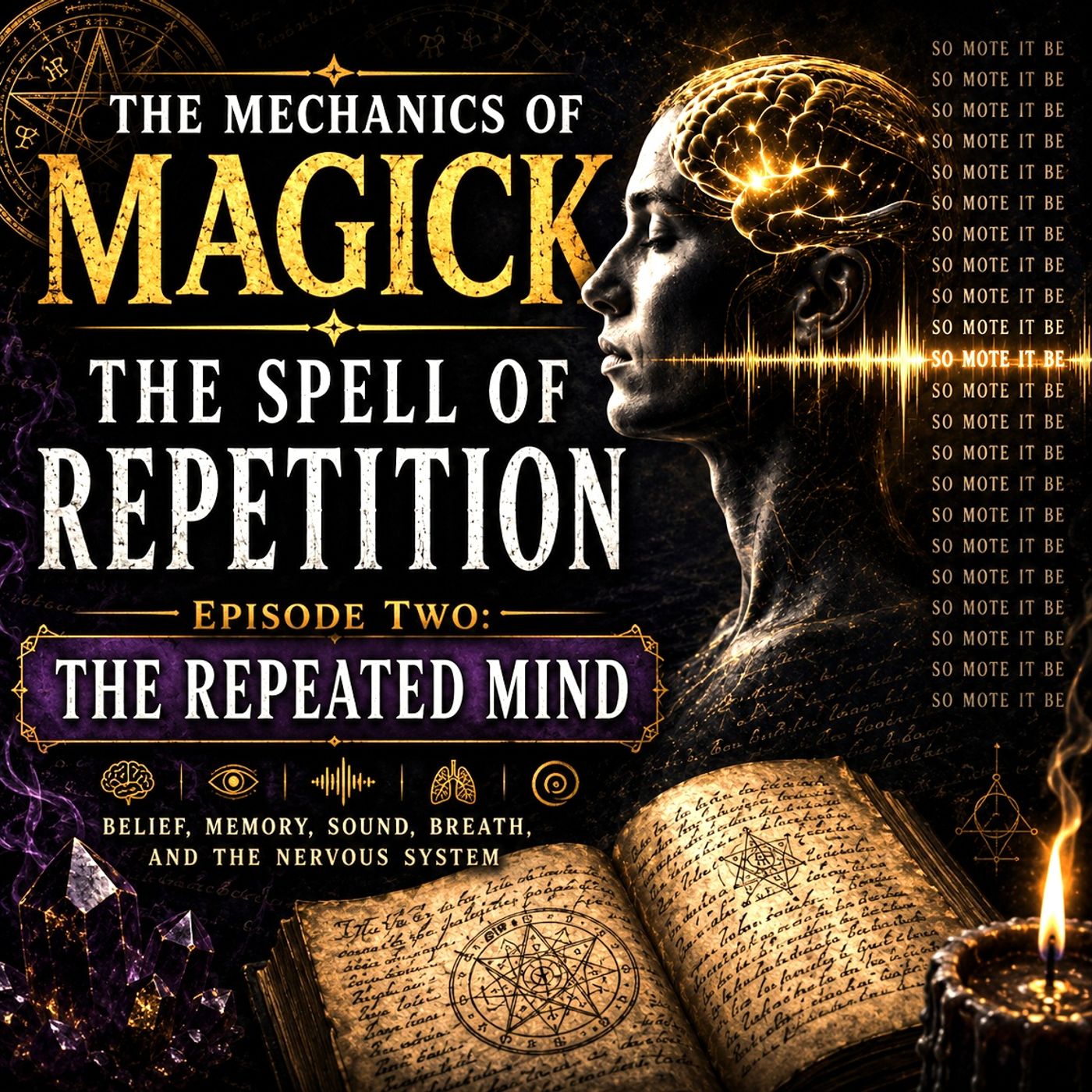
The Mechanics of Magick: The Spell of Repetition Episode Two- The Repeated Mind
from The Occult Rejects · host The Occult Rejects
Links For The Occult Rejectshttps://linktr.ee/theoccultrejectsOccult Research Institutehttps://www.occultresearchinstitute.org/Substackhttps://substack.com/@theoccultrejects?r=7auau0&utm_campaign=profile&utm_medium=profile-pageCash Apphttps://cash.app/$theoccultrejectsVenmo@TheOccultRejectsBuy Me A Coffeebuymeacoffee.com/TheOccultRejectsPatreonhttps://www.patreon.com/TheOccultRejectsBibliographyRepetition, Fluency, and BeliefBacon, Frederick T. “Credibility of Repeated Statements: Memory for Trivia.” Journal of Experimental Psychology: Human Learning and Memory 5, no. 3 (1979): 241–252.Begg, Ian Maynard, Ann Anas, and Suzanne Farinacci. “Dissociation of Processes in Belief: Source Recollection, Statement Familiarity, and the Illusion of Truth.” Journal of Experimental Psychology: General 121, no. 4 (1992): 446–458.Dechêne, Alice, Christoph Stahl, Jochim Hansen, and Michaela Wänke. “The Truth About the Truth: A Meta-Analytic Review of the Truth Effect.” Personality and Social Psychology Review 14, no. 2 (2010): 238–257.Fazio, Lisa K., Nadia M. Brashier, B. Keith Payne, and Elizabeth J. Marsh. “Knowledge Does Not Protect Against Illusory Truth.” Journal of Experimental Psychology: General 144, no. 5 (2015): 993–1002.Hasher, Lynn, David Goldstein, and Thomas Toppino. “Frequency and the Conference of Referential Validity.” Journal of Verbal Learning and Verbal Behavior 16, no. 1 (1977): 107–112.Reber, Rolf, and Norbert Schwarz. “Effects of Perceptual Fluency on Judgments of Truth.” Consciousness and Cognition 8, no. 3 (1999): 338–342.Unkelbach, Christian. “Reversing the Truth Effect: Learning the Interpretation of Processing Fluency in Judgments of Truth.” Journal of Experimental Psychology: Learning, Memory, and Cognition 33, no. 1 (2007): 219–230.Zajonc, Robert B. “Attitudinal Effects of Mere Exposure.” Journal of Personality and Social Psychology 9, no. 2, part 2 (1968): 1–27.Memory, Spacing, and RetrievalCepeda, Nicholas J., Harold Pashler, Edward Vul, John T. Wixted, and Doug Rohrer. “Distributed Practice in Verbal Recall Tasks: A Review and Quantitative Synthesis.” Psychological Bulletin 132, no. 3 (2006): 354–380.Ebbinghaus, Hermann. Memory: A Contribution to Experimental Psychology. Translated by Henry A. Ruger and Clara E. Bussenius. New York: Teachers College, Columbia University, 1913. Originally published 1885.Karpicke, Jeffrey D., and Henry L. Roediger III. “Repeated Retrieval During Learning Is the Key to Long-Term Retention.” Journal of Memory and Language 57, no. 2 (2007): 151–162.Roediger, Henry L. III, and Jeffrey D. Karpicke. “Test-Enhanced Learning: Taking Memory Tests Improves Long-Term Retention.” Psychological Science 17, no. 3 (2006): 249–255.Tulving, Endel, and Donald M. Thomson. “Encoding Specificity and Retrieval Processes in Episodic Memory.” Psychological Review 80, no. 5 (1973): 352–373.Whitehouse, Harvey. Modes of Religiosity: A Cognitive Theory of Religious Transmission. Walnut Creek, CA: AltaMira Press, 2004.Semantic Satiation and Verbal TransformationBalota, David A., and Sarah Black. “Semantic Satiation in Healthy Young and Older Adults.” Memory & Cognition 25, no. 2 (1997): 190–202.Jakobovits, Leon A. Effects of Repeated Stimulation on Cognitive Aspects of Behavior: Some Experiments on the Phenomenon of Semantic Satiation. PhD diss., McGill University, 1962.Kounios, John, et al. “On the Locus of the Semantic Satiation Effect: Evidence from Event-Related Brain Potentials.” Memory & Cognition 28, no. 8 (2000): 1366–1377.Pilotti, Maura, John S. Antrobus, and Monica Duff. “The Effect of Presemantic Acoustic Adaptation on Semantic ‘Satiation.’” Memory & Cognition 25, no. 3 (1997): 305–312.Ströberg, Kim, Lau M. Andersen, and Stefan Wiens. “Electrocortical N400 Effects of Semantic Satiation.” Frontiers in Psychology 8 (2017): 2117.Warren, Richard M. “Illusory Changes of Distinct Speech upon Repetition—The Verbal Transformation Effect.” British Journal of Psychology 52, no. 3 (1961): 249–258.Warren, Richard M. “Illusory Changes in Repeated Words: Differences between Young Adults and the Aged.” American Journal of Psychology 74, no. 4 (1961): 506–516.Speech, Song, and Musical RepetitionDeutsch, Diana. “The Speech-to-Song Illusion.” Journal of the Acoustical Society of America 134, no. 5 (2013): 4241.Deutsch, Diana, Trevor Henthorn, and Rachael Lapidis. “Illusory Transformation from Speech to Song.” Journal of the Acoustical Society of America 129, no. 4 (2011): 2245–2252.Jakubowski, Kelly, Sebastian Finkel, Lauren Stewart, and Daniel Müllensiefen. “Dissecting an Earworm: Melodic Features and Song Popularity Predict Involuntary Musical Imagery.” Psychology of Aesthetics, Creativity, and the Arts 11, no. 2 (2017): 122–135.Margulis, Elizabeth Hellmuth. On Repeat: How Music Plays the Mind. New York: Oxford University Press, 2014.Marjieh, Raja, Pol van Rijn, Ilia Sucholutsky, Harin Lee, Thomas L. Griffiths, and Nori Jacoby. “A Rational Analysis of the Speech-to-Song Illusion.” Preprint, 2024.Vickhoff, Björn, Helge Malmgren, Rickard Åström, Gunnar Nyberg, Seth-Reino Ekström, Mathias Engwall, Johan Snygg, Michael Nilsson, and Rebecka Jörnsten. “Music Structure Determines Heart Rate Variability of Singers.” Frontiers in Psychology 4 (2013): 334.Breath, Vocalization, and Autonomic PhysiologyBernardi, Luciano, Peter Sleight, Gianfranco Bandinelli, Simone Cencetti, Lino Fattorini, Jacek Wdowczyc-Szulc, and Andrea Lagi. “Effect of Rosary Prayer and Yoga Mantras on Autonomic Cardiovascular Rhythms: Comparative Study.” BMJ 323, no. 7327 (2001): 1446–1449.Lehrer, Paul M., and Richard Gevirtz. “Heart Rate Variability Biofeedback: How and Why Does It Work?” Frontiers in Psychology 5 (2014): 756.Shaffer, Fred, and J. P. Ginsberg. “An Overview of Heart Rate Variability Metrics and Norms.” Frontiers in Public Health 5 (2017): 258.Zaccaro, Andrea, Andrea Piarulli, Marco Laurino, Erika Garbella, Danilo Menicucci, Bruno Neri, and Angelo Gemignani. “How Breath-Control Can Change Your Life: A Systematic Review on Psycho-Physiological Correlates of Slow Breathing.” Frontiers in Human Neuroscience 12 (2018): 353.Meditation, Chanting, and NeuroscienceFox, Kieran C. R., Matthew L. Dixon, Savannah Nijeboer, Manesh Girn, James L. Floman, Michael Lifshitz, Melissa Ellamil, Peter Sedlmeier, and Kalina Christoff. “Functional Neuroanatomy of Meditation: A Review and Meta-Analysis of 78 Functional Neuroimaging Investigations.” Neuroscience & Biobehavioral Reviews 65 (2016): 208–228.Kalyani, B. G., G. Venkatasubramanian, R. Arasappa, N. P. Rao, S. V. Kalmady, R. Behere, H. Rao, M. Vasudev, and B. N. Gangadhar. “Neurohemodynamic Correlates of ‘OM’ Chanting: A Pilot Functional Magnetic Resonance Imaging Study.” International Journal of Yoga 4, no. 1 (2011): 3–6.Travis, Fred, and Jonathan Shear. “Focused Attention, Open Monitoring and Automatic Self-Transcending: Categories to Organize Meditations from Vedic, Buddhist and Chinese Traditions.” Consciousness and Cognition 19, no. 4 (2010): 1110–1118.Ritual, Attention, and Embodied PracticeBell, Catherine. Ritual Theory, Ritual Practice. New York: Oxford University Press, 1992.Hobson, Nicholas M., Juliana Schroeder, Jane L. Risen, Dimitris Xygalatas, and Michael Inzlicht. “The Psychology of Rituals: An Integrative Review and Process-Based Framework.” Personality and Social Psychology Review 22, no. 3 (2018): 260–284.McCauley, Robert N., and E. Thomas Lawson. Bringing Ritual to Mind: Psychological Foundations of Cultural Forms. Cambridge: Cambridge University Press, 2002.Rappaport, Roy A. Ritual and Religion in the Making of Humanity. Cambridge: Cambridge University Press, 1999.Xygalatas, Dimitris. Ritual: How Seemingly Senseless Acts Make Life Worth Living. New York: Little, Brown Spark, 2022.Also want to remind people about the website, if you're into reading we have tons of information by multiple contributors, and we got t-shirts up on the site if you're interested. Fun fact, the art is all based on the eyeball.
Embed this episode
What this episode covers
Links For The Occult Rejects https://linktr.ee/theoccultrejects Occult Research Institute https://www.occultresearchinstitute.org/ Substack https://substack.com/@theoccultrejects?r=7auau0&utm_campaign=profile&utm_medium=profile-page Cash App https://cash.app/$theoccultrejects Venmo @TheOccultRejects Buy Me A Coffee buymeacoffee.com/TheOccultRejects Patreon https://www.patreon.com/TheOccultRejects Bibliography Repetition, Fluency, and Belief Bacon, Frederick T. “Credibility of Repeated Statements: Memory for Trivia.” Journal of Experimental Psychology: Human Learning and Memory 5, no. 3 (1979): 241–252. Begg, Ian Maynard, Ann Anas, and Suzanne Farinacci. “Dissociation of Processes in Belief: Source Recollection, Statement Familiarity, and the Illusion of Truth.” Journal of Experimental Psychology: General 121, no. 4 (1992): 446–458. Dechêne, Alice, Christoph Stahl, Jochim Hansen, and Michaela Wänke. “The Truth About the Truth: A Meta-Analytic Review of the Truth Effect.” Personality and Social Psychology Review 14, no. 2 (2010): 238–257. Fazio, Lisa K., Nadia M. Brashier, B. Keith Payne, and Elizabeth J. Marsh. “Knowledge Does Not Protect Against Illusory Truth.” Journal of Experimental Psychology: General 144, no. 5 (2015): 993–1002. Hasher, Lynn, David Goldstein, and Thomas Toppino. “Frequency and the Conference of Referential Validity.” Journal of Verbal Learning and Verbal Behavior 16, no. 1 (1977): 107–112. Reber, Rolf, and Norbert Schwarz. “Effects of Perceptual Fluency on Judgments of Truth.” Consciousness and Cognition 8, no. 3 (1999): 338–342. Unkelbach, Christian. “Reversing the Truth Effect: Learning the Interpretation of Processing Fluency in Judgments of Truth.” Journal of Experimental Psychology: Learning, Memory, and Cognition 33, no. 1 (2007): 219–230. Zajonc, Robert B. “Attitudinal Effects of Mere Exposure.” Journal of Personality and Social Psychology 9, no. 2, part 2 (1968): 1–27. Memory, Spacing, and Retrieval Cepeda, Nicholas J., Harold Pashler, Edward Vul, John T. Wixted, and Doug Rohrer. “Distributed Practice in Verbal Recall Tasks: A Review and Quantitative Synthesis.” Psychological Bulletin 132, no. 3 (2006): 354–380. Ebbinghaus, Hermann. Memory: A Contribution to Experimental Psychology. Translated by Henry A. Ruger and Clara E. Bussenius. New York: Teachers College, Columbia University, 1913. Originally published 1885. Karpicke, Jeffrey D., and Henry L. Roediger III. “Repeated Retrieval During Learning Is the Key to Long-Term Retention.” Journal of Memory and Language 57, no. 2 (2007): 151–162. Roediger, Henry L. III, and Jeffrey D. Karpicke. “Test-Enhanced Learning: Taking Memory Tests Improves Long-Term Retention.” Psychological Science 17, no. 3 (2006): 249–255. Tulving, Endel, and Donald M. Thomson. “Encoding Specificity and Retrieval Processes in Episodic Memory.” Psychological Review 80, no. 5 (1973): 352–373. Whitehouse, Harvey. Modes of Religiosity: A Cognitive Theory of Religious Transmission. Walnut Creek, CA: AltaMira Press, 2004. Semantic Satiation and Verbal Transformation Balota, David A., and Sarah Black. “Semantic Satiation in Healthy Young and Older Adults.” Memory & Cognition 25, no. 2 (1997): 190–202. Jakobovits, Leon A. Effects of Repeated Stimulation on Cognitive Aspects of Behavior: Some Experiments on the Phenomenon of Semantic Satiation. PhD diss., McGill University, 1962. Kounios, John, et al. “On the Locus of the Semantic Satiation Effect: Evidence from Event-Related Brain Potentials.” Memory & Cognition 28, no. 8 (2000): 1366–1377. Pilotti, Maura, John S. Antrobus, and Monica Duff. “The Effect of Presemantic Acoustic Adaptation on Semantic ‘Satiation.’” Memory & Cognition 25, no. 3 (1997): 305–312. Ströberg,...
Ready to play
The Mechanics of Magick: The Spell of Repetition Episode Two- The Repeated Mind
No transcript for this episode yet
Similar Episodes
No similar episodes found.
Similar Podcasts
No similar podcasts found.