The Modern Anglo-Dutch Empire
from The Duke Report Podcast Hosted by The Duke Report™️
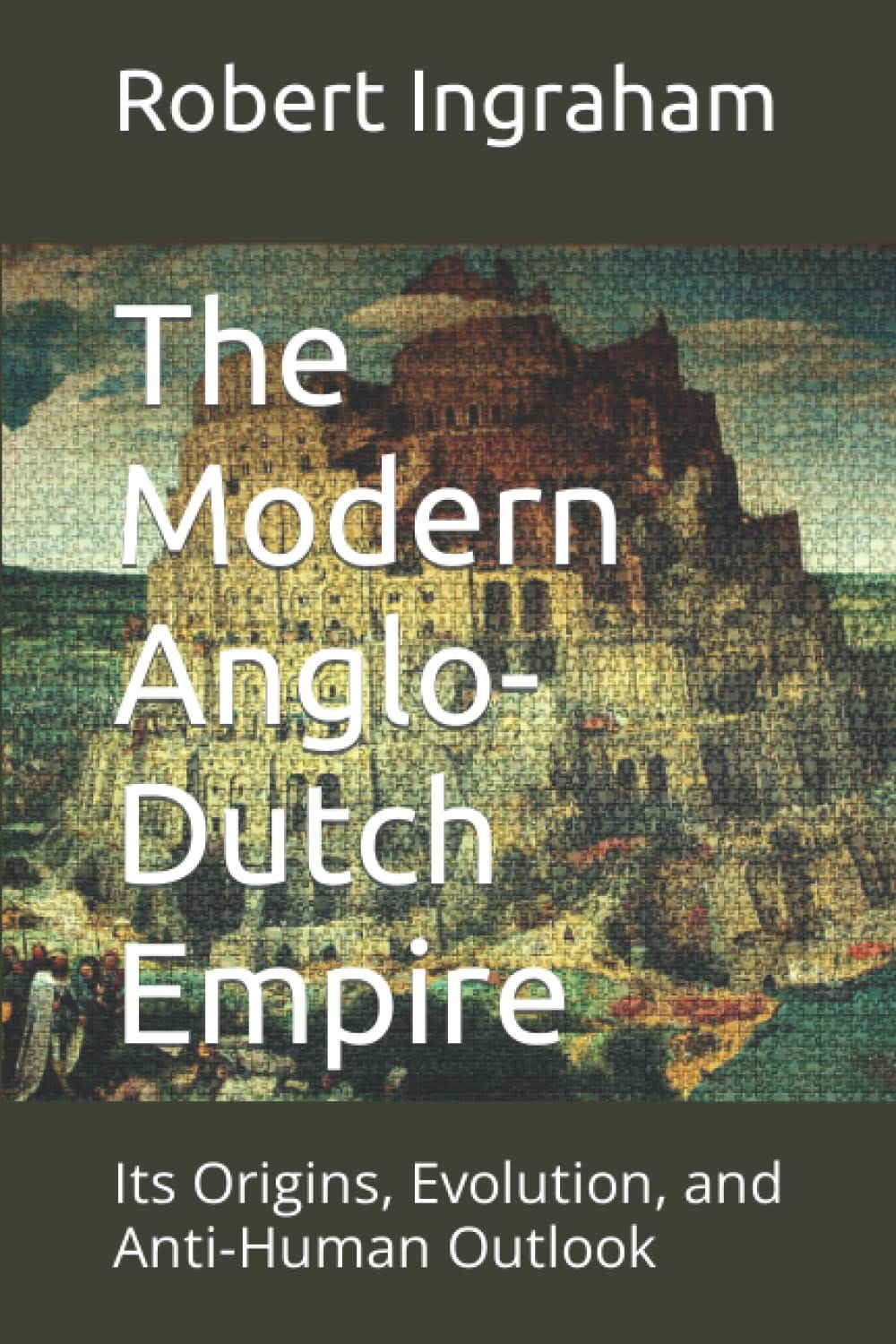
Robert D. Ingraham's work, The Modern Anglo–Dutch Empire its Origins, Evolution & Outlook, is a book about Empire, focusing on the modern manifestation, the misunderstood Anglo-Dutch System, which originated in the late 16th century and reached maturity between 1688 and 1763, a system the author states is still very much present today. In another sense, the book addresses the fundamental nature of Empire itself, describing it as an ongoing oligarchical idea. The author asserts that the issue of Empire and the human race's long struggle to free itself from it is the most critical political concern today, particularly in the face of a profound economic and strategic crisis, making defeating the Empire's current schemes a matter of life or death for humanity. The book details that Empire is the mortal enemy of humanity and posits that the historical mission of the United States is to eliminate this enemy once and for all. Thanks to my readers' generosity, all my articles are free to access. Independent journalism, however, requires time and investment. If you found value in this article or any others, please consider sharing or even becoming a paid subscriber, who benefits by joining the conversation in the comments. I want you to know that your support is always gratefully received and will never be forgotten. Please buy me a coffee or as many as you wish. Ingraham criticizes virtually all modern academically-approved histories as incompetent. This incompetence stems from a failure to appreciate the profound importance of the American Revolution and the axiomatic species-difference between the American constitutional republic and the British Empire, a difference seen as persisting to the present day. This failure is particularly glaring in the inability to distinguish between American methods of national banking and constitutional currency issuance and the European system of private central banking. A second failure is the widespread contamination of historical analysis with a mechanistic-fatalist approach, observed in both Marxist and various neo/pseudo-Marxist types, as well as the Chicago and Vienna schools' view of impersonal "market forces," which are philosophically identical in their empirical-mechanistic methodology. The subject of history is argued to be Man, yet university histories often evade the basic question of what sets man apart from lower beasts, enabling science, art, and mastery over the planet. A competent history must address this fundamental question of what it means to be human; otherwise, mere factuality produces lies, a problem amplified by the "information society". By examining the history and nature of the Anglo-Dutch Empire, it seeks to provide glimmers of understanding regarding what in man's nature distinguishes him from lower beasts. The subject is the millennia-long struggle for humanity to free itself politically, economically, culturally, and morally from the ongoing ontological reality of an oligarchical idea of Empire. The specific focus on the modern Anglo-Dutch System is due to the current threat it poses. The creation and consolidation of this system, particularly from 1582 to 1763, requires the most attention, though the rise of Venetian power after 1100 and British actions against the American Republic in the 19th and 20th centuries are also examined. The axiomatic nature of the modern oligarchical empire was complete by 1763. The book advocates a voluntaristic view of history, shaped by the creativity of individual human minds, arguing that history is not determined by events or inevitable economic processes. Civilization progresses when societies are imbued with this notion of humanity; mankind suffers when empires dominate and rule the many like cattle. The Anti-Humans Ingraham contrasts an "anti-human outlook" with a view of humanity's potential. The anti-human view is illustrated by a quote suggesting indifference to suffering and considering methods like widespread death (a "Black Death") to control population growth, as war has been insufficient. In contrast, a passage describes man as standing in noble prime, free through reason, strong through law, and nature's lord. 1582 is identified as the beginning of the modern form of empire, the Anglo-Dutch Liberal System. The philosophical, economic, and scientific ideas transmitted from this "revolution" are described as virtually all-encompassing, including concepts of private finance, money, trade, and the philosophical empiricism of Sarpi and his epigones. Sarpi's denial of basic human nature is highlighted as an important guidepost. Coherent with the Empire idea of rule by the few, there is a necessity to deny lawful human creativity. The prospect of a self-governing republic fostering reason, progress, and creativity is "anathema" to the Empire crowd, whose view is "Olympian oligarchical". From their perspective, Sarpi's most valuable contribution is his understanding that "mental chains" are more effective than armies for enforcing human servitude. Ingraham dismisses contemporary ideas suggesting history progresses in irreversible linear stages, such as moves to post-industrial or globalized economies, as "transparent Empire propaganda" and a "tired tactic". This propaganda is linked to groups like the City of London and Wall Street, who have sought to reverse policies like those of Franklin Roosevelt and the American System since 1971, aiming to return to a system of private financiers ruling the world. Sun Yat-Sen's 1924 critique of English intellectuals advocating cosmopolitanism is quoted, where he argued it was a tactic by imperialist nations to maintain dominance. The author states that substituting "globalization" for "cosmopolitanism" reveals the same British imperial outlook today. As of August 2008, the modern system of empire was described as facing a profound existential crisis due to its policies causing chaos, hyperinflation, and financial ruin, alongside growing global resistance to oligarchical rule. This crisis, while dangerous, is also presented as an opportunity to rid the world of the "pestilence of Empire". Historically, American patriots such as Benjamin Franklin and Abraham Lincoln viewed the System of Empire as America's mortal enemy, with deep roots, a knowledge that is largely lost today. Roman Law Roman Law and Aristotelianism are referred to as the Empire's "spoor". The Corpus Juris Civilis is presented as the source of modern contract law and property rights theories, characterized by a "completely bestial" approach to the treatment of enemy possessions, including the enslavement of captured free persons and the claim of found property based on "natural law". The policies of Venice, particularly after 1200, are blamed for destroying Europe's recovery after the fall of the Roman Empire. Paolo Sarpi, as chief counselor to Venice, published The History of the Inquisition and The History of the Council of Trent, signalling the end of the Venetian-Spanish-Vatican alliance. Sarpi led Venice in defiance of papal authority, resulting in excommunication and an Interdict, and survived an assassination attempt by agents from Rome. In Sarpi's perspective, there is no room for hypothesis, creativity, or discovery; only "observation" and linear data calculation, described as 21st-century "information theory" where human identity is impossible and discovery is "outlawed". Razor Not So Sharp William Ockham's principle, Pluralitas non est ponenda sine neccesitate, is explained as a reductionist method denying human reason, hypothesis, or universal principles, based solely on sense perception. Ockham is called a fanatic materialist whose approach eliminated causality from Aristoteleanism. Sarpi is seen as taking this sense-perception basis to an extreme where human reasoning ceases to exist. The Sarpi cabal launched a public attack on Aristoteleanism at the University of Padua in 1604, using Galileo's lectures targeting Aristotle's cosmology as a polit… This is a public episode. If you'd like to discuss this with other subscribers or get access to bonus episodes, visit thedukereport.substack.com/subscribe
Embed this episode
No transcript yet.