
EPISODE · Mar 18, 2026 · 1H 16M
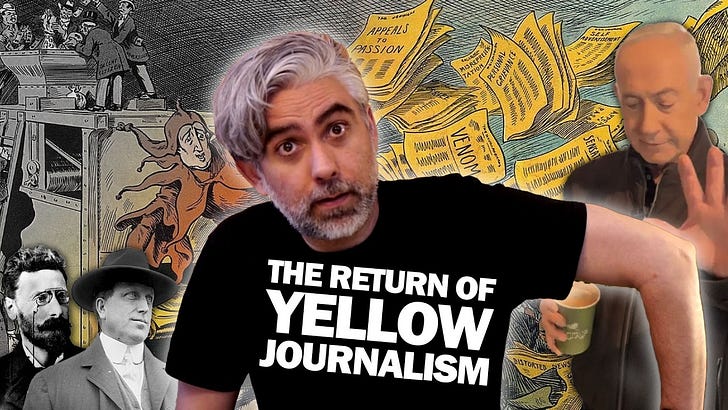
The Modern Rebirth of Yellow Journalism. Talking Paxton, Cornyn, and Oklahoma (with Reese Gorman)
from Politics Politics Politics · host Justin Robert Young
One of the most striking developments during the Iran war has been the reappearance of something that used to define American media a century ago: yellow journalism. Historically, the term referred to sensationalized reporting that prioritized outrage and emotion over accuracy, often using thin sourcing and dramatic narratives to mobilize public opinion. The Spanish–American War, famously fueled by headlines like “Remember the Maine,” is the classic example. Today the structure is different, but the incentives are remarkably similar. Instead of a handful of powerful newspaper publishers driving the narrative, the modern system is decentralized. Social media users, influencers, and coordinated networks can amplify stories through algorithms until traditional outlets feel compelled to cover them simply because they are trending. All of this results in feedback loop. A rumor or distorted piece of information circulates online, gets boosted within a particular political community, and eventually becomes a topic of mainstream reporting. At that point the original claim, even if false, has successfully entered the public conversation. Politics Politics Politics is a reader-supported publication. To receive new posts and support my work, consider becoming a free or paid subscriber. The Five Tribes of the Iran War This dynamic is especially powerful because the online political ecosystem is already divided into ideological “tribes” that interpret events through their own narratives. On the left, there is what might be called the new resistance, Democrats who see every development in the war primarily through the lens of whether it helps or hurts Donald Trump politically. Alongside them sits the progressive anti-war faction, deeply skeptical of Israel and convinced the conflict validates their warnings about American interventionism. On the right, the divide is just as sharp. One faction could be described as the Gnostic MAGA movement, a group of populist conservatives who believe Trump has betrayed the movement’s core promises by engaging in foreign conflict. In contrast, another faction believes Trump is right about everything, arguing that the war’s early results show his strategy is working and that critics are panicking too early. Then there is a final group: the “maybe this time Trump” neoconservatives, longtime critics of the former president who nevertheless support aggressive action against Iran and therefore find themselves, temporarily, aligned with his policy. These communities overlap in complicated ways, but each one is primed to amplify certain narratives that confirm its worldview. How a Rumor Becomes “News” The mechanics of modern yellow journalism often begin with a small piece of truth that can be exaggerated or distorted. Once it is framed in a way that triggers emotional reactions inside one or more of these ideological tribes, the story spreads rapidly through reposts, commentary, and algorithmic amplification. Eventually, the rumor becomes so widely discussed that major media outlets cover it, sometimes simply to debunk it. But by that point the narrative has already achieved its goal: it has entered mainstream awareness and eroded trust in competing sources of information. In wartime, this dynamic becomes even more powerful. Governments themselves may benefit from confusion, exaggeration, or competing narratives. The battlefield isn’t just physical territory, but also public perception. The deeper challenge is that the modern information ecosystem has no central referee. In the past, editors at major newspapers could decide what was credible enough to print. Today, social media algorithms and online communities perform that role collectively, often rewarding the most emotionally compelling stories rather than the most accurate ones. That means the burden increasingly falls on individuals to filter information themselves. If a story makes people furious or ecstatic instantly, that reaction is often a sign to pause before sharing it. A New Information Era The Iran war may eventually be remembered not only for its military consequences but also for what it revealed about the way modern media operates. The sensationalism that once drove early twentieth-century newspaper empires has reappeared in a decentralized, digital form. Yellow journalism never disappeared — it’s just changed and evolved to keep up with modern times. And in the middle of a war, its power to shape public perception may be greater than ever. Chapters 00:00:00 - Intro 00:02:14 - Susie Wiles 00:03:38 - DHS Shutdown 00:04:33 - Yellow Journalism in the Iran War Era 00:29:10 - Iranian Security Chief Killed 00:33:15 - Joe Kent 00:39:29 - Texas AI Ad 00:41:32 - Reese Gorman on Texas and Oklahoma 01:12:27 - Wrap-up This is a public episode. If you'd like to discuss this with other subscribers or get access to bonus episodes, visit www.politicspoliticspolitics.com/subscribe
Embed this episode
Ready to play
The Modern Rebirth of Yellow Journalism. Talking Paxton, Cornyn, and Oklahoma (with Reese Gorman)
No transcript for this episode yet
Similar Episodes
No similar episodes found.