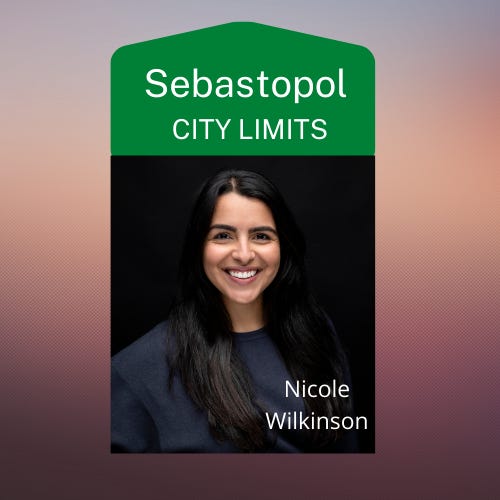
The New School Model for West County High
from Sebastopol CITY LIMITS Podcast Hosted by Dale Dougherty
There’s a new school in town. Well, not exactly. It’s a set of ideas about how to improve the old school. While the Analy/El Molino merger, and the resulting battle over the name of West County High School, would make anyone wary of promising change within the education system, Nicole Wilkinson, an Analy alumnae and teacher, gave a brilliant presentation at a school board meeting in January 2022 about the “New School Model.” It was well received by the board. However, at the same board meeting, Superintendent Toni Beal, a supporter of the New School Model, was dismissed. Leadership changes at West County High created the impression that work on this model was paused, but Nicole insists that she has been moving ahead this spring, working with a cohort of teachers. She’s building support for the new school model, even as the details and leadership are being worked out on a 3-5 year implementation plan. The new school model started with a grant from the CTE Foundation, and West County High School was selected along with Elsie Allen and Casa Grande in Sonoma County. What’s new is less about curriculum change and more about mindset shift, which includes culture and community. It seeks to create a better, more engaging educational experience for students and teachers, while helping to align the school with the Sonoma County “portrait of a graduate” and develop 21st Century skills. Transcript Nicole: What we see in the data is that kids are not engaged and they're not engaged everywhere. It's not just in West County, but it is true in West County. And there's a lot of reasons for that. One of them that I focused on this year is that the instruction does not meet the 21st Century needs of kids. And that's not because we're not working hard and trying our best. Dale: Nicole Wilkinson is an educator working on something quite new for the West County High School District. Let me start by asking Nicole to introduce herself and give us a background on who she is. Nicole: Hello. Thank you so much for having me. My name's Nicole Wilkinson and I am an Analy alumnae. I went to Holy Names University and studied criminology, became a probation officer with that degree and was immediately dissatisfied. It felt reactive, not proactive. So I jumped into education as an intern teacher, which is nuts thinking back on it. I started off my teaching career teaching social science, PE and yoga to seventh and eighth graders at West County Charter Middle School, a project the West Sonoma County High School District tried to launch in Forestville. We spent two years trying to create a design thinking experience for middle school students. And it was a challenge. There wasn't enough funding to support the needs. Students had really high ACES scores, the adverse childhood experiences, and it just wasn't a sustainable school, but it was an invaluable experience as an educator to learn how to do everything on a small staff. So when that school folded, I was lucky enough to secure a job back at my alma mater at Analy and I taught World History and Dev Econ for a year before then I hopped over. Dale: What was your name as a teacher then? That it was a little different. Nicole: It was a little different. I'm known on the streets as Miss Ochoa. It is my preferred name. The kids, they know now that I've been married since, but is that still your name? Yes, please. Still always call me that. So that's how I am known around here. Dale: The thing I really want to get to here is to talk about something I heard is happening. It's called the New School Model and you've taken it by the horns and are running with it. So tell me, when did this develop, this New School Model as an idea? It's actually a grant that you're working on. So how did that come about. Nicole: It came about in Spring 2020, I believe, the CTE Foundation had an idea. They had historically funded sections and various things for Sonoma County students, but emphasis on career technical education. And they wanted to explore what it would take to use their funding sources to support an entirely new school approach. So this is the idea. They went and they --what's the word recruited some schools and West Sonoma County was lucky enough to be a part of that conversation. And our then superintendent Toni Beale said yes. And we went through an interview process. She asked me to join her, Shawna Ferdinandson, our principal, and Allie Green, the principal at Laguna. We sat before the CTE Foundation and talked about what our dreams are. They asked us to identify where we're dissatisfied and what we want to do about that. So we sat for interviews. Those are recorded, which I think are wonderful artifacts now, just to see you see where it's evolved. And we were accepted into the grant with, along with Casa Grande and Elsie Allen. So the three of those high schools are involved in a new school model, whole school transformation supported over several years by the CTE Foundation with the ultimate goal of building the capacity from within so that there are these new school environments, but they're sustained by the districts themselves over time. Dale: So when did that grant get approved? Nicole: When did it get approved? Dale: When did you start working on this? Nicole: I started working on it not last year. When was it? I started really working on it a year and a half ago. Wow. I have to look back and it's been a significant amount of time. So this year, that we're ending we're spring right now. This was supposed to be the end of our planning year. I believe that the CTE Foundation is working with us to acknowledge all of the flux and shifts that has happened this year and that we're starting. There will be something different at school next year, and I'm happy to talk about that. But the rollout is going to be over three to five years. Dale: In January you presented this to the West County School Board. Can you summarize what you presented to them? Nicole: So at the school board meeting I wanted to both be specific, provide enough room for this to be co-created by our community and by our students, really. So what I presented in January was a two-pronged vision. One to take our portrait of a graduate outcome and bring them off of a poster, but into practice so that we make good on the promise to our young people. That by the time they are graduating from Analy High School, they will have had an opportunity to develop their skills of collaboration, communication, resilience, balance, et cetera. Making good on the promise of the portrait is number one. And as a by-product of that creating core values as a teaching staff and as a community and taking those skills that we want to teach students and embodying them as adults. And then the second to shift the conversation to college or career to college and career. I think Analy has a reputation of being a college prep type school. It's not documented, but that's what people think when they think of Analy. And from where I sit, unless somebody is independently wealthy, you'll still after college will need a career.. So shifting the conversation to college and career, that career technical education is not for those kids or some kids that want to work with their hands, but all students should have the opportunity to work with their hands and see where their core academics are applied in the real world. So those two sort of mindset shifts, like how do we take these skills that our local community said they want our graduates to embody? How do we make good on that promise? Create a system. So there are our core values. So, the portrait and then college and career. Dale: Let me play it back to you a little bit. So in the past, things like CTE were sometimes considered a separate track for students, often students that didn't succeed on the academic track. In some ways, I believe my experience of the maker movement leads me to think, there's bringing together, a convergence of those different tracks that the practical… Get full access to Sebastopol Times at www.sebastopoltimes.com/subscribe
Embed this episode
No transcript yet.