
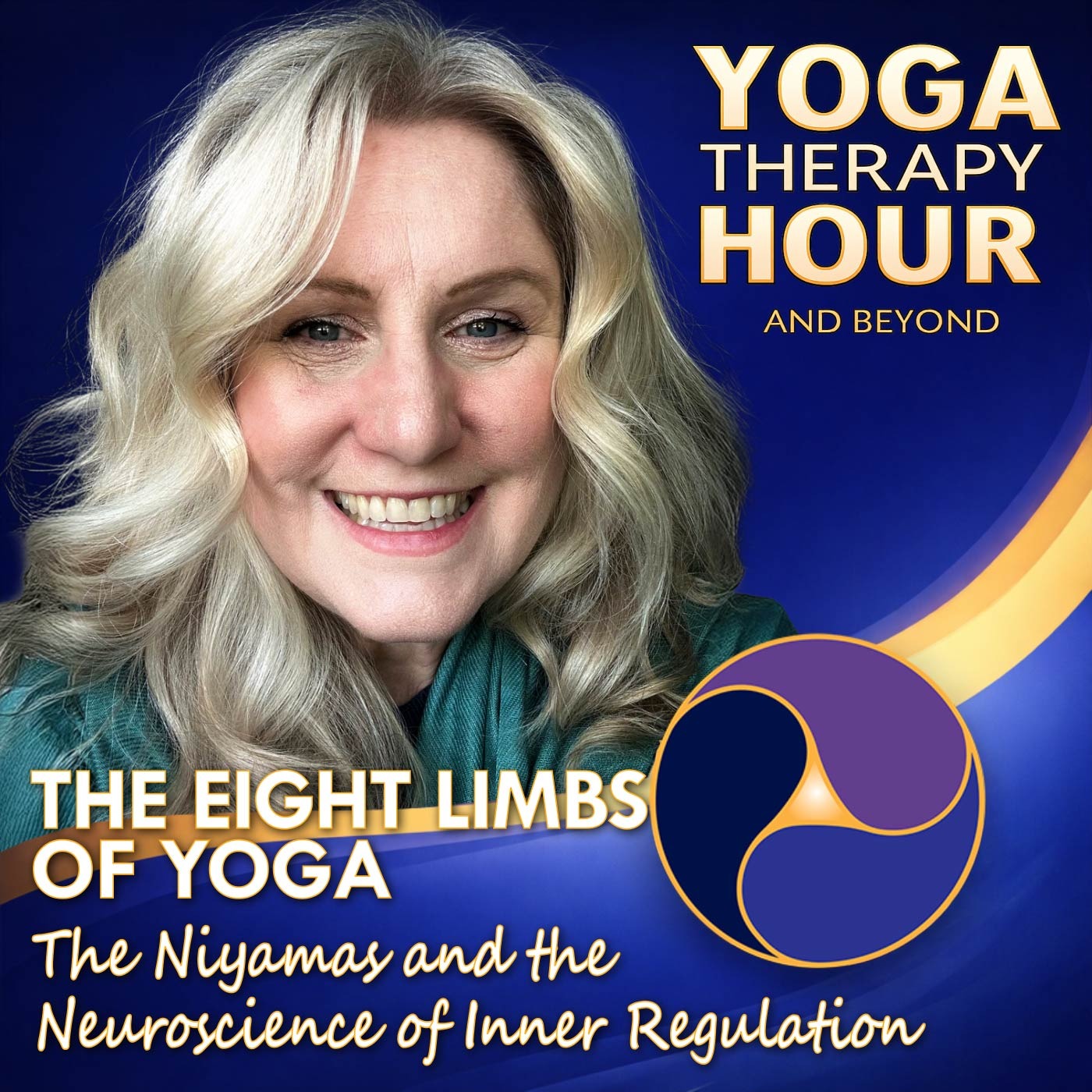
EPISODE · Jul 24, 2026 · 42 MIN
The Niyamas and the Neuroscience of Inner Regulation: Creating the Conditions for Change
from Yoga Therapy Hour with Amy Wheeler · host Amy Wheeler
Episode Description In this episode, Dr. Amy Wheeler continues the Season 10 exploration of the Eight Limbs of Yoga as a regulatory framework, turning inward toward the Niyamas—the personal disciplines that shape how we care for ourselves and engage in inner work. Rather than presenting the Niyamas as a checklist of ideals, this conversation reframes them as practices that create the internal conditions for nervous system regulation, clarity, and meaningful change. At the heart of this episode is a grounded inquiry: What happens when we reduce internal noise, increase awareness, and release the need to control everything? Through both classical teachings and modern neuroscience, Amy explores how daily practice (sādhana) supports a shift from overwhelm and reactivity toward steadiness, discernment, and trust. Key Themes Explored The Niyamas as Inner Regulation The Niyamas are not about perfection or moral pressure. They are about how we stabilize the internal environment so that clarity and integrity can naturally arise. You Cannot Offer What You Do Not Embody Our internal state directly shapes our professional presence. When we are cluttered, overwhelmed, or unreflective, it impacts how we show up with others. From Discipline to Daily Practice The Niyamas are lived through small, consistent actions—organizing our space, pausing for reflection, regulating the body, and observing the mind. Top-Down and Bottom-Up Regulation True transformation includes both: Working with the mind (top-down) Working with the body and physiology (bottom-up) Yoga therapy offers a unique bridge between these two approaches. The Niyamas Through a Neuroscience Lens Śauca (Clarity and Purification) Reducing allostatic load—our chronic stress burden—by organizing our external and internal environments. Less clutter leads to less cognitive overload, allowing the mind to settle and the prefrontal cortex to function more effectively. Santoṣa (Contentment) A present-moment orientation that shifts the brain’s predictive bias. As regulation increases, the brain becomes less focused on past threat and more open to possibility, safety, and “I am okay right now.” Tapas (Disciplined Effort) The steady repetition that builds new neural pathways. Tapas is neuroplasticity in action—choosing new responses, reinforcing them over time, and gradually reducing reactivity. Svādhyāya (Self-Study) Developing meta-awareness and interoception—the ability to observe thoughts, emotions, and sensations without immediately reacting. This creates a pause where new choices become possible. Īśvara Praṇidhāna (Surrender) Releasing excessive control reduces sympathetic overactivation and increases tolerance for uncertainty. When we soften the need to control everything, the nervous system becomes more flexible, resilient, and open to possibility. Clinical Insight When people struggle with the Niyamas, it is rarely a lack of discipline or integrity. More often, it reflects: High allostatic load (chronic stress) Nervous system dysregulation Limited access to internal safety From this perspective, the work is not to try harder, but to create conditions where regulation is possible. A Practical Reframe Instead of asking: Am I doing the Niyamas correctly? We might ask: What is increasing my internal noise? What helps my system settle? Where can I reduce load, even slightly? From there, the Niyamas begin to emerge rather than be forced. Integration with the Yamas The Yamas (social disciplines) and Niyamas (personal disciplines) function as a continuous loop: Inner regulation supports relational clarity Relational harmony reduces internal stress Together, they create a self-reinforcing cycle of regulation, discernment, and well-being. Reflection for Listeners Take a moment to reflect: Where in your life is there unnecessary cognitive or sensory load? What helps you return to a sense of “okayness” in the present moment? Where might you benefit from more effort—and where might you need to release control? Closing The Niyamas invite a steady relationship with yourself. Not as a project to fix— but as a system to support. As internal noise decreases and awareness increases, regulation becomes more accessible, Contact Amy Wheeler: www.TheOptimalState.com Optimal State App for iPhone: https://apps.apple.com/us/app/optimal-state/id1604424804 The Yoga Therapy Hour Podcast: https://podcasts.apple.com/us/podcast/yoga-therapy-hour-with-amy-wheeler/id1564687158 School of Integrative Health at NDMU: https://www.ndm.edu/academics/integrative-health Master of Science in Yoga Therapy at NDMU: https://www.ndm.edu/academics/integrative-health/yoga-therapy Explore NDMU’s Post-Master’s Certificate in Therapeutic Yoga Practices, designed specifically for licensed healthcare professionals: https://www.ndm.edu/academics/integrative-health/yoga-therapy/post-masters-certificate-in-therapeutic-yoga-practices Try our Post-Bac Ayurveda Certification Program at NDMU: https://www.ndm.edu/academics/integrative-health/ayurveda/post-baccalaureate-ayurveda-certification #IntegrativeHealth #HealthcareEducation #InterprofessionalEducation #GraduateSchool #NDMUproud #SOIHproud #SOIHYoga #SOIHAyurveda #NDMUYoga #NDMUAyurveda #SOIHGraduateSchool New Book Coming Out August 10th, 2026 https://www.amazon.com/Applying-Therapeutic-Yoga-Integrative-Health/dp/1032888628/ref=sr_1_1?crid=1RFZ3L5MCCNPH&dib=eyJ2IjoiMSJ9.I7harQDOLulfRbd3dx2vVa5VUZa840PHcWB7dDiT3_bB2nravzO7_9Xs9shMhcy2Iwu0wtTA1PxeUG4TTugEQJuK_OEpvzQ-OyVvtsUkXsc.ViqLrL-EQPX7s09wZF6_2eCpLCimHa7Ohfbw-F7Yuk4&dib_tag=se&keywords=applications+in+therapeutic+yoga+wheeler&qid=1775224796&sprefix=applications+in+therapeutic+yoga+wheele%2Caps%2C153&sr=8-1
Embed this episode
Ready to play
The Niyamas and the Neuroscience of Inner Regulation: Creating the Conditions for Change
No transcript for this episode yet
Similar Episodes
No similar episodes found.