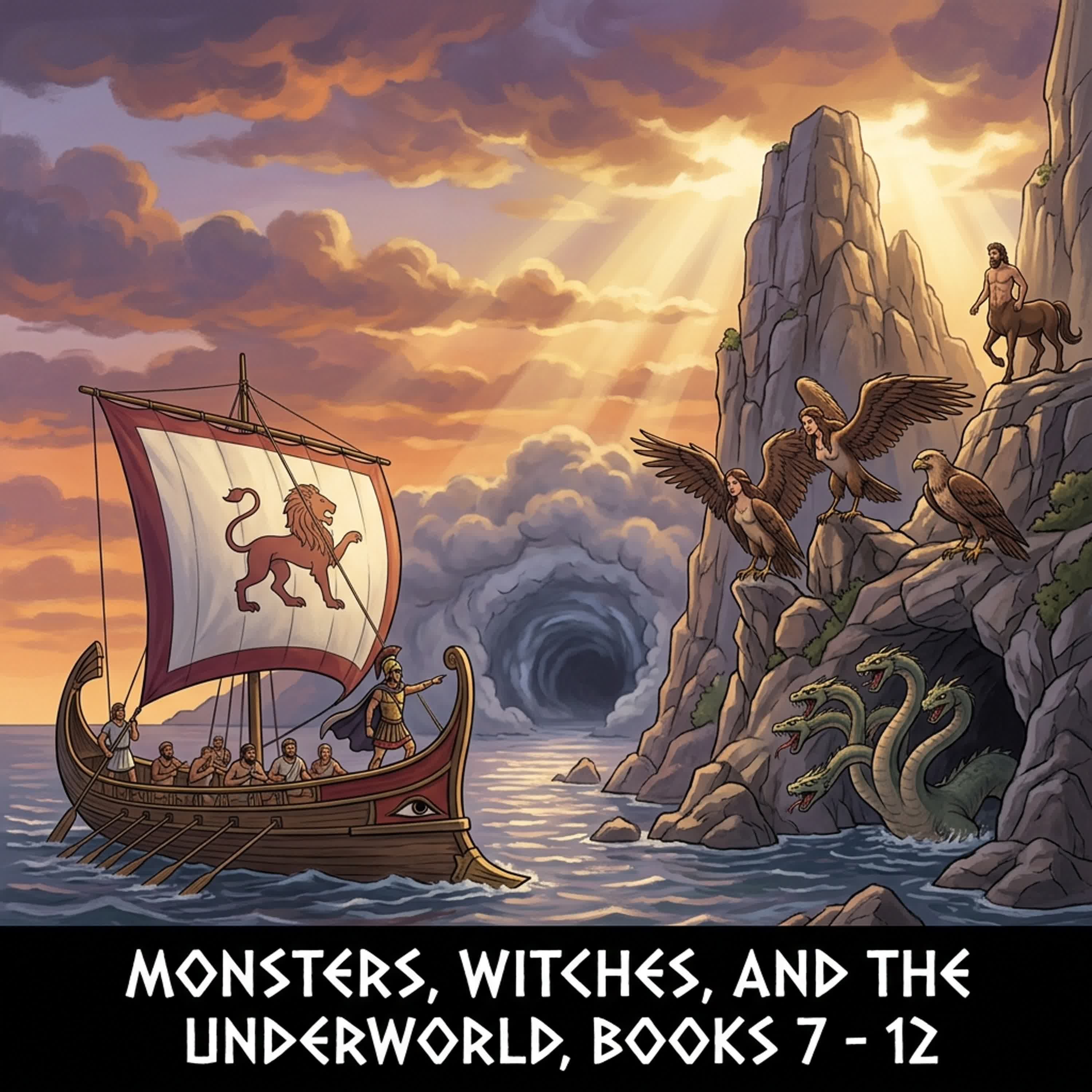
The Odyssey - 2 - Chapters 7-12
from Wisdom for the Present: Western Wisdom Literature Hosted by Kanu Emeruwa
What if our greatest obstacles aren't the external monsters we face, but the silent, unchecked growth of our own egos? In this episode of Wisdom for the Present, we dive deep into the legendary, psychological terrain of Homer's The Odyssey (specifically Books 7–12) to uncover how the ancient hero Ulysses' greatest struggle was never with one-eyed giants or sea monsters, but with himself. His journey presents a startlingly modern psychological mirror, challenging us to look at the collateral damage of our own victories, the subtle ways we self-sabotage, and what it truly costs to rebuild ourselves from absolute zero. We begin by exploring Ulysses' arrival at Phaeacia, naked, shipwrecked, and completely stripped of his crew and wealth. As he steps into the golden, utopian palace of King Alcinous and Queen Arete, we witness the ancient Mediterranean code of Xenia—sacred hospitality—acting as a vital survival mechanism in a lawless world. Yet, even in this sanctuary, human conflict rears its head when a young athlete named Euryalus insults Ulysses' honor, calling him a grasping merchant rather than an athlete. Ulysses' fiery reaction and his choice to reclaim his narrative through overwhelming athletic excellence illustrate the high stakes of personal reputation in the ancient world, forcing us to consider how we respond to modern-day "trolls". The episode then shifts into a deeper analysis of the psychological traps that sedate our agency and feed our vanities. We unpack the terrifying numbness of the Lotus-Eaters, whose sweet flowers represent the comfortable oblivion of modern digital algorithms, social media doom scrolling, and stagnant routines that make us forget our ultimate purpose. From there, we analyze Ulysses' famous battle of wits with the Cyclops Polyphemus. While Ulysses' brilliant "Nobody" linguistic trick beautifully neutralizes the monster's physical force, his subsequent need for personal credit and validation drives him to shout his real name from his departing ship. This single act of ego-driven vanity invites Neptune's devastating curse, demonstrating how easily we can snatch defeat from the jaws of victory just to have the last word. Next, we dissect the catastrophic breakdown of trust and communication within Ulysses' team during their encounters with Aeolus, the Laestrygonians, and Circe. By hoarding information and refusing to delegate the rudder, Ulysses creates an information vacuum that breeds deep paranoia among his crew. Believing their leader is withholding treasure, the men open the bag of adverse winds just as they are on the verge of reaching home, blowing their entire mission back to square one. Under the weight of this trauma, the crew repeatedly falls victim to their base, unthinking appetites—symbolized perfectly by Circe transforming the undisciplined men into swine. It is a sobering lesson in how a lack of shared vision and transparency from leadership can lead an entire organization to lose its higher purpose and self-destruct. Ultimately, Ulysses' path to reclaiming his agency requires a literal and metaphorical descent into the underworld to audit his values against the stark reality of death. In this haunting space, he meets the ghost of Achilles, who completely repudiates the ancient heroic code of glory, declaring that he would rather be a poor, living servant than the king of the dead. Armed with this raw, philosophical grounding, Ulysses must navigate the final gauntlet of the Sirens' promise of infinite information, and the agonizing, no-win choice between Scylla and Charybdis. By implementing strict pre-commitment boundaries—plugging his ears and binding himself to the mast—and bearing the moral weight of sacrificing six men to save the rest, Ulysses survives to learn the ultimate lesson of the shipwreck: that before we can reach our own Ithaca, we must first be stripped of every external status and ego-driven illusion we rely upon. In This Episode * The Prison of the Ego: How Ulysses' desperate need for personal validation and credit with the Cyclops transformed a brilliant victory into a life-altering curse. * Xenia and Sacred Space: Understanding ancient hospitality as an essential survival mechanism and comparing it to our modern systems of mutual protection. * The Lotus-Field of Apathy: Recognizing comfortable numbness—from social media algorithms to stagnant habits—as an existential threat to our life's purpose. * The Danger of Secrecy: How Ulysses' failure to delegate, communicate, and offer transparency led his crew to open the bag of winds and ruin their homecoming. * Circe's Mirror: How trauma, exhaustion, and a lack of clear leadership can cause teams to abandon their agency and descend into base, short-term appetites. * The Achilles Audit: Re-evaluating our priorities through Achilles' post-mortem realization that worldly status and legacy are entirely hollow compared to presence and connection. * The Gift of the Shipwreck: Embracing the moments when we are stripped of our external titles and control as the mandatory prerequisites for discovering who we truly are. Practical Reflection What is the "comfortable numbness" in your daily routine (a screen, a habit, a stagnant job) that is sedating your ambition and making you forget your ultimate purpose? How can you design your environment to hard-block this distraction? What "bag of winds" are you keeping secret from your team, partner, or family? How is your lack of transparency breeding paranoia, and where do you need to let go of the rudder and trust others? If you were looking back at your life from the absolute finish line, what status, petty grudge, or empty ambition would you realize is hollow? What would you tell yourself to stop caring about today? Suggested Substack Excerpt Before you can reach your own Ithaca, you must first survive the shipwreck of your own ego. Join us as we explore Books 7–12 of Homer's The Odyssey to uncover timeless psychological lessons on leadership, comfortable numbness, and the high cost of unchecked pride. AI Disclosure This episode was created using Google NotebookLM Audio Overview, based on human-curated source material, structured guidance, and editorial review. AI is used as a tool for clarity and delivery, not as a replacement for thoughtful study or engagement with the original texts. Copyright © 2026 Wisdom for the Present / Kamashcu Production Studios. All rights reserved. This is a public episode. If you would like to discuss this with other subscribers or get access to bonus episodes, visit wisdomforthepresent.substack.com
Embed this episode
No transcript yet.