The Odyssey - 3 - Chapters 13-18
from Wisdom for the Present: Western Wisdom Literature Hosted by Kanu Emeruwa
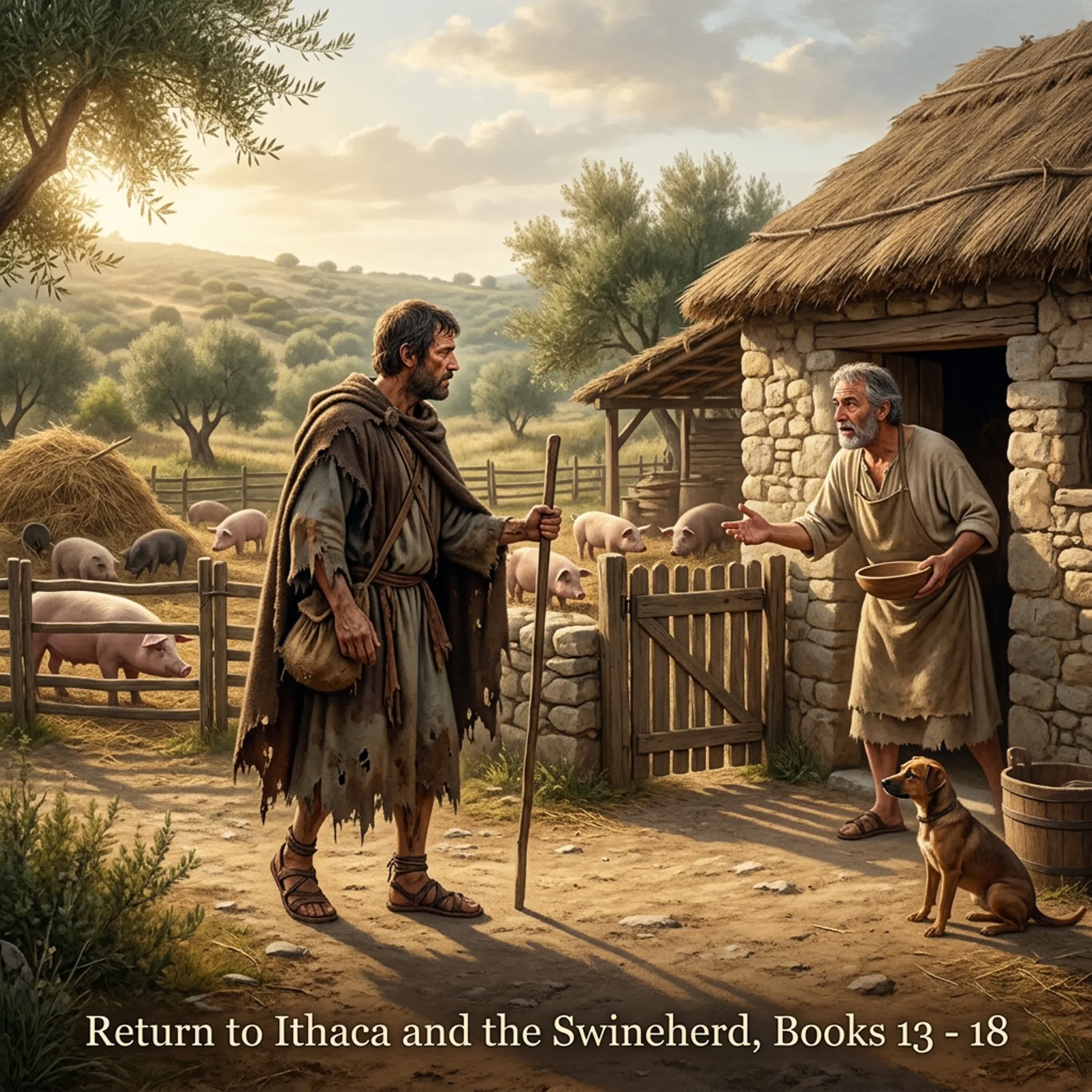
What if the journey of a lifetime doesn't end with a grand homecoming, but with a descent into a psychological and strategic battlefield? In Books 13 through 18 of Homer's epic, The Odyssey, we witness a profound shift where mythological monsters dissolve into devastatingly human threats. Instead of battling the supernatural perils of the Cyclops or the Sirens, Ulysses must confront the far more insidious challenges of human pride, runaway greed, toxic entitlement, and systemic decay in his own home. This ancient narrative serves as an enduring mirror for modern psychology, mapping the silent struggle between our primal survival reflexes and our capacity for strategic restraint. It challenges us to examine how we respond when the very structures of our lives collapse and our core identities are put to the ultimate test. The conflict begins in Book 13 as Ulysses finally washes up on the shores of Ithaca, shrouded in a symbolic fog cast by Minerva. He is physically home, yet the reality of his homeland remains entirely obscured, forcing him to navigate a landscape of deep political instability. In his twenty-year absence, the social order has disintegrated, leaving a political vacuum filled by 108 young, aristocratic suitors who have occupied his palace. Rather than launching an open military assault, these men have weaponized xenia—the sacred ancient Greek law of hospitality. By refusing to leave and systematically consuming the estate's livestock, stores of wine, and economic wealth, they exploit the sacred host-guest contract, knowing that an armed eviction would spark a devastating regional war. It is a toxic, calculated takeover that leaves Ulysses’ son, Telemachus, isolated and target of a lethal ambush in the straits. To dismantle this overwhelming opposition, Minerva provides Ulysses with a radical and counterintuitive advantage: the disguise of a filthy, tattered beggar. This strategic invisibility initiates a gauntlet of intense psychological and ego-testing torture. When the treacherous goatherd Melanthius hurls verbal abuse and physically kicks him, Ulysses stands firm, consciously choosing to suppress his primal, combat-trained instinct for immediate lethal violence to safeguard the larger mission. The trial intensifies inside the banquet hall when the suitor Antinous mocks him and hurls a heavy wooden footstool that strikes his shoulder blade. Once again, Ulysses stands firm as a rock, choosing to absorb the physical pain and social humiliation rather than prematurely blowing his cover. Even in a literal fistfight with the local tramp Irus, Ulysses executes complex mental calculations, deliberately dialing back his superhuman strength to avoid raising suspicion. This ego mastery represents the ultimate triumph of long-term strategic planning over immediate emotional gratification. Beyond individual restraint, this section of the epic delves into the tragic dimensions of chaos, divine caprice, and blind hubris. When the hospitable Phaeacians return from safely delivering Ulysses home, the god Neptune, feeling insulted, petulantly transforms their returning ship into stone in front of their harbor, demonstrating the unpredictable and indifferent universe the ancients navigated. This environment of impending doom is mirrored in the human realm through Amphinomus, one of the suitors. Despite receiving a direct, compassionate philosophical warning from the disguised Ulysses about the vanity of human success and the certainty of retribution, Amphinomus is paralyzed by the comfort of the crowd and his social status. Though his heart is filled with dread, he overrides his own intuition and returns to the banquet table, illustrating how hubris and social inertia lead inexorably to ruin. Ultimately, the journey of reclaiming one's life requires us to pierce through the fog of status and recognize where true value lies. In Books 14 and 17, Homer masterfully subverts expectations by focusing on the enslaved swineherd Eumaeus and the discarded, dying dog Argos. While the highborn suitors represent a moral rot, Eumaeus and Argos demonstrate the highest virtues of loyalty, duty, and honor. They represent the "unseen infrastructure" that keeps the lights on while others merely consume. By practicing the "Ulysses pause"—creating a deliberate buffer to evaluate strategic goals over primal reactions—and the "Argos check"—acknowledging the quiet, uncelebrated labor supporting our environments—we can reclaim our own agency. True restoration is not achieved through superficial physical arrival; it demands that we step back, observe our circumstances objectively, and do the quiet, persistent work of rebuilding our households and peace of mind piece by piece. In This Episode * The Primal Ego vs. Strategic Restraint: Ulysses' choice to endure physical blows and verbal insults highlights the power of long-term planning over the biological urge to retaliate immediately. * The Weaponization of Hospitality: The 108 suitors exploit xenia, the sacred Greek law of hospitality, to systematically dismantle Ulysses' estate under the guise of being guests. * The Power of the Disguise: Minerva's physical transformation of Ulysses into a beggar serves as a strategic tool to audit the moral alignment of his kingdom from the bottom up. * Unseen Infrastructure of Virtue: The enslaved swineherd Eumaeus and the neglected dog Argos serve as the true moral core of the epic, demonstrating loyalty and honor when no one is watching. * The Tragedy of Social Inertia: The suitor Amphinomus ignores a direct, intuitive warning of his doom because he cannot bear the social discomfort of breaking away from his peer group. * The "Ulysses Pause" in Daily Life: A practical strategy to create a mandatory buffer when insulted, ensuring our responses serve long-term goals rather than short-term pride. * Reclaiming Peace as a Stranger: True restoration of one's identity or household requires objective observation, strategic patience, and step-by-step reconstruction. Practical Reflection When your ego is triggered by an insult or passive-aggressive comment, do you immediately react to protect your pride, or do you utilize a "Ulysses pause" to align with your long-term goals? Who are the "swineherds" and quiet contributors in your workplace, family, or community who keep the systems running behind the scenes, and how can you perform an "Argos check" to acknowledge them today? Are there areas in your life where you have received intuitive warnings of danger or ethical misalignment, but are staying comfortable due to social pressure and the warmth of the crowd? Suggested Substack Excerpt In Books 13–18 of The Odyssey, we explore the transition from fighting supernatural monsters to navigating the devastatingly human battlefield of the ego, strategic restraint, and unseen loyalty. Discover how Ulysses' ancient journey in disguise offers transformative tools like the "Ulysses pause" and the "Argos check" for reclaiming agency and leading with discernment today. AI Disclosure This episode was created using Google NotebookLM Audio Overview, based on human-curated source material, structured guidance, and editorial review. AI is used as a tool for clarity and delivery, not as a replacement for thoughtful study or engagement with the original texts. Copyright © 2026 Wisdom for the Present / Kamashcu Production Studios. All rights reserved. This is a public episode. If you would like to discuss this with other subscribers or get access to bonus episodes, visit wisdomforthepresent.substack.com
Embed this episode
No transcript yet.