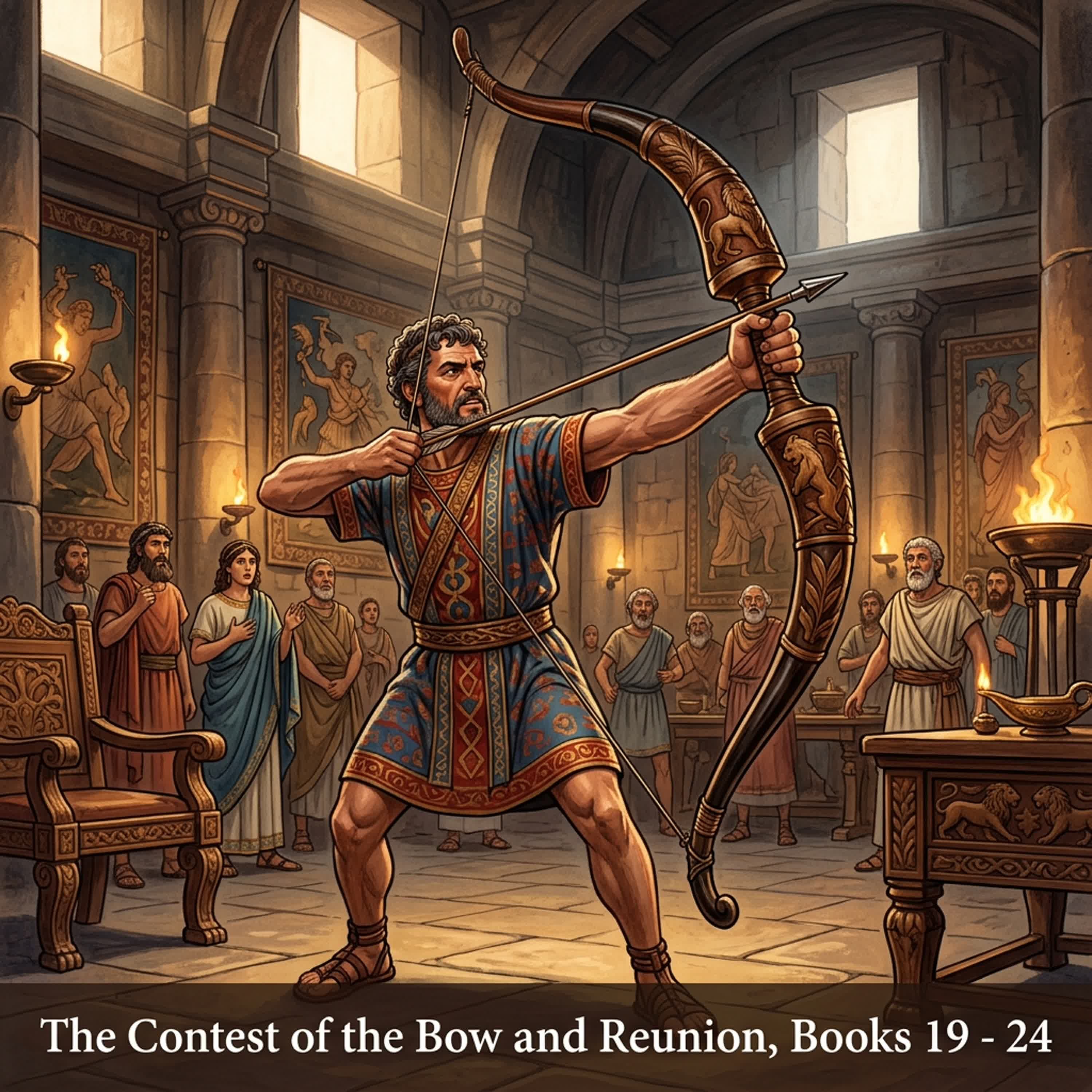
The Odyssey - 4 - Chapters 19-24
from Wisdom for the Present: Western Wisdom Literature Hosted by Kanu Emeruwa
We often think of a homecoming as a warm, comforting arrival, but the final books of Homer’s epic masterpiece, The Odyssey, present a homecoming landscape that is tense, complex, and psychologically profound. Instead of a peaceful return, we find a hostile takeover where the porch light has been completely shattered and the rightful king must enter his own home disguised as a filthy beggar. This ancient narrative goes far beyond simple myth, serving as a brilliant framework for modern psychology and our search for meaning amidst life's hostile environments. At the heart of Books 19 and 20 lies the immense, concentrated power of strategic restraint. Forced to endure horrific humiliation in his own dining hall, Ulysses systematically disarms the suitors by playing on their own lack of discipline, all while suppressing his immediate, biological urge to react. When his heart literally "growls within him" like a protective guardian dog at the sight of betrayal, Ulysses physically beats his breast and commands his central nervous system to stand down. This mastery of metis (cunning intelligence) over bia (brute force) illustrates how managing our reactive energy can serve our ultimate, long-term goals rather than sabotaging them. In today's digital age, we face environments that constantly provoke our egos, urging us to immediately lash out or curate polished, impenetrable disguises of success. Yet, The Odyssey reveals that true recognition and intimacy do not come from our flawless resumes, but from our scars. When the old nurse Euryclea washes Ulysses' feet, she does not recognize him by his face or voice, but by the jagged scar he received on a wild boar hunt in his youth. Our scars are the physical and emotional evidence that we have lived in the real world and faced the wild boars of struggle, proving that human connection is built on our vulnerability, not our victories. The dramatic climax in Books 21 and 22 exposes the chaotic storm of retributive violence and the devastating, inevitable cost of hubris. Blinded by their fragile, toxic egos, the suitors fail to string Ulysses’ composite bow, confusing his long absence with an absence of consequence. Ulysses' uncompromising justice in the Great Hall, which descends into a brutal bloodbath, reminds us that the universe eventually balances the ledger. While the grotesque physical violence of the ancient world is deeply unsettling to a modern conscience, the underlying enduring wisdom warns that those who believe the rules of reality do not apply to them will inevitably author their own doom. Finally, the epic shifts to the quiet after the storm as Ulysses and Penelope search for an immovable center to rebuild their lives. Penelope, an intellectual match for Ulysses, refuses to trust external appearances and puts him to the ultimate test of their shared, secret foundation: moving their marriage bed. This bed, built around a living, deeply rooted olive tree, represents the secret architecture of a relationship—the private struggles, shared vows, and commitments that cannot be easily dragged away by passing trends or moments of stress. To find lasting peace, we must protect this rooted center, break generational cycles of retaliation through peace covenants, and confidently carry our hard-won experiences forward into the unknown. In This Episode * The Power of Strategic Restraint (Metis): How Ulysses regulates his own physiological fight-or-flight response to prioritize long-term strategy over instant, reactive anger. * True Connection in Our Scars: Understanding why genuine intimacy is built on our shared wounds and vulnerabilities rather than our polished, curated disguises. * The Sacred Laws of Hospitality (Xenia): Why violating the foundational moral codes of community and mutual aid is a profound sacrilege with inevitable consequences. * The Catastrophic Cost of Hubris: How the suitors' belief that they were exempt from the rules of reality ultimately authored their own destruction. * Building an Immovable Center: The symbolism of the olive-tree bed as the living, rooted foundation necessary for any relationship to survive the chaos of the world. * The Trauma of the Veteran: How Ulysses' violent, hyper-vigilant reaction to his nurse highlights the profound difficulty of psychologically returning home from war. * Breaking the Cycle of Retaliation: The necessity of accepting a "covenant of peace" and absorbing unfairness to stop endless, destructive loops of vengeance. Practical Reflection How can you create a "micro-pause" between a trigger and your reaction in a toxic or hostile environment, using strategic restraint to serve your long-term goals instead of your immediate ego? Are you hiding your authentic self behind an impenetrable disguise of competence, and who are the trusted few in your life whom you allow to see and touch your scars? What is the "olive tree" bed in your life—the core value, shared truth, or fundamental commitment that is deeply rooted and cannot be easily uprooted by stress or passing trends? Suggested Substack Excerpt Explore the profound psychological wisdom of Homer’s The Odyssey (Books 19–24) as we dive into the power of strategic restraint, the vulnerability of our scars, and what it truly takes to build an immovable center in our lives and relationships. AI Disclosure This episode was created using Google NotebookLM Audio Overview, based on human-curated source material, structured guidance, and editorial review. AI is used as a tool for clarity and delivery, not as a replacement for thoughtful study or engagement with the original texts. Copyright © 2026 Wisdom for the Present / Kamashcu Production Studios. All rights reserved. This is a public episode. If you would like to discuss this with other subscribers or get access to bonus episodes, visit wisdomforthepresent.substack.com
Embed this episode
No transcript yet.