
EPISODE · Feb 19, 2025 · 1H 29M
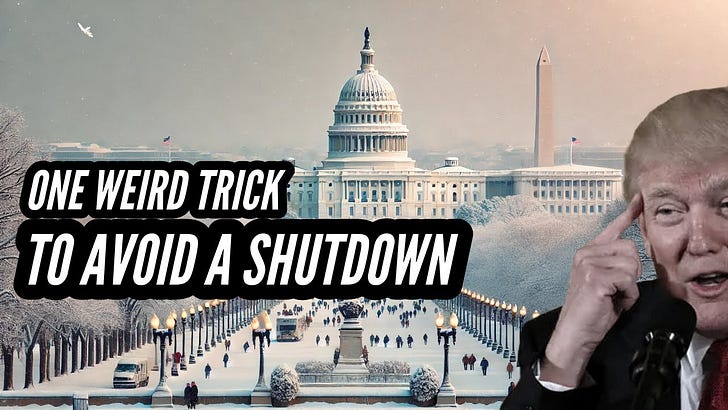
The One Weird Trick That Could Avoid A Shutdown (with Gabe Fleisher and John Teasdale)
from Politics Politics Politics · host Justin Robert Young and Gabe Fleisher
Wait, what? What just happened? To who? When? And it just flipped when it landed? A 13th kid with a fourth woman? Does that have anything to do with the other thing? You know, the one that just happened. Or maybe that was last week… The first month of Trump 47 has felt more like 47 weeks than it has four, with a relentless barrage of executive orders, personnel decisions, and, let’s say, charitably unconventional accounting procedures that have kicked ant piles both foreign and domestic. And with all of that, much of what you read on social media, Substack, or in your podcast feed is likely very, very hyperbolic—or, if you’re on the conservative side of the aisle, particularly gleeful. My goal, however, is to ask a simple question every day: What actually matters? On this episode of the show, we’re going to talk to two people with vastly different perspectives on the political system. First, we have Gabe Fleisher, who writes the Wake Up to Politics newsletter and, even as a fresh college graduate, has probably forgotten more about political history and minutiae than the average voter has ever cared to learn. On the other end of the spectrum, we have John Teasdale, an entrepreneur and co-creator of The Contender card game, who intentionally disconnected himself from politics for the past year and has only just returned stateside. “Sure, Justin, I’ll enjoy both of those conversations. But what about me? What does that give me as a framework to understand what’s happening right now?” Well, to help with that, I want to dust off something that doesn’t usually get brought out in the political realm, but given the breakneck pace of news, I think it’s worth it. In 2013, WNYC’s On the Media program put out a helpful infographic titled the Breaking News Consumer Handbook. You’ve probably seen it during major events like shootings or tragedies, but with the flood of headlines right now, I think it’s worth revisiting its five core tenets and applying them to this moment. In the immediate aftermath of any major event, most news outlets will get it wrong. This is crucial to remember because, amid the deluge of information, you owe it to yourself to slow down. Wait a few days, maybe even a week, before getting worked up about something. Half-truths, gossip, and rumor fly out of every orifice in Washington, and with time, further context often clarifies the situation—or at least reveals whether it’s even newsworthy. Don’t you deserve the full set of facts before being led around by the nose by the outrage machine? I think you do. Don’t trust anonymous sources. Case in point: as I was recording, a story broke from NBC News stating that U.S. intelligence indicates Vladimir Putin isn’t interested in a real peace deal. The sources? Four anonymous sources—two congressional aides and two intel sources, presumably provided by those aides. The article essentially asserts that while Putin may negotiate with Trump, he’s not deterred from taking Ukraine in the long run. To which I say: da-doi. Unless you genuinely believed that Putin was going to apologize for invading Ukraine and promise never to do it again, this “news” adds no value. It doesn’t outline the parameters of a peace deal, Russia’s red lines, or any concrete details. It simply reiterates that Putin remains an authoritarian thug, which, let’s be real, even MAGA supporters acknowledge. The end of war is not a morality play—it’s about making decisions that stop people from dying. This story is calorie free by making a stupid point and not even using named sources to do it. Don’t trust stories that cite other media outlets as sources. This is a favorite trick of churn-media articles, particularly those designed to game Facebook’s algorithm. If you mostly get your news from social media, you’re consuming content optimized for engagement, not accuracy. These outlets often regurgitate information from elsewhere, making their legitimacy dubious at best. Fourth, and this one is more relevant to shootings, but still applicable… There is almost never a second shooter. In a broader sense, Occam’s razor applies—sometimes the simplest explanation is the correct one. While plenty of conspiracy theories have turned out to be true (COVID lab leak, Hunter Biden’s laptop, etc.), not everything that pops up on social media is exactly what it seems, especially when it comes to government spending. Right now, people are combing through federal expenditures, uncovering what might appear to be scandals. Give it time. Wait a few days before reacting and hitting retweet. Pay attention to the language the media uses. Phrases like “we are getting reports” could mean anything. “We are seeking confirmation” means they don’t have confirmation. “The news outlet has learned” means they have a scoop or are going out on a limb. Stick to fundamental journalism: a compelling lead, a nut graph that clearly outlines the news, and at least three on-the-record sources directly involved in the situation. If those elements aren’t there, take the story with a grain of salt. In truth, there isn’t as much actual news as the fire hose of content would suggest. There’s plenty of gossip, innuendo, and hot takes, and that’s before you get to people in the arena yelling at each other on social media. But real, capital-N news? That’s much rarer than it seems. Chapters 00:00:00 : Introduction and Overview 00:01:20 : Political Analysis and Current Events 00:02:04 : Breaking News Consumer Handbook 00:11:04 : Interview with Gabe Fleischer 00:51:14 : Update on Ukraine-Russia Peace Deal 00:57:02 : New York Mayor Eric Adams' Administration Turmoil 01:00:03 : Elon Musk and Fort Knox Investigation 01:01:51 : Interview with John Teasdale 01:25:38 : Show Wrap-Up and Listener Support This is a public episode. If you'd like to discuss this with other subscribers or get access to bonus episodes, visit www.politicspoliticspolitics.com/subscribe
Embed this episode
Ready to play
The One Weird Trick That Could Avoid A Shutdown (with Gabe Fleisher and John Teasdale)
No transcript for this episode yet
Similar Episodes
No similar episodes found.