
EPISODE · Aug 4, 2026 · 43 MIN
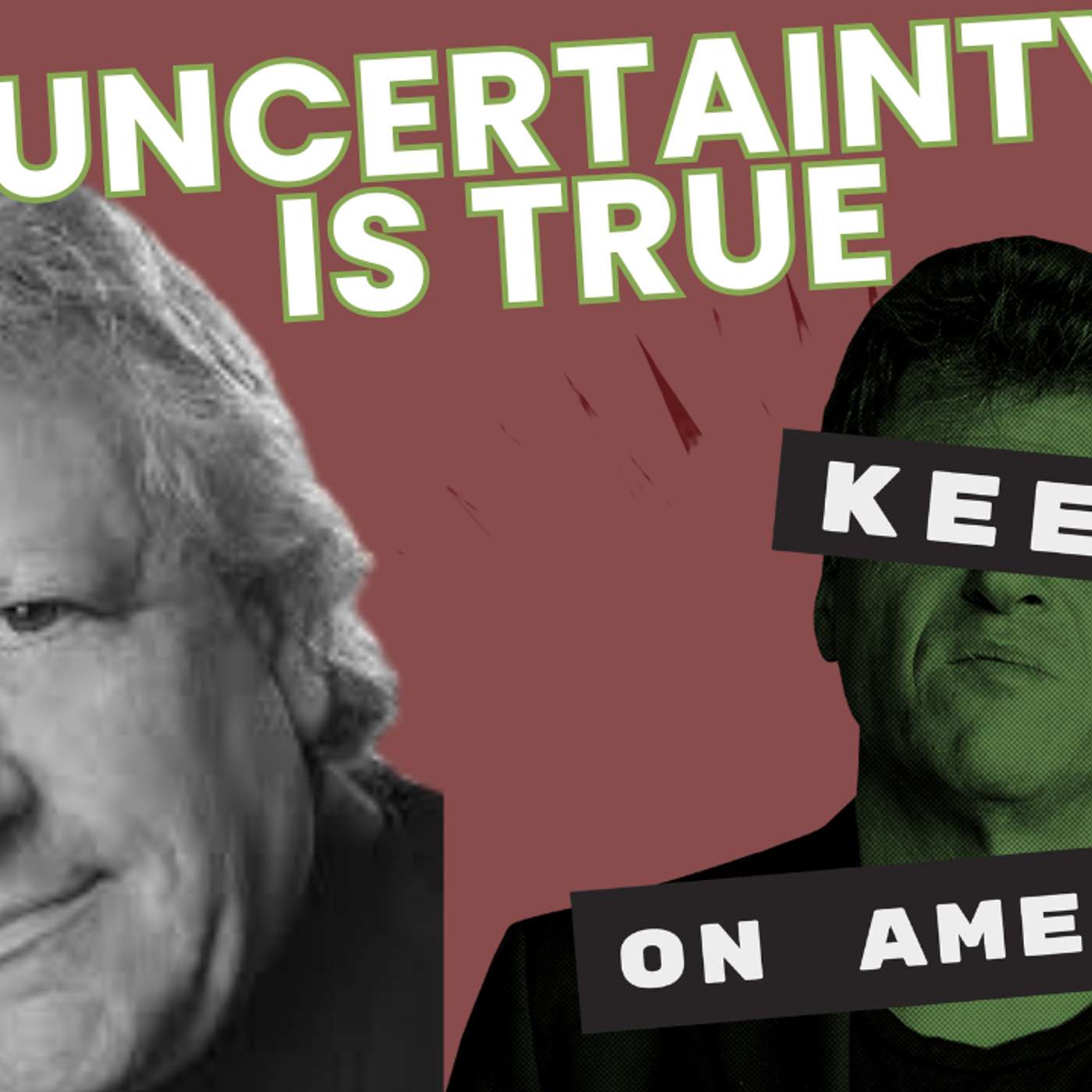
The Only Certainty Is Uncertainty: Stuart Firestein on Science in the Age of Tony Fauci
from Keen On America · host Andrew Keen
“Uncertainty is what tells you that science is reliable. It’s the people who are absolutely certain that you have to watch out for.” — Stuart Firestein The physician-scientist Tony Fauci is having a rough week. His newly revealed diary has even disappointed traditional allies at The Atlantic and The New Yorker who see the hitherto liberal saint of the pandemic as both too intimate with power and too certain of his scientific assumptions. Fauci’s fellow American scientist, Stuart Firestein, is having a better week. The Columbia neurobiologist has a new book out today, It Could Be Otherwise, which is a manifesto against scientific certainty. It’s the certain ones you have to watch out for, Firestein warns about those scientists intoxicated with the certainty of their own doctrines. Science, Firestein argues, requires a blend of hubris and humility. So the great Isaac Newton needed real chutzpah to claim to understand the mind of the creator with only a few equations. The expert is, by definition, riddled by doubt. They should be the most uncertain person in the room. Thus for Firestein, Charles Darwin is a greater scientist than Albert Einstein because Darwin’s theory of life is premised on randomness. So will contemporary science appear quaintly medieval in 500 years? Will 26th century man think of Darwin and Einstein like we moderns patronize Aristotle? Probably, Firestein suggests. In his Columbia course on ignorance, he tells his students that getting an A requires getting an F. We should all be so ignorant. Five Takeaways • Watch Out for the Certain Ones. Firestein won’t defend Fauci’s certainties, but he explains them: science requires a blend of hubris and humility — without some hubris, nobody would attempt a discipline that is mostly failure, mostly time spent in the dark. What corrupts the blend is a culture that demands the opposite of humility: exams with one right answer instead of ranked possibilities, journalists who need a confident quote, a public that has made science the theology of the twenty-first century. The result is Firestein’s paradox of expertise: the real expert is the most uncertain person in the room, because expertise means seeing the holes, the missing data, the failures. Certainty grows with distance from knowledge.• True Enough. Truth gets a small t only. Borrowing from the Harvard philosopher Catherine Elgin, Firestein describes science as moving from one provisional truth to the next — “true enough,” always improving, never final. His favorite proof is John Maddox, Nature’s longest-serving editor, asked how many of the journal’s published papers would prove wrong: “Oh, that’s easy. All of them.” Not wrong-wrong — unsettled science is not unsound science; it is reliable and it will get better. In science, revision is a victory, which is why Firestein sincerely hopes that in five hundred years our best knowledge will look as quaint as medieval astronomy — which, he notes, was accurate enough for people who weren’t launching satellites.• Two Kinds of Uncertainty. Epistemic uncertainty is what we don’t know yet; ontological uncertainty is the irreducible complexity of the universe itself — so complicated it might as well be random. Every answer in the lab raises ten better questions, which is how the more we know, the less we know. And yet we thrive amid the not-knowing: lasers, GPS, and randomized drug trials are all built on uncertainty. Ninety percent of hypertension diagnoses are idiopathic — no known cause — while nine different families of medicine treat it successfully. Even the brain, his own subject, isn’t unknowable — we know plenty at every level — but the vertical knowledge, from ion channels to consciousness, may never reduce to a single formula. Multiple explanations, Firestein says, are not a defeat.• Berlin, Darwin, and the Fox. The book’s presiding philosopher is Isaiah Berlin, the great value pluralist: many good answers to any real question, even incommensurable ones — which is emphatically not relativism (the poststructuralists get no comfort here; we still must choose, critically and responsibly). Berlin’s hedgehog and fox turn out to describe scientists too, and Firestein wants room for both. His scientific hero, though, is Darwin, whom he ranks above Einstein: the first person to show that tremendous organization and complexity can arise from essentially random events. Sixty-five million years ago, seven minutes of orbital difference and the asteroid misses. Randomness and uncertainty, properly understood, produce diversity and complexity — not chaos.• When AI Learns to Be Uncertain. AI appears exactly once in the book, a restraint Firestein is proud of: “we hate the bomb, but we love anesthesia,” and it’s the use, not the thing, that will decide. Socrates was famously against writing — it did ruin our memories, and libraries were worth it; calculators did ruin long division, and who cares. In the classroom, the smell scientist admits you can no longer smell Claude in an essay — hence his ignorance course’s 999-word assignment, harder than the 5,000 words Columbia students write in their sleep. But his sharpest cut is at AI itself: the machines will be valuable to the extent that they are uncertain. When AI learns to weigh possibilities rather than issue single solutions, it will be intelligent — it will be human. A deterministic tick-tock universe is no place for discovery, imagination, or freedom. It could be otherwise. About the Guest Stuart Firestein is a professor of neuroscience at Columbia University, where his laboratory studies the sense of smell, and a member of the Santa Fe Institute. A Guggenheim fellow and elected fellow of the American Association for the Advancement of Science, he is the author of Ignorance: How It Drives Science and Failure: Why Science Is So Successful, both translated into more than a dozen languages; he remains an Honorary Fellow of King’s College, Cambridge, where Failure was written. His new book is It Could Be Otherwise: Science in the Age of Uncertainty (Basic Books, August 4, 2026). References: • It Could Be Otherwise: Science in the Age of Uncertainty by Stuart Firestein (Basic Books, August 4, 2026). Kirkus: “A solid and even stirring defense of science.”• Ignorance: How It Drives Science by Stuart Firestein — the 2012 book, born of his Columbia course, that made not-knowing respectable.• The Hedgehog and the Fox by Isaiah Berlin — the essay, and the value pluralism, that give the book its philosophical spine.• True Enough by Catherine Elgin — the Harvard ph...
Embed this episode
Ready to play
The Only Certainty Is Uncertainty: Stuart Firestein on Science in the Age of Tony Fauci
No transcript for this episode yet
Similar Episodes
No similar episodes found.
Similar Podcasts
No similar podcasts found.