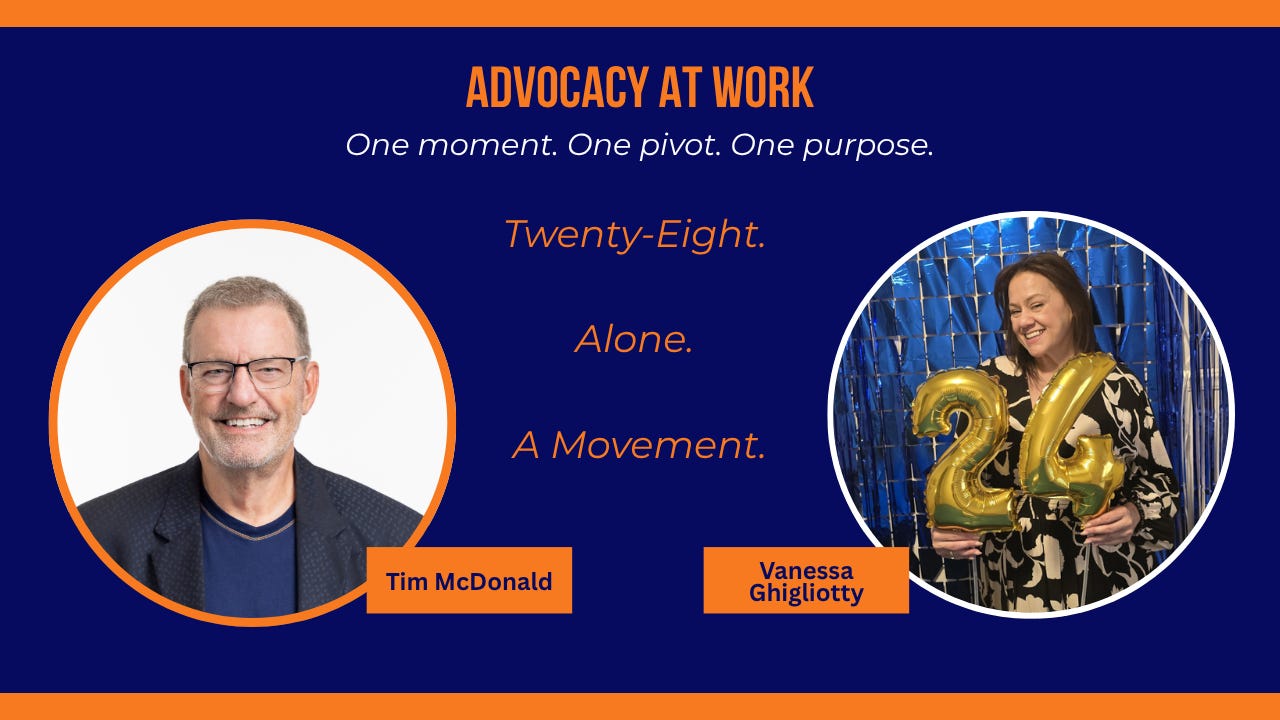
The Only Young Person Here
from Advocacy at Work Hosted by Tim McDonald
Twenty-four years ago, Vanessa Ghigliotty was 28 years old and had just graduated college. She was a young mom. She was planning to study for her LSATs. She was going to be a lawyer. She had dreams, plans, a future mapped out in her mind. Then she was diagnosed with stage 4 colon cancer. “Cancer throws you this big wrench into your plans,” she says, “and everything kind of gets disarrayed and discombobulated.” But here’s what makes Vanessa’s story extraordinary: it didn’t stay disarrayed. She walked into her first cancer support group to find a room full of wealthy people in their 60s and 70s, getting treatment before retirement. She was a baby by comparison, and she was completely alone. At Memorial Sloan Kettering, she was surrounded by generational wealth. By life experience. By people who had already lived their lives. And she hadn’t even started hers. “Everything that could go wrong when I was diagnosed with cancer did,” she recalls. “Every kind of setback that you get in your treatment, I got it. Every side effect, everything that never happens. I was the one in a million girl at MSK.” But instead of breaking her, that one-in-a-million experience gave her clarity: I don’t want people to have to go through what I went through. The Dark Ages of Colorectal Cancer: Before Young Adult Advocacy Existed When Vanessa was diagnosed, colorectal cancer was considered an old man’s disease. There were no young adult support groups. The American Cancer Society had programs for breast cancer and prostate cancer, but when she looked for colorectal cancer resources for people her age, there was nothing. The closest person in age to her in any support group was 45. And even then, they didn’t connect—because in those days, different cancers stayed siloed. Breast cancer patients didn’t associate with colon cancer patients. And young adult cancer patients didn’t exist as a category. “I had no one to go to. I had no one to find support to advocate,” Vanessa says. “There are so many things in your journey when you’re sick that you don’t know how to handle that you learn from your peers.” So for years, she learned alone. She navigated a fragmented medical system by herself. She figured out how to survive a disease that nobody her age was supposed to have. But eventually, she found the Colon Cancer Alliance—a tiny organization out of Ocala, Florida, with a staff of maybe ten people. There was one person there, Jeannie Hansen-Moore, who changed everything: she was a patient navigator, and she understood that cancer affected not just patients, but caregivers too. “Everything in their philosophy and everything they did matched up with what I was feeling and what I wanted,” Vanessa recalls. And then came the moment that would define her advocacy journey. The Stupid Cancer Moment: When She Found Her People Vanessa was at a walk in New York City, by the water, for Memorial Sloan Kettering. It was gorgeous. She was with her ex-husband and her mom. A young man approached her with a survey. He was asking about young cancer patients. “I flipped,” Vanessa remembers. “I was like, ‘Oh my God, young people, what? Yes.’ And I’m like, ‘I could tell you a million things.’ And my ex-husband was like, ‘You have to calm down.’ And I was like, ‘I can’t. I have been waiting for this. Hello. I’ve been talking about young onset cancer and everyone’s telling me it’s not a problem. You have no idea what you’re talking about.’” That young man was Matthew Zachary, founder of Stupid Cancer. He invited her to their first meetup, and when she walked in, everything changed. “Everybody looked like me. Everybody looked like me,” she says, her voice filled with emotion even now, decades later. She walked into that room and saw people her age. People facing cancer at a life stage when nobody expected it. People who understood what it meant to have your future stolen from you at 28. “I realized I need to meet people. I’m not a wallflower. I’m a doer,” she recalls. “I walked up to the first person, and it was Matthew Zachary, and we just bonded.” That moment—walking into a room full of people her own age, all fighting the same disease, all facing the same isolation she’d endured—became the catalyst for everything that came next. From Anger to Action: How Advocacy Actually Works Vanessa’s definition of advocacy has evolved dramatically over 24 years. When she started, she thought advocacy meant being loud and strong. Angry. You must hear me. This is going to be an epidemic with young people. She was right, colorectal cancer was shifting toward younger populations. She could see it coming. She went to conferences. She watched politicians’ responses. She gathered data. And she was furious about what she was learning. “Anger does not get you anywhere,” she says now, with the wisdom of someone who’s spent two decades learning this lesson. “Anger gets doors closed for you.” What actually moves systems isn’t rage. It’s relationships. Consistency. Showing up, again and again, with the same message and the same people beside you. It’s the slow wheel that keeps turning. “Here we are 24 years later and the screening age is lowered to 45,” she points out. “And what I’m hoping is that maybe another 10 years, another five to 10 years, we can get it lower to 40.” That’s not a headline victory. That’s not a dramatic policy reversal. That’s the slow, grinding work of advocacy—year after year, conference after conference, conversation after conversation, watching the needle move incrementally toward justice. “The screening age is lowered to 45. We got all the insurances to come along—not only public insurance, but private insurance too. I mean, this is huge. And that’s the difference in advocacy now is that it’s that slow wheel that just keeps going and you keep going and you have other people gathered around you with the same purpose and unite in one voice.” The Role of Community: Why Finding Your People Matters Vanessa is adamant about something: not everyone is an organizer. Not everyone is loud or outgoing or assertive. “Not everyone is outgoing. Not everyone is assertive,” she says. “Not everyone knows how to take the chaos of cancer and the chaos that cancer brings into your life and build something from it.” That’s why she emphasizes finding your place, not forcing yourself into someone else’s vision. She found hers in the Colorectal Cancer Alliance, alongside people like Jennifer Butler (then Jen Beckman), who shared her doer energy. They weren’t just talkers. They were people who, mid-conversation, were already on their phones making things happen. “When I find people who are that way like me, it’s like I have goosebumps,” Vanessa laughs. “Because I know together we can help people who don’t know how to help themselves because not everybody does.” But here’s the critical part: she acknowledges that not everyone is going to fit into an organization. And that’s okay. “Every single organization brings something different to the table,” she explains. “You have to sit there and say, where do I fit in? Where do I feel comfortable and what feels like home to me?” And if the answer is nowhere? You can still be an advocate. The Power of Social Media Advocacy: You Don’t Need an Organization This is something Vanessa wishes more people understood: you don’t have to join a nonprofit to be an advocate. “If they’re not a joiner, if they don’t gel with an org, what they can do is put their story out there on social media,” she says. “You put little tidbits. If you find an article relating to somebody just being diagnosed with colorectal cancer, you retweet or repost that article along with a snippet of your story that relates to that article. And then do hashtags.” Most people don’t understand the power of hashtags. They don’t realize how far a story can travel when it’s paired with the right tags, the right article, the right moment. “There’s a desperate need to get the messages that we all have out to the general public, not just amongst ourselves or the medical community,… This is a public episode. If you would like to discuss this with other subscribers or get access to bonus episodes, visit www.advocacyatwork.com
Embed this episode
No transcript yet.