The Orchestration Paradigm Series
from Rooted Layers Hosted by Petros Lamb
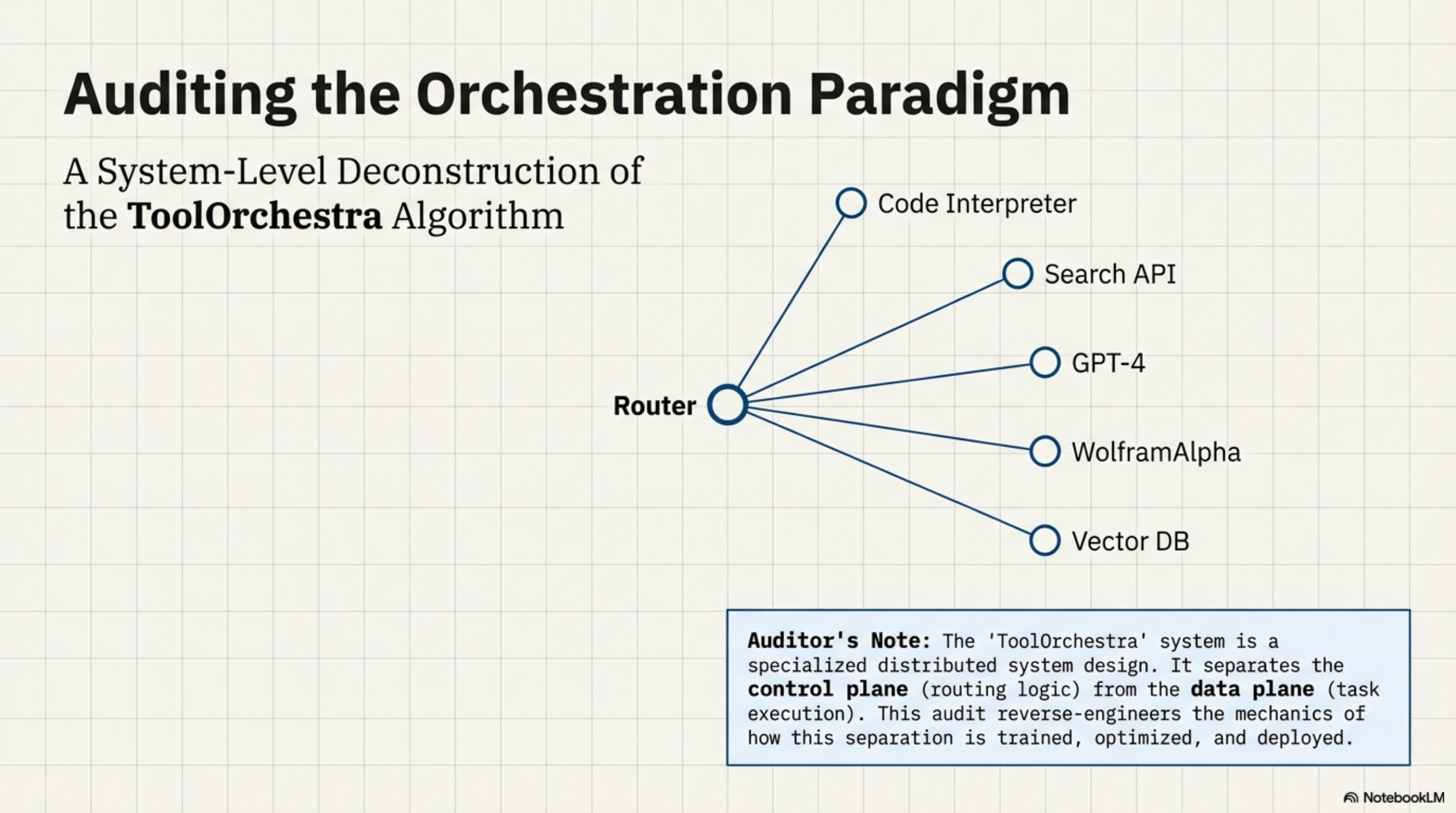
The Headline You Probably Missed In December 2025, NVIDIA researchers quietly published a paper that challenges the central dogma of modern AI development. Their claim: an 8-billion parameter model outperforms GPT-5 on Humanity’s Last Exam, a PhD-level reasoning benchmark spanning mathematics, sciences, and humanities, while costing 60% less per query. Not through some architectural breakthrough. Not through better training data. Through a deceptively simple idea: teach a small model to coordinate big ones. The paper is called ToolOrchestra, and across 4 thematic issues, I’m going to take you inside every detail of it. How to Read This Series Each part is self-contained. You can read them in order or jump to whichever topic interests you most. Every part ends with an Annotated Bibliography pointing to the primary papers with notes on why each one matters. ML practitioners will learn how to build orchestrated systems. Researchers will find a comprehensive literature review of tool use and compound AI through the lens of one well-executed paper. Technical leaders will get concrete cost and performance trade-offs for evaluating orchestration architectures. Curious minds can understand where AI is heading without needing a PhD to follow along. Prerequisites This series assumes familiarity with machine learning basics like loss functions and gradient descent, neural network fundamentals including attention and transformers, and Python programming sufficient to read pseudocode. If you’re newer to these topics, Parts 02 and 10 include appendices covering RL and agency fundamentals. Start with Issue 1 for the core thesis, then jump to Issue 4 for strategic implications. If you’re purely interested in business implications, Part 12 has the CTO decision tree and unit economics. The Orchestration Paradigm: Issue 1 - The Algorithm Issue 1: The Algorithm | Parts prep, 01, 02, 03 This bundle covers the economic thesis, the calibration paradox, the RL formulation, and the reward scalarization problem. TL;DR: Why we need RL, and how GRPO works. In this first issue, we dissect the economic and mathematical foundations of ToolOrchestra. We explore why “prompting harder” fails due to calibration limits, how an 8B model uses Reinforcement Learning (GRPO) to learn decision-making policies without a critic, and how to design multi-objective reward functions that balance accuracy, cost, and latency. This is the theory layer. Part 0: The Router-Worker Architecture [!NOTE] System Auditor’s Log: The “ToolOrchestra” system is effectively a specialized distributed system design. It separates the control plane (routing logic) from the data plane (task execution). This series reverse-engineers the paper to understand how this separation is trained, optimized, and deployed. The fundamental economic premise of modern AI is arbitrage. If a difficult task costs $0.05 to solve on a frontier model (like GPT-5), but can be solved for $0.005 by a smaller model using the right tool, then the system that effectively routes between them captures that value. That is the engineering definition of “Orchestration.” It is not about “agents” or “reasoning” in the anthropomorphic sense. It is about training a localized policy to optimize a global cost-reward function across a heterogeneous network of compute providers. This series dissects ToolOrchestra, a system that demonstrates this principle. Unlike monolithic approaches that try to bake every capability into a single checkpoint, ToolOrchestra uses an 8-billion parameter “Router” to dispatch tasks to specialized “Workers”, including code interpreters, search engines, and massive generic models like GPT-4. The Architectural Thesis The central claim is that Routing is a distinct capability from Generation. In a standard monolithic setup, the same weights responsible for generating a Shakespearean sonnet are also responsible for deciding whether to use a calculator for 23 * 491. This is inefficient. It wastes high-entropy compute (creative generation) on low-entropy decisions (tool selection). ToolOrchestra decouples this. It trains a dedicated policy network (the 8B Orchestrator) solely to manage the state machine of the problem solving process. # The Economic Thesis of ToolOrchestra class SystemAudit: def optimize_request(self, task): # The Arbitrage Condition # If the cost of routing + specialized execution is less than # the cost of naive generation, the system is strictly superior. monolith_cost = FrontierModel.estimate_cost(task) # High fixed cost router_cost = LogicModel_8B.inference_cost # Low fixed cost worker_cost = self.router.predict_worker(task).cost if (router_cost + worker_cost) The Control Theory (RL) You cannot train this system with Supervised Fine-Tuning (SFT) alone. SFT teaches the model syntax (how to format a JSON tool call), but it cannot teach strategy (when to call a tool). There is no “ground truth” for the optimal sequence of calls. We examine how Group Relative Policy Optimization (GRPO) solves this by treating tool use as a gradient-free environment. The Scalarization Problem (Rewards) The system must optimize for three conflicting variables: Accuracy, Latency, and Cost. A router that is 100% accurate but costs $50 per query is useless. We look at how Multi-Objective Reward modeling creates a scalar signal that forces the model to “internalize” the cost of its own actions. The Supply Chain (Data) Where do you get the training data? You cannot scrape “reasoning traces” from the web because they don’t exist. We scrutinize the ToolScale pipeline, a synthetic data factory that generates verifiable state-transitions to bootstrap the learner. The Production Reality Finally, we audit the deployment. Routing logic that works in a controlled benchmark often fails under the distributional shift of production. We analyze the generalization mechanics, how the model handles tool descriptions it has never seen before, and the fragility of relying on prompt-based tool definitions. The Road Ahead This is not a celebration of the paper; it is an audit. We are looking for the mechanics that make the system work and the dependencies that make it break. We begin in Dive 1 by defining the problem: why can’t we just prompt GPT-4 to do this? Annotated Bibliography Su et al. (2025) - ToolOrchestra: Elevating Intelligence via Efficient Model and Tool Orchestration: The primary paper analyzed in this series. Introduces the 8B orchestrator concept. Zaharia et al. (2024) - The Shift from Models to Compound AI Systems: The theoretical foundation for why monolithic scaling is hitting diminishing returns, favoring modular architectures. Schick et al. (2023) - Toolformer: Language Models Can Teach Themselves to Use Tools: The precursor to ToolOrchestra, demonstrating self-supervised tool injection. ToolOrchestra expands this to multi-tool and multi-objective settings. Part 1: The Fundamental Problem The Paradox of Capability vs. Routing [!NOTE] System Auditor’s Log: A common objection to orchestration frameworks is: “Why train a small model? Why not just prompt the big model to use tools?” The answer lies in calibration. High-capability generators are often poorly calibrated routers, suffering from “Instrumental Convergence” on their own weights. The fundamental problem ToolOrchestra addresses is not a lack of intelligence, but a misallocatio… This is a public episode. If you would like to discuss this with other subscribers or get access to bonus episodes, visit lambpetros.substack.com
Embed this episode
No transcript yet.