
EPISODE · Nov 17, 2025 · 11 MIN
The PanRadio Collaboration’s First Results – The 400-Day Afterglow of GRB 230815A
from Multi-messenger astrophysics · host Astro-COLIBRI
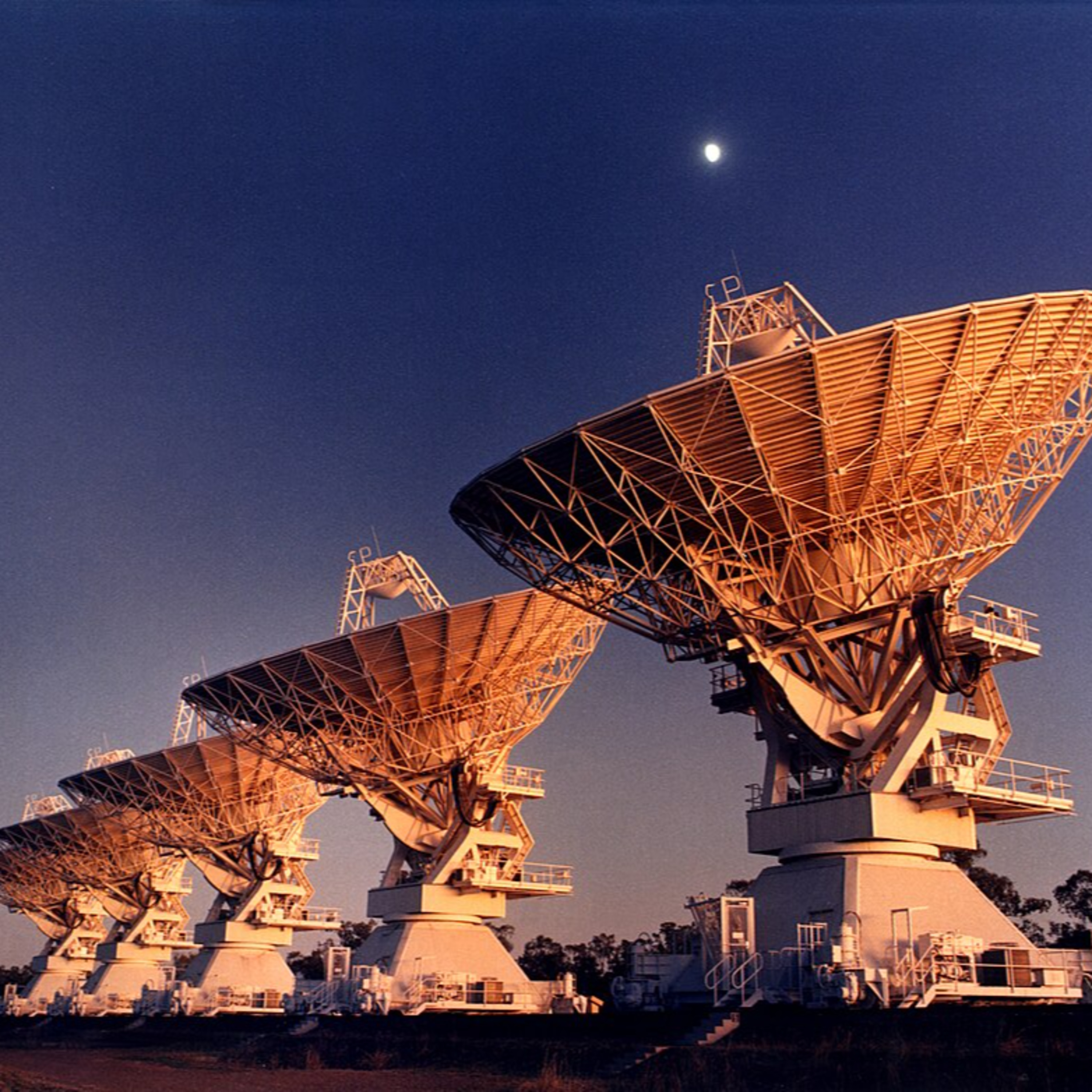
This episode dives into the extraordinary 400-day observing campaign of Gamma-ray Burst (GRB) 230815A, the first major result from the Panoptic Radio View of Gamma-ray Bursts (“PanRadio GRB”) program.**The PanRadio Program**The PanRadio GRB program is a systematic, multi-year radio survey carried out on the Australia Telescope Compact Array (ATCA). Its goal is to provide comprehensive, multi-frequency (1–50 GHz), and high-cadence radio monitoring of all southern *Swift* GRB events, following their afterglow evolution from within an hour to years post-burst. Crucially, this program provides a **more unbiased view** of GRBs, targeting events like GRB 230815A that typically would not receive traditional radio follow-up because they lack known redshifts or comprehensive multi-wavelength coverage due to high line-of-sight extinction ($A_V = 2.3$).**Key Findings from GRB 230815A**GRB 230815A was a long-duration GRB, likely originating from a collapsar. The 400-day observing campaign revealed a key conflict in its behavior:* **The X-ray Afterglow:** An early X-ray jet break was observed at approximately $\sim 0.1$ days post-burst. This implies a very narrow jet opening angle, estimated to be about $2.1^\circ$.* **The Radio Afterglow:** The radio light curves, traced over an unusually long duration of 400 days, evolved approximately according to the standard self-similar expansion expected for a relativistic blast wave in a homogeneous environment. Critically, the radio evolution was **at odds** with the early X-ray break.* **The Solution: A Two-Component Jet:** Researchers reconcile this conflict by proposing a **two-component jet structure**. The early X-ray break originated from the **narrow, fast component** ($\sim 2.1^\circ$), while the delayed or absent jet break in the radio light curves stems from a separate, **wider component** with a half-opening angle estimated to be $\gtrsim 35^\circ$.**Long-Term Impact**The extensive follow-up confirmed that after 400 days, the blast wave showed no evidence of transitioning to the non-relativistic regime, which constrains the ratio between the blast wave kinetic energy and the circumburst medium (CBM) density. The PanRadio program will build a large, unbiased sample to rigorously inspect the microphysical and dynamical parameters of GRBs, revealing the true diversity of their outflows and environments.**Article Reference**These results are published in the draft article: **"First results from the PanRadio GRB Collaboration: the 400-day afterglow of GRB 230815A"**. https://arxiv.org/pdf/2511.07644Acknowledements: Podcast prepared with Google/NotebookLM. Illustration credits: CSIRO
Embed this episode
Ready to play
The PanRadio Collaboration’s First Results – The 400-Day Afterglow of GRB 230815A
No transcript for this episode yet
Similar Episodes
No similar episodes found.
Similar Podcasts
No similar podcasts found.