
EPISODE · Aug 17, 2026 · 40 MIN
The Perils of Polypharmacy. What Happens When We Take Too Many Drugs?
from Diabesity Decodified - Is Food the root cause of Type 2 Diabetes Mellitus pandemic?
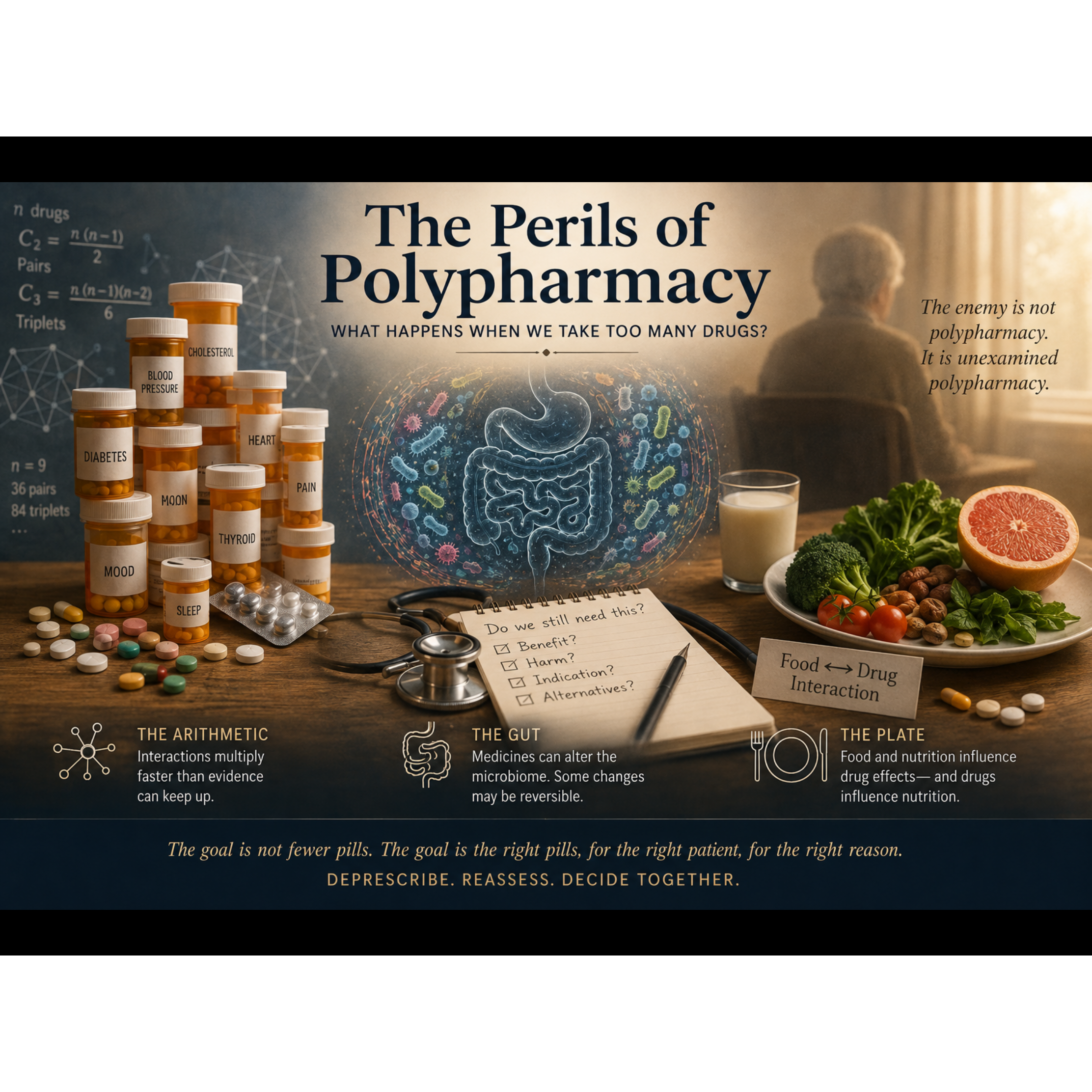
The Perils of Polypharmacy: What Happens When We Take Too Many Drugs?Thiruvalluvar wrote:“மருந்தென வேண்டாவாம் யாக்கைக்கு அருந்தியது அற்றது போற்றி உணின்.”“The body needs no medicine if what has been eaten is properly digested before eating again.”He reminded us that health depends on what enters the body, how much, and with what consequence.Today, we face a different question: what happens when we put too many medicines into the same body?A 2026 global meta-analysis of 545 studies involving more than 16.6 million older adults across 56 countries estimated polypharmacy—commonly defined as five or more medications—at 50.4%.The concern is unexamined polypharmacy: unnecessary medicines and poorly understood combinations.Three blind spots illustrate the problem.1. The arithmetic of combinationsNine medicines create 36 possible two-drug combinations and 84 possible three-drug combinations. As medication burden rises, evidence supporting the safety of a particular combination becomes thinner. The harder question is what the whole collection does in this patient.2. The gut we forgot to consultThe microbiome interacts with metabolism, immunity and drugs. Human observational studies associate medication burden with microbiome alterations.In aged mice, high-burden polypharmacy altered the gut microbiome, and several changes partially reversed after withdrawal.This is animal evidence—not proof of clinically important microbiome injury in humans. But it raises an important question: could some consequences be reversible, making deprescribing part of recovery?3. What is on the plate matters tooFood–drug interactions are bidirectional. Drugs can alter appetite, gastrointestinal function, absorption and nutritional status, while food can alter drug bioavailability.Polypharmacy has also been associated with malnutrition.Multiple medications are not inherently wrong. Several drugs may be entirely appropriate in complex disease.The question is different: Are we periodically asking whether every medication is still necessary, beneficial and right for the patient—or is it simply being continued because it was prescribed in the past?Deprescribing is deliberate reassessment:Which medication still provides benefit? Which indication has disappeared? Which treatment is redundant? Which drug may now cause more harm than benefit? Which can safely be withdrawn?These questions should be answered with the patient, not for the patient.It is about ensuring that every treatment still has a reason to be there.Thiruvalluvar’s wisdom was not simply about avoiding medicine. It was about knowing what the body receives, respecting proportion, and understanding consequence.Perhaps modern medicine needs to rediscover that principle.We built modern pharmacology one drug at a time. Perhaps we should reconsider what happens when too many drugs enter the same patient.A contemporary Tamil reflectionமருந்தை மறுப்பது அறிவன்று; மருந்துகள் பெருகின் மறுபரிசீலிப்பது அறிவு.Wisdom does not lie in rejecting medicine; when medicines multiply, it lies in re-examining them.
Embed this episode
Ready to play
The Perils of Polypharmacy. What Happens When We Take Too Many Drugs?
No transcript for this episode yet
Similar Episodes
No similar episodes found.
Similar Podcasts
No similar podcasts found.