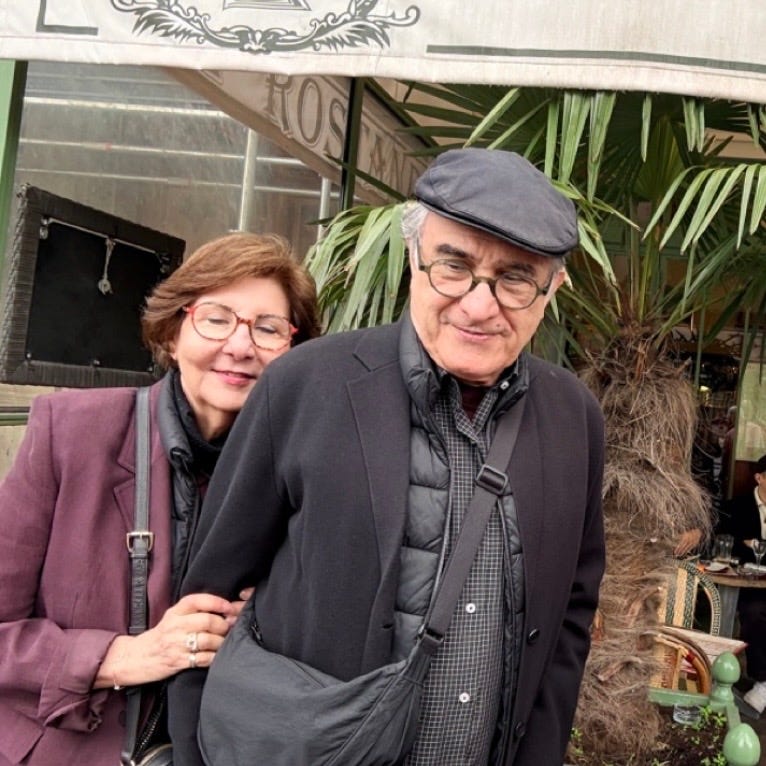
The Photograph Outside the Café
from Language Matters by Elias Winter Hosted by Elias Winter
Prologue — The Man in the Cap My father looked like Robert De Niro in the photograph. Not the young De Niro of violence and appetite, not the actor with danger still under the skin, but the older De Niro: compact, watchful, ethnic, weathered by intelligence and disappointment, wearing his face like a city that had survived several regimes. My father stood second from the left, in a dark cap, outside a café in Paris. Beside him stood my mother, seventy-six years old, quiet in the frame, almost modestly placed, as if even in a photograph she did not wish to occupy more space than necessary. There were four people in the picture: my father, my mother, my uncle, and my uncle’s wife. My uncle had come from America with his wife. My parents were already in Paris. Someone lifted a phone, asked them to stand together, and for a moment the century arranged itself beneath a café awning. The photograph could have been nothing. Four elderly people outside a café. A tourist image. A family update sent across WhatsApp. The kind of picture one looks at quickly, smiles at, and files away under the general tenderness of aging relatives traveling through Europe. But photographs are sometimes dishonest in the opposite direction. They look smaller than they are. They compress entire catastrophes into posture, entire marriages into the angle of a shoulder, entire exiles into the way someone stands in comfortable shoes on a Paris sidewalk. At first I saw my father’s cap. Then I saw my mother’s face. Then I saw the lives behind them. A photograph can look like tourism and still contain an entire century. Chapter 1 — The Woman Who Did Not Make a Scene I spoke with my mother recently and told her something I had known for a long time but had perhaps never said so plainly. I told her that I had met many women in my life. I told her that, being gay, I had never looked at women through the usual hunger that teaches men to confuse beauty with possession. I had known women as friends, colleagues, teachers, strangers, relatives, fellow sufferers. I had watched them without needing anything erotic from them. And in all that watching, across countries and years, she remained the most peaceful, non-dramatic, low-expectations person I had ever known. My father, who was also on the call, shook his head. “Not necessarily with me,” he said. That was necessary. It saved the sentence from becoming a shrine. No human being is peaceful in every room. No marriage confirms the public myth. My mother’s calm was not the blank serenity of someone without force. It was not passivity. It was not the decorative gentleness sometimes assigned to women after their complexity becomes inconvenient. She could be sharp with my father. She could be impatient. She could have her private weather. But her deepest temperament, the one that governed her life, was not theatrical. She did not turn suffering into performance. She was the youngest of three daughters, and by her own account she was spoiled by her mother. Her sisters were more outward-facing, more social, more drawn to parties and the beautiful surface of pre-revolutionary Iran. They belonged more naturally to the rooms where people were seen. My mother belonged to study. That was her rebellion, though no one would have called it that. She did not rebel by becoming loud. She rebelled by becoming serious. There is a kind of woman history forgets because she does not announce herself in the language history prefers. She is not the revolutionary on the barricade. She is not the glamorous socialite in the old photographs of Tehran. She is not the martyr, the dissident, the muse, or the scandal. She is the inward woman with books. The woman who does not mistake attention for existence. The woman who moves through family expectations and national convulsions with an intelligence too quiet to become legend. My mother was that kind of woman. In the photograph outside the café, this remains visible. She is not trying to dominate the image. She does not perform old age as charm or suffering. She is simply there, beside my father, carrying within her a life that cannot be guessed from the frame. Peace, in her case, was not emptiness. It was depth without noise. Chapter 2 — Chemistry Before the Revolution Before the revolution, my mother was beautiful. She was modern in the way some Iranian women of her generation were modern before the West learned to flatten them into symbols. The photographs of that era are often used crudely now: women with uncovered hair, short skirts, sunglasses, cigarettes, parties, beaches, Tehran before the clerics. The images are real, but they are also too easy. They allow outsiders to treat Iranian modernity as an outfit. My mother’s modernity was not only aesthetic. It was intellectual. She studied chemistry. She was drawn to structure, substance, transformation, the hidden behavior of matter. She belonged to that pre-revolutionary Iranian world in which a certain class of families still believed the future opened outward: toward Europe, toward America, toward universities, toward scientific seriousness, toward women crossing borders not as refugees but as students. At eighteen, she went to Wisconsin through the American Field Service exchange program. This was an older America, or at least an older idea of America: a country that still imagined itself as a host, a place that brought foreign teenagers into its homes and schools and allowed them to carry back not only English but an image of possibility. Later, in her thirties, she went to London to pursue a PhD in chemistry. For a woman of her generation, this was not minor. It was not merely impressive. It was a crossing. She had already known Europe before London. From Tehran, she would travel once a year to Paris and shop on the Champs-Élysées. It is almost impossible now to write that sentence without feeling the ache of a vanished arrangement of the world. A young Iranian woman could move from Tehran to Paris, buy clothes, return home, study science, live inside a cosmopolitan rhythm that did not yet know it was about to be broken. The Champs-Élysées was not just a boulevard for her. It was part of a civilizational circuit. Tehran, Paris, London, Wisconsin — these were not fantasies. They were rooms in the same house. That house no longer exists. But she had lived in it. And because she had lived in it, she carried its proof in her bearing. Not arrogance. Not nostalgia exactly. Something quieter. A sense that the world had once been more open than it later became. A sense that she had moved through that openness without needing to boast about it. She was not modern because she had seen Paris. She was modern because she believed knowledge could order a life. Chemistry, for her, was not decoration. It was discipline. It was a way of saying that the world could be studied, that matter had laws, that transformation was not magic but structure. Then history came for the laboratory. Chapter 3 — When History Interrupted Chemistry The revolution happened in the middle of her studies. That is how history often enters a life: not as an abstraction, not as a chapter heading, not as footage replayed decades later for ideological satisfaction, but as an interruption. A woman is studying chemistry in London. She has a future organized around research, exams, papers, laboratories, the slow credentialing of intellect. Then a country catches fire behind her, and the future no longer proceeds in a straight line. History interrupted chemistry. She returned to Iran. There are lives that develop through choice, and there are lives rerouted by force. Most lives are some mixture of both, though people often lie about the proportions. My mother did not stop being who she was when she returned. The mind that had gone to Wisconsin and London did not vanish. The elegant woman who shopped in Paris did not disappear. But the structure around her changed. The world that had made her trajectory intelligible collapsed into slogans, clerics, fear, improvisati… This is a public episode. If you would like to discuss this with other subscribers or get access to bonus episodes, visit eliaswinter.substack.com
Embed this episode
No transcript yet.