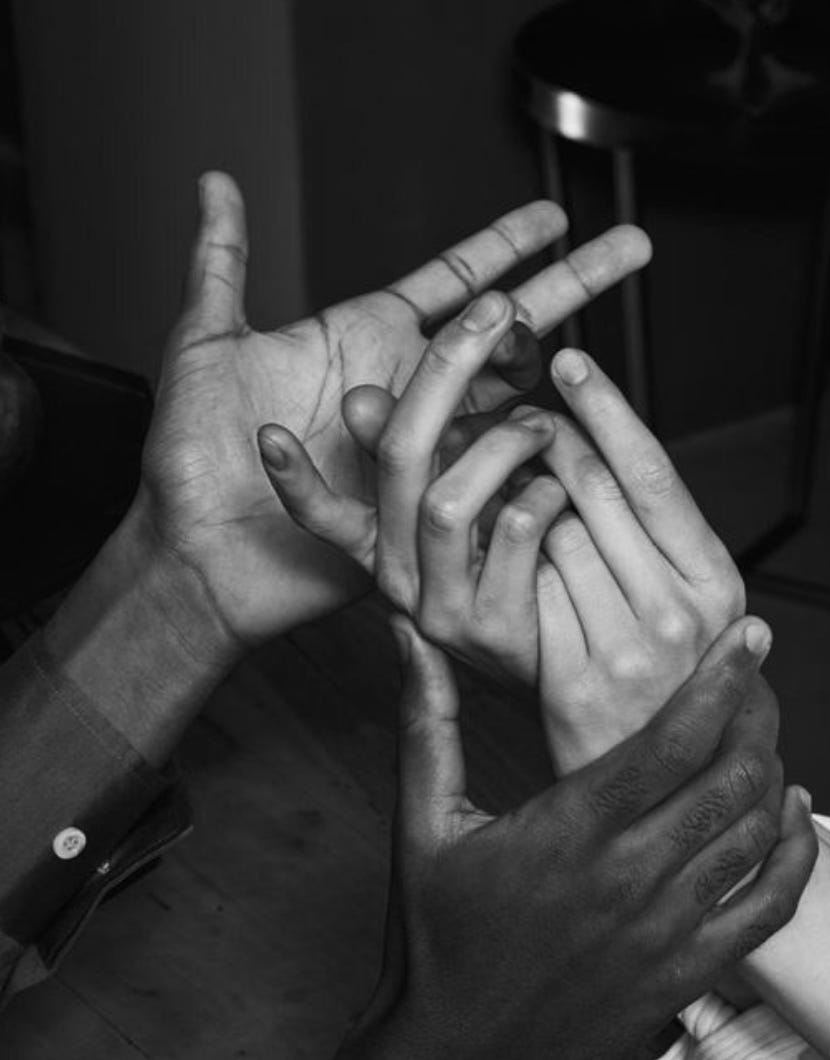
The Pin and the Palm.
from Sarah Blondin Hosted by Sarah Blondin
This is a free preview of a paid episode. To hear more, visit sarahblondin.substack.com The majority of my days are spent in solitude, surrounded by hallways of trees. I walk slowly down winding footpaths through the woods. I speak mostly to wind and sparrow, to the passing fog. The most loving dialogues I have are with quiet, non-verbal beings. It is from their silent generosity that I have learned what it means to be deeply heard and received, listened to and accompanied. It is, in truth, a mutual and life-affirming relationship. What I learn in my forest solitude is what informs everything I write and how I communicate in the larger world. In many ways, my relationship with nature has given me the closest feeling of unconditional love I have ever known. Sometimes when I sit down to write, I try to muscle a message into being. For this month’s post, I was sitting with retrospect—how I wished to live knowing that life, no matter how hard, often reveals in time a kind of miraculous gift we cannot see in the moment. But as I looked out at the forest blanketed in its first gown of snow, feeling the familiar tightening in my chest and mind as the holidays approach, I stopped. I looked out the window and asked the quiet what it wanted me to speak about. Without hesitation, my hand began moving, and I wrote for nearly three pages about relationships. The complicated ones, the hard ones, the ones that have shaped or scared us. The ones we move toward or away from during the holidays. The ones that help us grow, and the ones that keep us from growing. The intense, sometimes unsettling currents we move through in the presence of one another. I resisted posting it because this territory is heavy and fraught with pain that can trigger rather than inspire. What came pouring through me felt idealistic, even utopic, and not entirely helpful. But in the end, I saw there was no avoiding the truth that arrived: that we are love learning to love itself, and that we must find a way to be for one another what the wild world has been for me, what the cedar and the stones have shown me without tiring—that I am loved. Held in love. Worthy of love. And entirely capable of mirroring this love back into the world. And so, without intending to, I found myself writing about the complicated ways we love. It is a story of buried hurt, the softening of the hand, and the wild world modelling for us how to become human again. “For one human being to love another: that is perhaps the most difficult of all our tasks… the work for which all other work is but preparation.”—Rainer Maria Rilke, Letters to a Young Poet I’m remembering my first encounters with relationships as a young child. My wide eyes, and ever-curious and reaching heart scanning people and environments for direction and instruction, for signals and for safety. Everyone I met held a unique tone and sound, striking something in me that made me feel either more at home in myself and in the world, or less. My grandmother, an alcoholic, carried a deep severity; her sound was almost like stones pelting you. Insults, sharpness, an energy that felt fractured and alarming—especially coming from someone who was supposed to be so important in my family system. I remember each time she would come to visit, I would stand near her, my stomach tight, scanning her face for signs of which grandmother had arrived: the one who might look at me lovingly, or the one who looked lost in a slow and slurred world. I learned to make myself smaller in her presence, to dim my energy, hoping that if I took up less space, I might escape her aim. But you cannot hide from someone whose pain is looking for a place to land. And I was there, small and permeable, an easy target for her unmetabolized grief. And then there were the ones that spoke an entirely differently language to my body, like my grade 9 English teacher, who felt like an open door filled with mystical curiosities and poetry, almost otherworldly, and full of invitation. His eyes were like lanterns. I adapted by learning to hide from certain people, withdrawing into myself in a way that created distance between us. It felt like pulling back my life force, dimming the dial of my presence. I thought this would make me safer, but it only made me more afraid of everything, including myself. When we turn our energy down and retreat from the world around us, something in us grows static. We disconnect. We isolate. Connection with the world is what creates harmony and safety in our systems, but when there is interference, the whole body can feel clouded and without a center.
Embed this episode
No transcript yet.