God is good, isn't he? I'm telling, God is good. I want to say thank you to Brother Spencer for filling in today. For Brother Randy, appreciate Brother Spencer.
Actually, all of our instrumentalists, I'm telling you, when they're not here, you miss them, right? You didn't have a piano last week. Don't have an organ this week. These guys, they assist us in what we do and how we worship and how we sing praise to the Lord.
I appreciate them being prayer for the suttons there up in the great Northwest, enjoying some time away for them, the coxies that we're traveling back this week. Today starts for me what I consider the second half of the preaching calendar. You know, when I get through May, I get through June, we've been focusing on the family. Then we get to July, we've got God and country day.
And then once we get that cleared off the deck, hey, it's time for the second half of the year. And so for me, second half of the preaching calendar, right? The second season of preaching from the pulpit. But not only is it the second season of preaching from the pulpit or the second half, it's also today the second half of the season that you didn't even know that we were in, because we haven't yet talked about.
I've been waiting to get to this day to share some things with you about strategy, about vision, our discipleship process. You know, a few years ago, when Brother Josh was still on board here, the staff and I, we sat down in the conference room and we just spent some time hammering out a definition for what is a disciple. What do we see a disciple being? What are the things that we would see a disciple doing?
We hammered out our four big words, connecting, growing, serving, and reaching. And we've talked about that. I've preached messages several years ago about rounding the bases. We laid out our vision, first basis connecting, second basis, growing, third basis serving.
Home plate is reaching. Fast forward several years. We brought Brother Curtis on board. I want to say this, but the Curtis has been a blessing, blessing to me.
I know he's a blessing to our church. He's helped me to see discipleship differently, not as a program, but as a set of relationships. We've talked about this, that you can really, you can only carry people so far in discipleship and care them as far as they want to go. That's true for all of us.
Every one of us today, maybe not ideally, but in reality we are as close to Jesus as we want to be. Again, ideally we're like, no way man, I could be closer, but in reality we are exactly where we choose to be. And so what we've been looking at is, hey, how can we build some on-ramps to discipleship? How can we build some things that can allow people to say, hey, I want to go deeper, I want to follow more closely the Lord.
And so we've got three tiers of discipleship that we're working on. Here number one is what we already do. Every message that's preached, everything that's called on the pulpit, everything that comes in and wins the night, study school, we want to ask this question, how does it help me follow Jesus more closely? Then there's tier number three, which is the cherry on top.
Tier number three is relational discipleship. We're going to begin two relational discipleship groups this fall, and in which we're going to watch what God does. And our hope is that we'll see those groups multiply, grow, more people get involved. And the reason for discipleship in groups is because that's how Jesus did it.
Jesus discipled people relationally in groups. But in the middle, the meat of the sandwich is tier number two. And that comes back to our vision of rounding the basis. First place, second place, third place, home plate, connecting, growing, serving, reaching.
We ran staff meeting and Brother Curtis brought this up. He says, what if we looked at our strategy, our vision, and we laid it out like seasons in a year. And we saw a season of worship, a season of the word, a season of work, and a season of winning. I said, man, that's good.
I like that. That'll preach, actually going on. But it lays out on top of our vision. Worship is connecting with God in adoration.
Growing is a season of the word. Serving is a season of work, and reaching others is a season of winning. Now, we see that being laid out where we emphasize some things on our calendar. In June through August, it'll be a season of worship.
And then the fall will be a season of the word. And the winner will be a season of work. And the spring will be a season of winning. Now, you may have seen this on your calendar, but the last Sunday of August is going to be a night of worship.
We're tracking toward that. We're going to gather together, and we're going to worship the Lord. Now, Curtis and I, we didn't get together. I asked Curtis to fill in for me on Wednesday night.
I said, I'm going to be out of pocket a couple of weeks. Why don't you do a series? You just pick whatever's on your heart. And you teach it.
You know what he taught on? Worship. Now, we didn't talk about it, but I have a feeling oh, Curtis was thinking, we're supposed to be in a season of worship. We ain't talked about it, but that's what we're supposed to be.
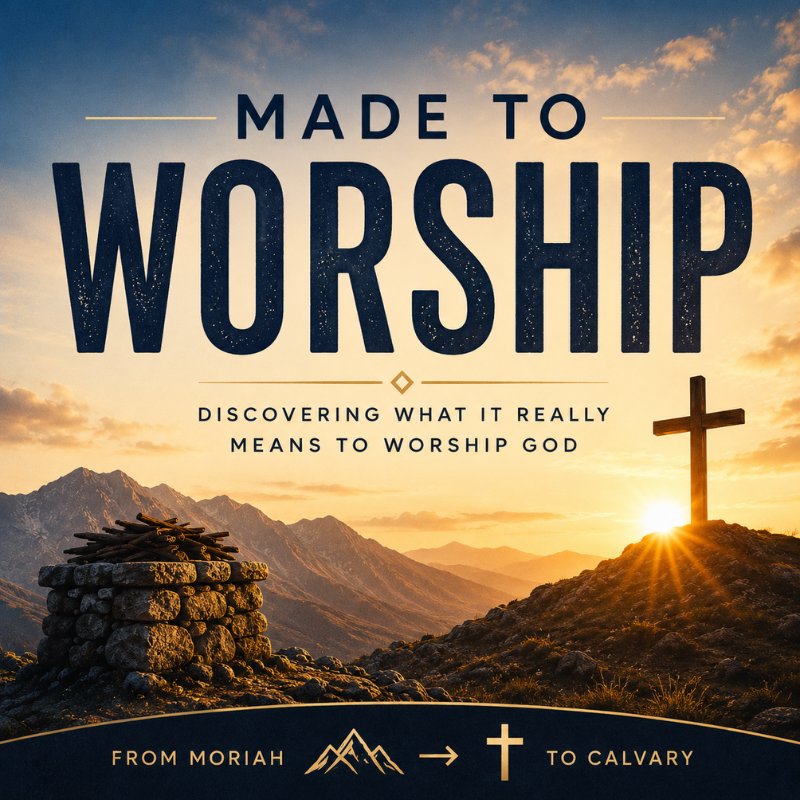
And that's what I'm going to teach on. I didn't talk to Brother Curtis, and he didn't know this, but what was on my heart and where we're headed, because we're in a season of worship, because I want to preach on the subject of worship. And I want to begin today a series entitled Made to Worship. The Psalmist said this in Psalm 95 verse 6.
He said, oh, come let us bow down and let us worship the Lord, our maker. You know what God has done? He has made us to worship. God has created us to worship him.
And so today we're going to begin a series on the subject of worship. Now, when I say the word worship, and I know Brother Curtis went over this in Wednesday night, study. But when I say the word worship, hey, what comes to your mind? Perhaps what comes to your mind is singing or giving praise to God.
Maybe what comes to your mind is choirs or hymns or praise names or instruments. But I want to emphasize something this morning that worship is much bigger than music. Music can be an expression of our worship, but music is not the definition of worship. Matter of fact, if our worship only happens when we gather together on Sunday mornings, we are missing it.
We're missing out on what the Bible teaches us about worship, because the Bible presents worship as a way of life. Hence the title of the series. We are made to worship. Worship is the daily response of a heart that has encountered the living God.
You know, we gather together on Sundays, not to begin worship. We gather together on Sundays because it should be the overflow of our worship. That we've been worshiping God all week. And I don't mean necessarily singing to God, but we can do that.
I'm talking about we've been responding to God. All week, we've been walking with God. All week, we gather together. And this is the overflow of our hearts to God.
So if we're going to understand worship, then we need to allow God, not our culture, not our church culture, not our preferences, not our traditions, not our church traditions, to define what worship is, but rather God's word can define what worship is for us. There's a principle in the Bible, or at least the principle of Bible study that's known as this. It's the principle of first worship. I'm sorry, a first mention.
You've heard that? The principle of first mention. And here's what it says. That any time a word, a doctrine, a teaching is introduced for the very first time.
It becomes foundational for every other time. It shows up in God's word. So when a word is introduced, when a teaching is introduced, when a doctrine is introduced, you may not get everything there is to know about that word, that teaching that doctrine. But in seed form, you get everything that grows out of it for the rest of God's word.
So when you get the first mention down, you can begin to understand every other time the word is mentioned. You know where worship is mentioned for the first time in God's word? It's not in the Psalms. It's not David, the great worshipper.
It's not with Moses and Exodus and the building of the tabernacle. It's not with Solomon and first chronicles in the building of the temple. It's not in Revelation where we see a future of worship scene gathered around the throne of God. It actually happens in the book of Genesis.
Genesis chapter 22 verse five, Abraham says to his two servants, you stay here, I and the lad will go yonder and worship. And then we will return unto you. And in that setting, we learn much about what worship is. Think about it.
He says, I and the lad will go yonder and we will worship. There's no music, there's no choir, there's no hymn, there's no congregation, there's not even a sermon that's being preached. Instead, there's a father, a son, and there's an altar. There is fire, there's wood, there's a knife.
But most importantly, there is a total surrender to God. So why don't you just stop right there and think about that? Before worship is ever associated with music, God associates worship with surrender. Before he ever associates it with praise, he associates worship with obedience.
Before worship is ever associated with celebration, God associates worship with sacrifice. I want to appreciate this morning a message entitled, The Principles of Worship. We have your Bibles, we're in Genesis 22. If you would, thank you Bible, stay with me, we'll honor the reading of God's word.
We're gonna be in Genesis 22, we're gonna look today at all 19 verses, but I'm gonna read all of them. We'll just walk our way through it. But beginning in verse number one, we'll read down through verse number five. The writer says, and it came to pass after these things, that God did tempt or test Abraham.
And he said unto him, Abraham, and Abraham said, behold, here I am. And he said, now take your son, your only son Isaac, the one that you love, and get to the land of Moriah. And offer him there for a burnt offering, of one of the mountains that I will tell the of. And Abraham rose up early in the morning and saddled his donkey, took two of his young men with him, Isaac his son, and he claved the wood for the burnt offering, and he rose up and he went to the place of God, of which God had told him.
Then on the third day Abraham lived with his eyes, and he saw the place of far off. And Abraham said unto his young men, Abagi here with the donkey, I in the lab will go yonder and worship, and we will come again unto you. Let's pray. Father, we come to you today.
We just want to say thank you Lord. Thank you for who you are, and God what you reveal to us, and I pray today that you will do a great work in us. You will do a great work through us, and God that you would teach us about worship. And Lord, by that I mean, shin you in worship, where lives that are lived in obedience and surrender to you, and what you have revealed in, and through your word, by your son, and what you reveal to us by your Holy Spirit.
And Father, I pray that you would lead us in order to walk more and more closely with our Savior. God today, if one be here who has never put their faith, their trust in Christ, who never vowed in submission to Him, I pray that today would be the day of salvation. God, I pray that today would be the day that you have received for the glory and the honor of a soul being saved today. God, draw us near to you.
Again, teach us, Lord, and help us to leave here today. Lord, we're rejoicing because we've learned more about what it means to truly worship you and what we were made to do. I pray this in Jesus name, amen. And amen, I want to share with you five things this morning, number one, worship begins when God speaks.
You can see verse number one. The Bible says that it came to pass after these things, that God did test Abraham, and He said unto Abraham, oh, you know that. That Abraham didn't wake up one morning and think, by God, I want to worship the Lord today. And I want to, you know, I'm just being creative, and I'm coming up with a slick idea, that this cool scenario where I'm going to really worship God, and I'm just going to surrender everything to Him, and I'm going to take my son and sacrifice Him to God.
That's not how it works. Abraham didn't come up with the idea. God's the one who spoke to Him, and here's the truth. Worship is always in response to what God initiates.
Abraham responded, that's the pattern of worship. God always takes the first step. Every act of genuine worship begins because God has spoken. Every Sunday morning, every quiet time, every conviction of the Holy Spirit, every moment when you're reading the scriptures and they're coming alive, and God is speaking into your heart, the question is never, hey, is God speaking?
Does God speak? No, the question is are we listening to God? Look at what he says in verse two. So he speaks, he says, now you take your son, your only son Isaac, you know that son that you love?
Do you feel the weight of the head? Your son, your only son, the one that you love? He said, I want you to get to the land of Moriah, you offer Him there for a burnt offering upon one of the mountains that I will tell you of. He said, man, what's God doing here?
What's God doing? He says, hey, take your son and offer him as a burnt sacrifice. Well, the good news is the Bible tells us exactly what he's doing. Verse number one, he did test Abraham.
This was never about God learning something that he didn't know, God already knows. God already knows Abraham's heart. This test was for Abraham. Abraham doesn't know it.
I'm just leaning in here that you're fairly familiar with the story with all the texts, we're gonna get to it. But you know, spoiler alert, Isaac doesn't die. A ram takes his place. Abraham had no idea that that was coming.
Abraham had no clue how the story was going to end. All he knew is that God asked him to do something and Abraham was yes, Lord. That's where worship begins, not with explanations, but with revelation, not with understanding everything, but with trusting the one who has spoken. You know, I would say this that probably every one of us would gladly follow the Lord's plan if he would just show us everything.
I got if you would just show me, you know, from A to Z, just tell me how this is all gonna work out. Show me how you're gonna provide. I know what you've asked me to do, but you know, if we were Abraham, like, go ahead and show me the ram thing and I'll be like, okay, I'm in on that. But that's not how God works.
Rarely, right? When God gives light for us to take the step, it's not, hey, he's lighting up the entire journey. He just gives us enough light, take the next step. Enough light, take the next step.
Enough light, take the next step. This is why Paul said we walk by faith, not by sight. The Christian life does not explain, I'm sorry, the Christian life got lived by explanations. It's lived by revelation.
Hey, what has God spoken to us? What has God revealed to us in his word? How are we responding to him? And our response is our worship.
That's the first principle I want you to carry throughout this series for the next seven weeks, is that worship always begins with God's revelation. Now begin with our emotions. It begins with the revelation of God. We don't worship because the music moves us.
We don't worship because the atmosphere is just right. You know, today there's churches that are, hey, what's the lighting? What's the stage light? Do we have fog?
Do we have the lights dim? Is the atmosphere conducive to worship? I tell you this, it's not the atmosphere. It's not the music.
Our worship begins when God reveals himself, when he makes himself known to us through his word, by his son, through the Holy Spirit. And everything that we do in worship is simply our response to who he is and what he has said. The first question of worship shouldn't be when I leave here today. How did the worship make me feel?
They've ever done that? But how was church today? How was worship today? And did I like the worship today?
Hey, the worship's not for us, right? It's for the king. The first question we should ask is this. What has God said and how will I respond?
Because that's where worship is at. Worship always begins when God speaks and it continues when we obey. Think about Abraham, verse three. God speaks to him, says, I want you to get up.
I want you to take your son. I want you to get to the land of Moriah. I want you to sacrifice him there. What does he do?
Verse three, Abraham rose up early in the morning. Saddled his dog, he took two of his young men, woke his son, eyes to come up, claved the wood for the bird offering. He rose up and he went to the place which God called him. That is a remarkable verse.
God says, I want you to sacrifice yourself. No argument, no bargaining. No negotiating. Just God asked.
Abraham gets up and he goes. And here's the question. When did Abraham begin worship? Most people say, when he got on the mountain, because of verse five, he says, we're going to go yonder.
We're going to worship the Lord. But I would tell you that everything that happened in verse three was worship. God of early, woke up Isaac, chopped the wood, got his servants together, saddled up his donkey, headed out. Every act of obedience was Abraham's worship.
You know what obedience is? It's the first language of worship. Jesus said in John chapter 14, he says, if you love me, what do you say? You will obey me.
He says, hey, if you love me, you'll sing louder. If you love me, you'll get praise. If you love me, you'll lift up a song. He said, no, if you love me, you will obey me.
Now please don't misunderstand me. Does singing matter? Yes. Does praise matter?
Yes. Does corporate worship matter? Yes. But biblical worship begins long before the music starts.
Every act of obedience becomes an act of worship to the Lord. Look what Abraham has to do. It's a three day journey. Now this wasn't lickety split.
This wasn't jumping your car. Two minutes drive down the road and show up at church, right? This was a three day journey. And every step along the way, every day as he marched toward Moriah was another opportunity to say, nope, I can't do this.
I can't go through with this. This is my son. This is the one that I love. This is the promise son.
This is the one that the covenant hinges upon. I can't do it. I won't do it. But what did he do?
Just kept moving forward. Why? Because worship for Abraham was not merely a decision that was made once. It was a decision that was made in surrender with every step that he took.
That's what happens in our life. It's not a one time deal. It's a daily surrender. It's a surrender every step of the way.
And then we get here to verse number five, which is the first mention, right? He says, Abraham said to his two young men, you abide here with the donkey. I in the lad will go yonder and we will worship. Now, can I want you to notice something here?
Not only is there no choir, there's no music, but he separates himself from the crowd. He leaves him behind. He leaves the donkey behind. He goes alone.
Now he's got Isaac, but he's alone, right? There's no one else with him, Sarah's not there. No one else is with him. He's trudging alone up that mountain to the place of sacrifice.
Worship is deeply personal. It doesn't matter if it's corporate, and we're all gathered here together, or whether it's private. It can be corporate worship, it can be private worship. But listen to me, but it must be personal.
Your spouse can't worship for you. Like a parent's can't worship for you. Your pastor can't worship for you. Every worshipper must personally worship the Lord.
There's no music. He separates himself from the crowd. He comes alone before the Lord. He's just what Abraham did.
But look at his confidence though. He says, boys, you stay here with the donkey. I and the lad will go yonder. We're going to worship, and we are coming back.
Not me. We. We're both coming back. And I'm telling you, this is an amazing thing.
And Hebrews, chapter 11, tells us that Abraham believed that if he sacrificed Isaac to the Lord, that God would raise him up from the dead. Why? Because God had promised him the son, and everything in the covenant was centered upon Isaac. If Isaac wasn't alive, the covenant didn't even feel.
Therefore, if he slew Isaac on the altar, God would raise him up from the dead. But he faith expresses itself through worship. We talked about this a few weeks ago. We studied Abel.
Hebrews, chapter 11, verse 4. By faith, Abel offered a more excellent sacrifice in the very first point of that message was that faith expresses itself through worship. Faith may not always understand what God is doing, but faith trust him. And when faith trusts and obeys, that trust and obedience is the expression of our worship.
Abraham trusted. Verse 6 says, he took the wood of the burnt offering. He laid it upon Isaac's son, and he took the fire in his hand and left life, and both of them went together up the mountain. Don't miss this.
Because right here in the text, we begin seeing something foreshadowed. You know what it is? It's the cross. Here's Isaac, the son.
What's he doing? He's carrying the wood of his own sacrifice. What Jesus do? He carried the cross.
He carried the wood of his own sacrifice. Not at Mount Mariah, but up Mount Calvary. Then comes this moving question. Isaac looks at his dad and says, hey dad, I mean we got the fire.
We got the wood. Where's the lamb? Can you imagine how Abraham felt in this moment? Because he's like, in his mind, you're it.
But he doesn't say that, right? Instead he comes back with an even greater statement of faith. He's a son. God himself will provide the lamb.
What? He doesn't know about the ram. And I don't know in this moment that he truly understands what it is that he's saying, but he is prophesying. I think this is what Jesus meant when he said that Abraham rejoiced to see me in his day in two ways.
Isaac got up off that altar, and that ram took his place. Because it's a picture of Jesus in both his resurrection and his substitution. So Isaac says, hey dad, where's the lamb? And Abraham says, God will provide himself the lamb.
He doesn't see the ram yet, and he doesn't know how God is going to provide, but he trusts that God will. Verse 9 and 10, it says, and they came to the place of which God had told him, Abraham built an altar there. And he laid the wood in order, and he bowed Isaac his son, and he laid him on an altar phone. The wood, Abraham stretched forth his hand.
He took the knife to slay his son. And what you see, the progression. Right? He builds an altar.
He arranges the wood. He brings Isaac, he lays him on the altar. He takes the knife. You know what this is?
Complete and total obedience. This wasn't partial obedience. It wasn't selective obedience. It was complete obedience.
If Abraham had stopped at any point along the way, he would have stopped worshiping. If he had refused to leave home, no worship. If he had failed to climb the mountain, no worship. If he refused to build the altar, he would have failed to worship.
If he refused to surrender, Isaac, he would have failed to worship. And here's what I want you to understand. Is it worship? It's not merely singing about surrender.
Worship is surrender. I say this sometimes when we sing that song right, invitation time, I surrender all. It's easy to sing this song. We sing about surrender.
Worship is surrender. Abraham surrendered himself in complete obedience to the Lord. Can I ask you a question this morning? Is there any area of your life where God has spoken, but you have not obeyed?
Maybe he's called you to salvation, but you haven't said yes, Lord. I trust Jesus. Maybe like an emperor this morning, and she followed the word and believed it back to him. You've been saved, but you haven't followed the word and back to him.
I mean, you know that to obey the Lord is to follow him and believe his baptism, but you haven't not yet. But he's called me to do it. Maybe it's serving somewhere in the church. God's put it on my heart.
He's called me. I know I need to volunteer. I hear Brother Randy. I hear Brother Randy.
I hear Brother Jeff. I hear Brother Jeff. I know God's laid it on my heart, but I haven't said yes. Maybe it's in a relationship that needs to be made right.
There's some bitterness in your heart. You've been holding on to it. God's not going to let it go. You've got to let it go.
Can we really say that we are worshiping God while we refuse to obey the God that we say that we are to obey? Can we say that we're obeying God when we're refusing to obey? What he's clearly said to us. Abraham teaches us that worship is not a spectator event, right?
It's a full-on participation with God. You hear his voice. You respond to his word. You respond with obedience.
So before we talk about songs or before we talk about the joy of worship, here's what we've got to ask. Hey, am I obeying the God that I claim to worship? Because worship happens when we respond in obedience to what God has revealed. And not only when we respond in obedience, but when we surrender completely.
Look what happens. Verses 6-10. I think we made it down to verse number 9. Abraham's built this altar.
He lays the wood in order. Watch what he does. He binds his son. He lays him down upon the wood.
I want to say again, there's no music. There's no singing. What do you hear? You hear stones being stacked.
You hear wood being lined up in order. You hear the rustling of rope as he ties and binds his son together. And yet what's happening here is more than history. He tells us.
It's worship. Now, the question becomes, why did God say, hey Abraham, I want you to get up. I want you to take your son, your only son, your son that you love. And I want you to offer him on an altar on Mount Mariah.
Did God want human sacrifice? Is that what God was wanting? Of course not. All throughout the Old Testament God condemned human sacrifice.
And we already know this. So we know the rest of the story. He doesn't die. God never intended for Isaac to die.
The reason that God asked for Isaac was because Isaac represented the one thing that Abraham treasured the most. You know who he was? He wasn't merely Abraham's son. No, man, this was the promised son.
This was the long-awaited son. This was the miracle child. This was Sarah's son. For 25 years he had waited.
And then the child came and he laughed over the birth of his son. He watched him grow. He taught him how to walk. He held him in his hands.
And every promise that God had made was wrapped up in this one boy. Isaac was a simply a part of Abraham's life. Isaac was Abraham's future. And now God says, hey man, I said I give you a child.
Give him back to me. But God wasn't after Abraham. I'm sorry he wasn't after Isaac. He was after Abraham's heart.
You see, worship exposes where our affection truly lies. We sacrifice for whatever we worship. We organize our lives around whatever we worship. That's why Jesus said we are your treasure is.
That's where your heart will be also. And can I tell you this, God's blessings can become our idols. I'm talking about the good things. Not the bad things.
Not the sinful things. Not about the good things. Your family, your children, your career, your ambitions, your success, your ministry. These are things that can be gifts from God that can become the things that we won't relinquish or trust God with.
What's your Isaac? I would say this today that we probably all have an Isaac. Not literally, right? But spiritually.
We have an Isaac. We have something that we lean into, something that we hold onto, something that we cling to tightly. What's the one thing that you would seriously struggle to lay on the altar if God said lay it down? For some of you might be a dream.
Again, it might be your family. It might be your career. Again, it might be your success, your desire for comfort. It might be the control of your own life.
It could be a relationship. Again, imagine this. It could be that bitterness that our sinful heart just wants to hold onto and stroke. It could be a secret sin that we've learned how to manage instead of confess.
But whatever it is, if you cannot surrender it, it's becoming idle. Worship is not measured in what we see. It's measured in what we surrender. That's why Romans, chapter 12 verse 1, Paul said, I have to teach you therefore, brethren, by the mercies of God that you present your body say living sacrifice.
Holy, acceptable unto the Lord, which is your reasonable service. Other versions say which is your reasonable act of worship. Notice what Paul says, or what he doesn't say. He doesn't say brethren, present your songs unto the Lord.
That's what he says. Present your bodies as a living sacrifice. Present your will, present your soul, present everything that you are, all that you are, all of your ambitions, all of your future, everything that you have presented unto the Lord. Biblical worship has always involved in offering the Old Testament.
It was a dead sacrifice on an altar. In the New Testament, it's a living sacrifice on an altar. You know what that means? Every day we wake up.
You know what we got to do? Crawl up on the altar. God, my life is yours. God, my family is yours.
My job is yours. My ambitions are yours. Everything that you've given to me, every good gift, God, it belongs to you. My schedule, my money, my gifts, my future, my life belongs to you.
And when we sacrifice it on an altar, as a living sacrifice, that is worship. Notice Abraham's hands in verse 10. It says that Abraham's stretch forth his hand and he took the knife to slay his son. I don't think that made a lot of sense to Abraham in the moment.
I don't think Abraham was like, man, this really makes sense to me. I think everything in him wanted to protect his son and yet he continues. Why? Because Abraham's trust to God's heart even when he could not understand God's command.
Can I tell you this, that there's going to be seasons in our lives when obedience just doesn't make sense. We're obeying the Lord. I don't understand it, but I'll do it. You'll pray and heaven seems to be silent.
You'll obey and things will get tougher. You'll trust and things don't change immediately. And in those moments, worship is choosing to trust God's character even when you can't trace his hand. I'm just going to trust the Lord and I'm going to follow him.
Again, faith doesn't always understand, but it does obey. And when faith obeys, our faith becomes worship expressed to God. And I said, what was in Abraham's hand? He had a knife.
But what was really in his hands and what God wanted was his son. You know, there's two ways that we can hold something valuable. We can hold it with a tight fist. We can hold onto it.
I'm not going to let anybody else have it. Matter of fact, I'm not even going to let God have it. I'm holding it with a tight fist. Or we can hold it with an open hand.
We can hold it with an open hand and say, God, look, it's mine. You gave it to me. But I choose to let you have it back if that's what you asked for. I'll trust you.
It was always yours anyway. When we're close fisted, we're not worshiping the Lord. When we're open handed. Now we're in a place where we worship the Lord.
Everything we have, our families, our possessions, our abilities, our health, our ministry, our lives, our all gifts from God. And here's how we worship the Lord. With an open hand. God, it's yours.
I freely lay it down for you. I'm giving it to you. If you want it, it's yours. If you ask for it, you've got it.
This is exactly what Abraham was doing on Mount Moriah. His hands are open. His heart's surrendered. His worship is complete.
And just when it appears that everything is lost, God steps in. Listen to him. God never asked for our surrender in order to destroy us. He asked for our surrender so that we can learn something about him that we didn't already know.
That's what happens here with Abraham. He is now going to trust in the provision of God verses 11 through 14. Again, I want you to just put yourself on Mount Moriah. The altar's been built.
The wood's been arranged. Isaac is now lying on the altar. Abraham has raised his hand with his knife. And everything is led to this moment.
And all of a sudden, Abraham! Abraham! And he says, here I am. It's interesting.
Chapter 22 verse 1, Abraham. Here I am. Verse 11, Abraham, Abraham. Here I am.
Tells us something. A worshipful heart never stops listening for the voice of God. The same Abraham who listened and heard the voice of God in verse 1. Listen to the voice of God in verse 1.
Listen to the voice of God in verse number 11. Here I am. God says, lay not thine hand upon the lad. Neither do thou anything unto him.
For now I know that thou fear his God. We didn't got already know that. I mean, I'm not sure. Yes he is.
God didn't know that. But he didn't know it experientially. God knew it in terms of his foreknowledge. God knew it in terms of his own knowledge.
But he did not experience it until Abraham did it. Years ago, I told you, when I began the revelation of Abraham, I talked to you about how I jumped off the Devil's Rock up at Lake Greason. I knew I was going to do it. I knew I was going to do it.
65 foot jump. But I didn't experience it until I did it. You know what I'm saying? I knew what I was going to do.
But I didn't know the experience of it until I did it. God knew what Abraham was going to do. But he didn't know the experience of it until Abraham did it. He said, for now I know that you fear the Lord.
What was God doing here? He was proving Abraham's faith. And in doing so, his worship was made visible. God doesn't measure our worship by how loudly we sing.
He measures our worship by how faithfully we obey. 1st 13 says, in Abraham lifted up his eyes and he looked. How much do you think about this? Just moments before he's looking down.
He's looking at that altar. All he can see is his son. 1st 13, he looks up. And he saw something that he had not seen before.
You know what he saw? A ram caught in a thicket. The Bible says, behold, behind him a ram caught in a thicket by his horns. Whenever you read the word, behold, it's like God said, get your eyes on it, man.
Look up here, don't miss this. And I want you to know that this ram, this wasn't an accident. It wasn't a, you know, what a lucky, you know, a stroke of luck that he had. But this ram just happened to show up.
No, God had already made provision before Abraham ever even knew that he needed it. I would encourage you this morning. God's provision is never late. He made the late.
His provision may not show up when you want it to show up, but his provision is never late. This ram wasn't just wandering around the mountain. God had ordained this moment from eternity. Abraham ever climbed Mount Moriah.
God already had that ram on the mountain. Can I tell you this before you entered into that valley of despair? God already knew what you needed. Before you ever received that diagnosis or that child wandered away or the job was lost or that burden entered into your life, God already knew.
Nothing has ever occurred to God. Nothing's ever rocked his world. Nothing's ever caught him off guard. Nothing has ever happened in your life.
And God said, oh, don't, man. I did not see that coming. God knows. Verse 14 says that he took that ram and the Bible says, Abraham called the name of that place, Jehovah's Shireh.
As he said to this day in the Mount of the Lord, it shall be seen. You know what Jehovah's Shireh means? The Lord who provides. Abraham came to know something about God that he didn't previously know.
He knew God before he ever went up Moriah, but when he came down Moriah, he knew him a lot more. He knew him as the Lord who provides. I don't want you to know this, that he didn't learn it in comfort. When everything was going great, when everything was smooth sailing, he was like, man, Jehovah is the God who provides.
When did he learn? In the toughest trial of his life. You see some names of God can only be learned through experience. And some of you know that, right?
Some of you know Jehovah wrote for personally. You know why? Because he healed you. In your sickness, God came through.
You say, hey, I know who God is. He's the God who heals. Some of you have been through a great turmoil in your life. You came to know who God is.
He's Jehovah Shalom. He is the Lord who is peace. And Abraham came to know who Jehovah was. He's Jehovah Shireh.
He is the God who provides. Abraham knew God before Moriah, but he knew him more deeply after Moriah. And here's what I want you to see. And this may be the most important truth about worship that we're going to discuss today.
I want you to see how the story ends. When Abraham walks out the mountain, he doesn't walk out the mountain alone. He walks out the mountain with Isaac. He walks out the mountain with a deeper faith.
He walks out the mountain with a greater knowledge of God. True worship never ends with what we surrender. It ends with what God provides. Let me say that again.
True worship never ends with what it is that we lay on the altar. True worship is with what it is that God provides. Don't misunderstand me. God doesn't always restore to us exactly what we put on the altar.
There are some crises in life. I'm going to tell you. They're real. They're difficult.
They're losses that are real that are difficult. Some prayers are answered differently than we hoped for. But God always gives us more of himself. And when you have more of God, then you discover this truth.
He's all that you need. He's more than enough. Sometimes God's provision is strength to walk through what we never wanted to walk through. Sometimes His provision is peace that defies explanation.
Sometimes His provision is grace for another day. But I'll tell you this, God's never failed any of His children. God didn't fail Abraham. He never failed David.
He didn't fail Moses. He didn't fail Paul. He hasn't failed you. And He hasn't failed me.
His provisions may not always look like what we expected or what we wanted, but His faithfulness has never failed. So when we worship, we don't worship because we know exactly how everything is going to work out. We worship because we know the character of the God who's promised to provide. That leads us to the greatest provision of all.
And it's here in this text. It's the final sacrifice. You see Genesis 22 is not merely about Abraham. It's about another father, another son, on another mountain, and another sacrifice.
When you read through Genesis 22, you can't help but see the astounding parallels between Isaac and Jesus, between Abraham and God the Father. Isaac is the beloved son. Jesus is the beloved son. Isaac was the son of promise.
Jesus is the promised Messiah. Isaac carried the wood of his own sacrifice up the mountain. Jesus carried the cross up Mount Calvary. Isaac was willingly submitted to his father.
Jesus willingly submitted to his father. Isaac was laid up on an altar. Jesus was held to a cross. You see what God's doing here?
In the very first book of the Bible, Genesis 22, God is saying, Ding, ding, ding, take a look. My son, the Messiah, Jesus is coming. The ultimate sacrifice for nearly 2,000 years before Jesus was born. God painted Christ into the scripture every sacrifice, every lamb, every altar, every drop of blood, every offering was pointing to Jesus.
But in Genesis 22, there is a difference. Abraham took his knife to slay his son, and God said, stop. When Jesus was put on the cross, there was no one there to say stop. Jesus didn't have a ram sacrificed in his place.
Jesus died. Abraham, in a picture, slew his son. So in a picture, Isaac was raised from the dead. Isaac believed that God could do it.
But when it came to Jesus, God really did raise Jesus from the dead. What Abraham experienced as a test, God experienced as payment for redemption. Isaac had asked the question, Dad, where's the lamb? I want you to know that that question has been asked down through the ages.
In Exodus, you had the Passover lamb, and the Jews ate the Passover lamb. You know what that Passover lamb wasn't? It wasn't the lamb. You get to the tabernacle of the temple every day, day after day, morning and evening.
Lamb, lamb, lamb, but not one of those lambs was the lamb. Then you get to the New Testament and John the Baptist is standing on the banks of the Jordan River. He's got his disciples around him, and he says to them, Behold, man, take a look. There he is, the Lamb of God who take of the way the sin of the world.
You know who is pointing to? Jesus Christ. Jesus is the lamb. He's the lamb that Abraham was speaking about.
He's the lamb that every sacrifice anticipated. He's the lamb that every altar foreshadowed. He is the lamb that every worshiper needs today. We all need Jesus as our Savior.
There's something else in this scripture that is interesting. And that is Mount Moriah. Abraham went up Mount Moriah. You know where Solomon built the temple?
Mount Moriah. Where Abraham was willing to offer a sacrifice of Isaac to God, the Jews offered sacrifices day after day, after day, after day, year after year. You know what happened? Just outside the walls of Jerusalem on Mount Calvary?