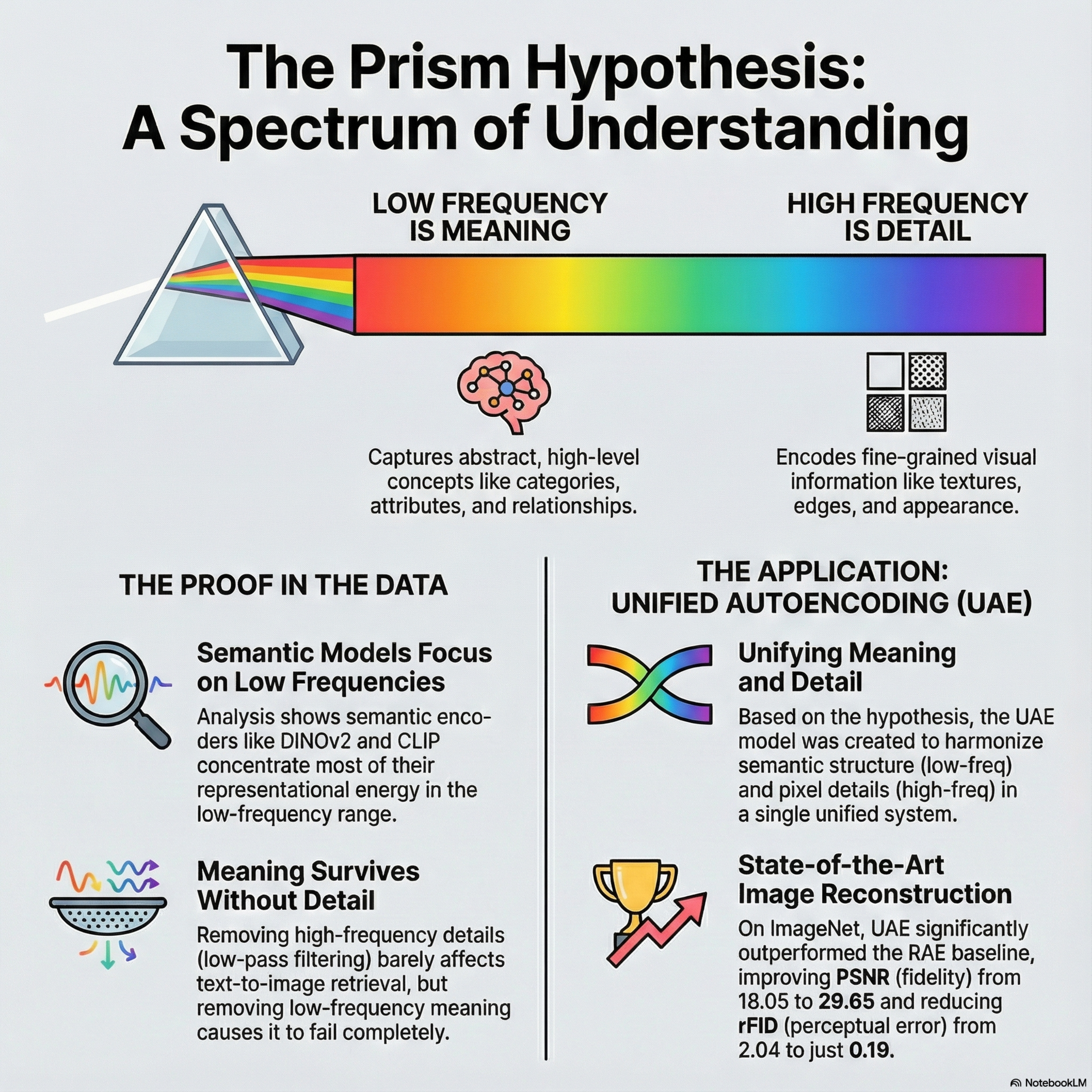
The Prism Hypothesis: Harmonizing Semantic and Pixel Representations via Unified Autoencoding
from Best AI papers explained Hosted by Enoch H. Kang
This paper introduces the Prism Hypothesis, which suggests that multimodal data shares a **common frequency spectrum** where **low-frequency bands** hold abstract meaning and **high-frequency bands** store fine details. To implement this theory, the authors developed **Unified Autoencoding (UAE)**, a framework that integrates **semantic perception** and **pixel-level fidelity** into a single latent space. This model utilizes a **frequency-band modulator** to separate global structures from intricate textures, allowing a single encoder to handle both **image understanding and generation**. By aligning with the spectral characteristics of existing encoders, UAE achieves **state-of-the-art reconstruction** and competitive generative performance. Ultimately, the research offers a method to resolve the traditional tension between **representational abstraction** and visual accuracy.
Embed this episode
No transcript yet.