
EPISODE · Jul 29, 2026 · 29 MIN
The Prophet and the Server Bill
from Language Matters by Elias Winter · host Elias Winter
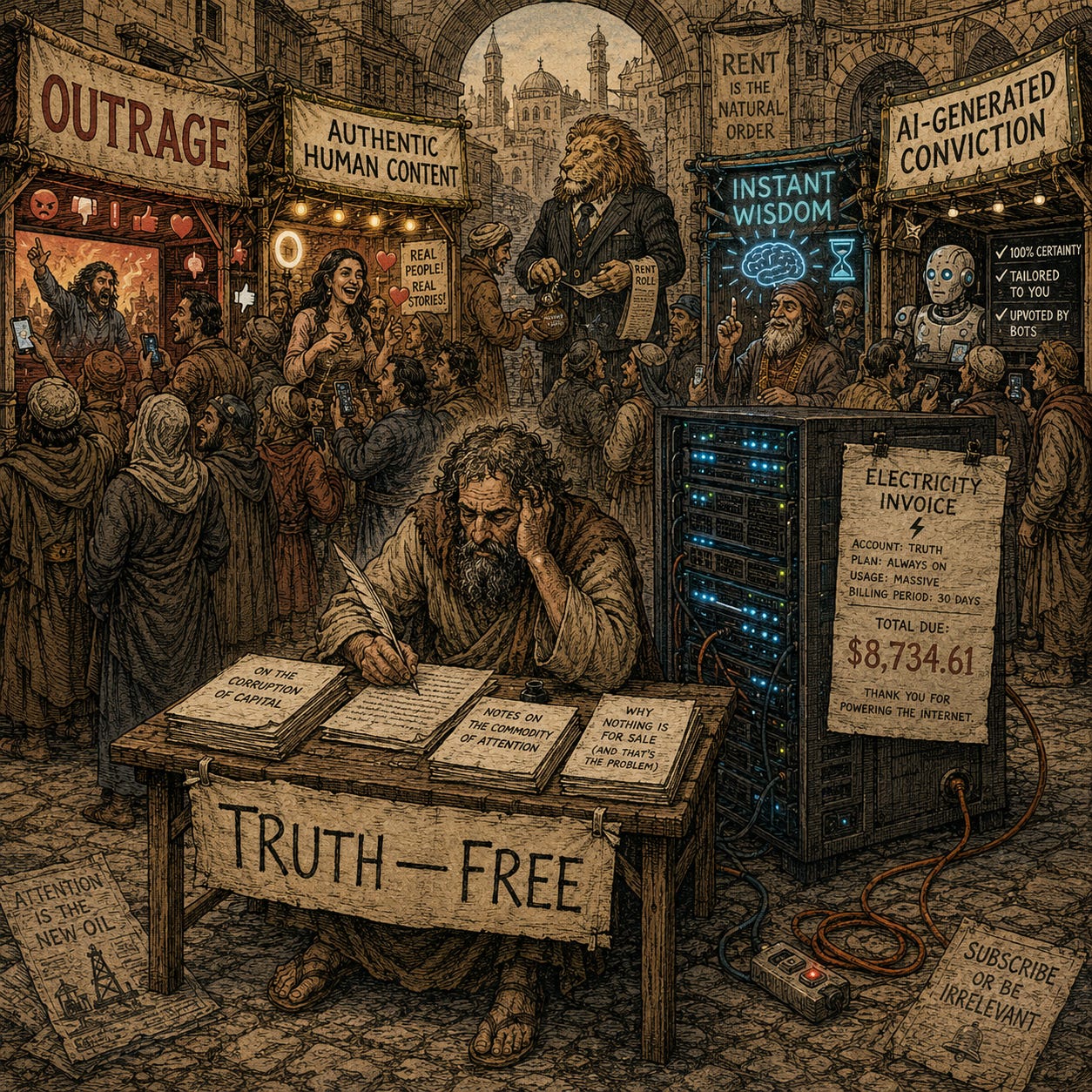
I. Two Things My Father Told Me My father once told me he wanted to leave me with two thoughts. The first was reassuring. “Elias,” he said, “do not underestimate your assets and your skills. You may leave one job and still be employable by a thousand other employers. Never doubt your strengths. You are talented.” This was excellent advice. I received it immediately, preserved it carefully and have replayed it during every professional crisis since. Then he gave me the second thought. “You are not a prophet. You are not that special. Yes, you are talented, but you are one among many talented people. Do not imagine you are a genius who has come to save everything.” I found this part less useful. For years, I treated the two statements as unrelated. The first was my father’s wisdom. The second was an unfortunate lapse in paternal judgment. But recently I have begun to suspect that they were one thought. I do have strengths. I have survived institutions that tried to make me doubt them. I have seen patterns that others missed. I have sometimes recognized a lie before the room was prepared to name it. But seeing a lie does not make me incapable of telling myself one. My particular danger begins with injustice. When I think a situation is fair, I am generous. I defend the weak. I make room for uncertainty. But once I decide that someone powerful is behaving unfairly, my tenderness vanishes. I become prosecutorial. Their moral failure starts to feel like evidence of my intellectual perfection. The powerful may be wrong. They may even be dishonest. But neither fact automatically makes every part of my argument correct. This matters because I have spent much of the past year thinking about artificial intelligence, writing, capitalism and truth. These subjects have begun to merge in my mind into one large animal, possibly a dragon, though I concede that describing one’s intellectual concerns as a dragon is already evidence that my father had a point. Beneath all of them sits a question I cannot escape: Why should anyone serve truth when survival usually pays better? II. The Lion Has No Epistemology A lion does not care about truth. This is not because the lion has embraced postmodernism. It has not read Foucault. It does not believe that every deer constructs its own reality. The lion is hungry. It watches the herd. It identifies the weak animal. It waits for separation. Then it attacks. At no point does the lion ask whether its interpretation of the deer is epistemically sound. It does not publish a methodology. It does not disclose a conflict of interest. It does not consult the deer about whether being eaten aligns with its lived experience. The lion has perception, appetite, strategy and force. That is enough. Evolution does not reward organisms for possessing beautiful theories of reality. It rewards organisms for surviving long enough to reproduce. Accurate perception helps, of course. The lion must correctly identify which moving object is edible and which is another lion. But accuracy is subordinate to survival. Truth is useful only when it serves life. Human beings like to imagine we have escaped this arrangement. We have not. We have merely converted survival into money. Money is stored food, stored shelter, stored medical care, stored mobility, stored deference and stored time. A person with money can survive mistakes that would destroy someone without it. He can purchase distance from danger. He can hire another person to absorb inconvenience. Status and money are therefore closely related. Status determines who is believed, who is protected, who receives opportunities and who gets the larger share when resources become scarce. The jungle did not disappear. It acquired payroll software. Modern professionals are lions who have replaced teeth with calendar invitations. They isolate the vulnerable member of the herd through a performance review, place the kill inside a reorganization and announce that the decision was difficult for everyone. By my private and completely unlicensed estimate, perhaps ninety-nine percent of human beings are primarily occupied with survival. I do not mean that they are wicked. Most people are trying to keep a job, protect a family, maintain social standing, avoid humiliation, accumulate security and preserve a future. My friends do this. My relatives do this. My mother does this. I do this more often than I admit. Very few people will sacrifice money, belonging or safety merely to know what is true. And yet some do. Why? If truth-seeking is so badly rewarded, why has evolution not removed it? III. Why the Village Keeps Producing Prophets The answer may be that human beings do not survive like solitary lions. We survive in groups. A group requires a shared reality. It needs to know where the water is. It needs to remember which path led to disaster. It needs some agreement about who belongs, what happened yesterday, what counts as a promise and why the harvest failed. A village of one hundred people cannot function through one hundred completely private universes. Someone must help construct the common world. This may be why every community produces a minority of people who are unusually drawn toward truth. They are not necessarily kinder, wiser or easier to invite to dinner. They simply experience contradiction as pressure. They cannot leave certain questions alone. The scientist tests the shared reality. The engineer makes it operational. The historian preserves it against convenient forgetting. The poet makes an invisible experience perceptible. The comedian notices the contradiction everyone else has agreed to ignore. The prophet tells the king that God is not impressed by the quarterly results. These people appear throughout my writing because I recognize them as members of the same extended family. Their methods differ, but their function is similar. They repair the common world. Of course, storytellers do not always serve truth. A king needs a historian, but he may prefer one who remembers selectively. A corporation needs analysts, but it may reward the analyst who discovers that the desired conclusion is statistically significant. A nation needs poets, but it may offer grants to those whose metaphors improve recruitment. A shared reality can be discovered, or it can be manufactured. Power has always employed storytellers. Still, truth has one advantage over lies: reality itself provides some of the evidence. A lie must be maintained. Documents must disappear. Contradictions must be explained. Witnesses must be discredited. Language must be continually revised so that yesterday’s falsehood remains compatible with today’s necessity. Truth can be rediscovered by strangers. Two people may approach the same physical problem from different cultures and eventually converge on the same equation. Engineers who do not share a religion can still agree that a bridge has collapsed. Communities can disagree about the meaning of suffering while still recognizing that the body is bleeding. This does not mean human beings possess truth perfectly. It means reality constrains the number of frameworks that can survive prolonged contact with it. So the truth-seeking temperament persists because communities need people who test the stories by which they live. But here is the humiliating part. The community may need truth-seekers. It does not need every truth-seeker. IV. One Percent Is Still a Very Crowded Room Suppose my estimate is correct. Suppose one percent of human beings are unusually driven by truth. One percent sounds lonely until one remembers how many human beings there are. One percent of eight billion is eighty million. That is not a remnant. That is a nation. The lonely prophet eventually discovers that the wilderness has a conference center. Every ballroom is occupied by another lonely prophet giving a keynote called Why No One Else Can See What Is Happening. There are millions of people who believe themselves unusually alert to falsehood. Some are correct. Some are mad. Many are both before lunch. I am not the only person who dislikes corruption, sees through institutional language or feels compelled to write what others avoid. I am one participant in a large, quarrelsome and mostly obscure class of people who believe the common world has become dishonest. This does not mean my work is worthless. It means my work is not guaranteed significance merely because I suffered while producing it. My father’s second thought returns here. You are talented. You are not singular. The statement feels cruel only if talent has been secretly converted into a claim of historical necessity. V. The Newsletter Bazaar Consider Substack. From a distance, it presents itself as a republic of writers and readers. Up close, it resembles a bazaar. Every writer has a stall. The stall has a sign, a photograph, a recurring product, a mailing list and a small patch of public attention. Some sell political outrage. Some sell spiritual calm. Some sell financial certainty. Some sell the experience of watching a highly educated person become alarmed three times a week. Everyone says he has come to the bazaar to defend civilization. Nearly everyone is checking how many people stopped at his stall. Attention is the raw material. Status attracts attention. Attention becomes subscriptions, influence, employment, invitations, leverage or money. The writer may think he is participating in the history of literature. The platform sees an open rate. This does not make the platform evil. It makes it a business. A business must survive. It must pay engineers, rent servers, process payments and persuade investors that the whole enterprise will one day become larger than the current spreadsheet suggests. Its governing purpose cannot be truth in the philosophical sense. Truth may flourish on the platform. Lies may also flourish. The platform’s immediate question is whether either one retains users. The same is true of most writers. They may care about truth, but they also care about recognition. They want to be read. They want to be praised. They want proof that their inner life has entered the public world. Some want money. Some want status. Some want money while describing their desire as community. This is where artificial intelligence enters the bazaar. It does not arrive merely as a new writing tool. It arrives as a threat to the existing distribution of status. VI. When Fluency Became Cheap For a long time, fluent prose was an asset. It required education, practice, confidence, time and access to the right books. A person who could produce a clean paragraph appeared to possess something scarce. Then artificial intelligence made fluency cheap. The machine could produce a competent email, an elegant introduction, a structured argument and a melancholy paragraph about rain before the human user had finished deciding whether he was actually sad. This did not merely threaten writers’ labor. It threatened their rank. If everyone can produce polished prose, polish no longer proves what it once proved. A visible marker of distinction has been devalued. The response has been fascinating. Some people use AI to climb the status hierarchy. They produce more, publish faster, sound more informed and acquire a synthetic command of subjects they discovered that morning. Others establish new signals of authenticity. They abandon capital letters. They preserve spelling mistakes. They write in fragments. They announce that a post was “typed quickly on my phone” as though haste were now a sacrament. They photograph notebooks. They leave the literary equivalent of fingerprints at the scene. This does not mean every informal writer is performing anti-AI authenticity. Sometimes a young woman writes without capital letters because she likes how it looks. But once polish becomes cheap, roughness can become a luxury signal. Imperfection says: a human suffered here. The argument about AI is therefore rarely only about truth. It is also about power. One camp sees AI as an instrument of corporations, billionaires, governments, intelligence services and content farms. They see labor being replaced, public opinion being manufactured and synthetic crowds being summoned to create the appearance of consensus. They are not imagining this danger. The powerful will use AI to lower costs, monitor populations, automate persuasion and produce oceans of language whose purpose is not communication but environmental saturation. The other camp responds that ordinary people must possess these tools too. If corporations can use AI to analyze markets, individuals must be able to analyze corporations. If governments can automate propaganda, citizens must be able to investigate it. If wealthy institutions can multiply their productive capacity, refusing ordinary people access does not protect democracy. It protects hierarchy. One side fears democratizing the weapon. The other fears monopolizing it. Both are arguments about who gets to wield power. Meanwhile, the small writers at the bazaar are often attacking the stall next door. The owner of a neighborhood steakhouse does not spend the evening worrying about the private-equity firm purchasing the whole block. He watches the steakhouse across the street and becomes convinced that its breadbasket is the principal threat to civilization. So the writer with twelve hundred subscribers denounces the writer with thirteen hundred subscribers for using Claude. The writer using Claude denounces the purist for manufacturing authenticity. The purist denounces the platform. The platform publishes a trust-and-safety document. The billionaire acquires another data center. Much of the debate over AI writing is a status conflict conducted in the vocabulary of truth. The AI user may be seeking status through amplified production. The AI opponent may be seeking status through certified purity. Both may be sincere. Sincerity does not abolish incentives. Sometimes the loudest declaration of principle is simply a market stall improving its sign. VII. The Prophet’s Free Hosting Plan At this point, I would normally complete the indictment. I would explain that platforms commodify attention, that capitalism corrupts language and that writers who chase status eventually become content managers wearing the skin of authors. Then my father’s second thought enters the room and asks who is paying for my website. I publish on Substack. Substack stores my essays. It sends the emails. It hosts the audio. It maintains the publishing tools. It connects the work to podcast platforms. Its engineers repair failures I never see. Its servers remember my sentences after I have gone to sleep. I do not pay Substack. I also do not bring Substack a great deal of money. I am not one of the large market stalls. I am the man near the edge of the bazaar giving away theological pamphlets and occasionally insulting the landlord. In strict economic terms, I am being subsidized. Commercial writers bring paying readers. Successful newsletters generate fees. Investors provide capital. Engineers build infrastructure. The market I condemn pays for the machine through which I condemn it. Capitalism pays the server bill for the man writing that capitalism has destroyed language. This is inconvenient. It does not mean my criticism is false. A person may criticize a road while walking on it. Dependence does not require worship. But dependence does require acknowledgment. I cannot present myself as morally untouched by the marketplace. My freedom from money is partly financed by people who are not free from money. Perhaps I am a parasite. Perhaps I am a guest. Perhaps I am a public good with very low engagement. Perhaps every successful platform can afford a certain number of unprofitable eccentrics because they improve the atmosphere, like ornamental plants in the lobby. Whatever the word, I use the infrastructure. If I truly believed that attention markets made truth impossible, consistency might require leaving them. I could write privately, gather a few people in a room and contribute to a shared reality small enough to recognize me. But I do not leave. I remain because I want the work to travel. I want readers. I want the truth to be heard. And somewhere inside that desire, status is waiting patiently for me to finish pretending it has nothing to do with the matter. VIII. Most Truth Is Born for Oblivion A community needs shared stories. It does not need very many. A nation may be organized around a handful of myths. A scientific field may remember a few names. A religious tradition may preserve several prophets and forget ten thousand people who also saw visions in the desert. The truth-seeking temperament may be socially necessary while most people who possess it remain socially unnecessary. Most poets will not alter the language. Most scientists will not discover a new law. Most historians will not rescue a civilization from amnesia. Most prophets will speak to rooms that remain unconvinced. They will die with their notebooks, unfinished theories, unpublished manuscripts and correct observations. Some will be forgotten because their work was weak. Some will be forgotten because their work was difficult. Some will be forgotten because a more powerful person said the same thing later. Some will be forgotten because history has limited storage and terrible taste. Civilization retains very little. History is not an archive. It is a shredder with occasional sentimental exceptions. This is the fate I have resisted. I have sometimes interpreted obscurity as evidence that the surrounding culture was too corrupt to recognize what I had made. Sometimes that may even be true. But obscurity is not proof of persecution. It is the normal condition of human expression. A work can be serious and disappear. A person can be right and remain unknown. A truth can arrive, touch three people and leave no institutional trace. The community may benefit from the existence of truth-seekers while discarding almost all of their names. That is not fair. Evolution has never promised fairness. The temperament survives. The individual is spent. Perhaps this is what the truth-seeker must finally accept: not death, which everyone accepts abstractly, but obliteration. No school. No legacy. No quotation in a future book. No evidence that the long nights of thought entered history. The work may vanish. The servers may shut down. The links may break. The common world may move on without issuing a final verdict. IX. My Father’s Second Thought My father told me not to underestimate myself. He also told me I was not a prophet. I now understand that these were not opposing instructions. The first protects me from institutions that would reduce me to their latest decision. A job can reject me without defining my abilities. A manager can misunderstand me without becoming the final judge of my worth. A marketplace can ignore my work without proving that nothing was said. The second protects me from turning every rejection into evidence that I am a persecuted genius. I may be talented. I may see something true. I may also exaggerate, misjudge, simplify, become cruel or mistake the intensity of my conviction for the completeness of my argument. The discipline is to hold both facts at once. Do not let the world convince you that you are nothing. Do not convince yourself that you are everything. And write without assuming that history owes you preservation. If I need recognition, legacy and eventual vindication before I can serve truth, then truth has become another strategy for acquiring status. I have simply built a more dignified market stall. Perhaps the final test of truth-seeking is whether the work remains worth doing after the fantasy of winning has been removed. No great audience. No conversion into money. No guarantee that the village adopts the story. No assurance that future generations remember the name. Only the work, the world it tries to describe and the few people who may encounter it before both writer and reader disappear. My father told me not to underestimate myself. He also told me I was not a prophet. I suspect he was telling me to write the truth, pay my debts and not expect the servers to remember my name. —Elias WinterAuthor of Language Matters, a space for reflection on language, power, and decline. This is a public episode. If you would like to discuss this with other subscribers or get access to bonus episodes, visit eliaswinter.substack.com
Embed this episode
Ready to play
The Prophet and the Server Bill
No transcript for this episode yet
Similar Episodes
No similar episodes found.
Similar Podcasts
No similar podcasts found.