
EPISODE · Jun 9, 2026 · 18 MIN
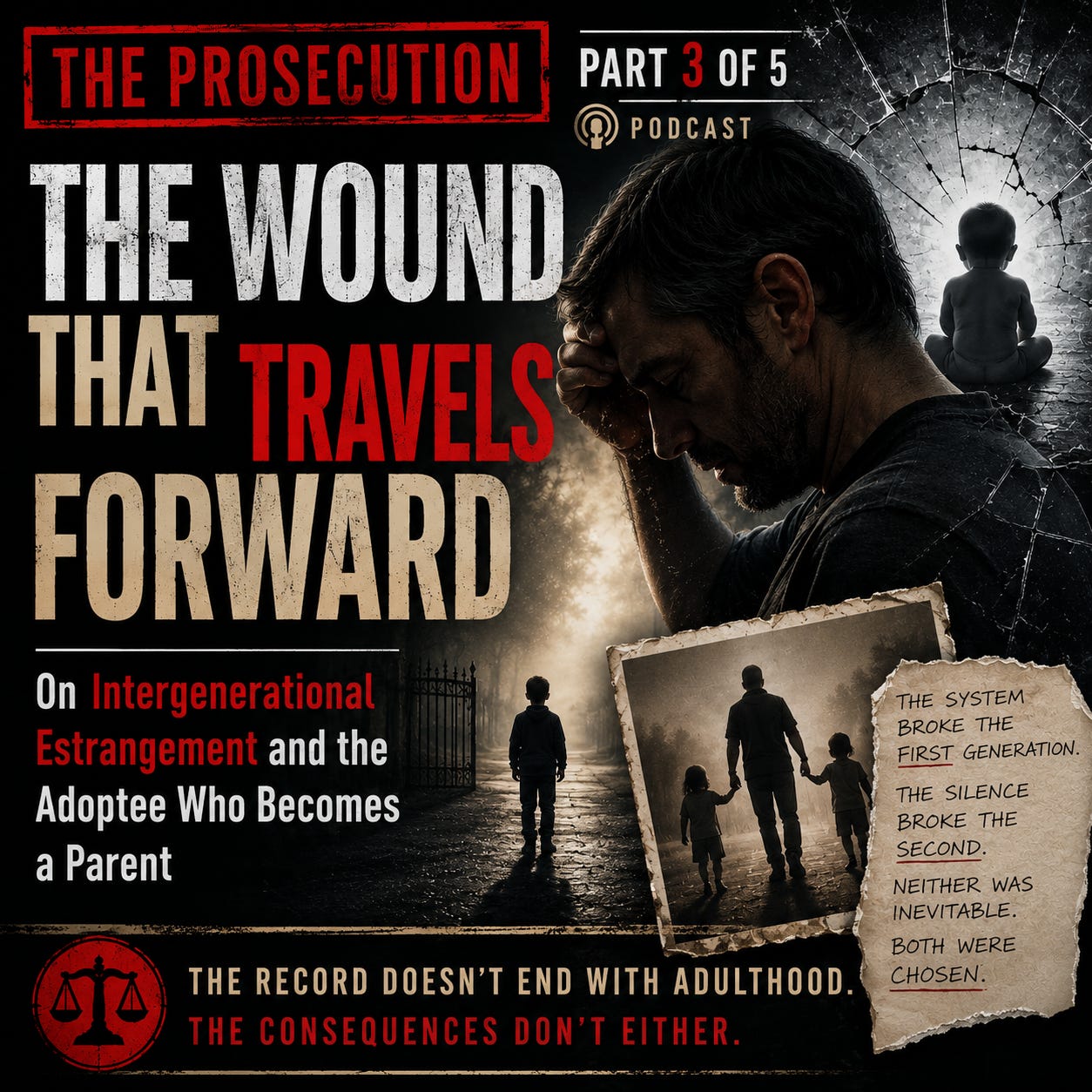
THE PROSECUTION - Part 3 -The Wound That Travels Forward
from The Experience of Adoption · host Thoughtless Delineation
There is a conversation no one wants to have about adoption.Not the one about sealed records, institutional silence, or the biology of infant separation. Difficult as those conversations are, they at least possess a beginning and an end. The harm happened. It happened to a person. That person is here, naming it.The conversation I am talking about is harder.It concerns what happens when that person becomes a parent.It concerns the wound that does not remain contained within the generation that received it.It concerns the children of adoptees—and what the system that broke the first generation quietly built into the second.I am estranged from my own children.I am not writing that as a confession.I am writing it as evidence.Because the system that created the conditions for that estrangement has no record of it, no category for it, no mechanism for tracing the chain of causation that produced it. It is simply classified as another family breakdown. Another private failure. Another silence.It is none of those things.The Mechanism Is Not a MysteryThe research on intergenerational trauma transmission is not ambiguous.Unresolved parental trauma is the initiating factor.What travels across generations is not a gene, a character flaw, or a predetermined destiny. What travels is a pattern—a way of responding to stress, threat, intimacy, and loss. It is learned within the parent-child relationship and absorbed long before the child possesses language to describe what is being absorbed.This is how the adoptee parent’s wound enters the next generation.Not through deliberate repetition.Through the body’s uninterrupted memory.The primary vehicle is attachment.Parents who experienced childhood trauma and developed anxious, avoidant, or unresolved attachment styles often pass those patterns to their children. These attachment strategies shape emotional regulation, relational expectations, and identity development well into adulthood.The mechanism is selective attunement.The traumatised parent does not encounter the child solely as the child exists. The child is filtered through the parent’s unresolved history. The child becomes an echo, a trigger, a demand the parent cannot always meet—not because love is absent, but because the parent’s nervous system remains engaged in a war that began long before the child arrived.The capacity that interrupts this transmission is known as reflective functioning: the ability of a parent to hold the child’s mind in mind. To see beyond their own pain and recognise the separate person standing before them.Early childhood trauma impairs this capacity.Not uniformly.Not irreversibly.But significantly.Measurably.Especially when the trauma has never been acknowledged, understood, treated, or interrupted.The adoptee parent—whose infant separation was never recognised as trauma by the system that caused it, whose adoptive family failure was never accounted for, and who was never given the framework necessary to understand their own experience—enters parenthood with this capacity already compromised.Research on parental attachment confirms what the body already knows:A parent’s unresolved attachment state is one of the strongest predictors of their child’s attachment outcome.More influential than temperament.More influential than circumstance.The parent’s internal working model—the blueprint established in their earliest experience of being held and known, or not—becomes the template through which the next generation learns what relationships mean.For the adoptee, that blueprint was drafted in the language of loss.What Silence TransmitsThe system taught me silence long before I had children.It was the operating condition of the adoptive family.Certain subjects were forbidden.The biological family.Origins.Questions about what happened.Questions about why.The truth existed within the household the way an injury exists within a body that has learned not to limp: present everywhere, acknowledged nowhere.What I understand now—and could not understand then—is where that silence originated.It was not merely institutional.It was personal.The adoptive mother who raised me had lost a child to the same system that eventually produced me.Her grief for that child remained unacknowledged, unprocessed, and unresolved.Turned inward, then outward.Expressed through possession.Expressed through control.This is what weaponised inverted maternal grief looks like from the inside:A love that is real but not clean.A relationship in which the adoptee must remain incomplete because the adoptee’s completeness threatens the fragile arrangement through which the mother’s own loss is being managed.The silence she maintained around her wound became the silence I maintained around mine.The habit of not naming what was real.The performance of belonging instead of belonging itself.The requirement to manage another person’s grief as a condition of receiving love.All of this was learned before language.Learned in the body.And the body does not forget.Research consistently identifies silence and communication patterns as primary vehicles through which unresolved trauma travels across generations.Not overt violence.Not always obvious neglect.Silence.The absence of language for what is real.The implicit lesson that certain truths are dangerous.I did not choose to transmit this.I did not know I was transmitting it.That is precisely the point.The system that enforced silence in the adoptive family produced a parent with no framework for breaking it.A parent who had lived inside silence so long it felt like reality itself.A parent who loved their children fiercely, but whose understanding of love had been shaped by performance, accommodation, and the belief that wounds remain unnamed if peace is to be preserved.This is what uninterrupted trauma looks like in the second generation.It rarely announces itself.It does not wear the face of the original injury.Instead, it arrives as distance.As hesitation.As a subtle inability to reach all the way across.As the recurring fear that intimacy will inevitably become loss.Because that is what the body learned before memory and before language—in the first days of life.The System Has No Record of ThisThere is no meaningful research mandate tracking the children of adoptees.Institutional accountability ends when the adoptee reaches adulthood.After that, whatever follows is classified as personal.Private.Individual responsibility.This is not neutrality.It is the final act of institutional evasion.The chain of causation is traceable.Infant severance produces neurobiological disruption.That disruption is placed inside an adoptive family carrying its own unresolved trauma—often produced by the same institutional forces.No screening.No support.No intervention.Weaponised inverted maternal grief shapes the household into a place where silence becomes the price of belonging.The placement fails.The adoptee carries unresolved attachment into adulthood and eventually into parenthood.Reflective functioning is impaired.Attachment insecurity transmits.The second generation is shaped by a wound it never witnessed and cannot name.At every point in this chain, intervention was possible.At every point, intervention was neglected.The system did not screen adoptive parents for unresolved trauma.It did not address the grief of parents harmed by its own machinery.It did not provide meaningful post-placement support.It did not treat the adoptee’s original wound.It did not track adult outcomes.It did not follow consequences into the next generation.And so the adoptee parent, estranged from their own children, is left carrying a grief that has no institutional category.A grief layered upon every previous estrangement.From biological family.From adoptive family.And now from their own children.The nervous system does not distinguish between these losses.It recognises only the pattern:Attachment formed.Attachment lost.No repair available.There is little public language for this form of grief.To speak openly about estrangement from one’s own children risks confirming every accusation the adoption system has ever implied:That the adoptee was damaged.That the adoptee was difficult.That the adoptee was incapable of sustaining family.Silence closes around this grief just as it closed around every grief before it.And the system that built that silence remains largely invisible.Unremarked upon.Unaccountable.Its fingerprints hidden within the distance between generations.What the Fourth Wound RequiresI am not writing this to seek sympathy.I am writing it to create a record.The first wound was the severance.The system caused it and called it welfare.The second wound was the adoptive family failure.The system created the conditions—including the weaponised inverted maternal grief that shaped the household—and kept no record.The third wound was estrangement from the adoptive family.The system had no category for it and called it the adoptee’s dysfunction.The fourth wound is this:Estrangement from my own children.An outcome produced by an uninterrupted pattern that began before I drew my first breath.The system has no record of it.It will not account for it.It will not even name it as a consequence of what it set in motion.I am naming it here.Not because naming it repairs the estrangement.Words have limits.No serious person mistakes language for restoration.But the record matters.The chain of causation matters.And the person who lived inside that chain has the right to assemble it in full view of the public.The wound travels forward when it remains unnamed.When it is named—precisely, forensically, without the performance of resolution—it becomes something the next generation may one day recognise.Not as their inheritance.As the system’s debt.The system broke the first generation.The silence broke the second.Neither outcome was inevitable.Both emerged from choices made by institutions that possessed alternatives and chose not to use them.That is the prosecution.And it does not end with me. This is a public episode. If you'd like to discuss this with other subscribers or get access to bonus episodes, visit thoughtlessdel.substack.com/subscribe
Embed this episode
NOW PLAYING
THE PROSECUTION - Part 3 -The Wound That Travels Forward
No transcript for this episode yet
Similar Episodes
No similar episodes found.
Similar Podcasts
No similar podcasts found.