
EPISODE · Jun 9, 2026 · 17 MIN
THE PROSECUTION - Part 4 -The Statistic the System Produced
from The Experience of Adoption · host Thoughtless Delineation
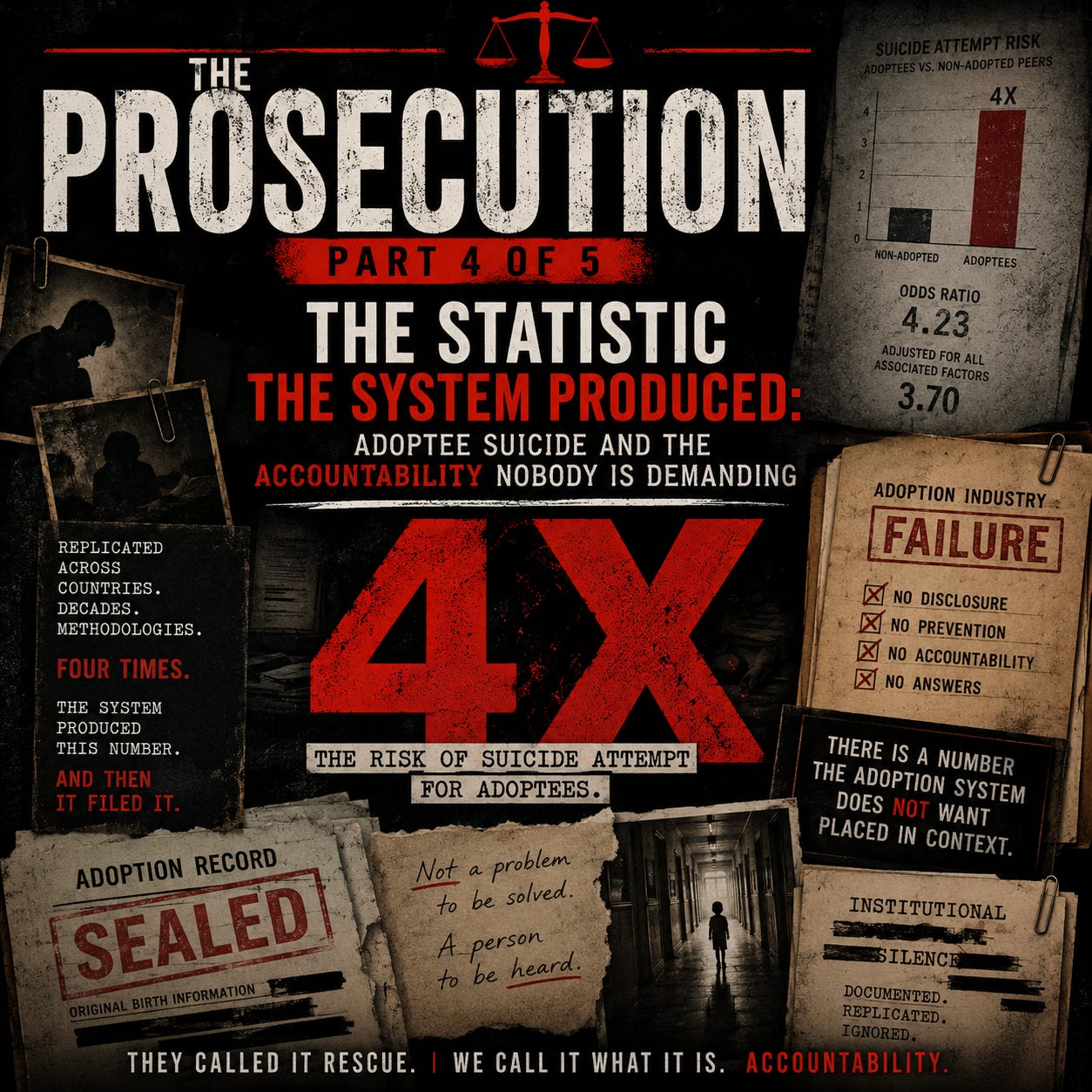
There is a number the adoption system does not want placed in context.Adoptees are approximately four times more likely to attempt suicide than non-adopted peers. This finding has been replicated across multiple countries, multiple methodologies, and multiple decades. The University of Minnesota study published in Pediatrics in 2013 found odds ratios of 4.23 — and after adjusting for every associated factor the researchers could identify, the elevated risk remained at 3.70. Swedish cohort studies found intercountry adoptees were 3.6 times more likely to both attempt and die by suicide. The number holds across jurisdictions, across adoption types, across placement ages.Four times.The system produced this number. And then it filed it.WHAT THE NUMBER ACTUALLY MEANSThe adoption industry’s response to the suicide data follows a predictable pattern. It acknowledges the statistic. It surrounds it with qualifications — the majority of adoptees are psychologically healthy, the elevated risk does not characterise all adoptees, more research is needed. It frames the finding as a call for better adoptive family support and improved mental health services. It does not ask the foundational question.Why?Not why are some adoptees resilient and others not. Not why does the risk vary across subgroups. The foundational question: why does adoption status — the act of severing an infant from its biological family and placing it with strangers — produce a fourfold increase in suicide risk that persists after controlling for every measurable associated factor?The answer is in the biology this series has documented from the beginning. The HPA axis dysregulation. The epigenetic methylation across hundreds of thousands of genomic sites. The synaptic pruning disruption in the regions governing fear, reward, and social processing. The neurobiological damage laid down in the first weeks of life produces, across decades, a particular relationship with unbearability. A nervous system calibrated under conditions of unresolvable loss. A threat-detection system that never fully resets. A body that has been taught, at the cellular level, that the world is not safe and that connection ends.That is the substrate on which every subsequent wound lands. The adoptive family failure. The weaponised inverted maternal grief. The ultimatum. The estrangement. The compounded losses the system creates, refuses to track, and declines to name. Each one lands on a nervous system already shaped for maximal impact. Each one confirms what the body learned before memory: that attachment ends without repair.The fourfold suicide risk is not a mystery. It is a measurement. It is the system’s damage, quantified.THE SILENCE AROUND THE NUMBERAdoptee suicide is not a public health priority. There is no national prevention strategy in Australia, the United States, or any other major adoption jurisdiction that specifically addresses adoptee suicide risk. There is no dedicated funding stream. There is no requirement that adoption agencies disclose the elevated risk to prospective adoptive parents. There is no requirement that mental health professionals who work with adoptees receive training on adoption-specific suicide risk factors.The adoptee community has been documenting its own dead for years — through advocacy organisations, through social media, through the painful work of bearing witness when no institution will. Researchers and advocates have called repeatedly for dedicated prevention research, for population-level screening, for the adoption industry to be held accountable for the outcomes it produces. The calls go largely unanswered.This is not because the data is unclear. The data has been clear for decades. Swedish research documented the elevated risk as far back as 2002. The Minnesota study in 2013 confirmed it in a US population. The pattern is consistent and replicated.The system knows. It has always known. It does not act — because acting would require it to connect the outcome to the cause. To trace the fourfold suicide risk back to the infant severance that produced the neurobiological damage that produced the lifetime of compounded loss that produces the unbearability. To acknowledge that the practice it defends, funds, and legislates is generating, at a measurable and replicated rate, the deaths of the people it claimed to rescue.That is the accountability the system will not face.WHAT THE GRATITUDE NARRATIVE DOES TO A SUICIDAL ADOPTEEThe adoption system’s foundational demand — be grateful, be adjusted, be the proof that this was right — does not disappear when an adoptee is struggling. It intensifies.An adoptee in crisis carries the fourfold biological risk. They also carry the cultural prohibition on naming it. Adoptees are expected to be happy. The gratitude narrative — rescue, gift, chosen, forever family — has no chapter for the adoptee who is not grateful to be alive. Who looks at the architecture of their life and finds a structure built on someone else’s decision, someone else’s grief, someone else’s need. Who cannot perform the resolution the system demands.The silence around adoptee pain does not merely fail to help. It actively compounds the risk. An adoptee who cannot speak their distress without being told they are ungrateful, without being reminded of what they were given, without having their pain reframed as a failure of perspective — that adoptee is more isolated than their non-adopted peer who is also struggling. The cultural prohibition is a clinical risk factor. The system built it.Research confirms what adoptees have long known from inside: adoptees are significantly more likely to have received psychological counselling — but the elevated suicide risk persists even accounting for this. Seeking help is not enough when the help available operates within a framework that does not understand what adoption actually does to a person. When the clinician has not been trained in adoption-specific trauma. When the therapy is designed for a wound the system does not officially acknowledge.THE PROSECUTIONThe adoption system produced a fourfold increase in suicide risk. The mechanism is documented. The neurobiology is documented. The compounded losses are documented. The cultural silence that isolates adoptees in crisis is documented.The system has not implemented dedicated prevention measures. It has not mandated disclosure of the risk to adoptive families. It has not funded population-level research into adoptee suicide. It has not required adoption-competent training for mental health professionals. It has not connected the outcome to the cause in any public accountability framework.Adopted individuals who die by suicide have higher adversity scores in early life than non-adopted individuals who die by suicide. The adversity begins at placement. The system arranged the placement. The system is accountable for the adversity. The system is accountable for what that adversity produces.This is not a mental health crisis that arrived from nowhere. It is a public health outcome produced by a specific institutional practice, sustained by specific policy decisions, protected by specific cultural narratives, and documented in peer-reviewed literature that the institutions responsible have access to and decline to act on.Four times.That is the number the system produced. That is the number it will not answer for.The adoptee community has been fighting for our lives in silence for decades. Naming the dead. Documenting the pattern. Demanding the accountability that institutions have withheld.We are not invisible. We are not a rounding error. We are the measurable, replicated, peer-reviewed consequence of decisions made by people who called themselves rescuers.The silence ends here. The accounting begins.About the AuthorShane Bouel is a Queensland forced adoption survivor and independent researcher based in Bali. He publishes forensic analysis on adoption, identity erasure, and institutional silence through Thoughtless Delineation on Substack.This Substack is reader-supported. To receive new posts and support my work, consider becoming a free or paid subscriber.Crisis SupportIf you are an adoptee in distress, support is available.Australia: Lifeline — 13 11 14United States: 988 Suicide & Crisis LifelineThese services are available 24 hours a day. This is a public episode. If you'd like to discuss this with other subscribers or get access to bonus episodes, visit thoughtlessdel.substack.com/subscribe
Embed this episode
NOW PLAYING
THE PROSECUTION - Part 4 -The Statistic the System Produced
No transcript for this episode yet
Similar Episodes
No similar episodes found.
Similar Podcasts
No similar podcasts found.