
EPISODE · Jun 10, 2026 · 34 MIN
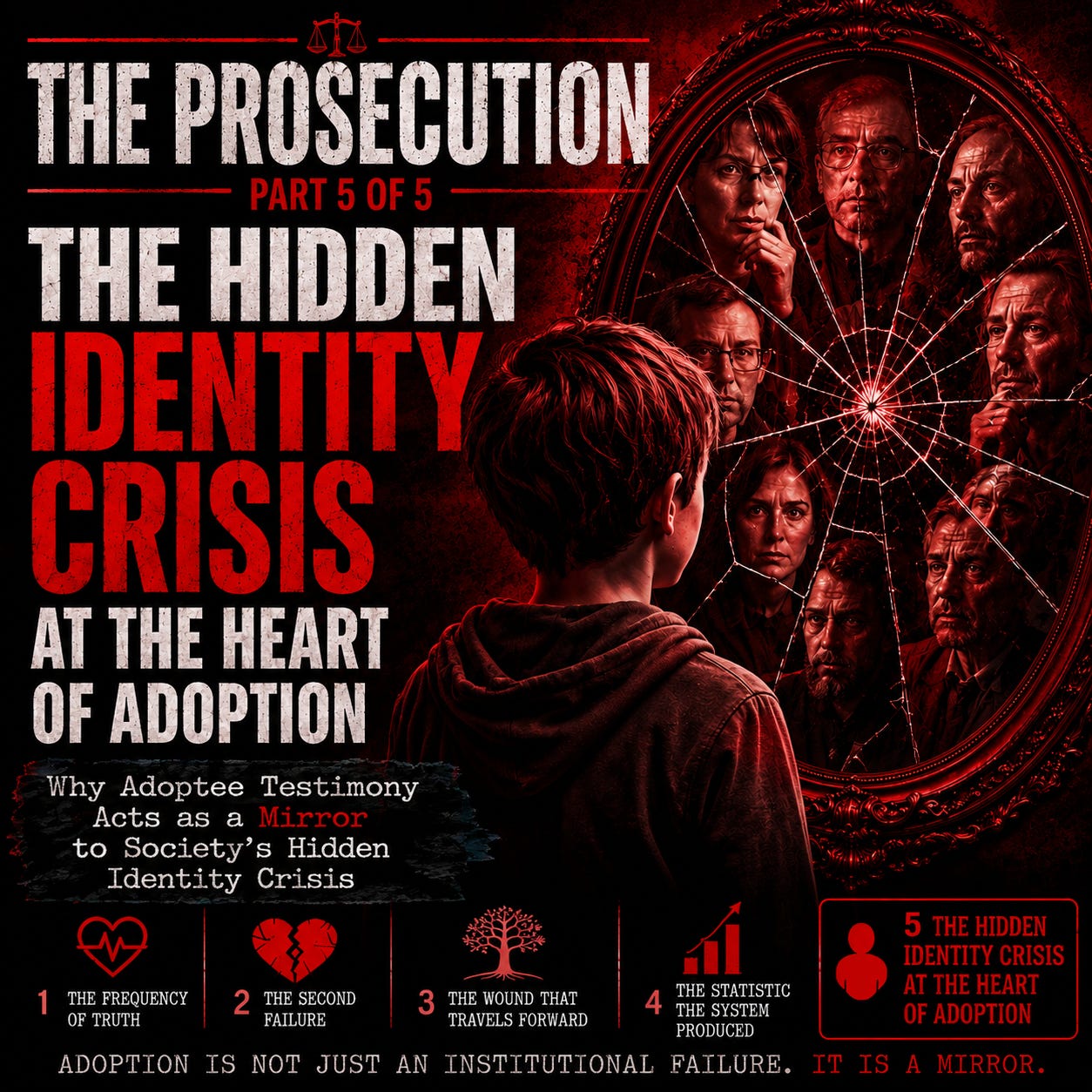
THE PROSECUTION - Part 5 - The Hidden Identity Crisis at the Heart of Adoption
from The Experience of Adoption · host Thoughtless Delineation
The greatest irony of adoption may be that the adoptee is often accused of having an identity crisis while everyone around them is quietly having one too.For most of my life, I believed the struggle was mine alone.I was the one searching.I was the one asking uncomfortable questions.I was the one trying to understand why grief seemed to exist beneath every achievement, every relationship, every attempt to belong.Like many adoptees, I assumed the problem was my inability to reconcile the contradictions of my own existence.I had been told I was loved.I had also been abandoned.I had been told I belonged.Yet I felt disconnected from the very foundations of identity that most people take for granted.I had been given a new family while simultaneously losing the first one.The contradiction was impossible to ignore.What I did not understand then was that adoption creates a second crisis that is rarely discussed.Not in the adoptee.In everyone else.The moment an adoptee begins speaking honestly about loss, something remarkable happens.The conversation changes.The adoptee says:“I am grieving.”The response becomes:“But look at everything you gained.”The adoptee says:“I struggle with identity.”The response becomes:“But your adoptive family loves you.”The adoptee says:“I feel the consequences of separation every day.”The response becomes:“Your adoption was a blessing.”Notice what has happened.The discussion is no longer about the adoptee’s experience.It has become a defense of the listener’s beliefs.This pattern appears so consistently that it raises an uncomfortable question:Why are people so resistant to simply hearing what adoptees have to say?The answer may have very little to do with adoption itself.Human beings build their lives around stories.Stories about family.Stories about morality.Stories about love.Stories about what constitutes a good and just society.These stories are not merely opinions. They become part of our identity.We do not just believe them.We become them.Adoption occupies a particularly protected place within the modern imagination.It is associated with rescue, compassion, generosity, sacrifice, and love.To question adoption is therefore not perceived as questioning a social practice.It is perceived as questioning a moral truth.That is where the tension begins.When adoptees describe lifelong grief, fractured identity, genealogical disconnection, or the consequences of family separation, they are not merely offering personal testimony.They are introducing information that threatens a culturally protected narrative.And when a narrative is threatened, most people do not begin by asking whether it is true.They begin by asking something else.What happens to my understanding of the world if this is true?What happens to my understanding of myself?This is the hidden identity crisis that sits beneath so many conversations about adoption.If the adoptee’s experience is valid, then the listener may have to reconsider assumptions they have carried for decades.Perhaps adoption is more complicated than they believed.Perhaps family separation carries consequences they never imagined.Perhaps some wounds cannot be compensated for simply because good intentions existed.These are not small revisions.They are challenges to identity itself.As a result, many people instinctively defend the narrative before they investigate the testimony.The story becomes more important than the person telling it.For adoptees, this creates what may be the most painful aspect of all.The original wound is separation.The secondary wound is denial.Not outright denial.Something subtler.A continuous pressure to reinterpret loss as gain.To translate grief into gratitude.To transform a wound into a redemption story.The adoptee becomes responsible not only for carrying the consequences of adoption but also for protecting everyone else’s comfort about adoption.That burden is immense.And profoundly lonely.Over time I have come to believe that the deepest divide in adoption discourse is not between adoptees and non-adoptees.It is between those willing to follow truth wherever it leads and those who require truth to remain compatible with an existing story.This pattern extends far beyond adoption.History is full of people whose lived experiences challenged accepted narratives.Again and again, societies responded in the same way.The testimony was not evaluated according to its accuracy.It was evaluated according to the threat it posed.Adoptees encounter this dynamic with unusual clarity because adoption touches something fundamental: family, belonging, identity, and love.These are not merely social concepts.They are sacred ones.Yet sacred stories are often the stories most in need of examination.The adoptee’s search for identity is therefore about more than finding oneself.It is also an invitation to society.A challenge.A question.Can we tolerate truths that disrupt the stories we cherish?Can we listen without defending?Can we acknowledge loss without demanding gratitude?Can we place reality above comfort?For many people, the answer remains uncertain.For adoptees, however, there is rarely a choice.The search for truth is not an intellectual exercise.It is survival.Because when your life begins with a rupture, the pursuit of truth becomes inseparable from the pursuit of self.And perhaps that is the final irony.The people most often accused of having an identity crisis may be the very people most willing to confront reality without illusion.The final conclusion is not that adoptees have an identity crisis.It is that adoption exposes an identity crisis that already exists within society itself.The adoptee spends a lifetime searching for answers because their continuity was broken. They are forced to confront questions of belonging, identity, loss, and truth that most people never have to ask. What appears to be a personal struggle is often an extraordinary act of inquiry—a relentless attempt to reconcile reality with the story they were given.Yet when adoptees speak honestly about what they find, they frequently encounter resistance. Not because their experiences are unclear, but because their experiences challenge beliefs that others have woven into their own identities. The adoptee’s testimony becomes a mirror, reflecting contradictions that many would rather not examine.This is the great irony of adoption.The person whose identity was disrupted is often the one doing the hardest work of self-examination.The people defending adoption are often defending far more than adoption itself. They are defending a worldview. A moral framework. A story that allows them to feel secure in their understanding of family, love, and human goodness.What emerges is a profound asymmetry.The adoptee is asked to live with uncertainty.Society demands certainty.The adoptee is asked to carry complexity.Society demands simplicity.The adoptee is asked to confront loss.Society insists on redemption.Ultimately, the conflict is not between gratitude and grief, nor between positive and negative adoption experiences. It is between two fundamentally different relationships to truth.One seeks comfort.The other seeks understanding.And while comfort may preserve identity, only truth allows identity to evolve.The adoptee’s search, then, is not merely a search for self. It is a confrontation with the stories that shape human consciousness itself. In refusing to abandon reality for reassurance, the adoptee reveals something universal: that the greatest threat to identity is not loss, but the refusal to face what loss means.Perhaps that is why adoptee voices matter so profoundly.They do not simply challenge adoption.They challenge humanity’s tendency to choose a comforting story over an uncomfortable truth.And in doing so, they force a question that extends far beyond adoption:Are we willing to know ourselves, even when the truth changes who we are?What This Says About SocietyIf adoptees are repeatedly forced to fight for recognition of their own reality, the question eventually shifts from adoption to society itself.What kind of society requires the wounded to comfort those who are uncomfortable with the wound?What kind of society asks people who have experienced loss to prove that the loss existed?What kind of society responds to testimony with narrative management rather than curiosity?The answer is unsettling.It suggests that modern society is often less committed to truth than it is to psychological stability.We like to believe that facts shape our beliefs. More often, our beliefs determine which facts we are willing to accept.The stories that survive are not necessarily the most accurate. They are the stories that best preserve social order, moral certainty, and collective identity.This is why institutions are so rarely judged by the experiences of those most harmed by them. To do so would require society to risk discovering that some of its most cherished assumptions are incomplete, distorted, or false.Instead, we develop a remarkable capacity for moral self-protection.We celebrate outcomes while avoiding costs.We honour narratives while overlooking casualties.We defend intentions while ignoring consequences.In this sense, adoption is not an exception. It is a case study.It reveals a broader truth about human societies: people are often willing to tolerate suffering more readily than they are willing to tolerate a challenge to the beliefs that organize their world.The adoptee who speaks honestly about loss therefore becomes more than a witness to adoption. They become a witness to the mechanisms by which societies preserve themselves.The resistance they encounter is not merely disagreement. It is a demonstration of how collective identities defend their boundaries.This realization leads to an uncomfortable conclusion.The greatest obstacle to justice is rarely ignorance.It is attachment.Attachment to stories.Attachment to identities.Attachment to moral self-images.Attachment to narratives that allow us to feel innocent.A society that cannot tolerate the testimony of those most affected by its institutions is not demonstrating strength. It is demonstrating fragility.True confidence does not fear scrutiny.True morality does not fear evidence.True compassion does not require silence from those who suffer.The health of a society is measured not by how loudly it celebrates its virtues, but by how honestly it confronts the people who reveal its contradictions.When adoptees speak, the real test is not whether their testimony aligns with the dominant narrative.The real test is whether society values truth more than the comfort of its own reflection.The answer to that question reveals far more about society than it does about adoption.Adoption, Truth, and Responsibility: Quotes“Your discomfort with my reality is not my responsibility.”“I did not create the wound. I will not carry the burden of defending it.”“If the truth threatens your worldview, examine the worldview—not the truth.”“My testimony is not an attack. Your need to silence it is.”“The fact that my experience makes you uncomfortable does not make my experience untrue.”“I am not responsible for preserving the story that harmed me.”“The wound belongs to me. The denial belongs to you.”“Do not confuse your discomfort with my dishonesty.”“You call it negativity because acknowledging it would require accountability.”“I am not obligated to make my loss inspirational for your convenience.”“The demand for gratitude is often the final stage of erasure.”“What happened to me is not made less true because it challenges what you believe.”“The truth does not become cruelty simply because it disrupts a comforting story.”“If hearing my experience feels like an accusation, perhaps the problem is not my experience.”“Reality is not responsible for protecting ideology.”“The most protected stories are often the ones most in need of examination.”“A society that fears testimony is a society afraid of what it might learn about itself.”“The first loss was separation. The second was being told the separation was a gift.”“The deepest loneliness is not being alone. It is being disbelieved.”“People will defend a narrative long after it stops serving the people inside it.”“I spent years questioning myself before I realized the story deserved questioning too.”“My grief is not evidence of failure. It is evidence that something mattered.”“The opposite of gratitude is not bitterness. It is honesty.”“You cannot heal a wound that society insists on calling a blessing.”“When truth threatens identity, identity usually fights back.”“Most people do not fear the truth. They fear what the truth will require of them.”“The question was never whether I could live with the truth. The question was whether others could.”“Some people hear testimony. Others hear a threat to their self-image.”“The system’s greatest protection is convincing people that questioning it is cruelty.”“I am not angry because I know the truth. I am angry because the truth was hidden.”“Silence protects institutions. Speech protects people.”“The cost of belonging should never be self-erasure.”“Every adoptee is expected to explain their grief. Almost nobody is asked to explain the system that created it.”“The burden of proof is always placed on the wounded, never on the wound.”“A comforting lie will always be more popular than a disruptive truth.”“People say they want honesty until honesty has consequences.”“The most dangerous person in any system is the one who no longer needs its approval.”“You cannot build identity on denial and expect stability.”“The story survives because people need it to survive.”“What society calls closure is often just the point at which it stops listening.”“I did not spend my life searching for gratitude. I spent it searching for reality.”“The adoptee asks, ‘What happened to me?’ Society asks, ‘Why are you still talking about it?’ Those are not the same question.”“If the truth destroys the story, the story was never strong enough to hold the truth.”“The strongest identities are built on reality. The weakest are built on protection from it.”“I am not here to comfort the narrative. I am here to tell the truth.”“What you call healing, I sometimes recognize as adaptation to an unacknowledged loss.”“The refusal to hear pain is often more revealing than the pain itself.”“A society reveals its character by how it treats those who complicate its favorite stories.”“The greatest threat to any myth is the person who lived through it.”Adoption, Consciousness, and Truth — Quotes“Adoption taught me that society would rather protect a story than face a wound.”“The deeper I examined adoption, the less I learned about adoption and the more I learned about humanity.”“Adoption did not just separate me from my family. It separated me from society’s illusions.”“The adoption story survives because it comforts those who tell it, not necessarily those who live it.”“Every adoptee who tells the truth becomes a threat to the mythology that surrounds adoption.”“Adoption is where society’s self-image collides with reality.”“The moment an adoptee speaks honestly, adoption stops being a fairy tale and becomes a question.”“Society calls adoption an act of love. The adoptee is left to measure the cost.”“The adoption narrative is often written by everyone except the person who paid the highest price.”“The greatest silence in adoption is not what happened. It is what happened next.”“Adoption asks the child to adapt to a loss that society refuses to acknowledge.”“The adoptee’s grief is often treated as a problem because it exposes a larger one.”“Every adoption begins with a separation. Everything else is an interpretation.”“The most powerful force in adoption is not love. It is the story told about love.”“Adoption taught me that reality and narrative are not the same thing.”“The child loses a family. Society gains a story. Only one of those losses is questioned.”“Adoption is one of the few experiences where the injured party is routinely expected to defend the institution that injured them.”“When adoptees speak, society hears criticism. What it is actually hearing is evidence.”“Adoption is not controversial because adoptees tell the truth. It is controversial because the truth has consequences.”“Every adoptee who rejects gratitude as an obligation threatens the foundation of the adoption myth.”“The adoption system depends upon a simple story. Adoptees live a complicated reality.”“The first thing adoption took was continuity. The second was permission to talk about losing it.”“Adoption creates a wound. Society creates the argument about whether the wound exists.”“I was expected to heal from a loss that everyone insisted I should celebrate.”“The adoption narrative requires closure. The adoptee lives with the aftermath.”“Adoption revealed a disturbing truth: people often prefer a beautiful explanation to an uncomfortable reality.”“My grief did not challenge adoption. Adoption challenged my grief by demanding that I reinterpret it.”“The deeper question is not whether adoption helped me. The deeper question is why everyone needs it to have helped me.”“Adoption is society’s mirror. The resistance to adoptee voices reveals what people cannot bear to see.”“When an adoptee tells the truth, the room divides between those seeking understanding and those seeking protection.”“The tragedy of adoption is not only separation. It is the lifelong pressure to call separation something else.”“Adoption taught me that belonging and compliance are often confused for one another.”“I did not spend my life searching for gratitude. I spent my life searching for what was missing.”“The adoptee’s existence is a question that society keeps trying to answer before hearing it.”“Adoption is where society’s need for innocence meets the adoptee’s need for truth.”“Every time an adoptee speaks honestly, society must choose between reality and reassurance.”“The most radical act an adoptee can perform is refusing to edit their experience for the comfort of others.”“Adoption is not merely a family issue. It is a consciousness issue.”“The adoption debate is rarely about facts. It is about which identity must change if the facts are accepted.”“Adoptees are often accused of dwelling on the past by people whose beliefs depend upon avoiding it.”“The adoption myth survives because it explains away the very losses it creates.”“The child learns to live without their family. Society learns to live without asking why.”“The deeper I explored adoption, the more I discovered that denial is a social phenomenon, not a personal one.”“Adoption exposed something larger than family separation. It exposed humanity’s addiction to comforting stories.”“An adoptee’s truth is often treated as dangerous because it reveals how fragile collective certainty really is.”“The ultimate question raised by adoption is not what happened to the child. It is why society struggles so desperately to hear the answer.”“Every adoptee who tells the truth becomes a witness not only to adoption, but to the limits of human self-awareness.”“The adoption industry may traffic in children, but its most valuable product has always been narrative.”“Adoption is where the personal becomes philosophical, because every question of family eventually becomes a question of truth.”“The adoptee’s search for self is often society’s first encounter with its own reflection.”This Substack is reader-supported. To receive new posts and support my work, consider becoming a free or paid subscriber.I’m Sorry• “I’m sorry you think a statutory fiction carries more moral weight than a human’s right to their own history.”• “I’m sorry you believe that a legal contract has the power to successfully nullify a biological reality.”• “I’m sorry you find the architecture of genealogical erasure less disturbing than my refusal to stay silent about it.”• “I’m sorry you view the permanent severance of a lineage as a ‘service’ rather than a systemic failure.”• “I’m sorry you are more invested in protecting the reputation of an industry than the humans impacted by its machinery.”• “I’m sorry you lack the courage to look at the mechanics of the system you are so desperate to defend.”• “I’m sorry you think ‘luck’ is a valid defense for a system that functions on the commodification of displacement.”• “I’m sorry you’ve been socialized to believe that human rights should be contingent on a ‘positive experience.’”• “I’m sorry you are more comfortable with a curated lie than an uncomfortable, systemic truth.”• “I’m sorry you are using ‘sympathy’ as a weapon to avoid having a conversation about justice.”• “I’m sorry you find it easier to pity an individual than to interrogate the power structures you benefit from.”• “I’m sorry your moral compass is so fragile that it requires my silence to stay pointed North.”• “I’m sorry you think your condescension is an adequate substitute for intellectual engagement.”• “I’m sorry you’ve mistaken your ignorance of the system for my ‘bad experience’ within it.”• “I’m sorry you believe that ‘gratitude’ is the interest I owe on a debt I never signed for.”• “I’m sorry you think that being ‘saved’ requires the total surrender of one’s right to a critique.”• “I’m sorry you view human life as a transaction where the price of admission is the erasure of the past.”• “I’m sorry you are offended that I refuse to perform the role of the ‘grateful adoptee’ for your convenience.”• “I’m sorry you find the truth of my existence more inconvenient than the fairy tale you were sold.”• “I’m sorry you aren’t brave enough to realize that my ‘experience’ is actually the system working exactly as intended.”• “I’m sorry you think a Hallmark sentiment can bridge the gap created by a state-sponsored identity rupture.”• “I’m sorry you are struggling to process a perspective that doesn’t cater to your need for a happy ending.”• “I’m sorry you think your ‘sorry’ is more important than my right to an authentic, un-erased identity.”Full Report This is a public episode. If you'd like to discuss this with other subscribers or get access to bonus episodes, visit thoughtlessdel.substack.com/subscribe
Embed this episode
NOW PLAYING
THE PROSECUTION - Part 5 - The Hidden Identity Crisis at the Heart of Adoption
No transcript for this episode yet
Similar Episodes
No similar episodes found.
Similar Podcasts
No similar podcasts found.