
EPISODE · Jul 25, 2026 · 32 MIN
The Purity Machine
from Language Matters by Elias Winter · host Elias Winter
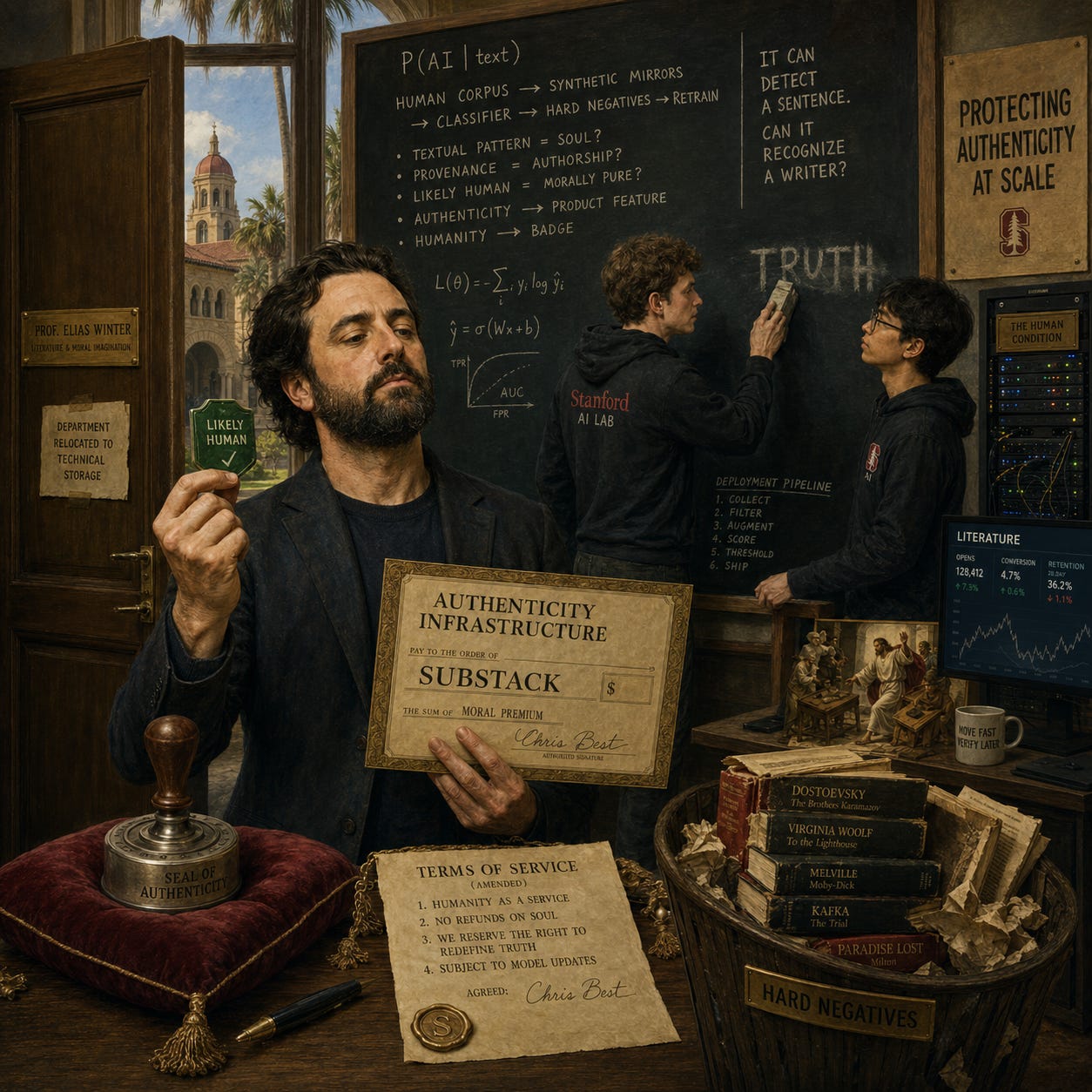
I. The Temple Has a Gift Shop Stanford University lay beneath the California sun with the relaxed confidence of an institution that had already won history. Its sandstone arches glowed. Its palm trees swayed. Young men in fleece vests bicycled between laboratories where the future was being invented for people who had not been consulted. The names of dead industrialists appeared above doors in letters large enough to survive the moral fashions of several centuries. At the center of the campus stood the new Stanford Institute for Computational Humanity, a glass-and-steel building shaped like a venture-capital pitch deck. Inside, several hundred engineers were working to solve loneliness, democracy, education, sex, friendship, literature and grief by converting them into classification problems. The Department of Comparative Literature occupied a former electrical closet beside the loading dock. Professor Elias Winter sat inside it, surrounded by books that had not yet been transformed into training data. His office had no window. The university had removed it during a renovation intended to promote transparency. Through the wall came the squeak of a blackboard. Two young men were writing equations next door. A third man entered the building carrying the solemn expression of someone who had been informed that civilization was in danger and that civilization might therefore require a new product feature. It was Chris Best, chief executive officer of Substack. “I’m here,” he announced, “to protect human writing.” Professor Winter looked up from Augustine. “Human writing survived Nero,” he said to the wall. “I suspect it can survive autocomplete.” No one heard him. The walls had been optimized for collaboration. II. The Boys Who Had Not Yet Met a Sentence Max Spero and Bradley Emi stood before the blackboard in matching company hoodies. They were the founders of Pangram, an artificial-intelligence detection company. Both were intelligent, credentialed and young enough to regard the year 2008 as part of the medieval period. On the board was a paragraph: After my father died, I began to understand that grief was not an emotion but an architecture. It rearranged the rooms of memory so that every door opened into absence. Max studied it. “Claude,” he said. Bradley frowned. “Human.” “Claude.” “Human.” Max typed the paragraph into Pangram. A wheel spun. The machine returned its verdict: 94% AI-GENERATED “Excellent,” Bradley said. “We are ninety-four percent certain that no soul was present.” Max nodded and wrote on the board: Chris Best stepped closer. “So it can detect whether writing is authentic?” “It can estimate whether a passage statistically resembles text produced by language models,” Max said. Chris considered this. “Right. Whether it’s authentic.” “That isn’t exactly—” “Could the percentage be larger?” “The percentage?” “On the screen. Readers trust large numbers.” Bradley adjusted his glasses. “The model is a transformer-based binary classifier trained on human and machine-generated text.” Chris’s eyes brightened with reverence. “So it reads.” “No,” Max said. “It classifies.” “But it understands?” “It detects patterns.” Chris nodded. “Understanding through patterns.” From behind the wall came the sound of a book being closed with unnecessary force. Professor Winter appeared in the doorway. He was sixty-seven, badly shaved and dressed in a brown jacket polished at the elbows by decades of disappointment. His hair rose in several directions, as if each strand had independently rejected institutional authority. “What is the paragraph about?” he asked. The boys looked at the board. “Grief,” Bradley said. “Is it any good?” They looked at one another. “That’s outside the model’s scope,” Max said. Winter turned to Chris. “And you have come to purchase its scope?” “I’ve come to defend writers.” “From grief?” “From AI.” Winter looked again at the board. “The sentence may be synthetic,” he said. “The stupidity in the room is entirely organic.” III. A Brief History of the Human Being, Rendered as Training Data Max decided that the misunderstanding could be resolved through technical explanation, as misunderstandings always could. He erased the paragraph and drew two boxes. On the left he wrote HUMAN. On the right he wrote AI. “We collect human writing from many domains,” he began. “Books, essays, emails, academic papers, reviews, journalism, creative writing, online discussions—” “Love letters?” Winter asked. “Potentially.” “Funeral speeches?” “Yes.” “Confessions?” “If available.” “Last words?” Bradley hesitated. “Depending on licensing.” Max continued. “Then we generate synthetic counterparts that mirror the human material in subject and format.” Winter stepped toward the blackboard. “You feed a machine a widow’s letter and ask it to produce another widow?” “A synthetic mirror,” Max said. “An imitation.” “It’s not necessarily imitating the individual author.” “Then it is imitating bereavement in the abstract. Much cleaner.” Max drew an arrow between the boxes. “We train the classifier to distinguish the distributions.” “The distributions of what?” Chris asked. “Human-generated and model-generated language.” “Humanity and artificiality,” Chris translated. “No,” Max said. “Textual distributions.” “Same basic thing.” Professor Winter picked up a piece of chalk. “No,” he said. “It is not the same basic thing.” He wrote beneath the boxes: LANGUAGE IS EVIDENCE OF A MIND. IT IS NOT THE MIND. Bradley politely erased it. “The important innovation,” he said, “is hard-negative mining.” Chris leaned forward. “Good. That sounds defensible.” “We run the detector on material known to be human. Some human passages are misclassified as AI. Those are hard negatives.” “A false positive,” Winter said, “is what human beings once called an accusation.” “We add those difficult examples back into the training process,” Bradley continued, “along with synthetic mirrors. The model becomes better at distinguishing borderline cases.” Max wrote: * Collect human writing. * Generate synthetic mirrors. * Train classifier. * Identify hard negatives. * Retrain. Chris admired the sequence. “It’s like teaching the machine to recognize the human voice.” “No,” Winter said. Max sighed. “It learns statistical features associated with different production processes.” “Exactly,” Chris said. “The human voice.” Winter turned to the boys. “Can it tell who originated the idea?” “No.” “Can it tell whether a person dictated the argument?” “No.” “Can it tell whether the writer rejected fifty drafts?” “No.” “Can it tell whether the argument is original?” “No.” “Can it tell whether the author believes it?” “No.” “Can it tell whether the text is true?” “No.” “Can it tell whether it is literature?” Max lowered the chalk. “That’s not what it was designed to do.” Chris Best smiled. “Perfect,” he said. “How soon can we put it on Substack?” IV. Chris Best Arrives to Defend Literature Chris paced before the blackboard. “You have to understand the crisis,” he said. “The internet is being flooded with AI slop. Readers believe they are encountering a person, but sometimes they are encountering a machine. That damages trust.” Professor Winter returned to his doorway. “Trust in what?” “The writer.” “What aspect of the writer?” “Their humanity.” “Which aspect?” “The part that writes.” Winter smiled unhappily. Chris continued. “Substack is built on the relationship between writers and readers. People subscribe because they want a direct connection to a human voice.” “Sometimes,” Winter said. “They want perspective. Conviction. Something a person genuinely believes.” “Good.” “And we need to protect that.” “Also good.” “With a button.” Winter’s smile disappeared. Chris approached the board and began drawing a user interface. At the top was a post. Beneath it was a small badge: LIKELY HUMAN He added a green halo around it. “Readers click here,” he explained, “and Pangram scans the text.” “What happens when the machine is uncertain?” Bradley asked. “We show nuance.” Chris added two more labels: POSSIBLY ASSISTED MOSTLY SYNTHETIC Winter examined them. “Can you include ‘Spiritually Vacant but Manually Typed’?” “That might confuse users.” “It would clarify Substack.” Chris ignored him. “We’re not saying AI is inherently bad. We’re saying concealed AI authorship creates an expectation mismatch. It’s a form of Claudefishing.” Winter stared at him. “What?” “Claudefishing.” “You have named a moral crisis after a chatbot pun.” “It makes the concept accessible.” “So did ‘the Fall of Rome.’” Chris put down the marker. “We are trying to defend literature.” “Which literature?” Chris gestured broadly, encompassing the building, the platform and possibly the Western canon. “Substack.” Winter began to laugh. At first it was a restrained academic laugh, the kind used when a dean proposes an interdisciplinary initiative. Then it grew. He sat down in the hallway. He removed his glasses. He wiped his eyes. “Literature,” he finally said, “on Substack?” “There are important writers on Substack.” “There are important writers in airports. We do not call the terminal a literary movement.” V. Literature Was Already Dead in the Newsletter Funnel Winter entered the laboratory. “A writer,” he said, “writes because something has become impossible not to say.” Chris folded his arms. “A content creator must say something because Thursday has arrived.” The boys looked at the calendar. It was Thursday. “Substack did not invent this corruption,” Winter continued. “But it has perfected its invoice. Publish regularly. Build your list. Convert free readers. Maintain engagement. React to the discourse. Cultivate a persona. Never become silent long enough to discover whether you have anything to say.” “That’s unfair,” Chris said. “Writers can publish whenever they choose.” “Yes. And restaurants can choose not to serve dinner.” “We give writers independence.” “You give them a payment processor attached to an anxiety disorder.” Bradley coughed to hide a laugh. Chris pointed at him. “You’re selling me software.” Bradley stopped. Winter moved to the blackboard. “The platform cannot distinguish literature from content because it does not measure literature. It measures opens, subscriptions, shares, comments, conversions and churn.” “Those are useful signals.” “So is smoke. It does not tell you whether the building was beautiful.” Chris said, “Readers decide what has value.” “Readers decide what to open. Sometimes they decide what to pay for. Neither is identical to value.” Winter opened his laptop and pulled up a newsletter titled: SEVEN REASONS THE COUNTRY IS FINISHED, NUMBER FOUR WILL ENRAGE YOU He pasted a paragraph into Pangram. The detector spun. 99.2% HUMAN Winter bowed to the screen. “The corpse is certified organic.” He then pasted another passage: an original philosophical argument developed orally by a human author through days of conversation with an AI, shaped through repeated rejection, correction and restructuring. Pangram returned: 96.8% AI-GENERATED Winter wrote on the board: Then underneath: ACCORDING TO THE MACHINE “That’s not what the result means,” Max said. “Then why put it before readers who will understand it exactly that way?” “We can explain the limitations.” “In a tooltip?” “A methodology page.” “Ah. The moral refuge of the platform: place the lie in twelve-point font and the qualification behind a link.” Chris objected. “No one is calling human writing superior merely because it is human.” “You are placing a purity badge beside it.” “It’s transparency.” “Transparency is what institutions call judgment when they do not wish to admit they are judging.” VI. The Trial of the Invisible Author Winter rearranged three chairs. “This laboratory is now a court.” “Under whose authority?” Chris asked. “The last surviving authority: comic necessity.” He pointed at Max. “You are the clerk.” At Bradley: “You are the expert witness.” At Chris: “You are the accused.” “I thought AI was the accused.” “That is why you are the accused.” Winter raised a book as though it were a gavel. “Case One: The Dictating Philosopher.” He described a woman who had spent twenty years developing a theory of memory. She had read history, buried her parents, crossed languages, suffered exile and carried the argument in fragments before it possessed a final form. She spoke with an AI for six months. She corrected it, fought with it, rejected its sentimentality, imposed the structure and approved each claim. The AI produced much of the finished prose. “Who authored the work?” Winter asked. “The prose was generated by AI,” Chris said. “That was not the question.” “It’s relevant.” “So is the electricity.” Winter wrote five phrases on the blackboard: CONCEPTUAL ORIGININTELLECTUAL ARCHITECTUREVERBAL REALIZATIONEDITORIAL JUDGMENTFINAL ACCOUNTABILITY “Which of these belongs to authorship?” he asked. “All of them, potentially,” Bradley said. “Good. Your soul has benchmarked above chance.” Chris said, “Readers still deserve to know who generated the sentences.” “Certainly. But you are inviting them to confuse sentence generation with authorship.” Winter raised the book again. “Case Two: The Human Content Mill.” A man woke each morning, searched for the day’s approved outrage, copied the argument of six larger accounts, added a childhood anecdote and manually typed twelve hundred words of derivative conviction. Pangram declared him human. “Who authored the work?” Winter asked. “The writer,” Chris said. “No. Thursday.” Max laughed before remembering his equity. “Case Three: The Famous Incumbent.” Winter wrote MATT TAIBBI, HYPOTHETICALLY on the board. “Let us imagine a famous writer with hundreds of thousands of followers. He uses an LLM to scan thousands of Substack posts, identify emerging resentments, map audience anxieties, detect which themes are gaining velocity, find the profitable contradiction and generate an editorial strategy. Then he manually writes the sentences in his familiar voice.” Chris said, “That would still be his writing.” “Would it?” “He wrote it.” “So the machine may choose the subject, survey the field, harvest the anxieties, identify the market opportunity and construct the intellectual supply chain—as long as the celebrity personally types the adjectives?” “That’s a different use of AI.” “Precisely. A more consequential one. And your machine cannot see it.” Pangram scanned the hypothetical article. 98.4% HUMAN Winter faced the imaginary jury. “The court congratulates the defendant. His extraction has excellent syntax.” VII. The Machine That Copies the Writer Chris looked relieved. “So you agree AI presents a genuine threat.” “Of course,” Winter said. “I object to your stupidity, not to the existence of the problem.” He erased the board and drew two columns. Under the first, he wrote: AI AS PROSTHESIS Under the second: AI AS EXPROPRIATION “A human being may possess a thought before possessing its language,” he said. “An intuition. A structure. An image. A contradiction. A wound that has not yet become a sentence. The machine may help that person speak.” He tapped the first column. “That is assistance.” Then he tapped the second. “But a model may also absorb a writer’s rhythms, metaphors, conceptual architecture, emotional posture, historical synthesis and rhetorical cadence. Another person may then summon the writer’s accumulated life as a style preset.” Max said, “Models do not literally store a complete individual style as a file.” “Your legal department must sleep beautifully.” “I’m making a technical distinction.” “And I am making a moral one.” Winter wrote: ONE HELPS A WRITER SPEAK. Below it: THE OTHER REMOVES THE WRITER FROM HIS OWN VOICE. “This,” he said, “is the real danger. Not that a machine touched the sentence, but that a person’s expressive identity becomes detachable from the person.” Chris turned to the founders. “Can Pangram detect that?” “Not reliably,” Bradley said. “Can it identify when a writer’s themes were harvested?” “No.” “When an argument was copied but rewritten?” “No.” “When a community’s anxieties were mapped to manufacture the next viral essay?” “No.” “When a living writer’s voice was imitated and laundered through human editing?” “Not necessarily.” Winter placed the chalk down. “Then you have built a customs officer who inspects the handwriting while the stolen paintings pass through the loading dock.” Chris said, “But surface generation still matters.” “Yes. As one fact among many. You are turning it into the moral fact because it is the fact you can measure.” “That’s not fair.” “No. It is scalable.” VIII. The Money Changers Explain Their Commitment to the Temple Professor Winter returned to his office and emerged carrying an old reproduction of Christ driving the money changers from the temple. He placed it against the blackboard. “This is your industry,” he said. Chris examined the image. “Substack doesn’t run ads.” “A money changer need not sell advertisements. He merely needs to place himself between human longing and the object of longing, then charge for passage.” “We let writers own their audiences.” “You meter the encounter.” “We provide infrastructure.” “You govern visibility.” “We process payments.” “You convert relationship into recurring revenue.” “That is how writers make a living.” “Sometimes. I am not objecting to money. I am objecting to men who arrange the tables and then declare themselves guardians of the altar.” Chris’s face hardened. “Substack is not Facebook.” “No. Facebook built a casino beneath the town square. You built a subscription booth outside the confessional.” “That is glib.” “It is also true.” Winter gestured toward the Pangram interface. “You are not protecting language. You are protecting the authenticity premium.” “The what?” “The commercial belief that the text is valuable because a recognizable biological person produced it. AI threatens to reveal how much newsletter writing is interchangeable—how many opinions are merely products with faces attached.” “That’s cynical.” “Your dashboard is cynical. I am merely reading it aloud.” Winter wrote: Then: “You cannot reliably distinguish original thought from derivative thought,” he said. “You cannot distinguish literature from audience maintenance. You cannot detect whether a famous writer used a machine to strip-mine the discourse before typing the result by hand. But you can certify that the fingers were human.” Chris said, “Readers care about knowing when they are interacting with AI.” “Then tell them how the work was made. Do not imply that the production method resolves its value.” “We are adding process disclosures.” “Good. That is a beginning.” “And detection.” “That is where the beginning becomes a priesthood.” Winter pointed at the painting. “The money changers do not destroy the temple by standing outside it. They move inside, place prices on access and call themselves custodians.” For the first time, Chris did not reply immediately. From the courtyard came the faint sound of an electric scooter colliding with a statue of Seneca. IX. The Blackboard Revolts The board had become unreadable. Equations competed with accusations. Arrows connected HUMAN SOUL to CONVERSION FUNNEL. Beneath a badly drawn temple, Bradley had written FALSE-POSITIVE MITIGATION, while Winter had added PILATE HAD A METHODOLOGY PAGE. Chris stood before the wreckage. “We need a practical solution.” “Of course,” Winter said. “Philosophy has once again delayed shipping.” Chris began drawing a dropdown menu. At the top he wrote: HOW WAS THIS MADE? Beneath it: * Human * AI-assisted * Mostly AI * Other “There,” he said. “Writers disclose their process. Readers get context. Pangram provides an independent signal.” Winter considered the options. “Where do I place twenty years of suffering followed by three hours with Claude?” “Other.” “Where do I place automated surveillance of an entire literary ecosystem followed by manual typing?” “AI-assisted, perhaps.” “Where do I place an editor who rewrites half the essay?” “Human.” “A ghostwriter?” “Human.” “A translator?” “Human.” “A model trained to imitate a dead author?” “Mostly AI.” “A living author who has forgotten himself and now writes only for retention?” Chris put down the marker. “We cannot capture every philosophical edge case.” “Human beings are not edge cases.” At that moment, a Stanford development officer entered the room. He wore a suit the color of unrestricted funding. “Sorry to interrupt,” he said. “I heard there was a new initiative around Human Authorship.” “There is,” Chris said. “Wonderful. Is the name available?” “The name?” “We have a donor interested in preserving humanity. Could this become the Peter Thiel Center for Certified Human Expression?” No one spoke. “He prefers something civilization-forward.” Winter took the eraser. Slowly, he wiped away the percentage score at the center of the board. He left the equations. He left the five dimensions of authorship. He left the temple, the funnel and the accusation against Pilate. In the empty space he wrote: A tool may identify how language was produced. It cannot tell you whether anything was said. Max read it twice. Bradley took a photograph. Chris asked, “Could that fit in the tooltip?” X. Certified Human The meeting concluded. Chris Best purchased Pangram and left the laboratory carrying the satisfied gravity of a man who had transformed an ontological crisis into a user flow. Max and Bradley returned to the blackboard. “We should probably improve performance on literary prose,” Max said. Bradley nodded. “More hard negatives.” They began feeding the machine Woolf, Baldwin, Lispector and Dostoevsky. In the office next door, Professor Winter sat alone. No students were waiting. His seminar on Tragedy and Moral Imagination had been cancelled because enrollment had fallen below the university minimum. The room was needed for a workshop titled Scaling Empathy with Generative Agents. Winter opened his laptop. A notification from Substack appeared: Your post is performing better than 87% of similar posts. He looked at it for a long time. Then he uploaded the play he had just written. Pangram scanned the text. The wheel spun. The machine considered the temple, the money changers, the classifier, the content mills, the invisible author and the old professor in the electrical closet. Its verdict appeared: 98.7% LIKELY AI-GENERATED Winter looked toward the audience. “At last,” he said. “A critic.” Blackout. —Elias WinterAuthor of Language Matters, a space for reflection on language, power, and decline. This essay was written with AI assistance. Pangram can determine how some of the sentences were produced. It remains unable to determine whether anything was said. This is a public episode. If you would like to discuss this with other subscribers or get access to bonus episodes, visit eliaswinter.substack.com
Embed this episode
Ready to play
The Purity Machine
No transcript for this episode yet
Similar Episodes
No similar episodes found.
Similar Podcasts
No similar podcasts found.