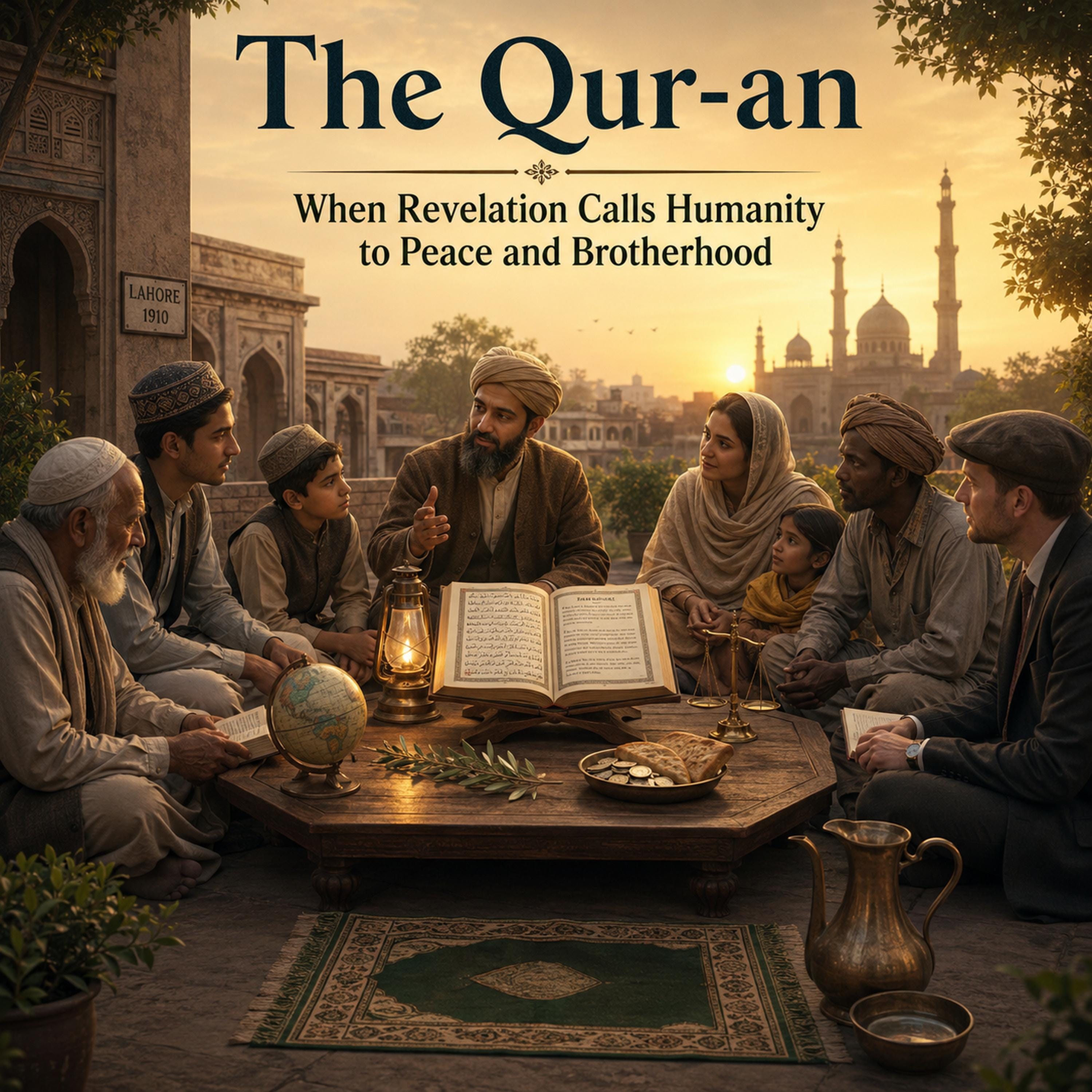
The Qur'an - 01 - Preface and Introduction
from Wisdom for the Present: Eastern Wisdom Literature Hosted by Kanu Emeruwa
What if we looked at a century-old religious text not as a collection of rigid dogma, but as a surprisingly radical manual for psychological growth and self-actualization? In this episode of Wisdom for the Present, we explore the 1920 preface to the Holy Qur’an, translated and introduced by scholar Maulvi Muhammad Ali. Writing during a turbulent historical era in British India under colonial rule, Ali presents a framework that fundamentally challenges how we view human progress, the unseen world, and our daily routines. Far from depicting a static afterlife, Ali offers a dynamic model of existence where our daily habits, mental states, and ethical choices literally construct the psychological landscape of our future. The episode begins by unpacking the literal, verb-like meaning of "Islam"—defined not as a static tribal label, but as an active, dual process of "making peace" vertically with the divine through surrender to what is good, and horizontally with fellow human beings through active service. Ali places this universalizing definition in direct opposition to the tribalism and sectarianism of his time, pointing to the text's opening description of God as the "Lord of the worlds" plural. In doing so, he lays down a radical theological baseline of universal divine revelation—arguing that prophets and guides were raised among all nations across the entire globe. Therefore, the Quran is presented not as an isolationist claim to superiority, but as a comprehensive, open-source compilation that sifts and honors the pure, enduring truths of all global traditions. Moving beyond external definitions, the discussion transitions to the "unseen world" (the Ghaib), translating ancient supernatural concepts into profound modern psychological realities. Ali deconstructs the traditional, mythological imagery of angels and devils, reframing them as external spiritual agencies that catalyze our internal moral faculties. In modern terms, angels represent the unseen promptings pulling us toward self-actualization, empathy, and virtue, while devils represent the baser pulls of our primitive "lizard brain"—greed, anger, and tribalism. Remarkably, Ali points out that while practitioners must believe in the agency of angels to anchor their moral actions, they are commanded to actively disbelieve in the devil, thereby stripping negative impulses of any cosmic authority or power over their lives. To ground these high-minded psychological principles in the physical world, the episode details the practical "four institutions" designed to systematically train our animal impulses. We explore how Salat (daily prayer) and its precise physical washing routine (wudu) function as strategic, somatic interruptions in our chaotic, ego-driven modern workdays—using physical postures of prostration to physically hack and dismantle our arrogance. Similarly, Fasting is analyzed as a deliberate willpower gym, training our moral muscles to resist temptations of deceit or corruption by first practicing self-denial of lawful, basic needs like food and water. These personal exercises naturally expand into systemic social safeguards: Zakat (the mandatory 2.5% poor-rate) acts as a structural death blow to wealth inequality, and the Hajj (pilgrimage) demands a physical stripping away of all status symbols, forcing billionaire CEOs and laborers to stand as visual and functional equals. Ultimately, this episode confronts us with a hopeful yet demanding model of cosmic accountability. Ali rejects the popular imagery of the afterlife as a courtroom of vindictive, eternal punishment, or a static cloud of passive retirement. Instead, he reveals that hell is a temporary, restorative "spiritual hospital" designed to painfully burn away the dross of our self-cultivated spiritual diseases, while heaven represents an infinite frontier of unceasing progress, growth, and higher purpose. We are left with the realization that our current thoughts and daily routines are the very bricks and mortar we are using to build our future realities. By injecting absolute, mindful intent into our everyday rituals, we can reclaim our agency, move past lifeless ceremonies, and actively participate in our own infinite progress. In This Episode * Islam as an Active Verb: Discover why the literal root meaning of Islam is "making peace"—an ongoing vertical and horizontal process rather than a static identity. * Dismantling Tribalism: How the phrase "Lord of the worlds" establishes absolute human equality and renders racial or ethnic superiority obsolete. * Universal Revelation: Exploring the radical claim that divine inspiration was granted to all nations, framing the Quran as a compilation of global wisdom. * The Psychology of the Unseen: How angels and devils translate to the modern psychological battle between our higher self and our evolutionary "lizard brain". * Stripping Authority From Evil: The structural reason why the text commands active disbelief in the devil to deny power to our baser impulses. * Hell as a Restorative Hospital: A profound look at why hell is presented as a temporary remedial state for spiritual healing rather than eternal vindictive torture. * Somatic Ego Hacks: How the four physical institutions—prayer, fasting, charity, and pilgrimage—act as concrete behavioral tools to master the ego and enforce social equality. Practical Reflection If your current mental, emotional, and spiritual habits are constructing the actual environment you will inhabit in the future, what kind of house are you building for yourself today? How can you introduce strategic, daily somatic pauses—similar to the physical postures of Salat—to deliberately interrupt the stressful, ego-driven loops of your workday? When you experience a destructive impulse (such as anger, greed, or self-entitlement), what changes if you view it merely as an external "pull" of the lizard brain that you have the complete agency to disauthorize? Suggested Substack Excerpt What if hell isn't a torture chamber, but a spiritual hospital? In this episode, we explore scholar Maulvi Muhammad Ali's radical 1920 preface to the Holy Quran, uncovering a timeless psychological manual for overcoming the ego, mastering the "lizard brain," and committing to infinite progress. AI Disclosure This episode was created using Google NotebookLM Audio Overview, based on human-curated source material, structured guidance, and editorial review. AI is used as a tool for clarity and delivery, not as a replacement for thoughtful study or engagement with the original texts. Copyright © 2026 Wisdom for the Present / Kamashcu Production Studios. All rights reserved. This is a public episode. If you would like to discuss this with other subscribers or get access to bonus episodes, visit wisdomforthepresent.substack.com
Embed this episode
No transcript yet.