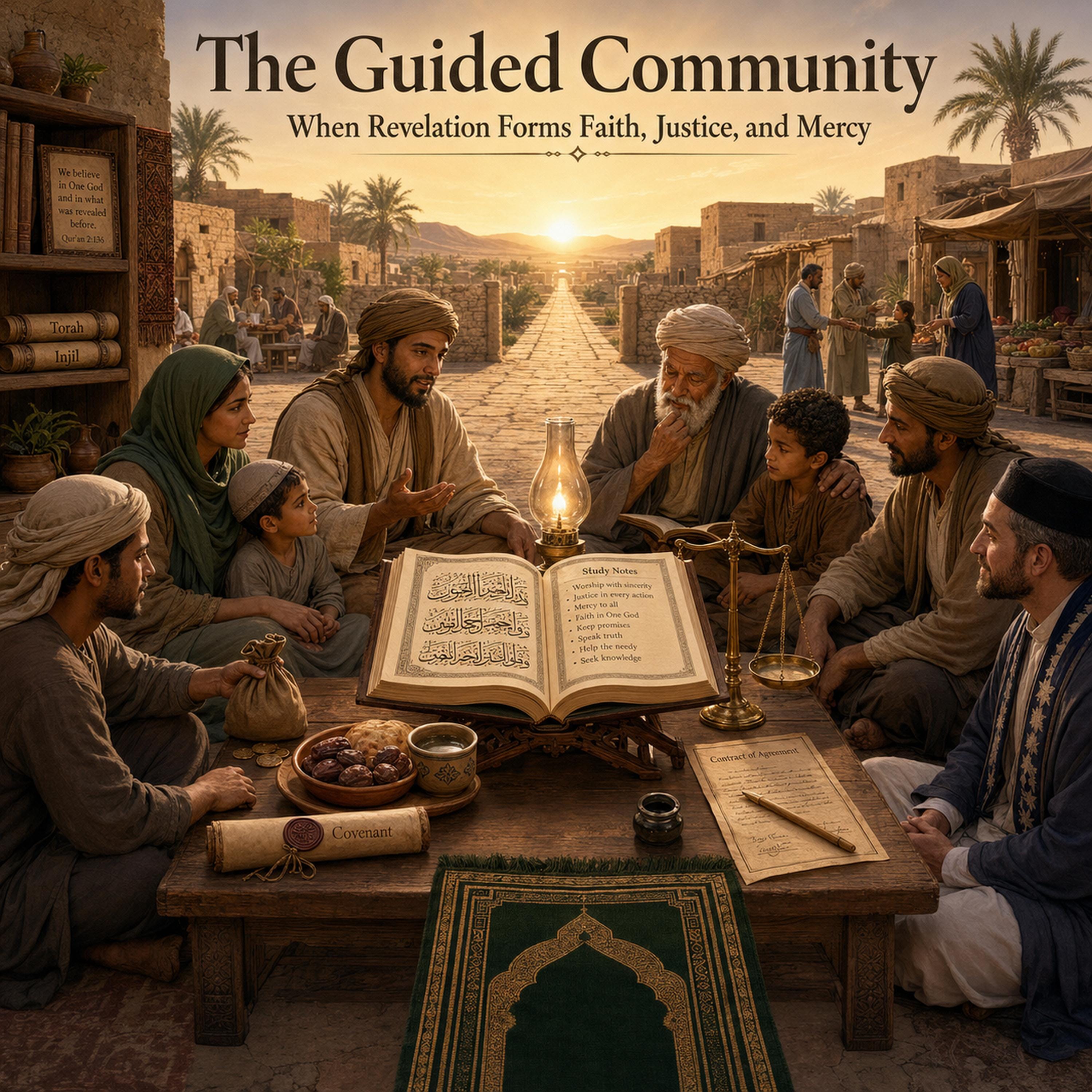
The Qur'an - 03 - Surahs 2-5
from Wisdom for the Present: Eastern Wisdom Literature Hosted by Kanu Emeruwa
What if our human capacity for error, messiness, and struggle is precisely what makes us capable of a higher form of existence than static, untested perfection? In this episode of Wisdom for the Present, we move past contemporary theological debates to extract enduring, practical wisdom from one of history’s most influential foundational texts: Chapters 2, 3, and 4 of the Qur’an ("The Cow," "The Family of Amran," and "The Women"). Moving systematically through these historical layers, we uncover a startlingly modern blueprint for human agency, exposing the roots of our cognitive biases, economic anxieties, and resilience in the face of sudden failure. We begin by unpacking the provocative concept of al-ghaib—often translated as "the unseen". Far from demanding blind, irrational faith, the commentary frames the unseen as the very foundation of sophisticated long-term reasoning, akin to how modern scientists rely on the observable effects of invisible forces like gravity. This intellectual sophistication is beautifully illustrated in the allegorical narrative of Adam's appointment as Khalifa (moral agent or successor) on Earth. When perfect, static angels raise a logical objection to humanity’s capacity for violence, they are commanded to bow not to human perfection, but to human potential—specifically, the unique cognitive capacity to learn, categorize, and "name" the complexities of our world. The episode then turns its analytical lens toward the high-stakes transition of the early Muslim community from Mecca to Medina, shifting from abstract spiritual survival to the messy realities of building a functioning society. This political transition inevitably attracted opportunists, and the text diagnoses their psychological profile with devastating accuracy. We analyze how ancient warnings against hypocrisy mirror modern behaviors of corporate subversion, social posturing, and toxic diplomacy. Those who mistake double-dealing for strategic brilliance or gaslight themselves into believing they are "only peacemakers" while sowing discord ultimately destroy their own capacity to perceive truth, entering a state of self-inflicted spiritual and intellectual blindness. This psychological rot is dramatized through vivid parables of fire-kindlers and torrential rainstorms, capturing the paralyzing effects of cognitive dissonance and confirmation bias. When caught in the storm of societal hardship, the cynical and faint-hearted plug their ears, moving forward only during brief flashes of prosperity and freezing in terror the moment darkness returns. We contrast this paralyzed state with the rigid ethical boundaries established in the rules of engagement and the revolutionary social reforms of Chapter 4. Amidst devastating humanitarian crises, the text completely upended the tribal economy by establishing independent property rights, legal inheritance, and dowries directly belonging to women—a massive wealth transfer that challenged the entrenched status quo to protect the most vulnerable. Ultimately, the episode challenges us to short-circuit our own deeply-ingrained psychological traps, specifically the "scarcity mindset" (the illusion of poverty that drives hoarding) through the practice of uncomfortable, intentional generosity. Through a post-mortem of the historical defeat at the Battle of Uhud, we explore how compounding failures can build profound emotional resilience, transforming "grief upon grief" into a tempering fire that puts trivial anxieties into perspective. By practicing the "forgiveness formula"—as illustrated by the staggering historical anecdote of Hassan’s disproportionate grace toward his servant—and mastering our basic biological drives through fasting, we reclaim our agency as true Khalifas of our own lives, converting the discipline of the unseen into concrete, visible change. In This Episode * The Epistemology of the Unseen: Why accepting al-ghaib is not about blind faith, but rather a sophisticated, long-term reasoning model comparable to base assumptions in theoretical physics. * The Khalifa Principle: Understanding how the unique human capacity to analyze, categorize, and "name" our challenges acts as our core evolutionary and moral advantage over static, untested purity. * The Anatomy of Hypocrisy: A deep dive into the psychological profile of bad-faith actors who hide behind the guise of "peacemaking" while actively sowing division. * Dismantling Scarcity: How to break the grip of the "scarcity mindset"—the illusion of poverty that drives hoarding—by engaging in intentional, uncomfortable generosity. * Sorrow as Exposure Therapy: Analyzing the Battle of Uhud and how surviving compounding failures builds "anti-fragility" and recalibrates our tolerance for minor setbacks. * Economic Revolution for the Vulnerable: How Chapter 4's legal and inheritance reforms fundamentally disrupted a patriarchal tribal economy to protect widows and orphans. * The Forgiveness Formula: A practical exercise in transforming normal biological retaliation instincts into disproportionate grace, disrupting cycles of resentment. Practical Reflection Where is the "illusion of poverty" or scarcity mindset currently making you act out of fear, causing you to hoard your money, credit at work, or personal time? Can you identify a current chaotic area in your life (career, finances, relationships) and actively apply the "Khalifa practice" by meticulously breaking down and naming its specific, manageable components? The next time someone makes an honest but painful mistake that directly impacts you, how can you actively bless them instead of merely suppressing your anger? Suggested Substack Excerpt Explore how Chapters 2-4 of the Quran offer a startlingly modern psychological blueprint for human agency, exposing the roots of our cognitive biases, economic anxieties, and resilience in the face of failure. AI Disclosure This episode was created using Google NotebookLM Audio Overview, based on human-curated source material, structured guidance, and editorial review. AI is used as a tool for clarity and delivery, not as a replacement for thoughtful study or engagement with the original texts. Copyright © 2026 Wisdom for the Present / Kamashcu Production Studios. All rights reserved. This is a public episode. If you would like to discuss this with other subscribers or get access to bonus episodes, visit wisdomforthepresent.substack.com
Embed this episode
No transcript yet.