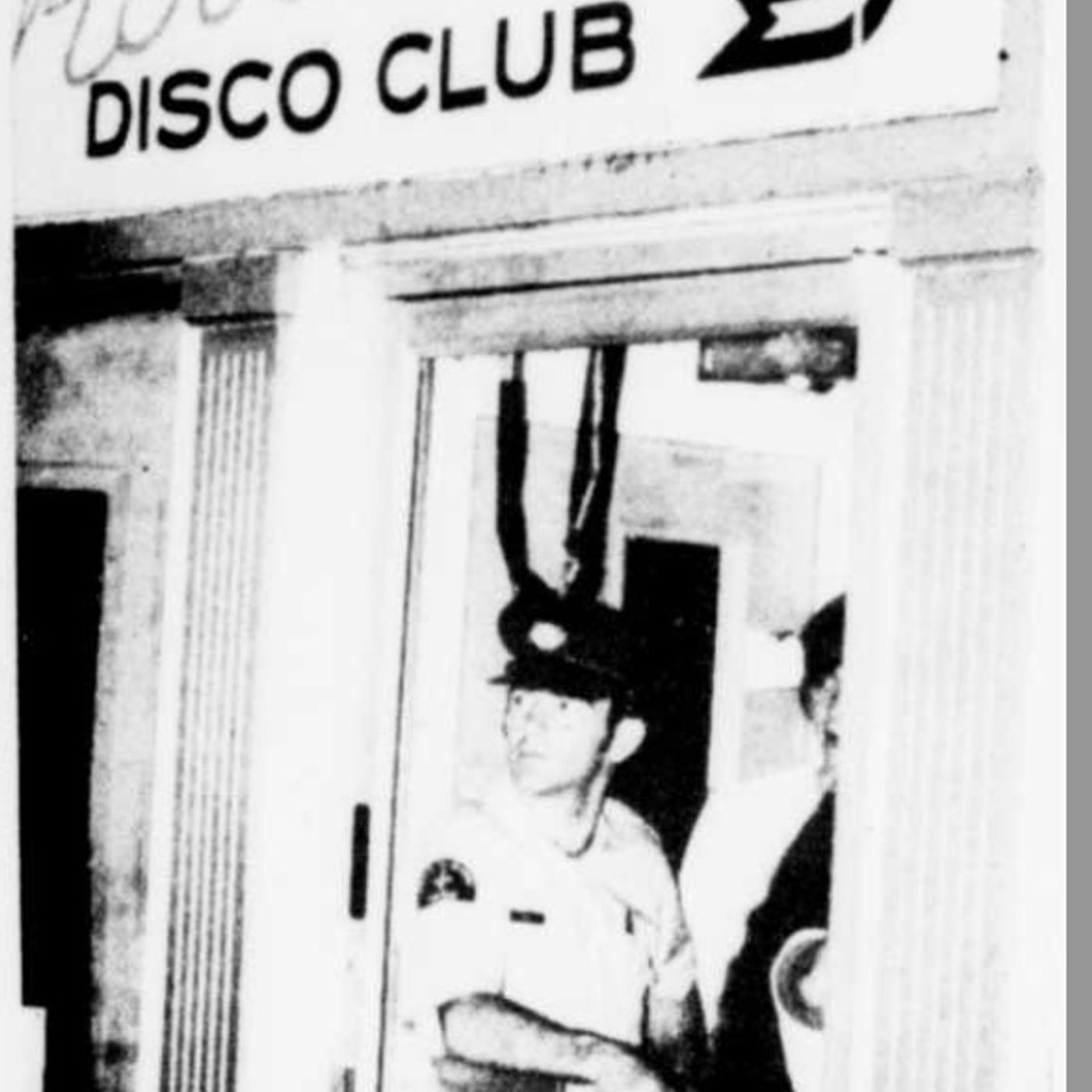
On Friday evening May 19, 1978, 16 officers from the Saratage Quebec and four officers from the Lennoxville Municipal Force stormed Disco Robert, the nightclub located in the upstairs of restaurant Shea Charles at 116 Roo Queen. Twenty-two miners were arrested and hauled off in a police van, even though the local police HQ was located just steps away from the Disco Tech. Police wanted to make a show of the teens and cuffs all the way past the curbside crowd. The raid was conducted under the joint direction of Corporal Patrick Hall of the SQ's drug alcohol and morality squad and newly appointed Lennoxville Police Chief Leo Hemel.
Two arrests were made for possession of narcotics. Among the group brought to the headquarters there were a large number of young girls. Teens raging in age from 14 to 16 sat nervously in the town drum tank waiting for their parents to arrive and escort them home before waiting again nervously for their day in juvenile court. The raid was prompted by complaints made by local parents who were disgusted by the Disco and the number of youths it attracted.
Yvonne Charlie Charla had been warned repeatedly about having minors in his establishment. One Lennoxville parent commented that he had been a long time coming and blamed Charla for not being more responsible. Yvonne Charla faced a number of charges ranging from fines to a suspension of his license. None of it came to pass.
The raid was the first full-scale drug squad operation to be carried out in Lennoxville and it would be the last for some time. This is who killed Teresa. At the time of the disco bob raid, the disco bob. Leo Hemel had been Lennoxville's chief of police for just three months.
He was a 45-year-old career law enforcement officer, previously served as chief in the small towns of Orramville and Sawyerville. The former chief, Kasmir Kreisach, was forced out on Valentine's Day February 1478 after a series of sexual assaults on the Champlain College campus that were met with police bungling and indifference. Kreisach was once described to me as prognacious. I think he was a former Polish boxing champ.
Hemel was less sure of himself, but he might have come off as maybe a little too forceful for his participation in his drug raid. Sure, it was fine to scare a few kids around up the usual suspects, but Leo made an event of it. He made the papers a cardinal rule in small towns, particularly town and gown towns to stay out of the paper. So Leo Hemel would have very quickly found themselves in the crosshairs of Lennoxville, a mayor, Cecil Daugherty, and more than likely, he was asked to tone it down.
By the 1980s, there was a lot of soul searching about the very necessity of the local police force in Lennoxville. A lot in many thought that the whole mess should just be turned over to the Certaic Bechvec. There was a town hall and locals questioned the value of the force, which cost each taxpayer $70 per year. One resident adding that, quote, taxpayers would certainly see their theft insurance premiums increase if the municipal authorities decided to divest themselves of their police service.
Yeah, taxes and insurance premiums. And it had barely been a year since one of their college students had turned up dead in a ditch. Some were critical of police chief Hemel stating that he lacked leadership and his officers were, quote, too familiar with residents. Still it seemed that there were no pleasing everyone.
In an expreath someone suggested that, hell, Hemel be more involved and get out more often in order to listen to the population. The EOML was definitely not a people person. One former Lennoxville policeman told me that he had all the offices bugged in the police HQ and he kept the case of hand grenades in the trunk of his patrol car. So passively indecisive or paranoid maniac, just who was Leo Hemel.
Most of this grousing at the town hall concerned town and gown politics. Jule, Robertge, ascended the orange crate and stated, we received from the police officers of Lennoxville a personal service that we could never obtain with the Sir Tae to come back. It is worth what it costs. It is therefore difficult to explain why there is so much incentive on the cost of this service.
That's from an article in the Tribune, the population of Lennoxville hopes to maintain its police service. Another resident Leo Paul Velkor argued against police extensions saying that five officers should be enough for the town, not eight, and pointing out that nearly 65% of the people of Lennoxville were over 55. So, Septigenarians, Septigenarians, besides it was the students, not the locals. The officials who largely occupied the police, he argued, and all those pesky criminals.
The Champlain College and Bishops University, 1978 student handbook, advises students to quote, stay away from Charles Restaurant, also on King Street, as it is expensively freeze dried. While adding that disco Shea Robert was quote, the Berg's only off-campus dancing spot, you may find the crowd a bit young. A friend who attended Champlain told me once that it was the bar of last resort, when the Golden Lion closed, everyone kind of rolled out of there and proceeded a block north to disco bobs, which stayed open much later. Hey, listen, the student handbook is a great resource, but one red flag is in its collection of restaurant reviews.
The Charles restaurant doesn't even get a ranking. They include everything from McDonald's and A&W to upscale places like the Pizion and the Ripple Covine, but there's no mention whatsoever of the Charles restaurant. Under burgers and fries, general Chinese food, chicken, Italian, charcoal, steaks, French, and vegetarian, surely the Charles restaurant. If anyone felt it was anything but the front that it was, we'd find a place in one of those categories alongside Curly Joes and Jerry's Pizza.
But it's not there. A former student of Champlain contacted me and said he was there in the 80s and he shared some memories of Yvonne Charlon, or called it Yvonne, is the patriarch of the Charlon family. He's the father of Young Mark Charlon, the boyfriend of Carofacto, Jean Charlon, one of our lead characters, and Robert Charlon, the other brother who was in charge of disco robbers. Charly was by then an older guy dressed like a French Canadian Herb Tarlic, a WKRP.
Grey hair, greased back, shoes matched the belt. Being a bar owner, there was no expectation that he was a fine upstanding citizen. In 88, my buddy was a football player at Champlain, and picked up some work as a bouncer at Shea Bobs. That evolved into bartending.
It was a rough place, and Charly wouldn't hesitate to help the staff sort out conflicts. When he moved to Montreal, Charly gave him a poker machine as a kind of parting gift. He still has it. So when I heard Charly was a shady dude, I was intrigued, but not entirely surprised.
Just a vibe, I guess. The rate of disco bobs wasn't an isolated event, but part of a series of 30 searches carried out in the townships, commercial establishments that spring. Eight municipalities in the S3 region were part of the operation, which included municipal forces, agents from the Cervatata Quebec, and even members of the Royal Canadian Mounted Police. In a press release, police authorities stated that the aim of the operation was to quote C's slot machines and any object having or that could be used in the perpetration of a crime.
Recall that Mario Vallei told the court in the Fectotrial that drugs were pushed in amusement establishments, slots in gambling machines, and disco bobs, as our friend told, our friend who inherited a game of poker machine, disco bobs had an array of games, including slots in gambling machines. Let Tribune guess that the June raids of slot palaces precipitated the murders of Fectot, Gremard, and Bergeron, and were ultimately about Grugg and Child Prostitution. Because you've got to wonder about Champlain college students questioning the age of the crowd at disco bobs, right? That's a little suspicious.
And this is from a Littrebune article on July 8, 78 in the aftermath of the Gremard murders. And Littrebune presented these arguments or this analysis concerning the settling of scores to the police authorities. They preferred to remain silent and make no comments. With a series of searches carried out at the beginning of June, the police will perhaps have touched the extremely sensitive nerve of a kind of local organization, because nothing suggests for the moment that all it has roots coming from far away.
Meaning this was a local affair, a local affair of settling accounts having to do with the drugs and ultimately prostitution. Corporal Patrick Hall of the Saratiri Vex drug, alcohol and morality squad, who headed up this Shea Robert bust, recalled that it was Hall's phone number that was found on Grimard and his pocket at the dump site at Asperi Road. In testimony at Coroner Jean-Pierre Rivard's inquiry from September 78, Hall said that he had known Rimmel Grimard for five years and that during their frequent meetings, because of the numerous information that Grimard had accumulated during his criminal career, he would occasionally give him tips on the goings on in the underworld. And this is Hall.
He said that he was doing well, but that what he was doing was okay and that he had wanted to hang up the gloves. That's Grimard. It's an interesting statement. Because Grimard did not seem like the bread and butter police informant.
Some police had painted him as being, only a minor player who occasionally shared information with police. According to a relative of Grimard's with whom I've communicated, this is them speaking, Rimmel Grimard was killed because he wanted to get out of the milieu and start a new life. If that's so, so who would have killed him and the others? Well, Yevan Charlan ran the Charles restaurant on the ground floor on Queen Street.
And to give you the geography now, you have the Charles, you have the lion block away, you have the Pettigrew taxi stand across the street from the Charles, and then across from the taxi stand, you have the Georgian hotel. It's kind of the lay of the land on Queen Street within roughly two blocks. And Charles, Yevan Charlan Charlan ran the Charles on the ground floor, and his son Robert was in charge of the upstairs, the Shea Robert disco bar. And I'll note here that Regis La Chance, remember him, had a decades-long relationship with Yevan Charlan.
He worked at the Queen Street restaurant when it was a Pat's Fried Chicken franchise, all through its transition to the Charles in the early 1970s and into the 1980s. For a time, Regis and his brother, his other brother, Jean Claude, also owned a restaurant called Claude Submarine at 1126 Rubelvedere, which was, you guessed it, a block away from Ruchort where Grimard and Bergeron were lasting alive in that Cadillac. I mean seriously, did anyone eat a sandwich at Claude Submarine? Did anyone ever grab a freeze-dried supper at the Charles?
We know what these places were, and why you maintain a failing business like that. Switching gears, but not entirely. The problem with Luke Gregoir in all of this, the problem with Luke Gregoir isn't just his age. That in 1977, he was only 17 and therefore too young to have committed the brutal murder of Louis' camera.
If he had a hand in it, he would have more than likely been groomed and accompanied by an older partner. That's one thing, but the other problem is he shouldn't have been in the townships area when the other attack occurred in January 1983. The whole premise around this stuff is that there was a wave of murders, there were three murders, Theresa's being the last, and her body was found in 79. And then after that, nothing happened.
That's not true. That's not true. Something very interesting happened in January 1983. Around 3 AM on Tuesday, January 18th of that year, a first-year bishops university student returning from a run, a snack run to the Perret's convenience store was attacked in the parking lot of the Golden Lion Pub at the corner of College and Queen Streets.
A man described as being approximately 5 feet, 11 inches tall, with a slight build and a light textured beard grabbed the student and tried to drag her toward a waiting car where the driver was waiting by the open passenger door. The student hit the man several times, kicked him in the groin, and ran. This story first broke, of course, in the college newspaper, where the editor commented, we may live in a small community, but an incident early Tuesday morning shows were not immune to the realities of city life. And then further, the incident was reported to the police, but an officer on duty Thursday night said he was completely unaware of it.
How many times did this have to happen in Lennoxville before people got the point apparently forever and for decades? This woman reported the incident, of course, to the Lennoxville police, and the police said at the time that they were working on a composite sketch that would soon be available. If anyone else wants to go digging in archives to find that sketch, be my guest, it's not going to be me. As I've said, the Golden Lion was a block from disco bobs.
College and Queen is where Theresa Lour was thought to have hitchhiked from there on the day of her disappearance. At three o'clock in the morning on January 18, 1983, Luke Gregoire should not have been lurking in the shadows of Lennoxville. In November 1982, he was granted day parole for the 1981 parking garage attack on Nicole Couture, but he was not granted full parole almost a good ten days later from that attack. But hey, it's Quebecco, right?
Does anyone play by the rules here? Who knows? Nevertheless, on January 18, 1983, someone short and stature attacked a bishop student in the Lion parking lot. So was it Luke Gregoire or someone else?
John Charla? And someone else? Whoever it was, vehicles occupied by multiple assailants appeared to have been roaming the region unhindered over a span of at least two decades. And no one did anything about it.
I've written before about this article concerning my sister that appeared in the Giornal de Morial in December 1978. Disparacion misterios, en suar, de drogue. Even a person only speaking English can decipher what that could mean. But specifically the translation can be tricky.
It can be interpreted as a mysterious disappearance, history of a druggy. But it probably means mysterious disappearance, a drug story. During the five and a half months when she was missing, this was the only time, as I've said before, the Giornal de Morial covered Tires' case. There were no lead-up articles in November.
It was 78, there was no follow-up after that, one publication until a course her body was found. And the result was immediate. Readers received the message that if the matter was drug related, it was a personal matter, something to be resolved by the family. And nothing that needed community involvement to their participation.
Tires' missing person investigation died right there on December 20, 1978. I've often wondered if the article was planted by police as a means to discredit the victim that carries more weight now after everything we've talked about, about how high the stakes were with the La Plante trial and in convicting him and making sure that someone like Regis La Shouse was obfuscated. You know, if that sounds like fantasy, it's certainly not unprecedented. There was no writer attached to the drug piece.
It was written anonymously. In his commission of inquiry on police operations in Quebec from the 1980s, Jean-Cable cited that a journalist with the Jean-Cable Mariel Pierre-Bouchard was a collaborator of the police services in the 1970s. So journalists working for police interests, coroners working for police interests, all of this was on the table. The article states that, quote, Lennoxville Police Chief, Mr.
Leo Hamal, wonders if the disappearance of 19-year-old Theresa Alor might not be drug related. It continues, Hamal has doubled his efforts in his investigation, and that has led to him searching more particularly in the current world of drugs, which is very active in the Sherburg region. At Leo Hamal, did I give the interview, calling it pure fabrication? Well, sure, but, you know, this is from the guy who allegedly wiretapped his officers, right, in the police HQ.
So who knows what's the fact of fabrication? But ultimately, maybe the more interesting thing is, what if Hamal was right? Better still, what if everyone knew he was right, including the Cervaté de Quebec? Did the answer lie in the current world of drugs?
After the article appeared, Hamal became less aggressive. He was effectively muzzled by, he was intimidated by the SQ. He would have been browbeat by Cecil Bordeaux of the Marrow of Lennoxville. And you know, by February, Chief Hamal was chasing like bogus leads, in Theresa's case, in Montreal, not in Sherburg.
He wasn't focused on Sherburg. But Hamal was the first to go on record that he thought it was a murder, and others did not. This is from the same article. Runaway or murder are two plausible hypotheses.
I am more inclined toward the second hypothesis, while some of my colleagues believe more toward the first. My mom commented that by the time Theresa's body was found in that spring, Leo had gone completely grey, as if he'd seen a ghost. Ultimately, do we come back around to where we started? Not a drug overdose, but a drug story in which Theresa Lour played the part of collateral damage.
Flash forward a decade, another raid at Shea Bob's disco bar on Queen Street designed to nip student delinquency in the bud. This time a dozen kids are rounded up and hauled to the police station, to the delight of the 17 police officers involved. They're all working overtime. This time it is Yeran Charlon's son, Robert Charlon, who is charged and subject to fines and a licensed suspension.
By 1989 Robert Charlon is the owner of Shea Bob's. Before the Charlon's, you could be implicated in drugs, illegal gambling, theft and robbery, sexual assaults, even murder. And life in Lynixville just rolled on. This is who killed Theresa.
Thanks for listening. I have too much more to add today. I'll only say if you like the podcast, please go to website, www.tresour.com. T-H-E-S-A-A-L-L-O-R-E-Point-GAMM.
And from there you can follow us on social media on Twitter, Facebook, Instagram, YouTube, Substack. You can subscribe to all of those social media places there by the book. Wish you were here. There's a link there to it.
You can give us a five-star rating on ITMs that would be greatly appreciated. Read on, go to the website and indulge yourselves. There's a lot of great stuff there. We're coming to the end of this story.
I'll do three more podcasts. Post on this in June before we finish up. Next week, who killed Theresa? Right?
Let's get it on the table. Let's put the cards on the table. This has been Who Killed Theresa and your host John Orr. Happy starts.
Great. Great day. I'm done with the song. You will be.
I never got it.